Think of it like leasing an empty, private motorway. The road is built, perfectly paved, and ready to go, but you get to decide what kind of vehicles drive on it and how fast they go. That’s the essence of dark fibre: physical, unused fibre optic cable that a business can lease and 'light up' with its own technology. It’s the ultimate foundation for a private, high-performance network where you are in complete control.
So, What Exactly is a Dark Fibre Network?
Simply put, dark fibre is the raw infrastructure—the glass strands—that have been laid in the ground but are not actively being used by a service provider. Instead of signing up for a standard internet package where the provider manages everything, you lease the dormant cable itself.
This hands-on approach means your business effectively becomes its own service provider. You choose the hardware, you set the data transfer protocols, and you decide exactly how much bandwidth you need. It’s a world away from conventional business internet, where you’re essentially renting a slice of a provider's shared network. If you want a refresher on the basics, our guide on what fibre optic broadband is is a great place to start.
With a standard service, you're sharing the road with other traffic. With dark fibre, you own the road. It's a dedicated, physically separate connection for your exclusive use.
The Growing Demand for Private Infrastructure
It is no surprise that more professional services firms and enterprises are seeking this level of network autonomy. Here in the United Kingdom, dark fibre is becoming a cornerstone of our digital infrastructure, driven by an insatiable appetite for faster, more responsive connections. The market has been growing at a steady clip, with a compound annual growth rate (CAGR) of around 9% in recent years. This is not just a niche product; it is a testament to the real-world value it delivers.
Here’s a practical example: Imagine a visual effects studio in Hampshire that needs to shift huge, terabyte-sized video files between its main office and a remote rendering farm every single day. A standard managed connection would likely be slow and eye-wateringly expensive. By leasing a dark fibre link, the studio can connect the two sites with its own 100 Gbps equipment. They have essentially built a private data superhighway, completely bypassing public internet congestion.
To make the distinction clearer, let us break down the core differences between leasing dark fibre and using a conventional 'lit' service.
Dark Fibre vs Lit Fibre: A Quick Comparison
This table offers a straightforward look at how these two approaches stack up against each other.
| Feature | Dark Fibre (Unlit) | Lit Fibre (Managed Service) |
|---|---|---|
| Network Management | Your business is responsible for all equipment, configuration, and monitoring. | The service provider manages the network, hardware, and performance. |
| Scalability | Virtually unlimited; increase bandwidth by upgrading your own hardware at either end. | Limited to the service plan; upgrades often require contract renegotiation and provider intervention. |
| Control & Customisation | Complete control over hardware, security protocols, and network architecture. | Limited to the options and configurations offered by the provider. |
| Cost Structure | Higher initial capital expenditure on equipment, but predictable, fixed long-term leasing costs. | Lower initial setup cost, but recurring monthly fees that scale with bandwidth increases. |
| Security | Inherently more secure as the network is physically isolated and privately managed. | Security is managed by the provider and the infrastructure is typically shared with other customers. |
In short, the choice comes down to control versus convenience. Lit fibre offers a simple, managed solution that works for many, while dark fibre provides the raw potential for businesses that need to build something truly bespoke.
How Dark Fibre Technology Actually Works
So, what is happening under the bonnet? To really appreciate what dark fibre can do for you, it helps to understand the nuts and bolts. You do not need to be a network engineer, but a quick grasp of the basics makes it clear why it offers such a huge leap in control and capacity.
At its core, it is simple: you are just sending pulses of light down a tiny glass strand. But not all fibre is the same. You will mainly come across two types, single-mode and multi-mode, and the difference between them is vital for performance.
Single-Mode vs Multi-Mode Fibre
Think of a fibre optic cable as a tunnel for light. The design of that tunnel dictates how far and how fast that light can travel before the signal starts to get messy.
- Single-Mode Fibre: This is a very narrow, straight tunnel, designed for a single, focused beam of laser light. Because the path is so direct, the signal can travel for miles and miles with very little loss of quality. It is the go-to standard for long-distance connections, like linking your office in Dorset to a data centre up in London.
- Multi-Mode Fibre: This tunnel is wider, allowing the light to bounce around a bit as it travels. It is built for less powerful light sources (like LEDs) and works brilliantly over shorter distances—perfect for connecting buildings across a business park or a university campus.
For most dark fibre setups that link sites in different locations, single-mode fibre is the technology of choice. It gives you the high-speed, long-distance foundation you need. Once you have that physical path sorted, the real fun begins: deciding how to light it up and use its full potential.
The image below gives a simple visual breakdown: do you want to manage your own network with dark fibre, or use a lit fibre service managed by a provider?
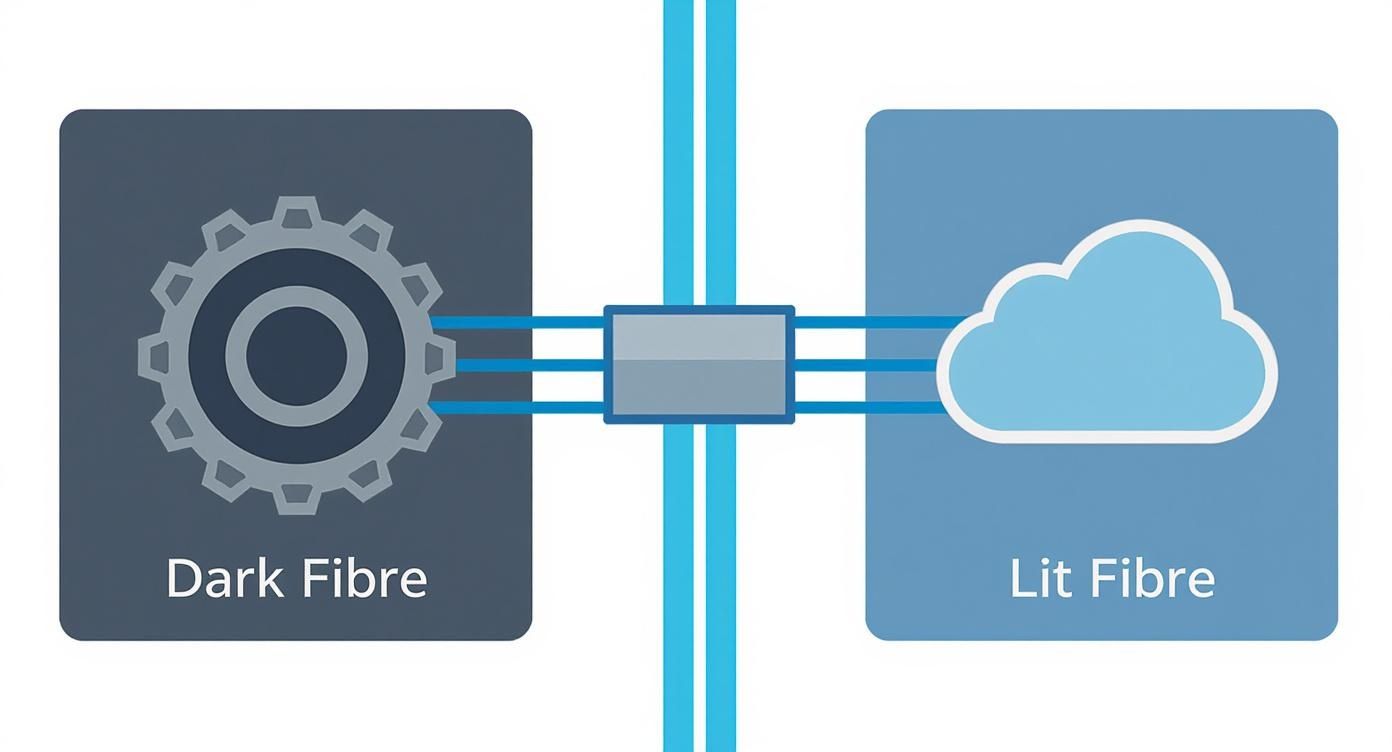
With dark fibre (the gear), you are in the driving seat. With lit fibre (the cloud), the provider handles everything for you.
Unlocking Massive Capacity with DWDM
This is where the magic of a dark fibre network really shines. You might have only leased a single pair of glass strands, but that does not restrict you to a single connection. The technology that makes this possible is called Dense Wavelength Division Multiplexing (DWDM).
DWDM is an incredibly clever trick that lets you run multiple, completely separate data streams down the same single strand of fibre at the same time.
It works by assigning a different colour, or wavelength, of light to each data channel. Picture sending red, blue, green, and yellow beams of light down the same cable simultaneously. At the other end, special filters separate the colours, and each one becomes its own private, high-speed data lane.
Let us say a professional services firm uses this setup. On one dark fibre connection, they could run several distinct services:
- Red Wavelength: A 10 Gbps link for real-time data replication to their disaster recovery site.
- Blue Wavelength: A beefy 100 Gbps connection for pushing daily backups to a cloud provider.
- Green Wavelength: A dedicated 40 Gbps channel purely for their internal VoIP phone system.
- Yellow Wavelength: A secure connection for all the general office internet traffic.
Each of these "colours" is totally isolated from the others, even though they share the same physical cable. This is how you can wring colossal amounts of bandwidth out of a single dark fibre lease. You have not just leased a single road; you have leased a motorway and given yourself the power to add as many new lanes as your equipment can handle. It is scalability on a completely different level, without ever needing to dig up the road.
The Real-World Business Advantages of Dark Fibre
Opting for dark fibre is not just about getting a faster connection; it is a strategic move towards total operational independence. The benefits go far beyond raw speed, giving you a level of control and predictability that you simply cannot get from a managed service. By leasing your own private digital road, you build a powerful competitive advantage based on pure performance, security, and the freedom to grow.

This control fundamentally changes the game. Instead of just consuming a service from a provider, you become the architect of your own network, shaping it to fit your exact needs without compromise.
Unmatched Scalability, On Your Terms
One of the most compelling reasons businesses turn to dark fibre is its almost limitless potential for growth. With a standard "lit" fibre service, needing more bandwidth means calling your provider, renegotiating a contract, and almost certainly facing a price hike. Dark fibre removes that dependency completely.
Your capacity is only limited by the equipment you plug in at each end. That is it.
Take this example: A media production house in Wiltshire needs to shuttle enormous 8K video files to a cloud rendering service. They start with a 10 Gbps connection on their dark fibre. A year later, as their projects get bigger, they just upgrade their own optical transceivers to light the same fibre at 100 Gbps. No new contracts, no waiting for the provider, no painful negotiations—just a straightforward hardware swap.
Total Control and Customisation of Your Network
Dark fibre puts you firmly in the driver's seat. You have absolute authority over your network's design, from the specific hardware you choose to the security protocols you put in place. This level of autonomy is invaluable for any organisation with demanding or highly specific technical needs.
For a business, this means you can build a network that is perfectly aligned with your operational and compliance mandates, rather than trying to fit your processes into a provider's standardised service offering.
Here’s a practical case: A financial services firm in Dorset has to comply with strict data protection rules. With a dark fibre link between their office and their data centre, they are free to install their own military-grade encryption hardware. They are not stuck with the limited security options offered by a third-party provider, giving them—and their clients—complete peace of mind.
Superior Security Through Physical Isolation
With cyber threats becoming more sophisticated every day, data security is non-negotiable. Dark fibre provides an inherently secure foundation because it is a physically separate, private network. Your data never touches the public internet or travels on shared infrastructure alongside other customers' traffic.
Think of it as owning a private, walled-off road instead of driving on the public motorway. This isolation dramatically shrinks your attack surface, making it the perfect choice for any sector handling sensitive information.
- Healthcare providers can securely transfer patient records between clinics and hospitals.
- Legal firms can ensure confidential client data remains completely private.
- Research institutions can protect valuable intellectual property from prying eyes.
A Predictable, Long-Term Investment
While the initial cost of equipment can be higher than a standard setup, dark fibre often works out as a more predictable and cost-effective investment in the long run. You pay a fixed lease for the physical fibre, usually over many years. Once that is in place, your recurring costs are stable, no matter how much data you push through it.
This is a world away from many managed services, where costs can fluctuate and balloon as your bandwidth needs grow. The telecommunications sector itself is a huge user of dark fibre in the United Kingdom, using it to expand network capacity for the massive data demands of 5G and IoT. This kind of fixed cost provides budget certainty, a huge asset for any business. You can see how this compares to other options in our analysis of a leased line vs broadband.
Real-World Use Cases for Dark Fibre Networks
While the technical specifications of dark fibre are impressive on paper, its real value shines when you see how it solves genuine business problems. Moving from theory to practice, you start to see how organisations across the United Kingdom are using their own private, unlit fibre to gain a serious competitive edge. It is not just about raw speed; it is about the strategic freedom that comes with having total control over your network.
Having the ability to build a network from the ground up lets a business solve operational headaches in a way that off-the-shelf "lit" services just cannot match. Once you understand these practical applications, the question "what is dark fibre?" becomes less about the technology and more about the opportunities it unlocks.
High-Speed Point-to-Point Links
For some businesses, every millisecond counts. A direct, lightning-fast connection between two critical locations is not a nice-to-have; it is fundamental to how they operate. Dark fibre is the ultimate way to build these private data motorways.
Take a financial services firm in London's Canary Wharf. For high-frequency trading, the speed at which their systems talk to servers in a Slough data centre has a direct impact on their bottom line. The public internet, with all its detours and traffic jams, is simply not an option.
By leasing a dark fibre strand between the two sites, they essentially build their own exclusive, private road. This gives them:
- Ultra-Low Latency: Data travels the shortest physical path possible, with no congestion from other people's traffic to slow it down.
- Immense Bandwidth: They can install their own 100 Gbps equipment (or even faster) to handle enormous volumes of market data as it happens.
- Rock-Solid Security: The connection is physically separate from everything else, protecting sensitive trading algorithms and client data from outside interference.
This direct link gives them a tangible advantage, turning what is often an IT afterthought into a core part of their business strategy.
Unifying a Campus Network
Organisations spread across multiple buildings—think universities, large business parks, or NHS hospital trusts—often battle with patchy and inconsistent network performance. Trying to get seamless, high-speed connectivity between sites using a mix of commercial internet lines is often a costly and complicated mess.
A perfect example is a university in the South West with a main campus and several research labs scattered across town. Researchers in different buildings need to collaborate on colossal datasets, from genetic sequencing to climate modelling files.
By connecting all their buildings with a private dark fibre ring, the university creates one giant, unified campus network. A researcher in one building can access a server in another as if it were right down the hall, with no frustrating bottlenecks.
The benefits become obvious almost immediately:
- Shared Resources: All staff and students get seamless, high-speed access to central IT systems, research data, and online library catalogues.
- Cost Efficiency: It replaces dozens of smaller internet contracts with one, predictable infrastructure cost.
- Future-Proofing: When the university decides to adopt new technology like virtual reality lectures, the network already has the capacity to handle it without needing a major overhaul.
Building Robust Disaster Recovery Solutions
For any business today, the ability to bounce back from a disaster is a matter of survival. A solid business continuity plan depends on having a reliable, high-capacity link to a second site where your data is safely replicated. Dark fibre is the perfect foundation for this.
Imagine a professional services firm in Hampshire with its primary servers in its main office. To guard against a fire, flood, or major power outage, they set up a mirrored backup site at a secure data centre 30 miles away.
To make this work, they need to constantly replicate huge amounts of client data in real-time. A standard internet connection would be far too slow and insecure for that constant flow of information. A dark fibre link between the two locations allows them to hit their recovery targets with complete confidence. They can use DWDM to dedicate a specific wavelength purely for this data replication, ensuring their backup site is always a perfect, up-to-the-second mirror of their live environment. It is the gold standard for business continuity.
Getting Your Hands on Dark Fibre: From Planning to Power-Up
Deciding to go down the dark fibre route is a major move, but it is a journey that needs a good map. Moving from the initial idea to a live, private network is not something you can rush. Let us walk through the practical steps, from sorting out the budget to finally flipping the switch.
Successfully lighting up your own fibre is not just about leasing a cable. It is about being meticulous with your cost analysis, choosing the right partner, and understanding what it takes to manage the network day-to-day.
Getting the Numbers Right: A Look at the Costs
Before you get too far, you need a solid financial plan. The cost of dark fibre is not like your standard monthly internet bill; it is broken down into a few key parts that all need careful budgeting. Getting this right from the start saves you from nasty surprises down the line and makes sure your investment is a smart one.
Here is what you are typically looking at:
- Indefeasible Right of Use (IRU): This is the big one. It is a large, upfront payment for a long-term lease on the fibre strands, usually for 10 to 20 years. Think of it as securing your exclusive, long-term rights to that physical connection.
- Ongoing Maintenance Fees: Even though you control the network, the provider still has to look after the cable buried in the ground. These regular fees cover the cost of physical repairs, like if a digger accidentally severs the line.
- Capital Expenditure (CapEx): This is all the kit you need to buy to light up the fibre. We are talking about optical transceivers, switches, routers, and any DWDM gear you might need to split the signal into multiple channels.
The Step-by-Step Procurement Journey
With a clear budget in hand, it is time to find and secure your fibre. This is the stage where you pick your route, check out different providers, and negotiate the contract. It pays to be thorough here – a rushed decision can lead to a solution that does not quite fit or costs more in the long run.
A typical procurement process looks something like this:
- Route Planning and Feasibility: First things first, you need to map out the physical path your connection will take. A provider will run a feasibility study to check if their existing network runs close to your sites and figure out the cost of building the final link to your front door.
- Vetting Providers: Not all providers are created equal. You will want to carefully examine their network maps, dig into their reputation for reliability, and understand exactly how they handle physical repairs when things go wrong.
- Scrutinising Service Level Agreements (SLAs): The SLA is your insurance policy. This document needs to spell out the provider’s duties in black and white, including uptime guarantees for the physical cable and, crucially, the maximum time to repair (TTR) if there is a break.
A strong SLA is your safety net. For a business-critical disaster recovery link, a guaranteed repair time of four hours is vastly different from one that promises a fix within 24 hours. This detail can make or break your business continuity plan.
Deployment and Day-to-Day Management
Once the lease is signed, it is time for deployment. This is where your in-house technical team or a trusted partner really steps up. From this point on, you are in charge of everything that makes the network active, from plugging in the gear to keeping an eye on it every day.
This final phase means you either need the right skills internally or need to bring in a managed services partner. The responsibility is significant: you will be installing and configuring all the optical equipment, monitoring network performance around the clock, and being the first line of defence for any hardware-related issues. It is this ongoing commitment that ensures your private network truly delivers the rock-solid performance your business needs.
Finding Dark Fibre in Dorset and the South West
Knowing what connectivity is available on your doorstep is not always a simple question to answer. For businesses across Dorset, Somerset, Wiltshire, and Hampshire, the situation can be mixed. Major hubs like Bournemouth, Poole, and Salisbury are seeing more and more fibre infrastructure, but things get trickier once you head out into more rural spots.
This is often where the big national providers cannot give you the full picture. Their network maps are great for a high-level view, but they often miss the fine-grained detail needed to see what is possible in less populated areas. A successful dark fibre project here in the South West really hinges on having deep, local knowledge of where the carrier routes are, the exchange locations, and even planned roadworks.
Navigating the Regional Network Landscape
The secret to finding dark fibre in our region is to look beyond the standard online availability checkers. It takes a much more hands-on, investigative approach. Working with a specialist partner who really knows the local area can turn a frustrating search into a clear, straightforward plan.
This is especially true when you consider the digital divide that still exists across the United Kingdom. While around 73% of UK premises can now get full-fibre broadband, that number falls to just 52% in rural areas, compared to 71% in towns and cities. This gap highlights why you often need expert help to find high-capacity options that are not on the standard menu.
Think of a manufacturing firm on the outskirts of Yeovil. A quick search on a national provider’s website might show no direct dark fibre. But a local expert would know that a major carrier has long-haul cables running right alongside a nearby A-road, making a connection perfectly possible with minimal new digging.
The Importance of Local Expertise
A local technology partner is your guide through the maze of network carriers. For businesses in Dorset and the surrounding counties, this kind of partnership brings some real advantages:
- Proper Feasibility Studies: We go beyond the public maps, carrying out detailed surveys to pinpoint the closest and most affordable places to connect to existing fibre.
- Carrier Relationships: We have long-standing relationships with the network providers in the area, which means we can get straight answers on availability and better pricing than you might get going direct.
- End-to-End Project Management: A local expert handles everything from planning the route and negotiating the contract to overseeing the final installation, making sure it all goes off without a hitch.
This kind of on-the-ground intelligence is what makes the difference. It helps you see not just if dark fibre is an option, but also the smartest and most cost-effective way to get it. For more advice on creating a solid network, take a look at our guide to infrastructure, routers, and switching. By working with a team that understands the local landscape, you can be confident you are building a network that is ready for whatever comes next.
Common Questions About Dark Fibre
It is one thing to understand the theory behind dark fibre, but quite another to figure out what it means for your business day-to-day. We get a lot of practical questions from business leaders and IT managers across Dorset and the South West, so let us tackle some of the most common ones.
Think of this as a no-nonsense guide to help you decide if a private fibre network is the right move for you.
Is Dark Fibre More Expensive Than a Leased Line?
At first glance, yes, the initial outlay can look higher. That is because you are not just leasing the connection; you also have to buy and manage the equipment that lights it up. But for any organisation with serious and growing data demands, it almost always works out to be more cost-effective in the long run.
With a standard lit service, you are paying a recurring fee that goes up every time you need more bandwidth. Dark fibre flips that model on its head. You pay a fixed price to lease the physical glass, and when you need more capacity, you simply upgrade your own hardware. This gives you predictable costs without the headache of constant contract renegotiations.
Do We Need Specialised Staff to Run a Dark Fibre Network?
Yes, you do. Managing a dark fibre link is a step up in technical responsibility compared to a standard internet service. Your team will be responsible for everything – from installing and configuring the optical equipment to monitoring and troubleshooting the entire link.
For many businesses, the smartest move is to partner with a specialist. This gives you all the raw power and control of dark fibre without the major overhead of hiring and training an in-house team of network engineers.
This hybrid approach gives you the best of both worlds: complete control, backed by expert management.
How Do I Find Out if Dark Fibre Is Available at My Locations?
There is no simple online checker for this; availability can only be confirmed with a proper feasibility study. The first step is figuring out which network carriers have physical infrastructure running near your sites, and that information is not always public.
The process involves working with a carrier or a technology partner to run a detailed site survey. They will pinpoint the nearest fibre splice point and map out the work—and cost—involved in running a dedicated connection from there right into your building. A local partner can take care of all this for you, using their existing carrier relationships to get you accurate answers on availability and pricing much faster than you could on your own.
Ready to discover if a private network is the right move for your business? The team at SES Computers has the local expertise to assess your needs, conduct feasibility studies, and design a dark fibre solution that gives you the competitive edge. Contact us today to start the conversation.