At its most fundamental level, VoIP (Voice over Internet Protocol) is a technology that allows you to make telephone calls over the internet rather than a clunky, old-fashioned phone line. It simply takes the sound of your voice, turns it into digital data, and sends it across the web just like an email.
This is a world away from the analogue systems we all grew up with, offering a level of flexibility and functionality that was previously unimaginable.
Understanding VoIP in Modern Business Communications
Think about the difference between posting a letter and firing off an email. The letter is tied to a physical network of post boxes, sorting offices, and delivery routes. The email, on the other hand, zips across the internet’s digital pathways, arriving almost instantly anywhere in the world. This is the best way to understand the leap from traditional phone lines to VoIP; it swaps out the rigid, physical copper wires for the speed and agility of your internet connection.
For professional firms across the UK—from an accountancy practice in Dorset to a solicitor's office in Hampshire—this is not just a technical tweak. It is a proper strategic move. It frees your business communications from being chained to a specific desk, giving your team a consistent, professional presence whether they are in the office, working from home, or visiting a client.
The Catalyst for Change
The shift to VoIP really accelerated with the sudden, widespread need for reliable remote working. In fact, since 2020, business use of VoIP and video conferencing has rocketed by over 212%. This surge was born out of necessity, as businesses scrambled for communication systems that could support scattered teams without sacrificing quality or professionalism. You can see more on the UK VoIP adoption statistics on sqmagazine.co.uk.
This is not just a trend; it is a response to tangible benefits that directly boost a company's bottom line and day-to-day efficiency. The technology has evolved far beyond just making calls; it is now the backbone of modern business collaboration.
A practical example: An estate agency with several branches can run on a single, unified VoIP system. Calls can be transferred seamlessly between offices, and agents can use their main business number on their mobile phones while out on viewings, ensuring they never miss a crucial client call.
More Than Just a Phone System
Often, adopting VoIP is the first step in a much bigger strategy. Many of its core features—like video conferencing, instant messaging, and nifty integrations with your CRM software—are the building blocks of a complete collaboration toolkit. These elements all work in concert to create a more connected, efficient, and productive workplace.
To get a better sense of how these pieces fit together, it is worth reading our guide on what is Unified Communications.
Ultimately, VoIP gives businesses the power to communicate more effectively, grow without hassle, and adapt to the ever-changing world of work. It is about equipping your team with the tools they need not just to keep up, but to get ahead.
Traditional Phone Lines vs VoIP at a Glance
To make the distinction clearer, it helps to see the two systems side-by-side. The table below breaks down the key differences between the old analogue way of doing things and a modern VoIP setup.
| Feature | Traditional Phone System (PSTN) | VoIP System |
|---|---|---|
| Infrastructure | Requires physical copper wires to each location. | Uses your existing internet connection. No extra lines needed. |
| Cost Structure | High line rental and per-minute call charges. | Lower monthly fees, often with inclusive call packages. |
| Scalability | Adding lines is slow, expensive, and complex. | Add or remove users instantly with a few clicks. |
| Location | Tied to a physical office desk. | Use your number on any device, anywhere with internet. |
| Features | Basic features (voicemail, caller ID) often cost extra. | Advanced features (video, call recording, CRM integration) are often standard. |
| Maintenance | Requires specialist engineers for maintenance and changes. | Managed in the cloud, with updates handled by the provider. |
As you can see, the contrast is stark. VoIP is built for the flexibility and cost-efficiency that modern businesses demand, while traditional systems are a relic of a less connected era.
How a VoIP Call Actually Works
So, what really happens when you pick up the phone? It is easy to take for granted, but a VoIP call is a fascinating journey. Unlike an old-fashioned landline that needs a dedicated copper wire from A to B, a VoIP system converts your voice into digital data and sends it zipping across the internet.
Let's break it down.
When you speak into your handset, you are creating analogue sound waves. The very first thing your VoIP phone does is convert those waves into digital information. It chops your voice up into tiny, organised bundles called packets. It is a bit like a scanner turning a printed photo into a JPEG file – your voice is simply being translated into a language the internet can work with.
This diagram gives you a great visual of that basic process.
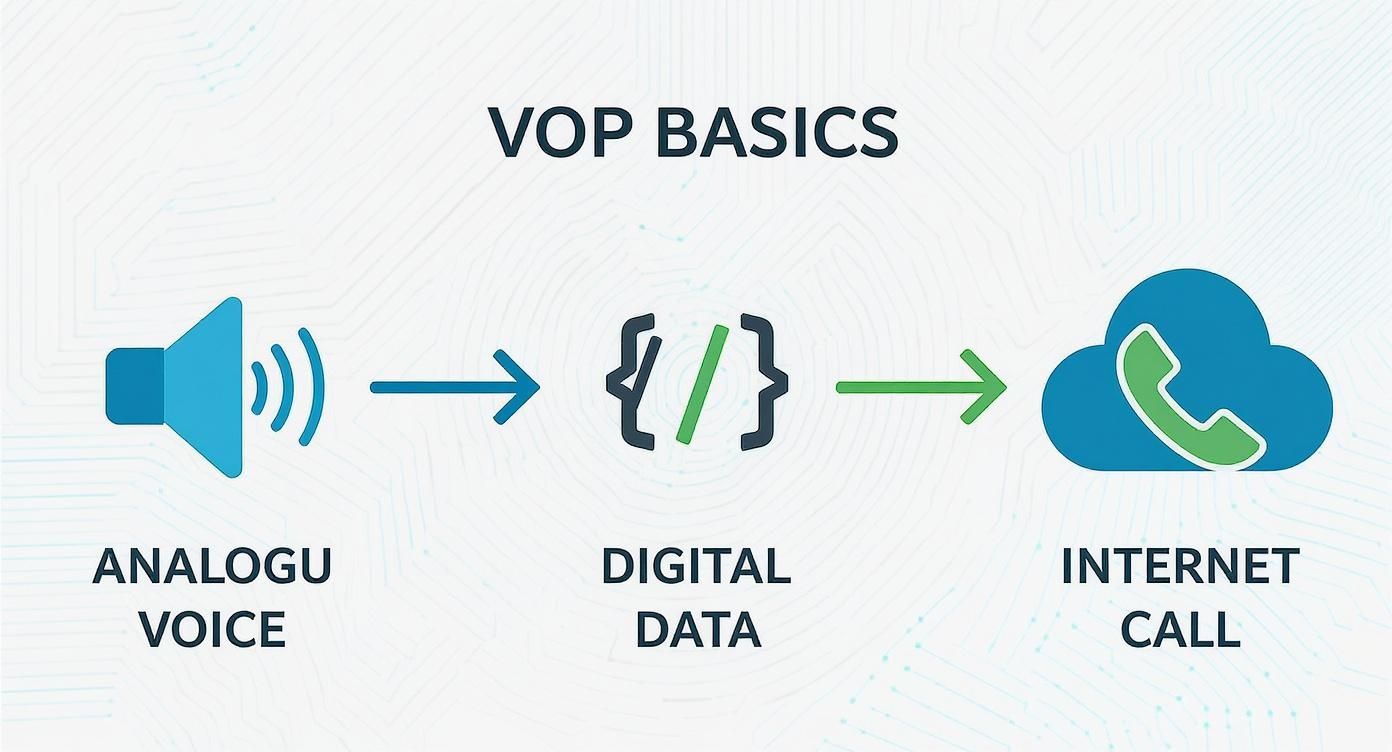
As you can see, your voice starts as a simple analogue signal, gets digitised into packets, and then travels across the internet to the person you are calling. It all happens in the blink of an eye.
The Role of SIP: The Call's Traffic Controller
Once your voice is converted into data packets, the system needs to know where to send them. That is the job of the Session Initiation Protocol (SIP). Think of SIP as the digital traffic controller for your phone call. It manages all the signals that set up, maintain, and eventually end the call.
Before a single word is transmitted, SIP gets to work. It checks if the person you are calling is available, tells their phone to ring, and confirms both ends are ready to talk. When you hang up, SIP is what tells the network the conversation is over. It is the unsung hero that makes a VoIP call feel just as reliable and instant as a traditional one. For a deeper technical dive, this is a great guide on how a VoIP phone works.
Using Codecs: The Digital Translators
With SIP having established the route, the voice packets are ready to go. But raw audio data is bulky, and sending it as-is would hog your bandwidth and likely result in a terrible, laggy call. This is where codecs (a portmanteau of coder-decoder) step in.
A codec has two crucial functions:
- Compress: Before the packets leave your phone, the codec shrinks them down, making them far smaller and easier to send. It is the same principle as zipping a large folder of files before you email it.
- Decompress: As soon as the packets arrive at their destination, the codec on the other end instantly decompresses them, reassembling them into the clear audio the listener hears.
Different codecs offer different results. Some, like the G.722 codec, deliver high-definition audio that is incredibly crisp and clear, which is fantastic for professional business calls. Others are designed to use as little bandwidth as possible, making them a good option for less stable internet connections.
A Practical Example: Imagine a solicitor in Manchester using their laptop's softphone to call a client's traditional landline in London. Their voice is digitised, compressed by a codec, and routed by SIP over the internet. A VoIP gateway then translates the digital signal back into an analogue one for the final leg of the journey, allowing the client to answer on their old-fashioned phone without noticing any difference.
The quality of this entire process depends entirely on your internet connection. Things like jitter, latency, and packet loss are the enemies of a good call, as they disrupt the flow of data and lead to choppy audio. This is exactly why a stable connection with a proper Quality of Service (QoS) configuration is non-negotiable for any business using VoIP. QoS tells your network to prioritise voice traffic above everything else, ensuring your calls always get the bandwidth they need to sound professional.
What Can VoIP Actually Do for My Business?
Understanding the technical wizardry behind a VoIP call is one thing, but let's get down to brass tacks. What will it actually do for your company? The answer is not just a technical upgrade; it is a strategic business decision that delivers tangible, day-to-day advantages impacting your efficiency, flexibility, and bottom line.
For UK SMEs, the switch to VoIP is well underway. Around 31% of UK businesses have already made the move, a trend driven by the simple need for more adaptable and cost-effective communication systems. This is not just a fleeting trend; it is a response to real-world economic pressures. You can read more about the growth of VoIP in the UK on structuredcommunications.co.uk.

Significant and Immediate Cost Savings
Let's be honest, this is often the biggest draw. Traditional phone systems are notorious for their hidden and fixed costs—line rentals for every single number, eye-watering per-minute charges for international calls, and maintenance contracts. VoIP does away with all of that.
Practical Example: A Growing Consultancy
Think of a consultancy in Hampshire that often works with clients overseas. Their old system meant paying for a costly new line installation for every new employee. On top of that, their monthly bill was always a nasty surprise thanks to high international call rates. By switching to VoIP, they scrapped the physical line rental fees and moved to a simple plan with inclusive international minutes, slashing their monthly communications spend by over 60%.
Because VoIP runs over the internet connection you are already paying for, you consolidate bills and eliminate redundant charges. That is capital freed up to be reinvested where it really matters—marketing, new equipment, or staff development.
Unmatched Scalability and Agility
Business rarely grows in a neat, predictable line. You might need to hire three new people one month and none the next. With a traditional phone system, scaling up is a slow, painful process involving engineer visits and long waits for new lines to be installed.
VoIP, on the other hand, is built for agility. Adding a new user is as simple as logging into a web portal and clicking a few buttons.
- Instant Setup: A new team member can have a number and be making calls in minutes, not weeks.
- No Physical Limits: You are no longer constrained by the number of copper wires running into your building.
- Flexible Contracts: Scale your user count up or down as your needs change. You only ever pay for what you actually use.
This kind of flexibility is a game-changer for professional services with fluctuating staff levels, like recruitment agencies or accountancy firms during tax season.
Empowering Hybrid and Remote Working
The modern workplace is no longer four walls and a roof. VoIP is the communications backbone that makes effective remote and hybrid work a reality, not a headache. Your business number is no longer chained to a desk phone; it follows your team wherever they are.
An employee can take a call on their direct business line using a headset at home, answer it on a mobile app while travelling to a client, or use a traditional handset in the office. This presents a seamless, professional front to your customers, no matter where your team is. Crucially, it means staff do not have to give out their personal mobile numbers, maintaining a professional boundary and enhancing your company’s credibility.
Advanced Features That Drive Efficiency
Modern VoIP systems come loaded with powerful features that used to be reserved for enterprise-level budgets. These tools are often included as standard and can make a huge difference to your team's productivity.
- Call Recording: Essential for training, quality control, and resolving any disputes. For financial services or legal firms, this is often a critical compliance requirement.
- CRM Integration: Imagine a client calls and their entire contact history automatically pops up on the screen. That is the kind of context that helps your team deliver brilliant service.
- Auto-Attendant: A "digital receptionist" that professionally greets callers and directs them to the right person or department, 24/7. It is a simple way to improve the customer experience from the very first interaction.
By automating and improving these small but vital moments, VoIP helps your team work smarter, not just harder.
Choosing the Right VoIP Setup for Your Business
Once you have decided VoIP is the way forward, the next big question pops up: what is the best way to actually set it up? There is no single right answer here. The perfect VoIP deployment really comes down to your company's specific needs, your budget, how much technical know-how you have in-house, and the level of control you want to maintain.
Getting your head around the main deployment models is the first crucial step to making a decision you will be happy with down the line. For businesses in the UK, the choice typically boils down to a few key options, each with its own pros and cons.
On-Premise VoIP Systems
Think of an on-premise setup as the traditional, hands-on approach. With this model, your company buys and keeps all the server hardware—the Private Branch Exchange (PBX)—on-site, right in your own office. You own it, you control it, and your IT team is responsible for managing and maintaining it.
This gives you the ultimate level of control and customisation. You are not relying on an outside provider for your system's uptime or security, which can be a make-or-break factor for businesses in certain sectors.
- Best for: Organisations with tight data sovereignty rules, like a law firm handling sensitive client files or a financial services company that needs total command over its communications. It is also a solid choice if you already have a skilled IT department ready to take it on.
- Considerations: Be prepared for a hefty upfront investment in hardware and software. You will also need to budget for ongoing maintenance, potential equipment replacements, and the cost of staff time to keep everything running smoothly.
Hosted or Cloud VoIP
At the other end of the spectrum is hosted VoIP, often just called Cloud VoIP. Here, everything is managed off-site by a specialist provider. You will not see any bulky server hardware cluttering up your comms room. Instead, you simply pay a predictable monthly fee for each user, and the provider handles all the heavy lifting—from server maintenance and software updates to security and keeping the service online.
It is easy to see why this model has become so popular. The low barrier to entry, simplicity, and sheer flexibility are hard to beat.
Practical Example: A Dynamic Marketing Agency
A fast-growing marketing agency in Hampshire thrives on flexibility. With a hosted solution, they can add three new phone lines for a sudden project intake just by making a quick call or using an online portal. They do not have to worry about server capacity or maintenance, allowing them to focus entirely on their client work.
Hosted VoIP is all about agility, making it a fantastic choice for businesses that prioritise predictable costs and easy scalability over owning the hardware themselves.
Hybrid VoIP Solutions
Just as it sounds, a hybrid model cherry-picks the best of both worlds. It allows you to keep some of your phone system infrastructure in-house while using the cloud for other functions, like connecting remote workers or serving as a backup for disaster recovery.
A classic example is a company with a main headquarters running an on-premise PBX for maximum control, but using a hosted service to connect its smaller branch offices and remote employees. It is a balanced approach, mixing robust security and control with flexibility exactly where you need it.
To help you sift through the options, we have put together a table breaking down the key differences.
Comparing VoIP Deployment Models for Your Business
This table gives a quick overview of how On-Premise, Hosted, and Hybrid VoIP solutions stack up, helping you make a more informed decision for your business.
| Attribute | On-Premise VoIP | Hosted (Cloud) VoIP | Hybrid VoIP |
|---|---|---|---|
| Initial Cost | High (hardware, software licences) | Low (minimal setup fees) | Moderate (mix of hardware & subscription) |
| Ongoing Costs | Maintenance, staff, potential upgrades | Predictable monthly subscription per user | Mix of maintenance and subscription fees |
| Control | Full control over hardware & software | Limited; managed by the provider | High control over on-premise elements |
| Maintenance | In-house responsibility (IT team) | Handled entirely by the provider | Shared responsibility |
| Scalability | Can be complex and costly to scale | Very easy; add/remove users on demand | Flexible, leverages cloud for growth |
| Best For | Businesses with strict security/data needs | SMEs, startups, remote-first companies | Businesses with mixed needs, branch offices |
Deciding on the right model is a strategic choice. Each path has its merits, but the best one for you will be the one that aligns perfectly with how you operate.
To dig deeper into the market, looking at the best VoIP phone systems for small business can offer some excellent context.
Ultimately, choosing the right setup is about matching the technology to your business goals. For more specific guidance on providers here in the UK, our review of the best VoIP providers in the UK is a great place to start comparing services and finding a partner that truly fits.
Securing Your VoIP System in the UK
Once you move your business communications over to the internet, security has to be front and centre. It is easy to focus on the cost savings and features, but understanding the security side of VoIP is just as important. A solid security strategy is not a "nice-to-have"—it is an absolute must for protecting your conversations, your data, and ultimately, your reputation.
The first line of defence is always encryption. The best way to think about this is like putting your call inside a sealed, tamper-proof digital envelope before it travels across the internet. Two key technologies work together to make this happen:
- Transport Layer Security (TLS): This protocol secures the call's setup data—the who, when, and how long of the conversation. It stops anyone from snooping on the call details.
- Secure Real-Time Transport Protocol (SRTP): This handles the heavy lifting of encrypting the actual audio. It scrambles your voice into a jumble of data that is completely useless to anyone without the right key.
Any provider worth their salt will use both TLS and SRTP. It should be a non-negotiable part of your checklist when choosing a system.
Bolstering Your Network Defences
Encryption is vital, but it is only one piece of the puzzle. Your VoIP system is only as secure as the network it lives on, and a weak network is like leaving the back door unlocked for attackers.
A properly configured firewall acts as your network’s gatekeeper. It needs to be set up to intelligently allow legitimate VoIP traffic through while slamming the door on anything that looks suspicious. This is your best defence against common attacks like "toll fraud," where criminals hijack your system to rack up thousands in expensive international calls, leaving you with the bill.
A Practical Example: An accountancy firm in Dorset implemented a strict firewall rule that only allows VoIP traffic from their provider's known IP addresses. This simple action immediately blocked unauthorised login attempts from random international locations, effectively shutting down a major security risk.
UK Compliance and Data Sovereignty
For any business in the UK, data protection is not just good practice; it is the law. Where your data is physically stored matters a great deal, which is why choosing a VoIP provider with UK-based data centres is so important.
This principle, known as data sovereignty, ensures that all your call data and records remain within the UK's legal jurisdiction. This makes complying with the General Data Protection Regulation (GDPR) far more straightforward, giving you and your clients peace of mind that sensitive information is protected by local laws.
The UK VoIP market is growing fast, with forecasts showing an increase of USD 5.3 billion in the next few years and a compound annual growth rate of 9.3%. This incredible expansion shows just how reliant businesses are becoming on internet-based communications. You can read more about the drivers behind the VoIP market growth on technavio.org. As VoIP becomes even more woven into the fabric of daily business, maintaining a strong and compliant security posture will be more critical than ever.
Your Practical Roadmap for Switching to VoIP
Deciding to overhaul your business communications is a big move, and like any big move, a bit of planning goes a long way. Shifting from an old phone system to a modern VoIP setup is not something you do on a whim. This roadmap will walk you through it, helping you sidestep the common tripwires and get your business talking from day one.
Interestingly, the journey does not start with handsets or providers. It starts with your internet connection. VoIP is entirely dependent on your network, so making sure it is up to the job is the absolute first step.
Step 1: Check Your Network is Ready for Action
Before you even think about new features, you have to be sure your internet can handle the extra load of high-quality voice traffic. A slow or flaky connection is a recipe for disaster—think dropped calls, garbled audio, and frustrated people on both ends of the line. It is not just about raw speed, but about a stable, consistent connection.
A proper network assessment will look at key metrics like bandwidth, latency, and packet loss. This analysis tells you whether your current setup is solid enough or if you need to upgrade to guarantee those crystal-clear conversations.
A Practical Example: A small accountancy firm in Dorset assumed their standard broadband would be sufficient. It was not. They suffered from poor call quality until an assessment revealed their connection buckled under pressure during peak business hours. A simple upgrade to a dedicated business fibre line resolved the issue instantly, giving them the reliability they were missing.
Step 2: Figure Out What You Need and Pick a Provider
Once you are confident in your network, it is time to think about what you actually need from a phone system. How does your team work day-to-day? Where do you want the business to be in a few years? How many people need a phone line? Do you need features like call recording for compliance, or perhaps an integration with your CRM for the sales team?
Jot down a checklist of your must-have features. This list will be your north star when you start looking at providers. For UK businesses, it is smart to find a local provider who offers:
- Scalability: The system should easily grow with you. Adding a new team member should not be a major project.
- Reliable Support: Look for a partner with a UK-based support team that understands the challenges small businesses face.
- Clear Pricing: No hidden surprises. Ensure all costs, from the initial setup to the monthly fee per user, are laid out in plain English.
Step 3: Plan the Rollout and Get Your Team Onboard
A smooth switchover all comes down to good planning. On the technical side, this means porting your existing business numbers to the new service—a process your provider should handle without any downtime. You will also need to decide on hardware, whether that is physical IP desk phones or headsets for staff using software-based phones on their computers.
But the tech is only half the battle. You have to prepare your people. Schedule proper training before the new system goes live. You want your team to feel confident making calls, transferring people, and using all the new bells and whistles from the moment you flip the switch. Good training is what turns a new technology investment into a genuine business asset.
Your VoIP Questions, Answered
As more UK businesses start looking into what VoIP is all about, the same few questions tend to crop up. Here are some straightforward answers to the things we get asked most often, helping you get to grips with the practical side of making the switch.
Can I Keep My Existing Business Phone Number?
Yes, absolutely. This is probably the number one concern for any established business, and for good reason. You can, and you should.
The process is called number porting, and it simply means we move your existing phone number from your old provider over to your new VoIP service. We handle the entire transfer behind the scenes, so there is no disruption for your customers. You get all the benefits of the new tech without having to change a single business card.
What Kind of Internet Connection Do I Need?
The quality of your VoIP calls hinges entirely on your internet connection. But do not worry, you do not need anything exotic or hugely expensive. What you do need is a connection that is stable and reliable.
For most small and medium-sized businesses, a standard business-grade fibre connection is perfectly fine. The things that really matter are:
- Bandwidth: You just need enough headroom to handle your team's voice calls on top of your normal internet traffic.
- Low Latency: Think of this as the delay. Lower latency means your conversations happen in real-time, without that frustrating lag or people talking over each other.
- Minimal Packet Loss: This is when tiny bits of voice data get lost on their way across the internet, causing choppy or garbled audio. A solid connection keeps this to an absolute minimum.
Are VoIP Calls Secure?
A very fair question, especially if you are discussing sensitive client details. Any reputable VoIP provider puts security front and centre, building in multiple layers of protection to keep your calls private.
Modern VoIP systems use powerful encryption protocols like TLS (Transport Layer Security) and SRTP (Secure Real-Time Transport Protocol). It is a bit like sending your conversation in a locked, armoured van. The data is scrambled, making it completely useless to anyone who might try to listen in.
Beyond encryption, having a properly configured firewall and enforcing strong passwords are your first lines of defence. And by choosing a provider who hosts your system in UK data centres, you are also taking a big step towards staying on the right side of GDPR.
Ready to see how a modern phone system could work for your business? SES Computers offers expert advice and tailored 3CX VoIP solutions for businesses across Dorset, Hampshire, and Wiltshire. We make the move simple, secure, and genuinely cost-effective.