Incident response is, at its core, a business's organised way of dealing with a cyber security breach. It's the step-by-step plan you follow to prepare for, find, stop, and fix the damage from a security incident. Think of it less like a textbook definition and more like the emergency action plan for a digital disaster.
Understanding Incident Response Beyond the Definition
Picture your business as a ship sailing on calm seas. A cyber attack is the sudden, violent storm that hits out of nowhere, threatening to sink everything. Incident response is your well-drilled crew, the emergency procedures they follow, and the life-saving equipment that keeps you afloat when chaos breaks out.
This is not just a technical task you hand off to the IT team; it is a core part of keeping your business running. It provides a clear, coordinated strategy for managing the fallout from a security breach, making sure everyone knows exactly what to do when a crisis hits. Just winging it and reacting to threats as they pop up is a recipe for disaster, leading to panic, higher costs, and a damaged reputation.
Why a Reactive Approach Fails
Trying to figure things out during a live cyber attack is like building a lifeboat while the ship is sinking. Without a plan, you are left scrambling, making panicked decisions and costly mistakes.
- Who is in charge? With no clear leader, the response is disorganised and slow.
- How do we stop it from spreading? Any delay gives threats like ransomware more time to lock up your files and cripple your systems.
- What are our legal duties? UK businesses have strict obligations under GDPR, which can include notifying the Information Commissioner's Office (ICO) very quickly.
A formal incident response plan turns that chaos into a controlled, methodical process. It ensures that when an attack happens—and it is a matter of when, not if—your business can act swiftly to protect itself.
Take a professional services firm, for example. An employee at a London-based accountancy practice falls for a phishing scam, and their email account is compromised. Without a plan, that breach could sit unnoticed for weeks while attackers quietly steal sensitive client financial data. With a proper incident response plan in place, the unusual activity is flagged by monitoring software, the account is secured almost instantly, and the damage is assessed, allowing the firm to notify affected clients and regulators as required. This is what separates a resilient business from a vulnerable one.
Why a Formal Incident Response Plan Is Non-Negotiable
Relying on guesswork when a security incident hits is a gamble no business can afford to take. That reactive, scramble-to-fix-it approach is a relic of the past. Today, it is a direct path to chaos, prolonged downtime, and costly mistakes that make a bad situation infinitely worse.
A formal, documented incident response plan changes the game entirely. Think of it as a pilot's emergency checklist; it is a pre-agreed set of steps that ensures clarity and control when the pressure is immense. This is not just about managing IT problems—it is a strategic investment in the resilience and survival of your business.
The Severe Consequences of Unpreparedness
Without a clear plan, the fallout from a cyber attack spirals far beyond the initial technical glitch. The consequences create a domino effect that can seriously wound a business.
Here is what you are up against without a plan:
- Catastrophic Financial Penalties: GDPR fines are no joke. A fumbled response that blows past the strict 72-hour data breach notification deadline can lead to penalties that threaten your company's very existence.
- Extended Operational Downtime: Every minute your systems are offline is money down the drain. A solid plan gets you back up and running faster by laying out the exact steps to contain the damage and restore normal operations.
- Permanent Loss of Client Trust: For any professional services firm, reputation is everything. Mishandling an incident and exposing sensitive client data can shatter that trust for good, destroying relationships you have spent years building.
A well-crafted plan is more than just an IT document; it is a board-level asset. It demonstrates due diligence to regulators, insurers, and customers, significantly mitigating both the financial and reputational fallout of an attack.
Escalating Threats and Legal Duties
The reasons for formalising your incident response are piling up. Cyber threats targeting UK firms are getting smarter, and attackers actively hunt for smaller businesses they assume are undefended. An unprepared business is an easy target.
At the same time, your legal duties have become much stricter. GDPR is not a guideline; it is a legal mandate that demands a swift, informed, and coordinated response to any data breach. A documented plan is the first and most critical step in proving compliance and managing these legal risks. For a deeper look into this, explore our guide on creating a data breach response plan.
The UK Government's Cyber Security Breaches Survey reveals a worrying trend: while 75% of large businesses have formal incident response plans, that number plummets for smaller companies. The survey also found the average cost for non-phishing incidents hit £1,970 per business, but for those who incurred direct costs, the mean soared to £8,260. The numbers do not lie—investing in preparation is always cheaper than cleaning up the mess.
Navigating the Six Phases of the Incident Response Lifecycle
When a crisis hits, a formal incident response plan is the one thing that separates a controlled, manageable process from outright chaos. Effective incident response is not a single, panicked reaction; it follows a clear, internationally recognised lifecycle. This process is broken down into six distinct phases, each with its own objective. Following them ensures every action is deliberate, effective, and ultimately contributes to a stronger security posture for the future.
Think of this lifecycle less like a rigid checklist and more like the protocol emergency services use. Each phase guides your team through the logical next steps, from preparing for a crisis long before it happens to learning from it after it is over. For professional services firms—where data integrity and client trust are everything—understanding this process is the first step towards building genuine cyber resilience.
This is all about moving from a frantic, disorganised reaction to a calm, structured response.
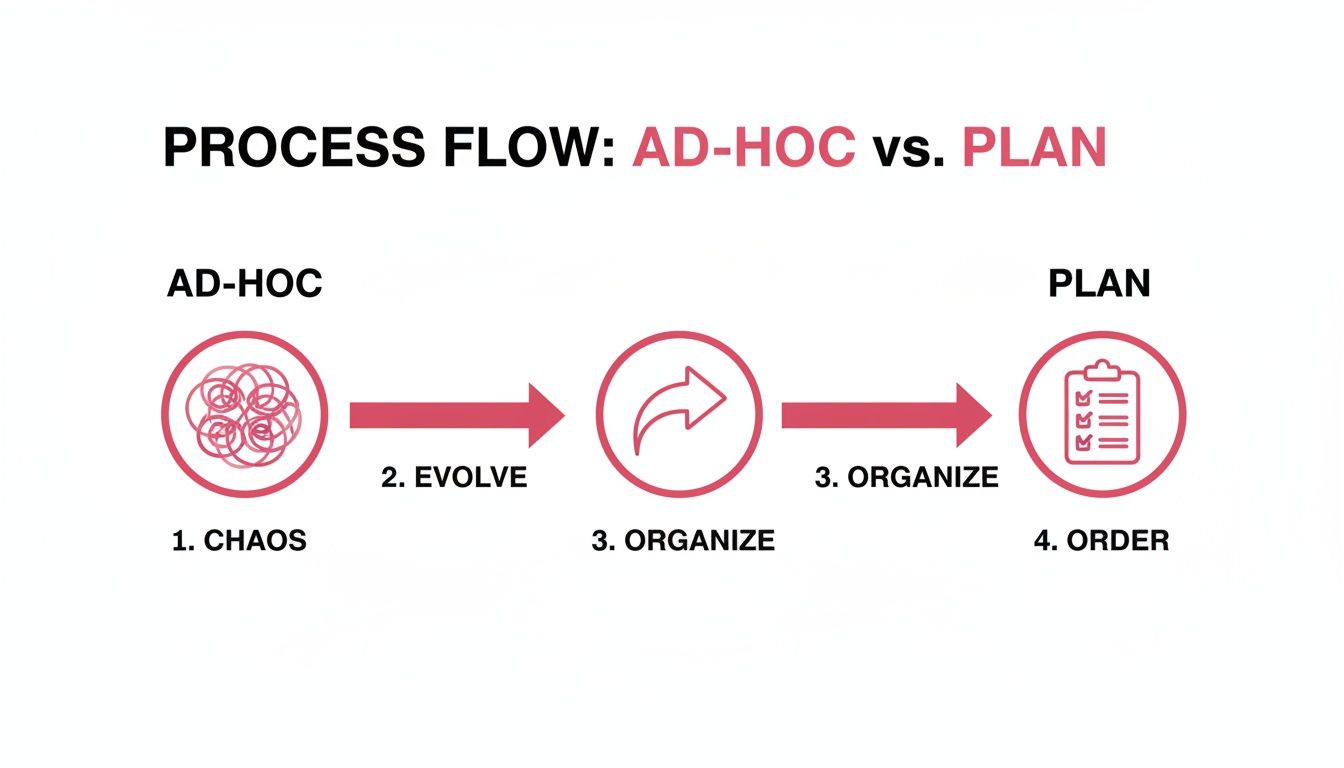
As you can see, a formal plan brings order and predictability, allowing a business to organise its defences and evolve its capabilities over time.
To make this tangible, the table below breaks down each phase of the incident response lifecycle. It outlines the goal for each stage and provides a real-world example of what it looks like for a professional services firm.
Incident Response Lifecycle Phases and Key Actions
| Phase | Objective | Example Action for a Professional Services Firm |
|---|---|---|
| 1. Preparation | Establish the capabilities needed to respond to an incident. | Develop a formal IR plan, conduct phishing awareness training for all staff, and test data backup and recovery systems quarterly. |
| 2. Identification | Confirm if a security event is a genuine incident and determine its scope. | An IT analyst investigates an alert for unusual late-night login attempts on a client portal to confirm if it is a brute-force attack or a system error. |
| 3. Containment | Limit the immediate damage and prevent the incident from spreading further. | A junior partner's laptop is infected with ransomware; IT immediately disconnects it from the network to stop it from encrypting shared client files. |
| 4. Eradication | Completely remove the threat and its root cause from the environment. | Rebuild a compromised server from a trusted image, patch the vulnerability that was exploited, and force a password reset for all users. |
| 5. Recovery | Safely restore systems to normal operation and validate their integrity. | Restore the client database from the last known good backup, then monitor it closely for 24-48 hours before making it fully live. |
| 6. Lessons Learned | Analyse the incident to improve future security and response efforts. | Hold a post-incident review to determine the breach originated from a targeted phishing email, leading to investment in better email filtering technology. |
By following this structured approach, a firm can move methodically from one stage to the next, ensuring nothing critical is missed in the heat of the moment.
A Deeper Look at Each Phase
Phase 1: Preparation
This is where the real work happens, long before any alarm bells ring. The preparation phase is all about building the foundations for a successful response. It involves creating your plan, assembling your team, and getting the right tools and training in place.
Frankly, if you skip this step, the other phases do not stand a chance. This is where you proactively reduce your risk and give your organisation the muscle memory it needs to handle a security event smoothly.
Key preparation activities include:
- Developing and documenting a formal incident response plan so everyone knows exactly what to do and who to call.
- Conducting regular staff training on security basics, especially how to spot phishing emails.
- Implementing and testing security tools, like firewalls, antivirus software, and, most importantly, backup systems.
Phase 2: Identification
This phase kicks off the moment a monitoring tool or a staff member spots something suspicious. The goal here is simple: confirm if you are dealing with a genuine security incident, figure out how bad it is, and understand the potential fallout.
Getting this right—and getting it right quickly—is crucial. A false alarm wastes precious time and resources, but missing a real incident can give an attacker free rein to do untold damage.
This is the detective work of incident response. Your team will be analysing logs, alerts, and system behaviour to piece together the evidence and answer the critical question: "What is happening?"
Imagine an accounting firm’s IT support gets an alert about unusual login attempts on a client portal at 2 AM. The identification process means digging into where those attempts came from, checking if any succeeded, and seeing if any data was touched. This quick analysis confirms whether it is a brute-force attack in progress or just a harmless system glitch.
Phase 3: Containment
Once you have confirmed an incident, the immediate priority is to stop the bleeding. Containment is all about isolating the affected systems to stop the threat from spreading and causing more harm.
This phase is a delicate balancing act. You have to move fast to limit the damage, but you also need to be careful not to destroy evidence that will be needed for investigation later. The actions you take here are often temporary measures designed to stabilise the situation.
- Short-Term Containment: A perfect example is yanking a ransomware-infected computer off the company network. This simple act can prevent the malware from encrypting files on shared drives.
- Long-Term Containment: This is more strategic. It might involve moving the compromised systems to a completely isolated network segment where analysts can safely poke and prod the threat without putting the rest of the business at risk.
Phase 4: Eradication
With the incident now boxed in, the next step is to get the threat out of your environment for good. This means not just deleting the malware but also eliminating the root cause so the attacker cannot just waltz back in.
Simply deleting a malicious file is rarely enough. A persistent attacker likely left behind hidden backdoors or other tools to maintain their access. Proper eradication is a thorough clean-up operation, which might involve rebuilding compromised servers from scratch, patching the vulnerabilities that were exploited, and resetting every single user credential on the network.
Phase 5: Recovery
After you are certain the threat has been kicked out, the recovery phase is about getting back to business as usual, safely and efficiently. The goal is to restore your systems and data without reintroducing the problem or causing unnecessary disruption for your clients and staff.
This involves carefully restoring data from clean backups and keeping a close eye on the affected systems to ensure there are no lingering signs of the attacker. For a law firm, this would mean restoring their case management system from the last known good backup, then verifying the integrity of every client file before bringing the system back online.
Phase 6: Lessons Learned
The final phase is arguably just as critical as the first. Often called a "post-incident review," this is where your team sits down and analyses the entire incident from start to finish. The objective is to be brutally honest about what went well, what went wrong, and what you need to change.
This reflective process is what turns a bad day into a powerful catalyst for improvement, strengthening your defences for the future. The output should be an updated incident response plan, better security controls, and smarter, better-trained staff. For instance, if the whole mess started with a phishing email, the lessons learned might lead to investing in more advanced email filtering and running targeted awareness training for the employees who were caught out.
Assembling Your Incident Response Team and Toolkit

An incident response plan is just paper without the right people and technology to bring it to life. A detailed plan is a great start, but it is the skilled team and their tools that make the difference between a minor hiccup and a business-halting disaster.
For many small and medium-sized businesses, the idea of a dedicated, full-time Incident Response Team (IRT) can feel daunting. The good news is you do not necessarily need a room full of new hires. It is about assigning clear responsibilities to your existing people or bringing in a specialist partner to fill any gaps.
When a breach is discovered, a well-organised team means there is no time wasted figuring out who is in charge, who is digging into the technical details, and who is managing the crucial communications.
Key Roles Within an Incident Response Team
Even in a small business where one person might wear multiple hats, it is vital to understand the different functions needed to cover all your bases during a crisis.
- Incident Coordinator: Think of this person as the director of operations. They lead the entire response, manage resources, keep everyone coordinated, and make sure the team sticks to the plan.
- Technical Analysts: These are your digital detectives. They are the ones on the ground, trawling through logs, reverse-engineering malware, and using forensic tools to figure out how the attackers got in and how to kick them out for good.
- Communications Lead: This role is responsible for managing the message, both inside and outside the company. They will update management and employees, and if necessary, handle communications with clients, regulators like the ICO, and the media.
- Legal Counsel: When a breach happens, legal and regulatory obligations kick in, especially around GDPR. This role provides critical guidance on what you need to do to stay compliant. For most SMEs, this will be an external legal adviser.
In a professional services firm, for example, the IT Manager might be the natural Incident Coordinator. A technically sharp team member could be the designated Analyst, while the Marketing Director handles Communications. The trick is to define these roles before you need them.
The Essential Technology Toolkit
The right technology is a force multiplier for your response team. It gives them the visibility to spot threats faster and the power to act more effectively when every second counts.
These tools are the bedrock of modern what is incident response capabilities, feeding your team the data they need to move swiftly through the identification, containment, and eradication phases of an incident.
Must-Have Incident Response Tools
Here are the core components of a practical incident response toolkit that every business should consider:
-
Security Information and Event Management (SIEM): A SIEM is your central command centre for security data. It pulls in log data from everything—firewalls, servers, laptops—and pieces it all together. By analysing this information, it can spot suspicious patterns that would be impossible to see otherwise.
- Practical Example: A SIEM could flag an "impossible travel" alert if a user account logs in from London and then from another country just minutes later. This instant warning allows the team to investigate a potentially hijacked account immediately.
-
Endpoint Detection and Response (EDR): While a SIEM gives you the big picture, EDR focuses on the individual devices (endpoints) like laptops and servers. It constantly monitors them for malicious behaviour and gives you the ability to isolate an infected machine from the network with a single click, stopping an attack in its tracks.
- Practical Example: An employee at a consultancy firm accidentally clicks a phishing link and malware starts to execute. The EDR agent on their laptop detects the unfamiliar behaviour, blocks it, and quarantines the device automatically before ransomware has a chance to spread to the rest of the network.
-
Vulnerability Management Software: This tool proactively scans your systems for known security weaknesses that attackers love to exploit. Regularly finding and fixing these gaps is a fundamental part of the 'Preparation' phase, making you a much harder target.
For many UK SMEs, the most pragmatic approach is to balance in-house skills with expert support. Partnering with a specialist like SES Computers gives you immediate access to both the deep expertise and the advanced tools needed to build a resilient incident response function, without the hefty upfront investment.
Your Practical Incident Response Checklist
Knowing the theory is one thing, but having a clear, actionable plan for when things go wrong is what really counts. This checklist is not just about ticking boxes; it is a practical guide designed to help UK small and medium-sized businesses turn theory into a solid, real-world capability.
Think of it as your roadmap. By working through these steps before an incident hits, you create a clear path to follow when the pressure is on. It ensures everyone knows their role, leading to a coordinated and effective response instead of chaos.
Phase 1: Pre-Incident Preparation
This is your groundwork. The effort you put in now, on your own terms, will directly determine how well you weather the storm when an attacker strikes. Preparation is easily the most critical phase.
- Map Your Critical Assets: You cannot protect what you do not know you have. Document your most important systems and where sensitive data lives. This map becomes invaluable when you need to prioritise your defence.
- Create a Communications Plan: Who do you call? List the contact details for your response team, key managers, and external partners like your IT provider or legal counsel. Critically, decide on a backup communication method for when email or other primary systems are down.
- Test Your Backups Religiously: An untested backup is just a hope, not a plan. Regularly run through a full data recovery drill to make sure you can actually restore your business-critical files and systems from scratch.
- Train Your People: Your team is your first line of defence. Run regular, engaging training sessions to help them spot phishing emails and other suspicious activity, and make sure they know exactly who to report it to—immediately.
A well-prepared business can often contain a threat before it explodes into a full-blown crisis. This proactive work is what minimises disruption and protects your hard-earned reputation.
Phase 2: Actions During an Incident
The moment a potential incident is spotted, your team needs to act with speed and precision. The immediate goal is to stop the bleeding and gather crucial information without making the situation worse.
- Isolate Affected Systems: Your first priority is to stop the attack from spreading. Disconnect any compromised laptops, servers, or devices from the network straight away. Pull the plug if you have to.
- Preserve the Evidence: Do not panic and start wiping machines. Shutting things down or deleting files can destroy vital forensic evidence needed to understand how the attackers got in and how to stop them from coming back.
- Change Passwords: Immediately reset the credentials for any user accounts you suspect are compromised. It is often wise to force a password reset across related systems as a precaution.
- Activate Your Communications Plan: Get the word out to key internal stakeholders, following the plan you already created. Keep the updates concise, factual, and focused on the next immediate steps.
Phase 3: Post-Incident Responsibilities
Once the immediate threat has been dealt with, the focus shifts to recovery, learning, and meeting your legal duties. These steps are essential for getting back to business safely.
- Notify the ICO if Required: Under GDPR, if a data breach could pose a risk to people's rights and freedoms, you must report it to the Information Commissioner’s Office (ICO) within 72 hours. Getting this wrong can lead to heavy fines.
- Hold a Post-Incident Review: Get the team together to analyse what happened. What did we do well? What could have been better? Use this as a no-blame learning opportunity to strengthen your security and update your response plan. Our guide on what to do after a cyber attack dives deeper into this process.
- Communicate with Affected Parties: If customer or employee data was compromised, you may be legally required to notify them. Be transparent about what happened and give them clear advice on how they can protect themselves.
The escalating threat level underscores why this preparation is vital. The UK's National Cyber Security Centre (NCSC) managed 429 reported incidents in a recent period, with a staggering 48% deemed 'nationally significant'. This trend highlights the urgent need for every organisation to be prepared. For a comprehensive approach to incident preparedness and continuity, exploring a detailed disaster recovery planning checklist can provide valuable structure.
Building Your Cyber Resilience with an Expert Partner
Knowing what to do is one thing, but actually finding the time, budget, and in-house expertise to do it is another challenge entirely. For countless UK businesses, the daily grind leaves little room for building a proper incident response capability. This is precisely where a specialist partner can turn a daunting, complex task into a managed, effective business function.
Partnering with an expert bridges that critical gap between knowing you need a plan and having one that is battle-tested and ready to go. It is about making top-tier security accessible and affordable, letting you focus on your business while a dedicated team builds and sharpens your cyber defences in the background.
From Theory to Practical Defence
An expert partner like SES Computers moves beyond paper plans and checklists to deliver real, tangible security. We bring the expertise and resources needed to transform your incident response from a theoretical document into a living, tested capability.
Our core services are designed to give you complete peace of mind:
- Bespoke Plan Development: We sit down with you to create a customised incident response plan that actually fits your business—your specific risks, your industry, and your regulatory obligations.
- Realistic Tabletop Exercises: A plan is just a theory until it is tested under pressure. We run simulated cyber-attack scenarios to drill your team, find the weak spots, and build the muscle memory needed to act decisively in a real crisis.
- Post-Incident Forensic Analysis: If the worst happens, our specialists conduct a deep forensic investigation. The goal is simple: ensure the threat is completely neutralised and uncover the root cause to stop it from ever happening again.
Partnering with a specialist is not about outsourcing responsibility; it is about insourcing expertise. It gives your business access to seasoned professionals who handle these situations every day, ensuring a calm, methodical, and effective response when it matters most.
A Proactive Partnership for Long-Term Security
At the end of the day, effective incident response is a continuous cycle of preparation, testing, and improvement. A true partnership delivers this ongoing support, ensuring your defences evolve as new threats emerge. When an incident does occur, especially a data breach, understanding crisis communication best practices is absolutely crucial for managing public perception and protecting your reputation.
By working with an experienced team, you gain more than just a plan; you gain a shield. It allows you to navigate the complexities of modern cybersecurity with confidence, knowing you have proven support in your corner. To see how this model works in practice, take a look at our overview of what a managed IT service provider can do for your business.
Your Incident Response Questions, Answered
To help clear up some of the finer points, we have put together answers to the questions we hear most often from UK business leaders about incident response. Think of this as a quick-fire round to tackle any lingering uncertainties.
How Often Should We Be Testing Our Incident Response Plan?
The standard advice is to test your plan at least annually. The most common way to do this is with a tabletop exercise, where you gather the response team and walk through a simulated incident, step-by-step, to see how the plan holds up.
However, if your business is in a high-risk sector or you have recently made major changes to your IT systems, you should really aim for quarterly tests. More frequent testing keeps the plan from going stale and ensures your team's skills are always sharp. It is about building muscle memory for a crisis.
What’s the Difference Between Incident Response and Disaster Recovery?
This is a really important one to get right. While they are related, they solve different problems on different timelines.
- Incident Response (IR) is laser-focused on a security breach. Its job is to find the threat, contain it, and kick it out of your network. Think of it as the immediate, hands-on reaction to a cyber attack.
- Disaster Recovery (DR) is much broader. It is the plan for getting your core IT systems and data back online after any kind of major disruption—that could be a cyber attack, but it could also be a fire, flood, or catastrophic hardware failure.
Think of it like this: Incident response is the team of paramedics stopping the bleeding at the scene of an accident. Disaster recovery is the long-term hospital care and rehabilitation needed afterwards. An incident might trigger your disaster recovery plan, but not all disasters are security incidents.
Does Our Cyber Insurance Mean We Don’t Need an Incident Response Plan?
Absolutely not. In fact, it is the other way around. Most cyber insurance providers now require you to have a formal incident response plan in place just to get coverage.
Your insurer needs to see that you have done your part to manage risk. Without a documented plan, you could find your claim is denied. Your plan is your playbook for the crisis itself; your insurance is there to help with the financial fallout, like legal fees, forensic investigations, and fines. You need both to be truly resilient.
Ready to build a robust, tested defence that goes beyond theory? The expert team at SES Computers can create a bespoke incident response plan that protects your business, your clients, and your reputation. Contact us today to get started.