At its heart, managed IT services and support is about outsourcing your technology management to a dedicated team of specialists—what we call a Managed Service Provider, or MSP. Rather than waiting for something to go wrong, an MSP works quietly in the background, keeping your systems running smoothly, securely, and efficiently, all for a predictable monthly fee.
Think of it as preventative care for your business technology. For a professional services firm, this might mean having an expert team that ensures your client management software is always up-to-date, secure, and accessible, preventing the costly downtime that could derail a critical project deadline.
Defining Your IT Strategy: Proactive Partnering vs. Reactive Repairs
For most professional services firms, whether you're a legal practice in Dorset or a financial consultancy in Hampshire, technology is the engine that drives your business. If that engine sputters and dies, everything grinds to a halt. For years, the standard response was the 'break-fix' model: you only call for IT help when something is already broken.
This reactive approach is a huge gamble. Imagine your server goes down, taking all your client files with it right before a major deadline. With a break-fix arrangement, you're left scrambling to find a technician, waiting for a diagnosis, and then facing a hefty, unexpected bill for the emergency call-out. All the while, you're losing billable hours and, potentially, client confidence.
The Shift to Proactive Management
Managed IT services turns that old model completely upside down. It’s like having a dedicated facilities management team for your entire digital world. They don't just show up to fix a leak; they're checking the pipes regularly to make sure they never burst in the first place.
This simple shift means your IT partner is motivated to prevent problems, not to profit from them. Their goal is to keep you up and running without a hitch because their success is directly linked to your operational stability. It’s this alignment of interests that transforms an MSP from a simple vendor into a genuine strategic partner.
A proactive managed services model focuses on preventing IT issues before they can disrupt your business. This approach changes IT from a reactive cost centre into a strategic asset that fuels efficiency, security, and growth.
For professional services, the impact is immediate.
- Preventing Downtime: An accountancy firm sails through a busy tax season without costly interruptions because its systems are constantly monitored and maintained.
- Enhancing Security: A solicitor's office can confidently protect sensitive client data from cyber-threats with 24/7 expert monitoring and advanced security in place.
- Predictable Budgeting: A consultancy can accurately forecast its annual IT spend with a fixed monthly fee, getting rid of the nasty surprise of a huge bill after a system failure.
Ultimately, the choice is between constant technological uncertainty and a future of stability and strategic advantage. For a deeper look into the strategic value and full scope of what modern IT support can offer, this complete strategic guide to managed cloud services offers an excellent overview of how these services become a core business enabler.
Comparing IT Support Models: In-House vs. Break-Fix vs. Managed Services
Choosing the right IT support model is a critical decision for any UK business. Each approach comes with its own set of pros, cons, and cost implications. Understanding these differences helps you decide which model best aligns with your business goals, budget, and tolerance for risk.
The table below breaks down the three main options—building an in-house team, relying on break-fix support, or partnering with a Managed Service Provider (MSP)—across several key features.
| Feature | In-House IT Team | Break-Fix Support | Managed IT Services |
|---|---|---|---|
| Cost Structure | High fixed costs (salaries, benefits, training). | Unpredictable, hourly rates. Costs spike during emergencies. | Predictable, fixed monthly fee. Easier to budget. |
| Response Time | Dependent on staff availability and workload. | Varies greatly. You are not a priority until you call. | Guaranteed response times defined in a Service Level Agreement (SLA). |
| Focus | Handles both daily tasks and strategic projects. Can be stretched thin. | Reactive. Focus is entirely on fixing the immediate problem. | Proactive. Focus is on preventing issues and optimising systems. |
| Expertise | Limited to the knowledge of your internal staff. | Can be a gamble. Expertise may vary from one technician to another. | Access to a broad team of certified specialists in security, cloud, etc. |
| Strategic Value | Can align with business goals, but often bogged down in day-to-day fixes. | Very low. No contribution to long-term business strategy. | High. Acts as a strategic partner, advising on technology to drive growth. |
As you can see, while an in-house team offers control and a break-fix provider offers a pay-as-you-go model, managed IT services provide a unique balance. It delivers the strategic, proactive oversight of an expert team but at a predictable, manageable cost, making it an ideal fit for SMEs looking to grow without the burden of massive overheads.
The Building Blocks of a Modern Managed Service
To really get to grips with managed IT services and support, it helps to look past the high-level concept and dive into the specific components that create a solid technology foundation. These aren't just isolated fixes; they're interconnected parts designed to work in harmony, giving your business layers of protection, efficiency, and stability. For any professional services firm, getting these blocks right is critical for maintaining productivity and, most importantly, client trust.
Think of it like building a secure, modern office. You'd never skimp on the foundations, and you’d insist on robust security, reliable utilities, and a clear plan for emergencies. A proper managed service organises your technology in exactly the same way, shifting your business away from the old break-fix cycle and towards a proactive, strategic mindset.
This evolution is all about moving from reacting to problems to preventing them in the first place.
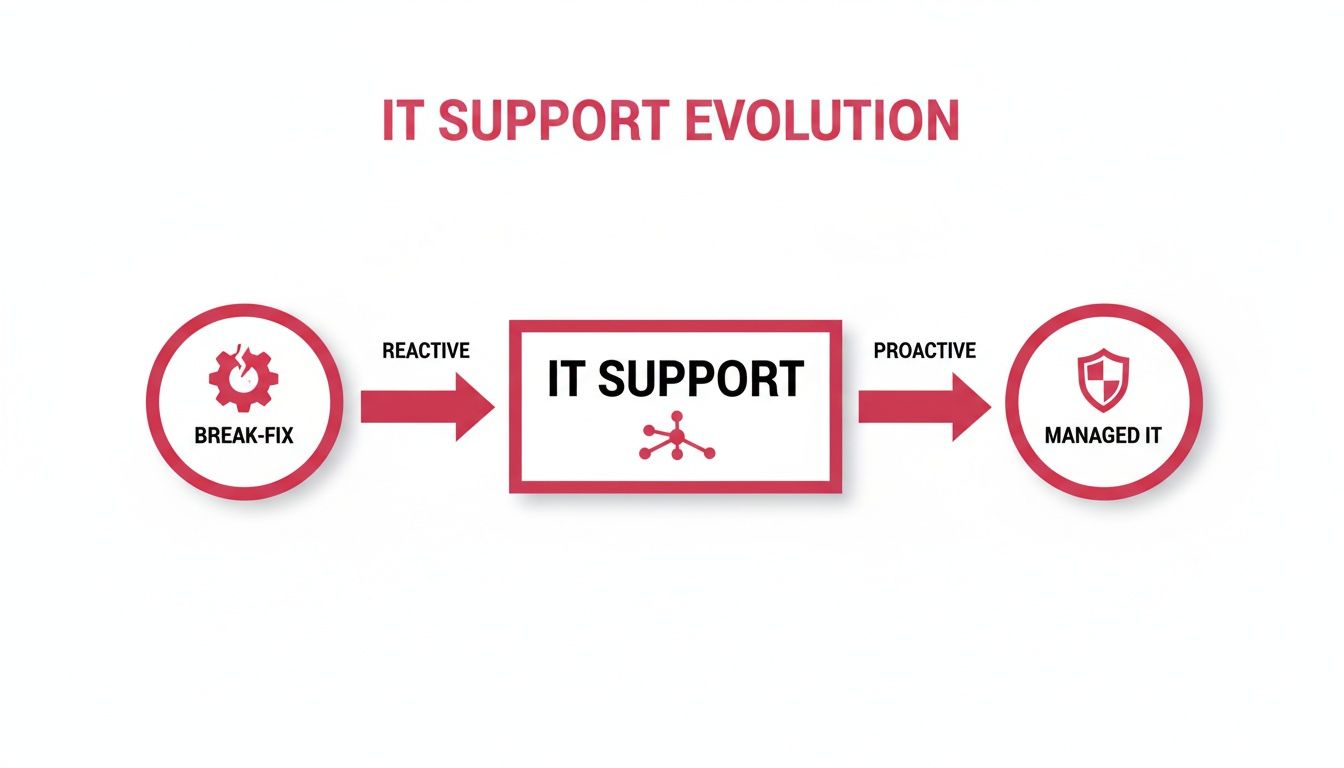
As you can see, the managed model is built around foresight. It’s a change in philosophy that directly protects your operations and your bottom line.
Proactive Monitoring and Maintenance
The absolute cornerstone of any managed service is proactive 24/7 monitoring. It’s the digital equivalent of having a security guard constantly patrolling your premises, checking every door and window. Sophisticated software keeps a watchful eye on the health and performance of your entire IT estate—from servers and laptops to the network switches that connect them all.
Crucially, these systems don't wait for a total breakdown. They spot the tell-tale signs of trouble long before they escalate into business-stopping problems.
- Practical Example: Imagine an accountancy firm in the middle of tax season. A monitoring system detects that a server's hard drive is showing early signs of failure. The MSP gets an instant alert, replaces the drive overnight, and restores the data from a backup. The firm’s staff arrive the next morning completely unaware that a major data loss event was just avoided. They experienced zero downtime.
This kind of preventative maintenance keeps your systems optimised, secure, and reliable, stamping out the disruptions that cost your business time and money.
Cloud Solutions and Hosted Services
The modern workplace isn’t tied to a single office anymore. Cloud solutions are what power this new flexibility, enabling your team to work securely from just about anywhere. A good MSP doesn't just sell you a generic cloud product; they design and manage a cloud strategy that’s a perfect fit for how your business actually operates.
This is a massive industry shift. A recent UK Government study on MSPs pointed to a huge structural change, with cloud computing quickly becoming the top service offered. The report predicts that as traditional on-site infrastructure management declines, cloud services will almost double. You can read the full government research on MSP trends to see the data for yourself.
By bringing in cloud services like Microsoft Azure or hosted desktops, an MSP can equip your firm with secure remote access, collaborative tools, and scalable resources—all without the hefty price tag of buying and maintaining on-site hardware.
Multi-Layered Cyber Security
In an era of relentless cyber threats, a single antivirus programme just doesn't cut it. Modern managed IT services deliver a multi-layered security strategy, effectively building several defensive walls between your sensitive data and those who want to steal it.
This approach weaves together multiple security measures to protect you from every angle.
- Endpoint Protection: Advanced antivirus and anti-malware on every PC, laptop, and server.
- Firewall Management: A robust, professionally configured firewall acting as the gatekeeper for your network.
- Email Security: Smart filtering that stops phishing attempts, spam, and malicious attachments before they ever land in an employee's inbox.
- Security Patching: The disciplined routine of keeping all your software and operating systems updated to close security loopholes.
Each layer supports the others. If a threat somehow slips past one, another is ready and waiting to stop it.
Data Backup and Disaster Recovery
Even with the best defences, the unexpected can still happen—hardware failures, cyber-attacks, or even a fire or flood. A rock-solid Data Backup and Disaster Recovery (BDR) plan is your ultimate safety net, ensuring your business can bounce back quickly when disaster strikes.
And this is about far more than just backing up a few files. It's about having a tested, ready-to-go plan to restore your entire operation from scratch if needed.
- Practical Example: A law firm's office gets hit by a power surge that fries their main server. Because their MSP had a proper BDR solution in place, a complete, up-to-the-minute copy of their server was already stored in a secure UK data centre. The MSP was able to bring their systems back online on a virtual server within just a couple of hours, allowing staff to connect remotely and carry on working with minimal disruption to client cases.
Without that managed plan, the firm could have been looking at days, or even weeks, of crippling downtime and reputational damage.
Calculating the True Value of Your IT Investment

It’s easy to look at managed IT services and support as just another monthly bill. But that’s a common mistake. To really grasp its value, you need to look beyond the invoice and calculate the return on investment (ROI). The real worth isn't in what you pay; it's in the expensive problems you prevent and the new efficiencies you create.
A professionally managed IT setup is a direct driver of profitability and protects your revenue. This requires a small but crucial shift in mindset: seeing IT not as a cost centre, but as a strategic investment. The first step is to get real about the hidden costs of managing IT reactively, or not at all.
The Hidden Costs of Poor IT Management
When your technology isn't properly looked after, your business bleeds money in ways that aren't always obvious on a spreadsheet. These indirect costs can quickly spiral, often dwarfing the price of a proactive managed IT plan.
Just think about the financial impact of a single hour of system downtime.
- A Practical Example: Imagine a 20-person accountancy firm where the average billable rate is £100 per hour for each employee. If a server failure knocks everyone offline for just four hours, that’s an immediate £8,000 in lost billable work. And that number doesn’t even touch on the damage to client trust or the immense stress it puts on your team.
Downtime is just one part of the story. Consider the productivity lost when your staff become unwilling IT technicians. An employee wrestling with a printer for 30 minutes is 30 minutes not spent on the job you hired them for.
The true cost of IT is not the monthly support fee. It's the combined loss of revenue from downtime, wasted staff hours on tech glitches, and the enormous financial risk of a single security breach.
Evaluating the Tangible Returns
Once you have a grip on these hidden costs, you can start to measure the positive returns that managed IT services deliver. These benefits go far beyond just "keeping the lights on"—they create concrete financial advantages.
Here’s a simple framework for seeing the return:
-
Predictable Budgeting: A fixed monthly fee gets rid of surprise repair bills. This turns your IT spending from a volatile, unpredictable cost into a stable operational expense, making your financial planning far more accurate.
-
Enhanced Staff Productivity: With proactive support, your team spends less time battling with technology and more time focused on the work that actually generates revenue. That efficiency boost is a direct, measurable return on what you spend.
-
Strategic Business Growth: A good Managed Service Provider (MSP) does more than fix things. They offer expert guidance to help you make smarter technology decisions that support your long-term goals. This strategic advice prevents costly missteps and ensures your IT can scale as your ambitions grow. You can find out more by exploring the key benefits of managed IT services in our detailed article.
The Incalculable Value of Risk Avoidance
Perhaps the most important return, yet the hardest to put a number on, is the value of avoiding a catastrophe. For a small or medium-sized business, the cost of a serious data breach can be utterly devastating.
Recent studies show that 41% of small businesses suffered at least one cyber-attack in the last year. The fallout isn’t just the immediate financial hit; it includes regulatory fines, legal fees, and reputational damage that can take years to mend.
A proactive managed service is your company's first line of defence. By implementing robust, layered security and ensuring you meet regulations like GDPR, your MSP dramatically lowers your risk profile. The cost of preventing a breach is a tiny fraction of the cost of cleaning one up. Looked at this way, managed IT isn't an expense—it's an essential insurance policy for your business's future.
How Managed IT Services Pricing Models Work
One of the first questions we always get asked is, "So, what's this actually going to cost me?" It's a fair question. To make a smart decision about your IT support, you need to get your head around the numbers.
Moving away from the old-school 'break-fix' approach—where you only call for help when something is already broken—means thinking about your tech budget differently. But it’s not as complicated as it sounds. Most Managed Service Providers (MSPs) in the UK use straightforward pricing structures designed for clarity and predictability, making it easy to find a plan that suits how you work and what you can afford.
Once you understand these models, you can look at quotes with confidence. It puts you in the driver's seat, able to choose a partnership that delivers real value, sidesteps nasty hidden fees, and supports your business as it grows. Let's walk through the common options you'll come across.
The Per-Device Pricing Model
This is one of the most direct ways to price IT support: per-device pricing. You simply pay a set, flat fee for each piece of equipment the MSP is looking after. That usually covers everything from servers and desktops to laptops, and can even include network hardware like firewalls or printers.
The beauty of this approach is its transparency. If you bring in a new team member and add a new computer, your monthly cost goes up by a predictable amount. If you decommission an old server, your bill drops.
- A Practical Example: Think of a small manufacturing firm here in Somerset. They might have ten shared workstations on the factory floor and a couple of servers in the back office. With a per-device model, they pay for exactly 12 items. This makes perfect sense because different employees use the same machines across various shifts, so paying per user wouldn't be cost-effective.
The Per-User Pricing Model
On the other hand, the per-user pricing model is often a much better fit for professional services firms or any business with a modern, flexible workforce. You pay one flat fee for each employee, and it doesn’t matter how many devices they use.
That single price covers their desktop in the office, their laptop for working from home, the tablet they take to client meetings, and their work mobile. It makes budgeting incredibly simple, especially with hybrid work being the new normal. Your IT costs are tied directly to your headcount—a metric every business owner already tracks.
The per-user model is built for how we work today. It understands that one person often needs secure, reliable access across multiple devices to be productive, whether they're at their desk, on the sofa, or on a train.
This is a game-changer for businesses where staff productivity is the main engine for growth.
- A Practical Example: A law firm in Dorset has 15 solicitors. Each has a desktop computer at the office and a company laptop for court appearances or remote work. Per-user pricing means the firm pays a single, predictable monthly fee for each of those 15 staff members, covering all their equipment and support without any complicated sums.
The All-Inclusive (or "All-You-Can-Eat") Model
For businesses that want total clarity and peace of mind, the all-inclusive model is the most comprehensive choice. It bundles pretty much all of your IT management and support into one fixed monthly payment. This typically includes 24/7 monitoring, cyber security protections, data backups, on-site support, and even strategic advice.
This model gives you ultimate budget predictability. Aside from a major new project, your IT bill is the same every single month. No more worrying about surprise charges for emergency call-outs or tricky problems that take hours to fix. You can forecast your costs with near-perfect accuracy.
It might look like it has a higher monthly price tag at first glance, but it often provides the best long-term value. By preventing expensive disasters and including services you’d otherwise pay for separately, it becomes a strategic investment. For any business that simply cannot afford downtime, this is the gold standard.
How to Choose the Right UK Managed IT Partner
Choosing a managed IT partner is one of the most important strategic decisions you can make for your business. It's not just a procurement exercise; it’s about finding a long-term partner who will become an extension of your own team. Get it right, and you'll boost efficiency and sleep soundly knowing your operations are protected. Get it wrong, and you could be in for a world of frustration, risk, and unexpected costs.
So, with so many providers vying for your attention, how do you cut through the noise and find a partner who genuinely gets what you need?
The market is certainly booming. The UK Managed Services sector was valued at a staggering USD 15.35 billion in 2023 and is on track to hit USD 28.29 billion by 2032. This explosion is largely driven by the ever-growing need for robust cybersecurity and flexible cloud services. But more choice makes the vetting process even more critical.
To make a smart decision, you need to go in with a plan. It all comes down to asking the right questions and knowing what a good answer looks like.
Assess Their Industry Experience
Your first filter should always be relevance. Does a potential provider have real, hands-on experience in your industry? A generic, one-size-fits-all approach to IT just doesn't cut it, especially for professional services firms with very specific software and compliance headaches. You need a partner who already speaks your language.
For instance, a law firm needs an IT team that lives and breathes case management software like Clio or LEAP. An accountancy practice, on the other hand, needs a provider who is an expert in Sage or Xero and understands the strict security protocols for handling sensitive financial data.
Don't be shy about asking direct questions:
- Do you currently support other businesses in our sector? Can you share some anonymised examples of the problems you solve for them?
- What's your experience with our core software? How do you keep it running smoothly and securely?
- Are you up to speed on data protection regulations in our field, like GDPR or specific FCA rules?
Scrutinise the Service Level Agreement
The Service Level Agreement (SLA) is the rulebook for your entire relationship. It's the contract that holds your provider to their promises, so it pays to read it with a fine-tooth comb. Vague commitments are a massive red flag; a professional partner will have an SLA that is crystal clear and specific.
Think of the SLA as your insurance policy. It should spell out exactly what you can expect, including guaranteed response times and resolution targets. It’s the single most important tool you have for holding your IT partner accountable.
Here are the key things to look for:
- Guaranteed Response Times: How quickly will they acknowledge an issue? This should be broken down by how critical the problem is.
- Resolution Targets: It’s one thing to acknowledge a problem, but how long will it take them to fix it?
- System Uptime Guarantees: A good SLA will promise something like 99.9% uptime for your most important systems.
- Support Hours and Methods: Do their standard hours cover your business day? And what happens if there's an emergency at 10 PM on a Friday?
Verify Their Scalability and Reputation
Your business isn't going to stand still, and your IT partner needs to be able to keep up. The provider that’s a great fit for a 10-person team might start to crack under the pressure when you grow to 30. Scalability isn't just about adding more user accounts; it's about their capacity to support more complex challenges as your business evolves.
Ask them how they handle client growth. What does that process look like? At the same time, do your homework and check their track record. Don’t just rely on what they tell you—ask for client testimonials or case studies from businesses that look and feel like yours. A confident, reputable provider will be more than happy to provide them. For more tips, have a look at our guide on how to evaluate managed IT service companies in the UK.
Navigating Compliance and Data Protection

For professional services firms here in the UK, looking after sensitive client information goes far beyond good business practice—it's a strict legal obligation. Regulations like the General Data Protection Regulation (GDPR) have real teeth. Getting it wrong can lead to eye-watering fines and, just as damaging, a shattered reputation.
This is where professional managed IT services and support shift from being a "nice-to-have" to an essential line of defence. Your Managed Service Provider (MSP) is your technical guardian, translating complex legal jargon into practical, robust security measures that keep you on the right side of the law.
Implementing Technical Safeguards for GDPR
Getting compliant isn't just about updating your privacy policy. It demands a layered security strategy, with very specific technical controls protecting your data at every turn.
A good MSP takes ownership of these critical elements for you:
- Robust Encryption: They make sure that all sensitive data is properly scrambled and unreadable to anyone without authorisation, whether it’s sitting on your server or travelling across the internet.
- Strict Access Controls: This means putting "least privilege" policies in place, so your staff can only see and touch the data they absolutely need for their role. It’s a simple but powerful way to reduce the risk of an internal breach.
- Secure UK-Based Backups: Your data is securely copied and stored in accredited UK data centres. This respects data sovereignty laws and guarantees you can get back up and running quickly if the worst happens.
When you’re looking for an IT partner, their experience in navigating these complex data protection rules is non-negotiable. It's crucial they understand the ins and outs of GDPR compliance guidelines.
An MSP doesn't just manage your technology; they manage your risk. By taking ownership of the technical side of compliance, they free you to focus on your clients, confident that their sensitive information is properly protected. For an actionable overview, check out our GDPR compliance checklist for UK businesses.
A Practical Example in the Legal Sector
Think about a local solicitor's practice. They handle incredibly sensitive, client-attorney privileged information every single day. The firm puts its trust entirely in its MSP to build and maintain a secure digital fortress around that data.
The MSP might configure the network to keep client files completely separate, deploy advanced email filtering to stop phishing attacks dead in their tracks, and run regular security audits to find and patch any weaknesses before they can be exploited.
This kind of proactive management is vital in high-stakes industries. It’s no surprise that the financial services sector accounts for roughly 20.7% of UK IT services spending, driven by its immense pressure to maintain operational resilience and meet strict compliance demands. By handing over these technical duties, the law firm not only meets its legal obligations but also protects its clients and safeguards its hard-won reputation.
Your Questions About Managed IT, Answered
Deciding to hand over the reins of your IT is a big step. It’s completely normal to have questions and a few reservations. We hear the same queries from business owners across the UK, so let's tackle them head-on and clear things up.
Will I Lose Control of My IT Systems?
It's a common worry, but the reality is quite the opposite. You actually gain more strategic control, not less. Think of it this way: instead of constantly putting out technical fires, you're freed up to focus on the bigger picture – how technology can actually help you grow your business.
A good Managed Service Provider (MSP) works with you. You set the goals and the direction, and they handle the day-to-day grind of keeping things running smoothly. Through regular chats and clear reports, you'll always know what's happening, making sure your IT is perfectly in sync with your business objectives. It's a partnership that puts you firmly in command of your technology strategy.
Is This Going to Be Too Expensive for My Business?
For most small and medium-sized businesses, managed services are actually the more financially savvy choice. It’s easy to get sticker shock from a monthly fee, but you have to compare it to the alternatives. The cost of hiring just one in-house IT expert can be substantial, and that's before you even think about the crippling costs of unexpected downtime or a security breach.
Managed IT turns unpredictable IT chaos into a predictable monthly cost. You’re not just paying to fix things when they break; you're investing in the stability and security of your entire operation.
Let's put it in perspective. An in-house technician could easily cost you £45,000+ a year in salary alone. A 15-person firm could get access to a whole team of specialists in security, cloud tech, and day-to-day support for a fraction of that cost. It's simply a much smarter way to use your budget.
How Painful Is It to Switch to a New IT Provider?
We get it – the thought of switching anything can feel like a massive headache. But a professional MSP has this down to a fine art. The whole process is designed to be as smooth and disruption-free as possible.
It all starts with a thorough check of your current setup. From there, your new provider builds a detailed migration plan that works around your schedule. Key tasks are often handled after hours or on weekends to make sure your team can carry on with their work without a hitch. The goal is always a seamless handover.
Ready to secure your operations and unlock your business’s full potential? The team at SES Computers has over 30 years of experience delivering reliable managed IT services and support across Dorset, Hampshire, and Somerset. Explore our managed IT services today and discover how a proactive partnership can drive your success.