Think of website managed services as having a dedicated pit crew for your company's website. It’s a partnership where you hand over the technical heavy lifting—the maintenance, security, and performance tuning—to a team of experts. This isn't just about calling for help when something breaks; it's about having a team constantly working in the background to make sure nothing breaks in the first place.
What Are Website Managed Services Anyway?

It’s easy to see a new website as a finished product. You invest time and money, it goes live, and you tick it off the list. But a professional website is a living, breathing asset. It’s built on complex software that needs regular attention to stay secure, fast, and functional.
Left to its own devices, a website can quickly become a liability. It gets slow, becomes vulnerable to hackers, and software conflicts can crash it entirely without warning. This is exactly where website managed services step in, taking the burden of technical ownership off your plate and putting it into the hands of specialists.
The core idea is to shift from a reactive "break-fix" model—where you scramble for help after a disaster—to a proactive one. Instead of waiting for a crisis, a managed service provider is always on guard. This principle extends across the business world, as you can see in the broader role of managed services in IT that keep entire company operations running smoothly.
Moving from Reactive to Proactive Care
Let’s use a practical example. Imagine you run a consultancy firm and your website's contact form suddenly breaks. In a reactive world, you might not notice for days, and all those potential client enquiries vanish into thin air. When you finally realise, you’re left with the stress of finding a developer who can drop everything to fix it.
A managed service provider is set up to prevent that from ever happening. Their proactive approach means:
- Constant Monitoring: They have systems that watch your site 24/7. For instance, they might run an automated test on your contact form every hour. If it fails, they get an alert and can fix it long before you or your potential clients would notice.
- Preventative Maintenance: Your website's core software, themes, and plugins are updated on a regular schedule to close security loopholes and keep everything compatible.
- Performance Optimisation: They are actively working to make your site faster, which is vital for keeping visitors happy and ranking well on Google.
By outsourcing the technical headaches, you get your time back. It frees you up to do what you do best: run your business, look after your clients, and focus on growth instead of putting out digital fires.
An Analogy for Professional Services
Think of your website like a vital piece of machinery on a factory floor. You wouldn't just run it until it grinds to a halt, stopping all production. Of course not. You’d have a strict maintenance schedule to keep it clean, serviced, and operating at peak efficiency.
Website managed services bring that same professional logic to your online presence. It’s a continuous partnership designed to get the most out of your website, shield it from threats, and make sure it’s always working hard for your business. It ensures your digital shopfront is always open, secure, and ready for clients.
The Core Components of Managed Website Support

So, what are you actually paying for with a managed website service? It helps to think of it not as a single product, but as a collection of specialised support layers, all working together to keep your online presence secure, fast, and reliable. For professional services firms across the UK, this bundle is what delivers genuine peace of mind.
A good analogy is maintaining a commercial building. You need an electrician for the wiring, a plumber for the pipes, and a security firm for the alarms. A managed service provider brings all those digital experts under one roof, giving your website a single, cohesive team.
This all-in-one approach is more important than ever. The UK's managed service sector is a huge part of our economy, pulling in around £51 billion in revenue across nearly 13,000 businesses. We've seen a massive shift in that market, too. Application and hosting services have jumped from a 17% to a 33% market share, showing just how vital these cloud-based support services have become.
To get a clearer picture, let’s break down the essential services you should expect.
The following table gives a quick overview of what each core component involves and why it's so critical for a modern business.
At a Glance View of Core Managed Services
| Service Component | What It Is | Why It Matters for Your Business |
|---|---|---|
| UK-Hosted Infrastructure | Your website's files and data are stored in secure data centres located within the UK. | Faster load times for UK clients, better SEO, and easier compliance with GDPR and local data laws. |
| Proactive Security & Patching | A team continuously monitors for threats and applies software updates (patches) to close security gaps. | Prevents cyberattacks before they happen, protecting your data and your reputation from costly breaches. |
| Automated Backups & Recovery | Regular, complete copies of your website are automatically created and stored securely off-site. | Provides a "rewind button" to quickly restore your site after a server crash, hack, or human error. It's your ultimate safety net. |
| Performance Optimisation | Ongoing technical adjustments to make your website load as quickly and efficiently as possible. | A fast site keeps visitors happy, reduces bounce rates, and is a key factor in Google's search rankings. |
This combination of services ensures your website isn't just a static brochure but a robust, secure, and high-performing business asset that you can rely on day in and day out.
Managed UK Hosted Infrastructure
Where your website ‘lives’ really matters. Managed UK-hosted infrastructure means your website data is physically stored in data centres right here in the United Kingdom. This isn't just about flying the flag; it delivers tangible business advantages.
For a start, it makes your website significantly faster for your UK clients. Data has less distance to travel, which translates to quicker page loads, a smoother user experience, and a welcome boost in your search engine rankings.
Beyond speed, it’s a cornerstone of regulatory compliance. Keeping client data within UK borders helps you stay on the right side of data protection laws like GDPR, giving your clients confidence that their sensitive information is being handled correctly.
Proactive Security and Patching
Imagine having a dedicated security team patrolling your digital storefront 24/7. That's precisely what proactive security and patching provides. Cyber threats are relentless, with attackers constantly probing for weaknesses in website software.
Your managed service provider acts as your digital guardian. Their job includes:
- Regular Patching: As soon as security updates are released for your website’s core software, themes, or plugins, they are applied to close off any newly discovered vulnerabilities.
- Vulnerability Scanning: For example, the team might run weekly automated scans that check your site for the "OWASP Top 10" security risks and report back any potential weak spots.
- Malware Removal: If a threat does get through, they jump on it immediately to isolate and remove the malicious code, preventing damage to your site and reputation.
This constant vigilance shifts your security posture from a reactive, panicked clean-up after an attack to a preventative, strategic defence. It keeps your digital front door locked and monitored at all times.
Automated Backups and Disaster Recovery
Ask yourself this: what would happen if your website was completely wiped out tomorrow? For most businesses, the answer is a catastrophe. This is where automated backups and a solid disaster recovery plan become your ultimate safety net.
A good provider automates this entire process. They take regular, complete copies of your website—all the files, databases, the lot—and store them securely in a separate, off-site location. For a law firm, this means that even if their main server fails, a complete and confidential copy of their site from just hours earlier can be restored quickly. It’s a vital part of business continuity, and you can learn more about the role of a managed backup service in safeguarding your operations.
Performance Optimisation and Monitoring
A slow website doesn't just frustrate visitors; it actively sends them to your competitors. Performance optimisation is the ongoing work of making your website as fast and responsive as it can possibly be. This involves all sorts of technical tweaks, from compressing images and tidying up code to fine-tuning the server settings.
Hand-in-hand with this is constant monitoring. Specialised tools watch your site's health and uptime around the clock. If the site ever goes down or starts to drag its feet, an alert is triggered instantly. This allows the support team to investigate and fix the problem, often before most of your clients even realise there was an issue. Thinking about efficiency, strategies like automating customer service are another great way to enhance your client experience.
Why Proactive Management Outperforms Reactive Fixes
So many businesses get stuck in a reactive "break-fix" cycle with their website, often without even realising it. A problem pops up, a sense of panic sets in, and then begins the expensive, last-minute scramble for a solution. This approach isn't just stressful; it's a serious business risk. Website managed services, on the other hand, flip the script completely, operating on a proactive model that’s all about preventing problems before they ever affect you.
Think of it like this: proactive care is your regular health check-up, a good diet, and consistent exercise. It’s about spotting potential issues early and keeping the system running smoothly. The reactive model? That’s like waiting for a major health scare before you even think about visiting A&E. It's disruptive, far more expensive, and the outcome is anything but certain.
This proactive mindset is clearly catching on. Market reports show strong growth for UK managed services, with one projecting the sector will expand at a 10.6% compound annual growth rate, hitting over £10 billion by 2035. This isn't just a fleeting trend; it’s a fundamental shift in how businesses view support, as detailed in the Future Market Insights report on UK managed workplace services.
The Hidden Costs of a Reactive Approach
Waiting for things to go wrong might seem like you're saving a few quid in the short term, but the hidden costs can be eye-watering. The break-fix model is a minefield of unpredictable expenses and risks that go way beyond the cost of a simple repair invoice.
Just think about the real damage when your website goes offline:
- Immediate Revenue Loss: If your business relies on online bookings, e-commerce sales, or lead generation, downtime means your income stream just stops dead.
- Reputational Damage: A slow, broken, or insecure website quickly chips away at client trust. It makes you look unprofessional and can leave a permanent stain on your brand's image.
- Emergency Repair Premiums: Trying to find a good developer at the drop of a hat to fix a critical website error is never cheap. You'll almost always pay a premium for their "emergency" time, with no guarantee of a quick fix.
The real cost of a reactive strategy isn't the final repair bill. It's the lost opportunities, the damage to your reputation, and the operational chaos that erupts when your most important digital asset fails without warning.
A Practical Example of Proactive vs Reactive
Let’s picture a law firm here in Dorset. They've just launched a big digital marketing campaign to attract new commercial property clients, investing thousands in ads that point valuable leads to a specific landing page on their website.
The Reactive Scenario:
On day two of the campaign, a routine plugin update conflicts with another and crashes the entire site. It stays down for 36 hours while their marketing manager frantically calls around, looking for a freelance developer who can help. All that ad spend is wasted, the leads are gone, and the firm’s reputation for being on the ball takes a serious knock.
The Proactive Scenario:
With a managed service partner, that plugin update would have been tested first in a safe, separate 'staging' environment. The conflict would have been spotted and sorted out behind the scenes, long before it ever touched the live website. The campaign would run without a hitch, turning that marketing investment directly into new business. This is why we always explain the huge value of a structured patch management policy to every business we talk to.
Gaining Predictability and Peace of Mind
At its heart, proactive website management is about swapping unpredictable chaos for predictable stability. Instead of having to budget for unknown emergency repair costs, you have a fixed monthly investment that delivers consistent performance, security, and uptime. It makes financial planning easier and takes that constant "what if" worry right off your plate.
This principle of getting ahead of problems extends far beyond just the technical side of things; it covers a company’s entire digital presence. For anyone wanting to dig deeper into how to monitor and manage your brand's perception online, this is a comprehensive online reputation management guide. Ultimately, investing in a proactive service ensures your website is a reliable asset that actively builds your business, not a ticking time bomb waiting to become a crisis.
How to Choose the Right Managed Services Partner
Choosing a managed services provider for your website is one of the most critical decisions you'll make for your business online. Think of it less like hiring a supplier and more like finding a long-term partner who will protect and grow your most valuable digital asset. For a UK SME, this means looking past the glossy brochures to find tangible expertise, crystal-clear agreements, and a team that genuinely gets what your business is about.
To cut through the marketing noise, you need a straightforward way to evaluate your options. The right partner should feel like an extension of your own team—someone you can trust to handle the technical heavy lifting, freeing you up to focus on running your company.
The following flowchart breaks down the two fundamental approaches to website care. It starkly contrasts a proactive, preventative maintenance strategy with a reactive, "break-fix" model.
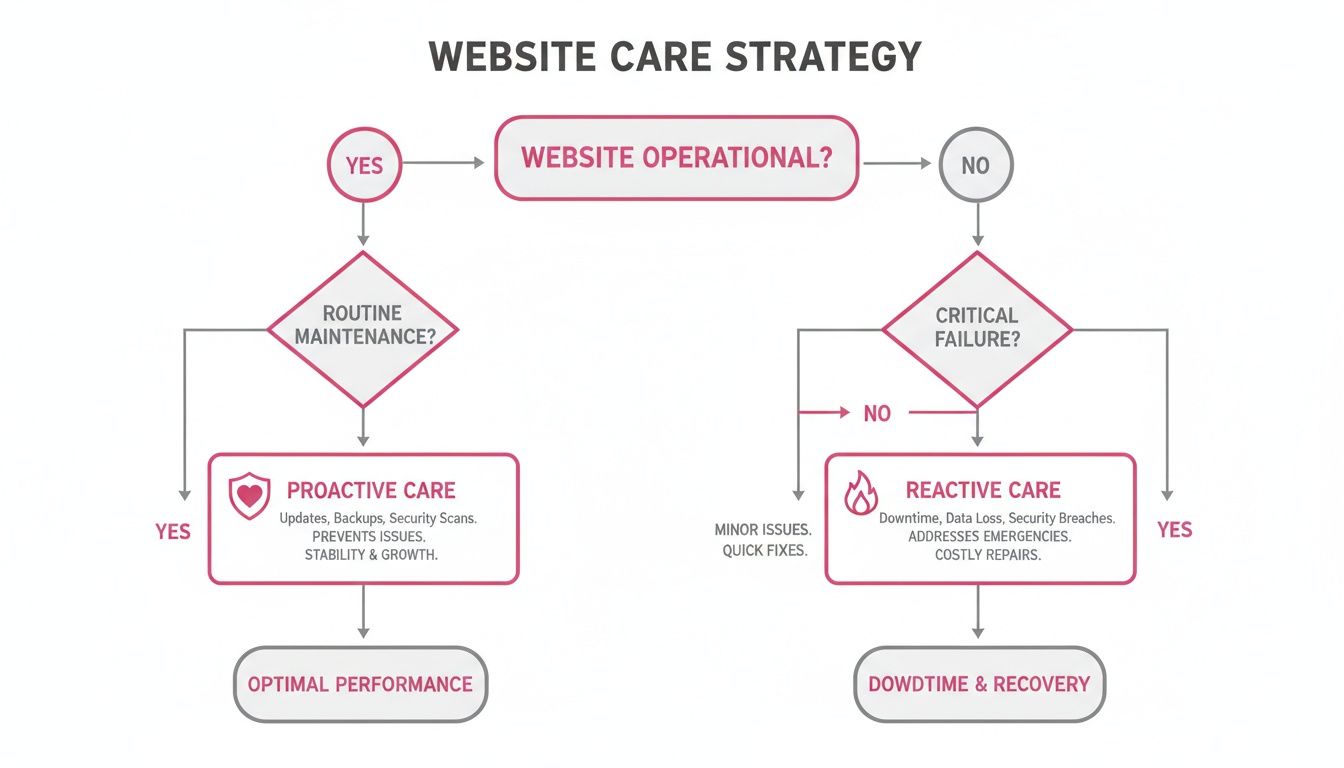
As you can see, proactive management is an investment in stability and continuous improvement. The alternative, a reactive stance, almost always leads to costly emergencies and disruptive downtime.
Assess Their Technical Expertise
First things first: do they have the right skills for your specific setup? A website isn't a one-size-fits-all product, so your provider must be fluent in the technology your site is built on.
Don't be afraid to ask direct questions. If your site runs on WordPress, you need to see a proven track record of managing and securing WordPress environments. If it's built on a more specialised platform like Craft CMS or Magento, they must be able to demonstrate deep, hands-on expertise with that exact system.
A vague, "we can do anything" answer should be a red flag. Look for a partner who can speak confidently about the common problems, performance tweaks, and security protocols relevant to your site's tech stack.
Scrutinise the Service Level Agreement
The Service Level Agreement (SLA) is the contract that spells out the standard of service you're paying for. It’s absolutely vital to read this document carefully and understand what the promises mean in the real world.
An SLA is more than just a document; it's the foundation of your partnership. It translates technical jargon into concrete commitments about response times, issue resolution, and system availability, giving you a clear benchmark for performance.
Many providers will promise "99.9% uptime," which sounds fantastic. But do the maths. Over a year, 99.9% uptime still allows for nearly nine hours of downtime. Can your business afford that? A higher guarantee of 99.99% cuts that potential downtime to under an hour per year.
Also, be sure to clarify the difference between response time and resolution time. A fast reply is nice, but a fast fix is what really counts. What are their guaranteed times for resolving a critical, site-down emergency versus a minor cosmetic issue?
Decision Framework Comparing Managed Service Tiers
For SMEs, it can be tough to know what level of service you actually need. Most providers offer tiered packages, and understanding the differences is key to not overpaying or, worse, being under-protected. The table below gives a typical breakdown of what you might find at different price points.
| Feature/Service | Basic Tier (Example) | Business Tier (Example) | Enterprise Tier (Example) |
|---|---|---|---|
| Hosting & Infrastructure | Shared Hosting | Managed Cloud/VPS | Dedicated or Clustered Servers |
| Software Updates | Monthly (Automated) | Weekly (Manual & Tested) | Daily/On-Demand (Staging & Production) |
| Security Monitoring | Basic Scans | Advanced Firewall & Malware Scanning | Proactive Threat Hunting & Audits |
| Backups | Daily, 30-day retention | Daily, 90-day retention, off-site | Hourly/Real-time, geo-redundant |
| Performance Optimisation | Basic Caching | CDN, Image Optimisation | Advanced Caching, Database Tuning |
| Support Response Time | 24-48 Business Hours | < 4 Business Hours | < 1 Hour (24/7) |
| Reporting | Monthly Automated Report | Monthly Detailed Report + Call | Custom Dashboards & Strategy Reviews |
This framework should help you align your budget with your business's dependence on its website. A simple brochure site might be fine on a basic plan, but an e-commerce platform generating daily revenue needs the resilience and rapid response of a higher-tier service.
Evaluate Communication and Reporting
A brilliant technical team is only half the story. The best partners are also excellent communicators who keep you in the loop without drowning you in technical jargon. Pay close attention to how they talk to you during your initial enquiries. Are they clear, transparent, and happy to answer your questions in plain English?
Regular, easy-to-digest reporting is a hallmark of a professional service. You should expect, at a minimum, monthly reports that summarise key activities like:
- Security Scans: Details of any threats found and neutralised.
- Updates Applied: A log of all plugin, theme, and core software patches.
- Performance Metrics: Hard data on your website's speed and uptime.
- Backup Status: Confirmation that your backups ran successfully.
This transparency doesn't just build trust; it gives you a clear view of the value you're getting. It proves they are proactively caring for your site, not just waiting for something to go wrong.
Check for UK-Based Support and Credentials
For any UK business, having a support team that operates in your time zone and understands the local market is a huge plus. A UK-based team means faster, more relevant support during your actual business hours—no more late-night calls or struggling with offshore call centres.
Finally, check their credentials. Certifications like Cyber Essentials or ISO 27001 aren't just badges; they demonstrate a serious, audited commitment to security best practices. It shows they not only protect your website but also have their own house in order, giving you confidence that your data is in safe hands.
How Managed Services Solve Real-World Business Problems

It’s one thing to talk about the benefits of proactive website support in theory, but the real value hits home when you see it solve a genuine crisis. For professional services firms all over the UK, a website isn't just a brochure; it's a core engine for growth, client communication, and building a solid reputation. When that engine starts to fail, the knock-on effect on the business can be immediate and painful.
This is precisely where a dedicated managed services partner steps in, turning abstract promises into tangible, positive outcomes. By taking on all the technical heavy lifting behind the scenes, they give you the freedom to focus on what you do best—serving your clients. You can get on with your day, confident that your digital front door is always open, secure, and running smoothly.
To bring this to life, let's look at three common scenarios where website managed services delivered a direct and measurable return for UK-based professional firms.
The Financial Advisory Firm
The Problem: A Dorset-based financial advisory firm was seeing its website slow to a crawl. Pages were taking over four seconds to load, a lifetime in online terms. They knew this delay was costing them, as potential clients were giving up and leaving the site before even getting a chance to see what the firm offered. It was a classic case of poor performance directly hitting lead generation.
The Solution: The firm brought in a managed service provider who got straight to work with a full performance audit. The team quickly pinpointed the culprits: huge, unoptimised images, bloated code, and no server-side caching to speed things up. They rolled out a clear plan, compressing images, tidying up the code, and setting up a Content Delivery Network (CDN) to serve the site's content from fast, local UK data centres.
The Result: The difference was immediate. Within a week, the website's average load time plummeted to under 1.5 seconds. This had a direct impact on business, leading to a 20% drop in their bounce rate and, crucially, a 15% lift in qualified client enquiries through their contact form over the next quarter. The investment quickly paid for itself through new client wins.
A fast, responsive website isn’t just a nice-to-have; it's a fundamental part of building trust and turning a casual visitor into a valued client. Proactive performance tuning is a direct investment in your business development.
The Architectural Practice
The Problem: An architectural practice in Somerset depended on its slick online portfolio to showcase its award-winning projects. Disaster struck when a staff member tried to install a new gallery plugin. A software conflict triggered a catastrophic failure, corrupting vital database tables and knocking the entire portfolio offline. With no recent, accessible backup, they were facing the terrifying prospect of rebuilding years of work.
The Solution: They called in their new managed services partner to handle the emergency. The provider’s automated, off-site backup system had, without anyone needing to think about it, been taking a full snapshot of the website every single night. They were able to instantly locate and pull a clean backup from the day before the faulty plugin was ever installed.
The Result: The entire website, including every last project in the portfolio, was fully restored and back online within two hours. What could have been a business-ending disaster—costing weeks of painstaking work and countless lost opportunities—was downgraded to a minor hiccup. It was a powerful, real-world lesson in the value of having a rock-solid, automated backup and recovery plan.
The Legal Consultancy
The Problem: A legal consultancy in Wiltshire handles incredibly sensitive client information, so security is paramount. One morning, their managed service provider's monitoring system flagged a coordinated brute-force attack trying to smash its way into the website’s admin area. The system was being hammered with thousands of password combinations from multiple global locations.
The Solution: The provider’s proactive security protocols kicked in instantly. The firewall automatically identified and blocked the malicious IP addresses, while the security team was alerted to the sustained attack. As an immediate hardening measure, they enforced two-factor authentication for all administrative users, adding another layer of defence.
The Result: The attack was completely neutralised with zero impact on the live website and, most importantly, no breach of client data. The consultancy's reputation for confidentiality was kept intact, and they dodged a bullet that could have led to huge regulatory fines and a total loss of client trust. It was a textbook example of how proactive monitoring stops a crisis before it even starts.
Answering Your Questions About Managed Services
Even when you see the benefits laid out, deciding to invest in website managed services is a significant step. For most business owners, it’s a shift in mindset—moving from treating your website as a one-off project to viewing it as an ongoing, vital part of your operations. Getting your head around the practicalities is the key to making a confident choice.
To help you find that clarity, we've pulled together answers to the three questions we hear most often from businesses across Dorset, Somerset, and beyond. These are the real-world concerns about cost, value, and what it’s actually like to make the switch.
Is a Managed Service Worth the Cost for a Small Business?
This is almost always the first question, and for good reason. It’s easy to look at a managed service as just another monthly line on the expense sheet. But that view misses the bigger picture: the return on your investment. The real value becomes crystal clear when you weigh the predictable monthly fee against the unpredictable, and often enormous, costs of not having that support.
Just think about the price of a single major incident. An emergency call-out to a developer to fix a crashed website can quickly run into hundreds, if not thousands, of pounds. Even worse is the hidden cost—every hour your site is offline, you're losing potential clients and chipping away at the trust you've built.
Let's break it down with a couple of practical scenarios for professional services:
- A financial advisor's website goes down for a day. They miss out on three solid leads, each with an average client lifetime value of £5,000. That's a £15,000 potential loss from a single outage.
- An e-commerce shop is breached due to an overlooked software patch. The costs of a forensic investigation, client notifications, and the damage to their reputation can be catastrophic. Verizon's research shows that a staggering 60% of small businesses close their doors within six months of a major data breach.
- Your team wastes hours trying to fix a "minor" glitch. Your time has a real monetary value. If your marketing manager spends a whole day wrestling with a website problem, that's a day they're not spending on activities that actually bring in new business.
When you look at it this way, the monthly fee for a managed service isn't really a cost—it's an insurance policy. It protects you from financial and reputational disaster, ensuring your website remains a high-performing asset, not a constant source of stress.
What Is the Difference Between Web Hosting and Managed Services?
This is a really common point of confusion, but the distinction is crucial. Think of it like renting a garage space versus hiring a full-service chauffeur and mechanic team.
Web hosting is the garage space. It’s the physical server where your website’s files live, making them available to the world. A basic hosting plan gives you the plot of land and connects the utilities, but you're responsible for everything else. You have to install the security system, handle all the maintenance, and fix things when they inevitably break.
Website managed services are your dedicated chauffeur and mechanic team. It’s a complete support system wrapped around your website, where hosting is just one small part of the package. It covers everything else:
- Security: Actively scanning for threats and applying security patches before hackers can exploit them.
- Maintenance: Keeping every piece of software—plugins, themes, the core platform—up to date.
- Performance: Constantly fine-tuning your site to make sure it's fast and reliable for every visitor.
- Backups: Creating a reliable safety net, so you can recover quickly from any disaster.
- Expert Support: Giving you a dedicated, professional team to call on for help and advice whenever you need it.
In short, hosting just gives your website a place to exist. Managed services make sure it thrives there, keeping it safe, fast, and always working for your business.
What Does the Onboarding Process Look Like?
The thought of moving to a new provider can feel overwhelming, but any good managed services partner will have a well-oiled process to make the transition smooth and stress-free. The entire goal is to get you up and running with virtually zero disruption to your business.
While the specifics might vary slightly, a professional onboarding process typically follows these clear steps:
- Initial Site Audit: First, the technical team will take a deep dive into your current website. They’ll run a full health check, looking at security, performance bottlenecks, and the versions of all your software. This gives them a complete blueprint to work from.
- Seamless Migration: Next, they handle the entire migration. This involves carefully taking a full copy of your website and moving it over to their own secure, high-performance hosting environment. This is almost always done behind the scenes, so your live site experiences zero downtime.
- Setup and Configuration: Once your site is safely in its new home, the team gets to work configuring all their management tools. This is where they set up the automated backups, activate the 24/7 security monitoring, implement performance-boosting technology, and connect your site to their update system.
- Establishing Communication: Finally, they'll make sure you know exactly how everything works. You’ll be introduced to your main point of contact, shown how to request support, and they’ll confirm when you’ll receive your regular reports. You'll know exactly who to call when you need them.
This structured approach takes the mystery out of the transition, giving you confidence from day one that your website is in safe hands.
At SES Computers, we know your website is more than just a website—it’s a critical business asset. For over 30 years, we've been providing proactive managed IT and web services to businesses across Dorset and the South West, making sure their technology drives growth, not headaches. If you’re ready for the peace of mind that comes with having an expert team in your corner, let’s have a chat about how we can help.
Explore our managed IT and cloud services by visiting us at https://www.sescomputers.com.