A cyber security package bundles multiple layers of digital protection into one managed solution. It’s a complete shift in mindset—moving your business from a reactive, 'fix-it-when-it-breaks' approach to a proactive strategy that stops threats before they can cause real damage.
What Are Cyber Security Packages Exactly?
Think of a cyber security package less like a single product and more like your business's dedicated digital security detail. It is an organised, multi-layered defence system built to protect your data, devices, and reputation from a relentless barrage of online threats like ransomware, phishing, and data breaches.
For a professional services firm, this might involve a package that protects sensitive client data from unauthorised access, while for a logistics company, it might focus on securing the systems that manage vehicle fleets and delivery schedules. The package is tailored to the specific risks of the business.
From Individual Tools to an Integrated Strategy
Many small businesses start out by buying individual security tools. Perhaps it is an antivirus program for one PC or a separate cloud backup service for another. While these are sensible first steps, they create a fragmented and chaotic defence that is difficult to manage. Each tool works in its own little silo, unable to share threat intelligence or respond as a unified force against a coordinated attack.
A cyber security package centralises your defences under a single, expert-managed service. This ensures consistent protection across your entire organisation, from employee laptops to company servers, leaving no device or user unprotected.
This shift from disjointed tools to a unified strategy is becoming absolutely critical for UK businesses. The UK cyber security sector has seen incredible growth, generating £13.2 billion in revenue—a 12% increase on the previous year. This boom reflects just how seriously businesses are now taking the protection of their digital assets. As you can read in the full analysis on the UK government's website, this trend means mature, effective security solutions are finally accessible for small and medium-sized enterprises.
Why a Proactive Defence Matters for Your Business
One of the biggest advantages of a managed cyber security package is the move away from reactive fire-fighting. Instead of waiting for a virus to infect a machine or a server to go down, a managed package actively monitors your systems 24/7, looking for trouble.
This proactive stance is built on several core activities:
- Constant Monitoring: Security experts keep a close watch on your network for any unusual activity that could be the first sign of an attack. For example, they might spot an employee's account trying to access files at 3 AM from an unrecognised location, and immediately lock the account.
- Vulnerability Management: Your systems are scanned regularly for weaknesses, and crucial security patches are applied before criminals get a chance to exploit them. A practical example would be patching a known flaw in your accounting software before a hacker can use it to access financial records.
- Threat Hunting: Professionals actively search for hidden threats inside your network that might have slipped past the initial perimeter defences.
For professional service firms across Dorset, Somerset, Wiltshire, and Hampshire, this means having a bespoke defence managed by a local expert who gets it. It offers genuine peace of mind, knowing your unique operational risks and client data obligations are understood and protected by a team that is just down the road.
The Essential Layers of a Security Package

A proper cyber security package is so much more than just sticking some antivirus software on a computer and hoping for the best. It is a multi-layered defence strategy, where every component has a specific job to do, all working together to create a seriously tough barrier against threats.
Think of it like securing a professional building. You would not just rely on a single lock on the front door. You would have a reception desk, keycard access for different floors, CCTV, and a night security patrol—all working in unison. In the digital world, each service provides a similar, specialised form of protection for your business.
Let's break down the core services that really form the foundation of a robust security posture.
Core Services in a Cyber Security Package
Understanding what each component does and why it is there is key. The table below outlines the essential services and the real-world business risks they help to neutralise.
| Service Component | Primary Function | Example Business Threat Prevented |
|---|---|---|
| 24/7 Monitoring | Constant surveillance of your network and systems for signs of malicious activity. | An attacker trying to breach your server outside of business hours is detected and blocked. |
| Endpoint Detection & Response (EDR) | Actively monitors devices (laptops, PCs) for suspicious behaviour and can isolate them to stop threats from spreading. | A ransomware file opened by an employee is contained to their machine before it can encrypt the entire network. |
| Automated Cloud Backup & Recovery | Regularly creates secure, off-site copies of your critical business data for rapid restoration. | A fire destroys your office servers, but you restore all your data from the cloud and are operational within hours. |
| Vulnerability Management & Patching | Systematically finds and fixes software weaknesses (vulnerabilities) before criminals can exploit them. | A known security flaw in your accounting software is patched, preventing hackers from using it to steal financial data. |
| Multi-Factor Authentication (MFA) | Requires a second form of verification (like a phone code) in addition to a password to access accounts. | A criminal steals an employee's password but cannot access their email because they do not have the employee's phone. |
| Security Policy & Training | Establishes clear security rules for staff and educates them on how to spot and avoid threats like phishing. | An employee recognises a fraudulent email asking for a password reset and reports it instead of clicking the malicious link. |
Each of these layers plays a vital role in building a defence that is resilient, responsive, and ready for modern threats. Now, let’s look a bit closer at a few of these key components.
24/7 Security Monitoring
Your business might close at 5 PM, but cyber threats never sleep. 24/7 Security Monitoring is your round-the-clock watchtower, with a crew keeping an eye on every corner of your digital estate. This is often handled by a specialist team in a Security Operations Centre (SOC).
These experts use advanced tools to analyse streams of data from your firewall, servers, and devices. They are looking for anomalies that could signal an attack in progress—like unusual data transfers to a foreign country at 3 AM. This constant vigilance means threats get spotted and shut down immediately, no matter when they pop up.
Effective cyber security isn’t a one-off setup; it is a continuous process of monitoring, detection, and response. Without round-the-clock oversight, even the best defences can be silently bypassed by a patient attacker.
Endpoint Detection and Response (EDR)
Traditional antivirus is a bit like a simple alarm on a door; it only goes off if it recognises a known threat. Endpoint Detection and Response (EDR), on the other hand, is the intelligent security guard patrolling the grounds of every company computer, laptop, and server—your 'endpoints'.
EDR does not just look for known troublemakers; it actively monitors for any suspicious behaviour. For example, if a team member’s email account is compromised and a malicious script tries to run quietly in the background, EDR will spot this abnormal activity. It can then instantly isolate that device from the network to stop the threat from spreading, just as a guard would lock down a compromised area.
Automated Cloud Backup and Recovery
Even with the best defences, the unthinkable can happen. A severe ransomware attack could encrypt all your files, or a flood could destroy your on-site servers. Automated cloud backups act as your digital, fireproof safe, securely storing copies of your critical data well away from your office.
Imagine your entire server is immobilised by ransomware. With a managed backup solution, you can quickly restore your systems and data to a point just before the attack happened. This capability turns a potentially business-ending catastrophe into a manageable disruption.
Vulnerability Management and Patching
Software vulnerabilities are like unlocked windows or weak spots in your office walls. Hackers actively scan for these weaknesses to get in. Vulnerability management is the process of regularly inspecting your systems for these flaws, while patching is the act of fixing them.
Your security partner will systematically scan your software for known vulnerabilities. When a security patch is released by a vendor like Microsoft or Adobe, it is tested and promptly applied across all your devices. This proactive maintenance closes security gaps before they can be exploited—a core principle detailed in our guide on what Zero Trust security is.
Multi-Factor Authentication (MFA)
Stolen passwords are still one of the most common ways criminals get into sensitive accounts. Multi-Factor Authentication (MFA) adds a crucial second layer of security, acting like a mandatory two-person key system for important data.
Even if a criminal has an employee's password, they still cannot log in without that second factor—usually a code from a mobile app. Implementing MFA across key applications like your email and accounting software is one of the single most effective steps you can take to block unauthorised access.
Together, these layers form a cohesive and resilient defence. By combining proactive monitoring, intelligent threat response, secure backups, and robust access controls, a cyber security package provides the comprehensive protection that individual tools simply cannot match.
How to Choose the Right Security Partner
Picking a provider for your cyber security is not like choosing a new stationery supplier. You are handing over the keys to your digital kingdom, trusting them to protect the very heart of your business. A good partner becomes a genuine extension of your team; a poor one can leave you in a worse state than when you started.
So, how do you see past the sales pitch? It comes down to a structured approach—asking the right questions to get a real sense of their technical skills, their reliability, and whether they actually understand what your business needs. This is not just about ticking boxes; it is about finding a partner who gives you genuine peace of mind.
First Things First: Check Their Credentials
Before you even start talking about packages, you need to know if a potential partner has the expertise to back up their claims. Anyone can call themselves a security expert, but accreditations are independent proof that they know what they’re doing.
Start by looking for recognised certifications. These are not just fancy badges; they represent a commitment to high standards.
- Cyber Essentials Plus: This is non-negotiable for any UK business. It is a government-backed scheme that proves a provider has the fundamental security controls in place and, crucially, that they have been independently tested.
- ISO 27001: This is the international gold standard for managing information security. Achieving it shows a deep commitment to creating and maintaining robust, systematic security processes.
- Vendor-Specific Certifications: Are they qualified with the tools they will be using? Look for accreditations from major names like Microsoft or Cisco. It proves they have hands-on proficiency.
Do not just take their word for it. Ask to see the certificates and check they are up to date. Any provider worth their salt will be proud to share them. This simple step helps you weed out the pretenders right from the start.
Dig Into the Service Levels and Support
When a security incident happens—and it is a matter of when, not if—the speed and quality of the response is everything. This is where the Service Level Agreement (SLA) comes into play. Think of the SLA as a formal contract that sets out exactly what you can expect.
An SLA is your safety net. It should clearly define response times, how you will communicate during a crisis, and what happens if the provider does not meet their promises. A vague or non-existent SLA is a massive red flag.
When you are looking at an SLA, get specific with your questions:
- What are your guaranteed response times? How quickly will someone actually start working on a critical issue versus a minor one? For a law firm, a server outage could be a critical incident requiring a 15-minute response.
- What are your standard support hours? Do they offer 24/7 cover for real emergencies, or are you on your own after 5 PM?
- How do you handle out-of-hours emergencies? Who is on call, and what’s the plan for dealing with a major incident at 2 AM on a Sunday?
A strong partner will have clear, measurable answers. You will know exactly what to expect when you need them most.
The Value of Local Knowledge and Industry Insight
Technical skill is essential, but it is only half the story. A partner who is physically based in your region—whether that is Dorset, Somerset, Wiltshire, or Hampshire—brings a lot more to the table. They understand the local business climate and can get on-site to help you far faster than a remote national call centre ever could.
Just as important is their experience in your industry. The security threats and compliance headaches for an accountancy firm are a world away from those of a manufacturing business. A partner who already knows your sector will be familiar with your specific risks and legal duties from day one.
A Practical Example: A Somerset Accountancy Firm's Dilemma
Picture a small accountancy firm in Somerset. They are sitting on a mountain of sensitive client financial data, and they have to comply with both GDPR and strict financial regulations. When they looked for a cyber security package, they knew price was not the most important factor.
They talked to three potential providers. One offered a cheap, off-the-shelf package but had zero experience with accountants. The second was a huge national firm with impressive credentials, but their support felt slow and impersonal.
The third, a local IT partner like SES Computers, immediately understood their world. They talked about the specific risks of invoice fraud, the need to protect client data in accountancy software, and how to build a backup plan that met regulatory rules. They designed a package tailored to those exact needs. The firm chose the local partner, confident they had found someone who truly "got it." This just goes to show why a one-size-fits-all approach to security never works.
Comparing Cyber Security Package Tiers
It is a simple truth: not all businesses face the same level of risk. A local retailer has completely different security needs from a multi-site accountancy firm that handles vast amounts of sensitive client data. Because of this, cyber security packages should not be a one-size-fits-all solution.
Choosing the right package is all about getting genuine value and avoiding paying for things you do not need. Think of it like a business insurance policy. You select a level of cover that accurately matches your assets, risks, and the complexity of your operations. The very same logic applies to protecting your digital world.
When you are looking for a provider, it is not just about the services they offer. You need to be sure they have the right credentials and can back up their promises with solid, responsive support.
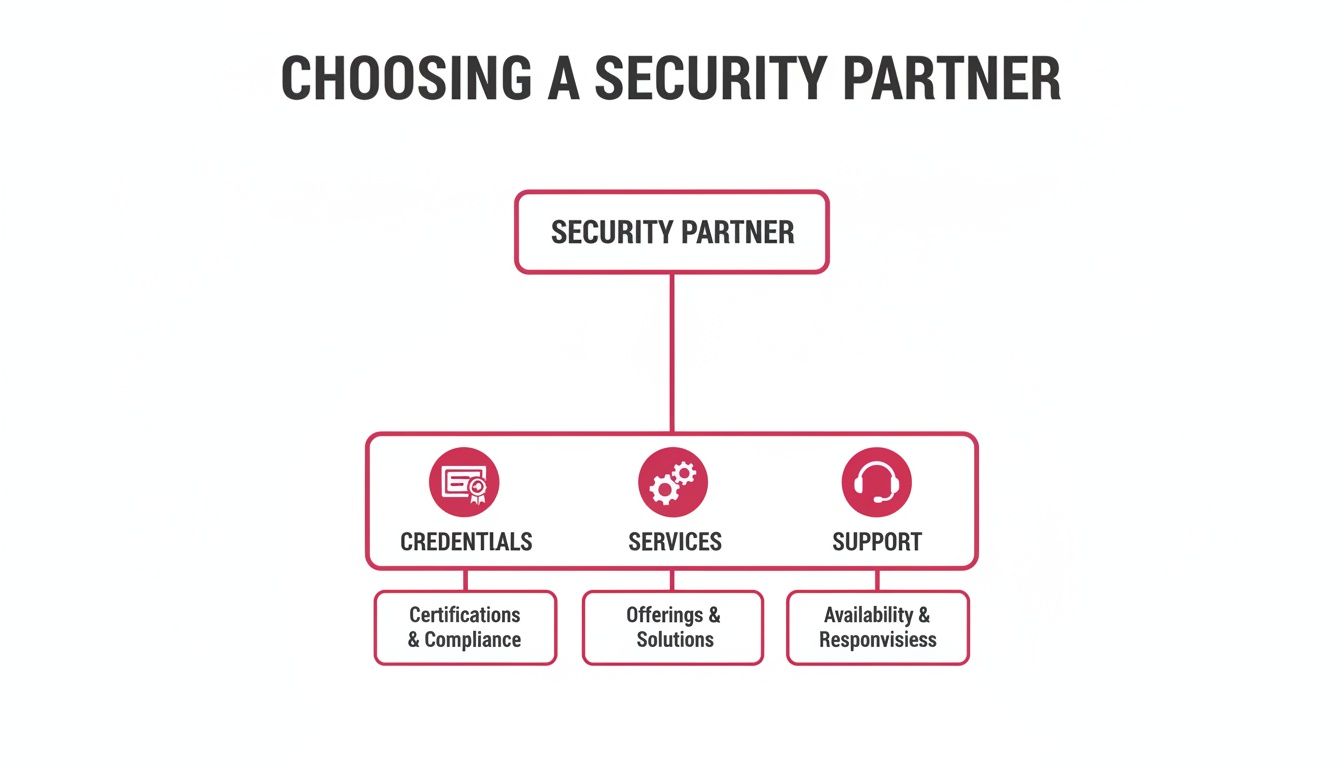
As the image shows, quality services and support are built on a foundation of verifiable expertise. This ensures you are partnering with someone who is both capable and trustworthy. Let’s break down what this looks like in practice across a few typical package tiers.
To illustrate how these packages are structured for different UK businesses, here’s a quick comparison table showing how the features scale up.
Sample Cyber Security Package Tiers
| Feature | Essential Package (e.g., Small Retailer) | Advanced Package (e.g., Care Provider) | Comprehensive Package (e.g., Accountancy Firm) |
|---|---|---|---|
| Endpoint Protection | Managed Antivirus & Firewall | Managed Antivirus & Firewall | Managed Antivirus & Firewall |
| Data Backup | Secure Cloud Backup | Secure Cloud Backup | Enhanced Secure Cloud Backup |
| Patch Management | OS & Office 365 Updates | OS & Critical App Updates | Comprehensive OS & App Patching |
| Endpoint Detection | ❌ | Endpoint Detection & Response (EDR) | Endpoint Detection & Response (EDR) |
| Human Security | ❌ | Phishing Awareness Training | Advanced Phishing Training & Reporting |
| Access Control | ❌ | Multi-Factor Authentication (MFA) | Managed MFA & Access Policies |
| Threat Monitoring | ❌ | ❌ | 24/7 Security Operations Centre (SOC) |
| Compliance Support | ❌ | ❌ | Dedicated Compliance Management |
| Proactive Defence | ❌ | ❌ | Advanced Threat Hunting |
Each tier builds upon the last, adding layers of protection that correspond to increased risk, data sensitivity, and regulatory demands. Now let's dive into what each level actually entails.
The Essential Package
This foundational tier is the perfect starting point for smaller businesses – think of a local tradesperson or a boutique shop with fewer than 10 employees. The main goal here is straightforward: establish a strong defensive wall and make sure the business can keep running if it gets hit by one of the more common threats.
An Essential package covers the absolute non-negotiables of modern security. It is the digital equivalent of fitting strong locks, installing a monitored alarm, and keeping your valuables in a fireproof safe.
Here’s what it typically includes:
- Managed Antivirus and Firewall: We ensure every single device is protected with the latest threat definitions and has a properly configured firewall to block unwanted traffic.
- Secure Cloud Backup: Your critical business data is automatically backed up, encrypted, and stored safely off-site. This means you can recover quickly from a hardware failure or even a ransomware attack.
- Proactive Patch Management: We keep all your essential software, like Windows and Microsoft 365, updated with the latest security patches, closing the door on known vulnerabilities before attackers can exploit them.
This tier is ideal for businesses whose day-to-day work is not heavily reliant on complex IT, but who still need to protect customer information and get back on their feet quickly after a problem.
The Advanced Package
As a business grows, its digital footprint expands, and the data it holds becomes more valuable. This is where the Advanced tier comes in. It is designed for businesses like a mid-sized professional services firm, a care provider, or any company with 10-50 employees handling more sensitive information.
This package takes the foundations of the Essential tier and adds proactive threat detection while also tackling the human side of security.
At this level, protection moves beyond just blocking known threats. It starts to actively hunt for suspicious, unknown activities inside your network. It also recognises that your employees are your first, and most important, line of defence.
Services in an Advanced package often add:
- Endpoint Detection and Response (EDR): Think of this as an intelligent security guard on every device. It actively looks for unusual behaviour. If someone accidentally clicks a malicious link, EDR can isolate that computer before the infection spreads.
- Phishing Awareness Training: We provide your staff with regular, simulated phishing emails and training modules. This is a practical way to teach them how to spot and report fraud, drastically reducing the chance of a breach caused by a simple mistake.
- Multi-Factor Authentication (MFA) Management: We will help you implement and manage MFA across your key applications. This makes it significantly harder for criminals to get in, even if they manage to steal a password.
This tier is a great fit for businesses that hold sensitive client or patient data, have a larger team, and need to show clients and regulators that they are taking security seriously.
The Comprehensive Package
The Comprehensive tier is built for larger SMEs, such as accountancy or legal practices, and any organisation with strict regulatory obligations like GDPR or other industry-specific rules. At this level, the focus shifts to 24/7 vigilance and having a provable, defensible security posture.
This package offers the highest level of protection by integrating constant surveillance with dedicated compliance support.
You can expect to find services like these:
- 24/7 Security Operations Centre (SOC): A dedicated team of expert security analysts monitors your network around the clock. They investigate alerts in real-time, actively hunt for hidden threats, and respond to incidents the second they happen.
- Dedicated Compliance Management: You get expert help in meeting specific regulatory requirements. This could involve generating compliance reports, managing data access policies, and making sure your security measures are perfectly aligned with legal standards.
- Advanced Threat Hunting: This is a proactive step where our team actively searches your systems for signs of sophisticated attackers who might have slipped past traditional defences. We find them and stop them before they can do any damage.
Choosing this package is a strategic decision for any business where data integrity and uptime are absolutely critical. It is for organisations where the cost of a breach would be catastrophic – not just financially, but to their hard-earned reputation.
Sorting Out the Costs and Ticking the Compliance Boxes
Deciding to bring in a professional cyber security package is a big step, and it is right to be thinking about the numbers and the rules that go with it. Too often, businesses see security as just another cost draining the budget, but that is a narrow view. The right approach turns security from a potentially massive, unplanned expense into a predictable, manageable part of your monthly operations.
Most security packages work on a simple per-user, per-month fee. This model keeps things clear and lets your security spend scale sensibly as your team grows. Instead of getting hit with a colossal, unexpected bill to clean up after a cyber attack, you have a fixed monthly investment that stops the attack from happening in the first place.
Think about it this way: the average cost of a cyber attack on a small business can easily run into tens of thousands of pounds. When you weigh that against a predictable monthly fee for professional protection, the choice becomes obvious. It is the difference between paying for a solid security fence or paying to rebuild everything after a break-in.
Getting to Grips with Pricing Models
To really understand the financial side, it is worth looking at the specific pricing structures and different tiers that security providers offer. These are usually designed to match the cost of protection to the size of your business and how complex your needs are. This means you are not paying for services you do not actually need.
A predictable pricing model makes budgeting a whole lot easier. It also means that when you bring a new person on board, their security is sorted from day one, keeping your entire team protected without any admin headaches or surprise cost increases.
How Your Security Spend Helps with Compliance
If your business handles any kind of client data – and that is especially true for solicitors, accountants, and care providers – strong security is not just a good idea; it is a legal necessity. A proper cyber security package is fundamental to meeting your obligations under regulations like the General Data Protection Regulation (GDPR).
Getting this wrong and failing to protect personal data can lead to hefty fines from the Information Commissioner's Office (ICO), not to mention the damage to your reputation. A managed security package gives you the technical safeguards and documented procedures to show you are taking your responsibilities seriously. This covers crucial areas like:
- Managed Data Encryption: Making sure all sensitive client information is unreadable to anyone who should not see it, whether it is stored on a server or sent in an email.
- Strict Access Controls: Putting policies in place, often backed by Multi-Factor Authentication (MFA), to ensure only the right people can access specific data.
- Auditable Security Logs: Keeping detailed records of security events, which are essential for investigating any issues and reporting them to the authorities if needed.
Suddenly, your investment in security stops being a cost and starts becoming a real competitive advantage.
A Practical Example of Compliance
Let's imagine a law firm right here in Wiltshire. Every day, they are dealing with incredibly sensitive client information, from property deals to private family matters. Under GDPR, they have a clear legal duty to keep that data safe.
By signing up for an advanced cyber security package, the firm gets managed data encryption on every laptop and server. On top of that, managed access controls mean only the assigned solicitor can open the files for a particular case. If a laptop is ever lost or stolen, the data on it is completely locked down and unreadable, preventing a major data breach.
Now, when clients or regulators ask about their security, the firm can point to clear documentation of everything they do, from 24/7 monitoring to ongoing staff training. This does not just satisfy their legal duties; it builds a huge amount of trust with their clients. Their investment in a cyber security package becomes a hallmark of their professionalism. To take it a step further, many firms also get certified, and you can find out more about the Cyber Essentials certification cost in our guide.
Time to Be Proactive About Your Business Security
As we have explored, thinking about cyber security as a simple IT cost misses the point entirely. It is a core investment in keeping your business running and protecting the reputation you have worked so hard to build. The best security is not a one-size-fits-all product; it is a solution carefully built around your unique risks and responsibilities.
For businesses here in Dorset, Somerset, Wiltshire, and Hampshire, working with a local specialist makes a real difference. You get responsive support from a team that genuinely understands the local landscape and can be there, on the ground, when it matters most.
Robust, professional-grade security isn’t some out-of-reach luxury reserved for massive corporations. It’s an accessible and absolutely essential part of staying resilient for businesses of every size.
The real power of a proper security package is that it stops problems before they start, preventing the financial and reputational damage that a breach can cause. It is not just about active threat defence, either. Good practice, like implementing a solid IT Asset Lifecycle Management plan, ensures every device is secure from the day you buy it to the day you retire it, which perfectly complements your active security measures.
Your Next Step Towards Real Security
Let's be clear: your people are your first line of defence. Giving them the right knowledge is one of the most powerful moves you can make. Good security awareness training turns your staff from potential targets into your greatest security asset. It is a vital piece of the puzzle. You can find out more about the benefits of structured IT security awareness training for your own team.
Ultimately, strengthening your business's security begins with a single step: understanding where you stand right now.
Get in touch with SES Computers today for a no-obligation chat. We will help you take a proper look at your current security setup and explore a cyber security package that fits your needs and your budget, giving you the peace of mind to focus on your business.
Frequently Asked Questions
When it comes to professional cyber security, many business owners find themselves asking the same questions. We have gathered the most common queries right here to give you straightforward, practical answers and help you decide on the best way forward for your business.
How Much Should a Small Business Budget for Security?
There isn’t a single magic number here. The right budget really depends on your specific situation—things like the kind of data you handle, your industry, and how many people are in your team. The most helpful shift in mindset is to stop viewing security as just another business cost and start seeing it as a crucial investment in keeping your doors open.
Think of it this way: you can either have a predictable, manageable monthly fee for a professional security package or face the completely unpredictable—and potentially devastating—cost of a data breach. When a single attack can cost a small UK business thousands in lost revenue, fines, and a damaged reputation, a proactive security budget just makes good business sense. Most providers offer tiered cyber security packages, so you can start with what you need and scale up as you grow.
Is Our Business Too Small to Be a Target?
This is easily one of the most common—and dangerous—misconceptions out there. The hard truth is that cyber criminals actively hunt for small and medium-sized businesses (SMEs). Why? Because they know SMEs often do not have the same level of defence as a large corporation, making them easier targets.
Do not just take our word for it. The statistics consistently show that a huge percentage of all cyber attacks are aimed directly at small businesses. Attackers use automated tools that constantly scan the internet for any weak spot they can find. Your size does not matter to them; your vulnerability does.
Thinking your business is "too small to matter" gives you a false sense of safety that leaves you wide open. If you have an internet connection, a bank account, or customer data, you are on their radar.
How Quickly Can a Security Package Be Implemented?
It’s a lot faster than you might think. While the exact timeline can vary a bit, any good provider will have a clear, structured plan to get you set up with as little disruption to your daily operations as possible.
The whole process usually follows a few key steps:
- Initial Security Audit: First, we will take a deep dive into your current IT setup. This helps us spot any existing weak points and understand how your business works.
- Solution Design: Using what we learned from the audit, we will map out a security plan that fits your business, detailing exactly what tools and services you need.
- Deployment & Configuration: This is the hands-on part where we install and set up core defences like Endpoint Detection and Response (EDR) and firewalls on your network and devices.
- Go-Live & Monitoring: As soon as everything is in place, the 24/7 monitoring kicks in. From that moment on, your business is being actively protected.
For most SMEs, we can get this entire process done—from the first chat to full protection—in just a matter of days or weeks, not months.
Ready to secure your business with a defence plan that truly understands your needs? Contact SES Computers for a no-obligation consultation and let's find the right cyber security package for you. Learn more at https://www.sescomputers.com.