Think of a hosted VoIP phone system as your business's entire telephone network, but instead of being housed in a clunky box in your server room, it lives in the cloud. It’s a complete, managed service delivered by a specialist provider, allowing you to make and receive calls over the internet rather than relying on old-fashioned copper phone lines.
This simple change means you no longer need expensive on-site hardware. All the maintenance, security, and updates are handled by your provider, leaving you with a communication system that's more flexible, easier to scale, and far more cost-effective.
Unlocking Modern Business Communication
Let's use an analogy. Your traditional office phone setup is a bit like owning and running your own server rack in the back office. It's a huge initial investment, needs constant attention from your IT team, and upgrading it as your business grows is a major headache.
A hosted VoIP system is the modern equivalent of swapping that server for a service like Microsoft 365. All the complex technology is managed securely off-site by experts and delivered straight to your team over your existing internet connection. This isn't just a minor upgrade; it's a fundamental shift that's changing how UK businesses communicate. It’s become a key tool for enabling effective remote work and delivering exceptional client service.
If you want to dig deeper into the nuts and bolts, you can explore our detailed guide on what VoIP technology is and how it all works.
The Shift from Hardware to Service
With a hosted solution, all the heavy lifting happens in the cloud. Your provider owns and manages the sophisticated Private Branch Exchange (PBX) equipment in their highly secure data centres. All your business needs to do is connect to this service using IP-enabled desk phones, software on your computers (softphones), or even an app on your mobile.
This service-first approach brings immediate benefits, especially for professional services firms across Dorset, Somerset, and Wiltshire:
- No Capital Expenditure: You completely sidestep the huge upfront cost of buying an on-premises PBX system. For example, a law firm avoids a £10,000 hardware purchase and instead invests that capital into business development.
- Predictable Costs: Budgeting becomes a breeze with a simple, fixed monthly subscription fee for each user. An estate agency can easily forecast its communication costs for the entire year, with no surprise bills.
- Expert Management: All the technical maintenance, software updates, and security are handled by the provider, freeing up your own team to focus on your business.
This move is becoming increasingly urgent as the UK heads towards the nationwide Public Switched Telephone Network (PSTN) switch-off. By 2027, all traditional copper phone lines will be permanently retired, making a move to an internet-based system like hosted VoIP a necessity for keeping the phones ringing.
What Are the Real-World Benefits for Your Business?
Moving to a hosted VoIP phone system brings about real, practical changes that go far beyond just having clearer calls. For small and medium-sized businesses, this technology unlocks immediate, measurable improvements in how you manage your money, adapt to change, and support your team. It's a strategic shift away from owning clunky, depreciating hardware towards subscribing to a service that gets better over time.
This isn't just a niche trend; it's rapidly becoming the standard for UK businesses. The UK hosted VoIP market is booming, expected to grow by a staggering £4.2 billion (USD 5.3 billion) by 2029. This growth isn't happening by accident—it’s driven by the undeniable value of cloud-based communications. You can dig into the numbers in the full VoIP market report.

Slash Your Costs
Let's be honest, one of the most compelling reasons to switch is the immediate, positive impact on your budget. Old-school, on-site Private Branch Exchange (PBX) systems demand a huge upfront investment in hardware. On top of that, you’re constantly hit with unpredictable costs for maintenance contracts, repairs, and specialist IT call-outs.
Hosted VoIP completely flips this model on its head. It gets rid of these heavy financial burdens, moving your costs from a large, one-off capital spend to a simple, manageable operational expense.
- No Big Hardware Bill: You dodge the five-figure cost of buying and installing a physical server box in your office.
- Predictable Monthly Bills: A straightforward per-user monthly fee makes budgeting for your comms incredibly simple and transparent. No more guesswork.
- Zero Maintenance Fees: All system updates, security patches, and hardware upkeep are handled by the provider and baked into your subscription. That means no more surprise repair bills.
Scale Up or Down in Minutes
Your business isn't static, so why should your phone system be? You might need to bring a new team on for a project, open a new office in a neighbouring town, or adjust your staffing for seasonal peaks. With a traditional system, scaling is a slow, costly, and disruptive headache that involves engineers and new kit.
A hosted system, on the other hand, is built for this kind of agility. It grows alongside your business in real-time, letting you adapt instantly to new opportunities or challenges.
Picture this: A growing law firm in Hampshire needs to get two new paralegals up and running to handle a surge in cases. With a hosted VoIP solution, their new phone extensions can be set up in minutes through a simple web portal. They can be making and receiving calls on their own direct lines the same day they start, with zero technical hold-ups.
This flexibility ensures you only ever pay for what you actually use. Adding a new user is as easy as adding a new licence to your plan, and removing one is just as simple. Your communications budget stays perfectly in sync with your team's size.
Empower a Truly Flexible Workforce
In today's world, the ability to work effectively from anywhere is non-negotiable. Hosted VoIP is the technology that makes this a reality, turning any device with an internet connection into a full-featured office phone. This is all thanks to softphone apps that run on laptops, tablets, and smartphones.
This capability keeps your team productive and professional, whether they're at their office desk, working from a home office, or meeting a client on-site.
- Always Look Professional: Your staff can make and receive calls using your main business number and their personal extension, no matter where they are.
- Access All Key Features: Softphone apps give them access to all the crucial office functions, like call transferring, voicemail, and conference calls, right from their device.
- A Seamless Client Experience: From your client's perspective, it’s business as usual. They get a consistent, professional service, completely unaware that the person they're speaking to might be miles away from the office.
What to Look For: Essential Features in a Modern VoIP System
When you're choosing a hosted VoIP system, it's easy to get bogged down in technical details. But the real value isn't just in the call quality; it's in the features that genuinely help your business run better. A good system is less like a simple phone and more like a central communications hub, designed to make your team more productive and your client interactions smoother.
Think of it as a toolkit for your professional services firm. These are the practical, everyday tools that ensure you never miss a new client enquiry, that your consultants can stay connected while on the road, and that your client service stays top-notch, no matter where your team is based.
Intelligent Call Routing and Auto Attendants
First impressions count, especially when a potential new client calls. You want the experience to be professional and effortless. That’s where intelligent call routing and auto attendants come in. They act as your digital receptionist, working 24/7 to get callers to the right person without anyone having to lift a finger.
Imagine a prospective client calling your accountancy firm in Dorset. Instead of a ringing phone, they’re greeted with a polished welcome message and simple options: press 1 for new enquiries, 2 for client support, or dial an extension. This simple setup means the caller gets to the right expert on their first try, which makes a world of difference for client satisfaction and helps you capture every opportunity.
Voicemail-to-Email for On-the-Go Productivity
Let’s be honest, nobody misses dialling into a clunky old voicemail system. A must-have feature for any modern VoIP setup is voicemail-to-email. It does exactly what it says on the tin: turns voice messages into audio files and sends them straight to your email inbox.
This is a genuine game-changer for busy professionals. A consultant visiting a client in Wiltshire can check an urgent message on their laptop between meetings, just like any other email. They can listen, forward the audio to a colleague for a second opinion, or save it for their records—all without ever touching a desk phone.
This simple function keeps your team responsive and makes sure important messages don't get lost in the shuffle. Many systems now even include a text transcription, so you can quickly scan a message if you’re in a meeting where you can't listen to the audio.
Seamless CRM and Software Integrations
One of the biggest advantages of a hosted VoIP platform is its ability to talk to the other software you already use every day. Linking your phone system to your Customer Relationship Management (CRM) software, like Salesforce or HubSpot, turns it from a simple communication tool into a source of valuable business intelligence.
When a client calls in, their entire history can pop up on the screen before you even say hello. This gives your team instant context, making for a much more personal and effective conversation.
- Better Client Service: Greet clients by name and have their account details at your fingertips. It’s a small touch that makes a huge impact.
- Automatic Call Logging: Every call in and out is automatically logged against the client's record in your CRM. No more manual data entry.
- Smarter Insights: By connecting call data to client records, you can start to see patterns in communication and get a much clearer picture of client engagement.
Full-Featured Mobile and Desktop Apps
True flexibility means your team can take their office phone with them, wherever they go. That’s what dedicated mobile and desktop apps—often called softphones—are for. They put the full power of your office phone system onto any laptop, smartphone, or tablet with an internet connection. Of course, this relies on having a router that can handle the traffic, which you can learn more about in our guide to the right Voice over IP router setup.
This means an employee working from their home in Hampshire can make a call from their laptop, and to the client, it looks like it's coming from your main office number. They can transfer calls, join a conference, and access the company directory, all while presenting a consistent, professional front for your business.
To help you get a clearer picture, we've put together a checklist of the most important features SMEs should look for in a hosted VoIP system. Think of this as a quick reference guide to compare providers and make sure you're getting the tools that will really benefit your day-to-day operations.
Hosted VoIP Feature Checklist for SMEs
| Feature | What It Does | Benefit for Your Business |
|---|---|---|
| Auto Attendant | Greets callers with a professional menu of options. | Ensures callers reach the right person quickly, improving first impressions. |
| Voicemail-to-Email | Sends voicemail audio files (and transcriptions) to your inbox. | Keeps your team responsive, even when they're away from their desks. |
| CRM Integration | Connects your phone system with your client database. | Provides instant caller context, personalises service, and automates call logging. |
| Mobile & Desktop Apps | Lets you make and receive office calls on any device. | Enables seamless remote and flexible working without sacrificing professionalism. |
| Call Recording | Records conversations for training, compliance, or quality purposes. | Helps with staff development, dispute resolution, and regulatory requirements. |
| Conference Calling | Allows multiple people to join a single call. | Simplifies team meetings and client discussions, regardless of location. |
| UK-Based Hosting | Stores all your call data on servers located in the UK. | Guarantees data sovereignty and compliance with UK privacy laws like GDPR. |
This checklist isn't exhaustive, but it covers the core functionality that delivers the most significant return for most small and medium-sized businesses. By prioritising these features, you can be confident you're investing in a system that will not only handle your calls but also actively support your business growth.
On-Premises vs SIP Trunking vs Hosted VoIP: Which Is Right for You?
Choosing the right phone system can feel like a big decision, and it helps to understand all your options. For most businesses in the UK, it boils down to three main choices: the traditional on-premises PBX, a hybrid approach with SIP Trunking, or a modern hosted VoIP system.
Each has its place, but they differ massively in terms of cost, flexibility, and the amount of hands-on management they require. Let’s unpack what each one really means for a business like yours.
The Traditional Route: On-Premises PBX
An on-premises Private Branch Exchange (PBX) is the old-school way of running your business phones. Just picture a physical server box tucked away in your comms room. That box is your own private telephone exchange, routing all your calls over traditional phone lines.
With this setup, you're in the driver's seat – you have total control. The catch? That control comes with a hefty price tag. You’re looking at a significant upfront investment in hardware, plus ongoing maintenance contracts and the need for IT staff who know how to manage it. For most SMEs, it's a major drain on both cash and resources.
Think of a local architectural firm in Somerset. They could easily spend over £10,000 on a new PBX system. On top of that, they'd have to budget for annual support and face the fact that the hardware will likely be obsolete in five to seven years, forcing another big spend.
The Hybrid Solution: SIP Trunking
SIP (Session Initiation Protocol) Trunking is essentially a halfway house, bridging the gap between old hardware and new technology. It lets you connect your existing on-premises PBX to the internet, so you can make calls using VoIP instead of expensive old ISDN lines.
If you’ve recently invested in a PBX and aren't quite ready to rip it out, SIP Trunking can be a smart move. It definitely cuts down on call costs and adds a bit more flexibility. But it’s crucial to remember that you're still stuck with the physical PBX in your office and all the headaches that come with maintaining it. The fundamental problems of hardware dependency and poor scalability don't go away.
The Modern Standard: Hosted VoIP
This is where things get much simpler. Hosted VoIP phone systems do away with the on-site hardware completely. Instead of buying and managing your own exchange, you subscribe to a service. All the clever technology is handled by a provider like us in secure data centres, and the service is delivered straight to your office over your internet connection. All you need are IP phones or apps on your computers and mobiles.
This model completely removes the big upfront costs and the stress of maintenance. It offers incredible flexibility, letting you add or remove new users in a couple of clicks and making remote or hybrid working a breeze. For any small or medium-sized business that values agility, predictable costs, and a system that will grow with them, hosted VoIP is the clear winner.
Telephony System Comparison: On-Premises vs SIP Trunking vs Hosted VoIP
Seeing the options side-by-side often makes the decision much clearer. This table breaks down the three main phone system models against the factors that matter most to SMEs.
| Factor | On-Premises PBX | SIP Trunking | Hosted VoIP |
|---|---|---|---|
| Initial Investment | High (hardware purchase) | Moderate (if PBX exists) | Very Low (no hardware) |
| Ongoing Costs | High (maintenance, lines) | Moderate (line rental, PBX care) | Low (predictable per-user fee) |
| Scalability | Difficult and expensive | Limited by PBX capacity | Instant and effortless |
| Remote Work Support | Very limited or non-existent | Limited and complex to set up | Excellent (native mobile/desktop apps) |
| Maintenance Burden | High (your IT team's responsibility) | High (still requires PBX upkeep) | None (provider manages everything) |
As you can see, while traditional systems gave you control, they came with significant costs and limitations. Hosted VoIP flips that model on its head, offering maximum flexibility and modern features for a simple, predictable monthly cost.
Planning a Smooth Migration to Hosted VoIP
The thought of overhauling your phone system can be daunting. It’s a core part of your business, and the last thing you need is disruption. But moving to a hosted VoIP system, when managed properly, isn't disruptive at all. It's a structured, straightforward process. With a bit of careful planning, the transition feels less like a major operation and more like a seamless upgrade.
This isn't about navigating a technical minefield; it's a managed project. We start by taking a close look at your current setup and finish with your team confidently using a far more powerful and flexible communication tool. Every step is methodical and designed around your business needs, ensuring there are no surprises.
This diagram shows the typical journey businesses take with their telephony, moving from clunky on-premise hardware to the much more agile, cloud-based model of hosted VoIP.
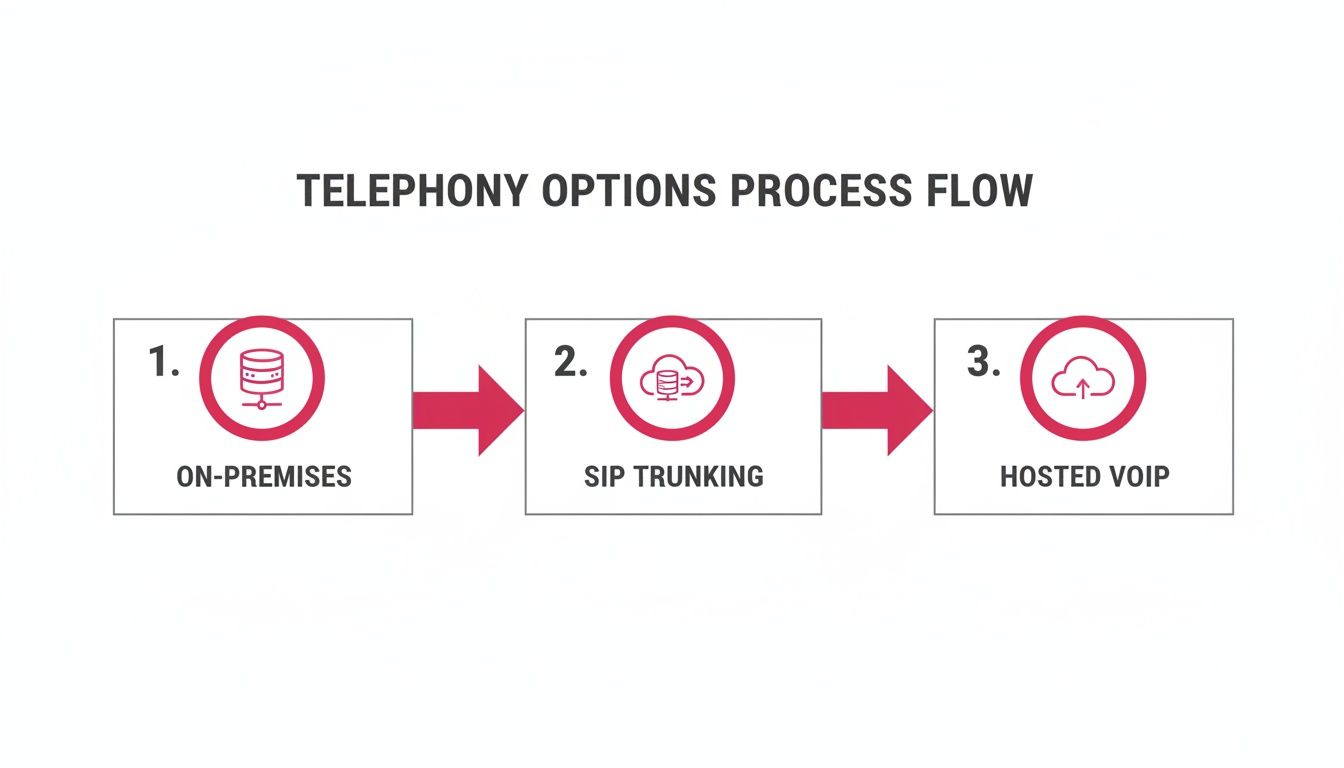
As you can see, hosted VoIP completely removes the need for an on-site server (the PBX box), making it the most modern and efficient solution for business communications today.
Your Step-by-Step Migration Plan
A successful switch is all about getting the groundwork right. We follow a clear, logical plan that tackles potential issues before they ever become a problem. This means that when the time comes to 'go live', the experience is flawless for your staff and, most importantly, your customers.
1. Initial Network and Connectivity Audit
First things first, we check your internet connection. Hosted VoIP depends on a stable connection for that crystal-clear call quality everyone expects. We’ll run checks on your bandwidth and network stability to make sure it can handle your call volume without a hitch, preventing problems like crackly lines or dropped calls.
2. Designing Your Ideal Call Flow
This is the really clever part. We sit down with you and map out exactly how your calls should be handled. Think about setting up an auto-attendant ("Press 1 for Sales, Press 2 for Support"), creating ring groups for different teams, and deciding where calls go after hours. The goal is to make sure every single call is answered professionally and gets to the right person, right away.
3. Number Porting and Hardware Setup
Of course, you need to keep your existing business numbers. We manage the entire number porting process for you. It’s a regulated process that moves your numbers from your old provider to the new service without any interruption. While that's happening in the background, we'll get your new IP desk phones configured and delivered, ready to simply plug in and use.
4. User Training and Go-Live
On the agreed-upon day, the switch itself is instant. We provide simple, practical training for your team to get them comfortable with the new handsets, the mobile app, and useful features like transferring calls or getting voicemail sent straight to their email. Our aim is for everyone to feel empowered by the new system, not intimidated by it.
A local care provider in Wiltshire recently moved to our hosted VoIP platform. Their biggest worry was maintaining their 24/7 availability for clients. We meticulously planned their call flows for day, evening, and emergency scenarios, and ran training sessions with their care coordinators before the launch. The result? Their transition was completed with zero downtime and not a single missed call.
Addressing Common Migration Concerns
It’s completely normal to have questions about things like call quality and security. A key advantage of using a provider with UK-based data centres is that it answers both. All your call data and system settings are stored securely right here in the UK, satisfying data sovereignty rules and giving you total peace of mind.
This shift away from old phone lines is part of a much bigger national change. With all traditional Public Switched Telephone Network (PSTN) services being retired before January 2027, planning your migration isn't just a good idea—it's an essential step to future-proof your business. You can find out more about the UK's nationwide switch to VoIP and why so many are making the move now.
Choosing the Right Local VoIP Partner
Getting your head around the tech is one thing, but picking the right partner to implement it? That’s what really makes or breaks your move to a hosted VoIP phone system.
It’s tempting to go with one of the big national names you see advertised everywhere. They often have slick packages, but a local, experienced provider offers something a faceless call centre just can't: genuine, on-the-ground expertise. For businesses across Dorset, Somerset, and Wiltshire, that local knowledge is a massive plus.
A local partner gets the lay of the land. They know the ins and outs of our regional internet infrastructure—the quirks, the problem areas, and the best-kept secrets for getting a rock-solid connection. That insight is priceless for planning a smooth migration and ensuring every call is crystal clear. And when you need help? You’re not just another ticket number in a queue. You get a real person, often someone who can be on-site if things get tricky.
What to Look for in a Provider
When you're weighing up your options, you need to look past the monthly fee. What you're really buying into is their technical know-how and their commitment to your business. Do they have a solid track record with businesses like yours? That’s a huge green light. They should be able to show you they know their way around leading systems and best practices. To get a feel for what that looks like, you can see how we approach hosting a 3CX phone system.
Ultimately, you want someone who acts less like a supplier and more like a strategic partner. Someone who’s genuinely invested in making your business run better, offering proactive advice tailored to what you actually need.
Verifying Technical and Security Credentials
Here’s a deal-breaker: a non-negotiable commitment to UK-hosted infrastructure. This is critical. It means all your call data and system settings are stored securely right here in the UK, keeping you compliant with data sovereignty laws like GDPR. When vetting a provider, look into their partnerships with established firms like fixed-line VoIP telephony service operators to gauge the quality of their network.
The move to VoIP isn't just a local trend; it's a global shift. The worldwide market, currently valued at around USD 161.79 billion, is expected to skyrocket to approximately USD 415.20 billion by 2034. That explosive growth is a clear signal that for UK SMEs, switching to a hosted VoIP system isn't just a good idea—it's a smart strategic move.
At the end of the day, the right partner delivers far more than just a dial tone. They provide peace of mind, expert guidance, and a robust platform that frees you up to focus on what you do best: running your business.
Frequently Asked Questions
Switching your business phone system is a big step, so it’s completely normal to have a few questions. We’ve put together some straightforward answers to the questions we hear most often from business owners thinking about moving to a hosted VoIP system. The idea is to give you that last bit of clarity you need to feel confident in your decision.
What Sort of Internet Speed Do I Need for VoIP?
This is probably the first thing everyone asks, and it’s a crucial one. You don't need a blisteringly fast connection, but it absolutely must be stable. Think of it like a steady stream rather than a powerful but intermittent firehose.
As a rule of thumb, each phone call needs about 100 kbps (or 0.1 Mbps) of bandwidth, both for uploading and downloading. So, if you have a small office with five people who might all be on calls at the same time, you'd want at least 500 kbps (0.5 Mbps) of reliable bandwidth set aside for them. Most business fibre packages in the UK offer far more than this, but the real key is consistency and low latency, something a quick professional audit can confirm for you.
Can I Keep My Existing Business Phone Number?
Yes, one hundred percent. Your phone number is part of your brand identity, and you can absolutely bring it with you. The official term for this is number porting, and it's a standard, well-managed process.
Your new provider handles all the admin, coordinating with your old provider to move the number across. The best part? There’s no downtime. Your customers won't notice a thing and can keep calling the number they’ve known for years.
It’s a common worry that a new system means a new number. In truth, your phone number is an asset that belongs to your business. It moves with you, ensuring your client communications are never disrupted.
Just How Secure Are Hosted VoIP Phone Calls?
For any business, especially when you're dealing with client details, security is non-negotiable. Any hosted VoIP provider worth their salt will have multiple layers of security built-in to protect your conversations.
Modern systems use powerful encryption, like Transport Layer Security (TLS) and Secure Real-time Transport Protocol (SRTP), to scramble the call data from end to end. This makes it practically impossible for anyone to eavesdrop. Plus, when you choose a provider that hosts everything in UK-based data centres, you get the added peace of mind that your data is protected by strict UK and GDPR privacy regulations.
How Long Does it Take to Switch Over?
For most small businesses, the move to a hosted VoIP system is faster and smoother than you might think. A well-planned migration, from the first chat to your team being fully up and running, typically takes between two to four weeks.
The step that takes the longest is usually the number porting, which has a regulated timeframe of up to 14 days. However, the final switchover itself is instant and is always scheduled for a time that won’t affect your business—like overnight or over a weekend—so you don't miss a single call.
Ready to see what a modern, flexible phone system could do for your business? The team at SES Computers has been helping SMEs across Dorset, Somerset, and Wiltshire make a seamless switch to hosted VoIP for over 30 years. Get in touch today for a no-obligation consultation.