Choosing the right internet connection is one of the most fundamental infrastructure decisions a modern UK business can make. The difference between a leased line and business broadband boils down to one key concept: exclusivity. A leased line is your own private, dedicated connection with guaranteed symmetrical speeds. In contrast, business broadband is a shared service where performance can ebb and flow depending on how many other people in your area are online.
For any professional services firm that depends heavily on cloud software, VoIP phone systems, or seamless remote collaboration, this distinction is everything.
Understanding The Leased Line Vs Broadband Difference
Deciding between a leased line and business broadband is really about aligning your connectivity with how much your daily operations truly rely on the internet. For many businesses, a standard broadband connection works just fine. For others, the guarantees that come with a leased line are simply non-negotiable. We've put this guide together as a practical resource for SMEs across Hampshire, Dorset, Somerset, and Wiltshire to help you make a smart investment in your company's operational backbone. When facing these kinds of critical infrastructure decisions, it's always wise to get expert advice from a reputable information technology company to properly assess your unique requirements.
The UK's broadband market has changed dramatically in recent years, with full-fibre technology now becoming the standard for new installations. By the third quarter of 2025, the number of full-fibre FTTP connections had soared to 11.56 million, finally overtaking the older FTTC technology. Today, full-fibre is available to 79.5% of UK premises, and a massive 88% of UK lines can deliver superfast speeds.
But at the same time, our data demands have shot up, with average monthly consumption now at 535 GB per line. This puts an ever-increasing strain on those shared networks, which is a key point to remember.
At a Glance Comparison
To quickly spell out the main differences, here’s a simple overview of how the two services stack up. This table gives you the basics before we dive deeper into performance, reliability, and cost.
| Feature | Leased Line | Business Broadband |
|---|---|---|
| Connection Type | A private, dedicated, and uncontended connection just for you. | A shared, contended connection you share with other local users. |
| Speed Guarantee | Guaranteed symmetrical speeds. If you pay for 100Mbps, you get 100Mbps upload and download. | Advertised as 'up to' a certain speed, which can fluctuate with network traffic. |
| Service Agreement | Comes with a robust Service Level Agreement (SLA) guaranteeing uptime and fix times. | Typically a 'best effort' service with less strict support guarantees. |
| Typical User | Businesses that can't afford downtime and rely on VoIP, cloud apps, or large data transfers. | SMEs with general internet needs like email, web browsing, and less critical cloud use. |
Getting these initial distinctions clear is the first step. If you're leaning towards broadband, it's worth exploring the various business broadband solutions available to see what fits your needs.
Comparing Performance, Reliability and Service Guarantees
When you start digging into the leased line vs broadband debate, you quickly realise that the advertised headline speeds are only a tiny part of the story. The real difference for any business lies in performance consistency, reliability, and the support guarantees that keep you operational when things go wrong. This is where the underlying technology of the two services creates a massive gulf in what you can expect.
Standard business broadband is an asymmetrical service. In plain English, this means your download speeds are much faster than your upload speeds. That’s perfectly fine for pulling information from the internet, like browsing websites or streaming video. But for modern business tasks—think video calls, cloud backups, or sending large design files—it’s the upload speed that counts, and that’s where broadband often becomes a bottleneck.
A leased line, on the other hand, is symmetrical. A 100Mbps leased line gives you 100Mbps down and 100Mbps up. This balanced, two-way data flow is absolutely essential for the interactive, real-time applications that most professional services firms now rely on.
The Problem of Sharing: Contention Ratio
The single biggest factor affecting broadband performance is the contention ratio. Business broadband is a shared service. You’re sharing the main connection with dozens, sometimes even hundreds, of other local users. Just like a motorway at rush hour, when everyone tries to use it at once during peak business hours, your speeds can plummet and delays (latency) shoot up.
A leased line completely eliminates this problem with a contention ratio of 1:1. The line is exclusively yours.
- No Peak-Time Slowdowns: Your speed is constant and predictable, no matter what other businesses in the area are doing.
- Low Latency: Data takes a direct, private route, minimising delays. This is critical for crisp VoIP calls and responsive cloud desktops.
- Guaranteed Bandwidth: You get exactly the bandwidth you pay for, all the time.
Practical Example: A busy accountancy firm in Hampshire during tax season. A contended broadband connection could grind their cloud-based software to a halt right when they need it most. A leased line removes that risk entirely, ensuring productivity never suffers because of neighbourhood network traffic.
This dedicated, private-line nature is what makes leased lines for businesses a truly mission-critical service.
To give you a clearer picture, here’s a quick summary of the key differences.
At a Glance: Leased Line vs Business Broadband
| Feature | Leased Line | Business Broadband |
|---|---|---|
| Symmetry | Symmetrical (e.g., 100Mbps up/100Mbps down) | Asymmetrical (e.g., 80Mbps down/20Mbps up) |
| Contention | 1:1 (Uncontended, Private Line) | Shared (Contended with many other users) |
| Uptime Guarantee | 99.9% or higher, backed by an SLA | "Best effort," no contractual guarantee |
| Fix Time Guarantee | Usually 4-6 hours, 24/7/365 | Typically next business day, can be longer |
| Latency | Very low and consistent | Variable, increases during peak usage |
| Primary Use | Mission-critical operations, VoIP, cloud | General office use, web browsing, email |
This table really highlights that you're not just buying speed; you're investing in reliability and guaranteed performance.
Your Business Lifeline: The Service Level Agreement (SLA)
For any organisation that simply cannot afford to be offline, the Service Level Agreement (SLA) is arguably the most important distinction of all. An SLA is a contract from your provider that guarantees a specific level of service, including uptime and, crucially, fix times.
Business broadband generally operates on a "best effort" basis. While support is available, there are no contractual promises on how quickly a problem will be fixed. This could leave you without a connection for days.
A leased line is backed by a robust SLA, providing genuine business assurance. These typically include:
- Uptime Guarantees: Providers will commit to 99.9% or higher network availability.
- Target Fix Times: A typical SLA includes a four to six-hour target fix time, 24/7, 365 days a year. If a fault occurs, an engineer is contractually obliged to have it resolved within that window.
The UK's 29.2 million fixed broadband lines operate on a shared infrastructure, making them all susceptible to variable performance. For businesses across Dorset, Somerset, Wiltshire, and Hampshire, where an outage can shut down point-of-sale systems or block access to client data, the guaranteed uptime and rapid fix times of a leased line are more than just a convenience—they're a necessity.
Analysing the Cost vs. The Investment
When you first look at the price tag for a leased line versus standard business broadband, it’s easy to dismiss the leased line as an unnecessary expense. This is a common pitfall. The real conversation isn't about the monthly fee; it's about the total cost of ownership and, more importantly, the return on that investment (ROI).
Thinking of a leased line as just another bill is a mistake. It’s better to see it as an investment in the operational backbone of your company. An unreliable broadband connection comes with its own set of hidden, and often crippling, costs that can hurt a business far more than the premium for a dedicated line.
These hidden costs show up in painful ways. When your internet goes down, productivity grinds to a halt. Billable hours vanish into thin air and deadlines get missed. For any business that deals directly with customers, an outage can mean lost sales on the spot and, even worse, long-term damage to your reputation.
The True Cost of Downtime
Let's ground this in a real-world scenario. Picture a 15-person professional services firm in Wiltshire—say, a legal practice or an accountancy firm—where each employee's time is billed out at an average of £100 per hour.
If the internet goes out for a full business day, that’s 8 hours of lost productivity for every single employee.
- Financial Impact: 15 employees x 8 hours x £100/hour = a staggering £12,000 in lost revenue and wages for a single day.
Suddenly, the annual cost of a leased line doesn't seem so high. When you grasp that the financial fallout from just one day of downtime can eclipse the entire yearly cost of a premium connection, the business case becomes undeniable. This isn't about convenience; it’s about shielding your business from huge financial risks.
Shifting Price Perceptions and Total Value
Historically, leased lines in the UK came with a hefty price tag. You might have seen broadband deals for around £50 a month while a leased line sat closer to £250—a fivefold difference. But the market has evolved. Leased line pricing has come down quite a bit, putting them well within reach for many SMEs.
Once you start looking at the total cost of ownership, the numbers really start to stack up in favour of a dedicated line, especially for businesses where downtime is not an option. You can discover more insights about the evolving cost of business connectivity and see how these dedicated fibre circuits offer guaranteed bandwidth and SLA-backed reliability. We’re talking about 99.9% or higher uptime guarantees, often with a 4-hour repair commitment.
The real question isn't "Can we afford a leased line?" It's "Can we afford the financial and reputational damage of not having one?" For a growing number of businesses, the answer is a firm no.
Building the Business Case
When you frame the decision around risk management and business continuity, the argument for a leased line becomes much stronger. It’s not just about faster internet; it’s an insurance policy for your entire operation. The ROI isn’t measured in megabits per second, but in the uptime, reliability, and peace of mind that lets your business run smoothly.
Think about these drivers when calculating your own ROI:
- Operational Continuity: Guaranteed uptime means your essential tools—from cloud accounting software to VoIP phone systems—are always on.
- Staff Productivity: No more frustrating slowdowns or complete outages. Your team stays focused, efficient, and frankly, a lot happier.
- Client Confidence: A stable, reliable connection sends a message of professionalism. It tells your clients you’re always available and that their projects are in safe hands.
By focusing on these concrete benefits, the upfront cost of a leased line is no longer an expense, but a strategic investment in the stability and future of your business.
Knowing When a Leased Line Becomes Non-Negotiable
Moving from business broadband to a leased line isn't just a technical upgrade; it's a strategic decision driven by operational necessity. For many professional services firms, there's a clear moment when the occasional slowdowns and unpredictability of broadband stop being minor annoyances and start actively costing money and damaging your reputation.
The real question isn't about chasing the fastest possible speeds. It’s about understanding when guaranteed, symmetrical performance becomes fundamental to your daily work. Let's look at a few common scenarios that firms across Dorset, Somerset, Wiltshire, and Hampshire run into, which often signal it's time to make the switch.
When Your Phones are Your Lifeline
Think about a busy sales team or a customer support desk running on a cloud-based phone system like 3CX. Here, every single call is a vital connection to a client or a new prospect. The quality of that conversation is a direct reflection of your company's professionalism.
With a standard business broadband connection, you're constantly fighting against its inherent limitations—the slower upload speed and the fact you’re sharing the line with your neighbours. This often leads to real problems:
- Jitter and Packet Loss: This is what causes voices to sound robotic and sentences to cut out, leading to awkward, unprofessional conversations.
- Dropped Calls: Nothing erodes client confidence faster than a call that simply cuts off mid-sentence, especially during an important negotiation.
- Poor Quality at Peak Times: When other local businesses are hammering their internet connection, your call quality can plummet just when you need it most.
A leased line solves all of this instantly. It gives you a private, symmetrical connection where the upload bandwidth is just as strong as the download. For any business where the phone is a primary revenue driver, a leased line is the only way to guarantee every call is crystal-clear and completely reliable.
Practical Example: We worked with a Dorset-based legal practice where constant client communication via VoIP is everything. For them, a dropped call during a crucial negotiation is unthinkable. The stability of a leased line wasn't a luxury; it was a direct investment in their client relationships and professional integrity.
Supporting a Fully Cloud-Based Office
More and more professional services firms are ditching on-site servers for the flexibility of hosted desktops, often called Desktop-as-a-Service (DaaS). In this setup, every employee's desktop, software, and data live in a secure data centre, accessed entirely over the internet.
This complete reliance on the cloud makes your internet connection the single most critical piece of your infrastructure. If it's not up to scratch, your team's productivity grinds to a halt.
- Input Lag: A frustrating delay between typing and seeing the characters appear.
- Slow File Access: Simple tasks like opening a document or saving a file become painfully slow.
- Application Freezes: Demanding software can become unresponsive or even crash completely.
Practical Example: A Wiltshire-based architectural firm we know moved its entire team to hosted desktops to run powerful CAD software. Trying to do that over a standard broadband connection would have been a disaster. The consistent, low-latency performance of their leased line ensures a hosted desktop feels just as fast and responsive as a local machine, keeping productivity high and frustration low.
Enabling Secure and Reliable Multi-Site Connectivity
For businesses with more than one office, the case for a leased line becomes even stronger. Picture a head office in Hampshire needing a seamless link to a branch in Somerset. Both sites need to access the same central systems—like a shared CRM, accounting software, or company-wide file servers.
Trying to run this over broadband is asking for trouble. Performance can be wildly inconsistent, making it painfully slow for the branch office to get anything done. On top of that, securing the connection with a VPN over the public internet adds another layer of complexity and potential failure.
A leased line offers a private, secure point-to-point connection between your sites. Because the traffic never touches the public internet, data transfer is both fast and inherently secure. This means employees at the branch office get the exact same high-performance experience as those at HQ, creating a truly unified and efficient operation. When consistent multi-site performance is on the line, the lease line vs broadband debate has a very clear winner.
A Decision Framework for Your Business
Choosing between business broadband and a leased line is more than a simple cost comparison; it's a strategic decision. You need to look honestly at how your business actually operates and what its ambitions are for the future. This isn't about guesswork; it's about matching your connectivity to your commercial reality.
The right framework helps you analyse your company’s unique profile. It forces you to consider your reliance on real-time services, your tolerance for downtime, and your security obligations. Walking through these points gives you a clear, data-driven answer, so you can invest with confidence.
To get started, the flowchart below provides a quick visual guide. It helps frame the decision around some of the most common high-dependency services we see with businesses today.
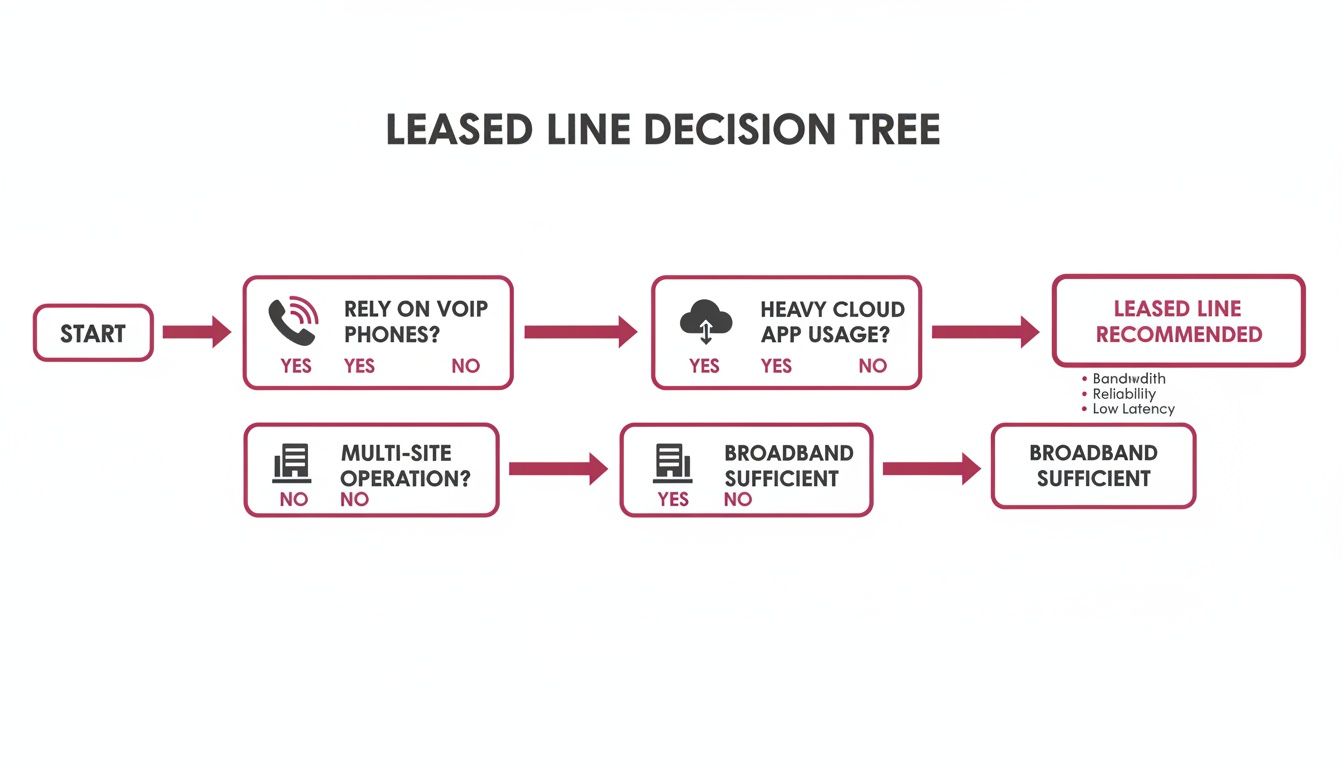
As you can see, a heavy reliance on tools like VoIP, cloud applications, or multi-site connectivity immediately points towards a leased line. For many, these are no longer luxuries but essentials.
Connectivity Decision Matrix for Your Business
To build a more complete picture, use this matrix to assess your operational needs and determine whether business broadband or a leased line is the right fit for your organisation. For each row, see which column best describes your current—and future—ways of working.
| Business Need | Consider Business Broadband If… | Prioritise a Leased Line If… |
|---|---|---|
| Cloud Application Use | Your team uses standard cloud tools like Office 365, but you don't depend on hosted desktops or large-scale cloud databases for core operations. | Your business runs on hosted desktops (DaaS), a cloud-based CRM, or other mission-critical software where latency directly halts productivity. |
| VoIP Telephony | You use VoIP for occasional calls, but it's not the primary communication tool for a large sales or support team. Minor dips in quality are acceptable. | Your sales or support teams depend on a VoIP system like 3CX for all client communication. Crystal-clear call quality is non-negotiable. |
| Downtime Tolerance | Your business can manage a few hours of internet downtime per quarter without significant financial loss. Staff can switch to offline tasks. | An hour of downtime translates into thousands of pounds in lost revenue, reputational damage, or a complete operational standstill. |
| Data Security & Compliance | You handle standard business data but aren't bound by strict regulations that mandate private, secure connections for data transfer. | You process sensitive client data (e.g., financial, legal, medical) and need to ensure the highest level of security and compliance. |
| Multi-Site Operations | You have multiple locations, but they operate independently and don't require a constant, high-performance link back to a central head office. | You need a secure, reliable, and high-speed link between a head office and branch locations for shared applications and centralised data. |
Interpreting Your Results
After working through the matrix, a clear pattern should emerge. If your business consistently lands in the "Prioritise a Leased Line" column for two or more categories—especially downtime tolerance and cloud dependency—the case for a dedicated connection is undeniable.
Practical Example: Think of a professional services firm in Somerset. They might tolerate some cloud slowdowns. But if they also process sensitive client financial data and their phone system is entirely VoIP-based, the combined risk makes a leased line the only prudent choice.
This framework isn't just about solving today's problems. It’s about building a foundation that matches your ambition. If you plan to expand your team, move more services to the cloud, or open new branches, your decision must reflect that future. Choosing the right connectivity is a fundamental step in creating a resilient, scalable business.
Planning Your Connectivity Migration
Once you’ve settled the leased line vs broadband debate, the next challenge is making the switch without causing chaos. A structured, well-thought-out migration is crucial for any business, but it's especially vital when moving to a leased line. This isn't just a simple swap; it's a project that needs proper management to ensure your new connection is an asset from day one.
The first real step for a leased line is the site survey. It's not optional. An engineer needs to visit your premises to figure out exactly what it will take to run a dedicated fibre optic cable to your building. This is a world away from a standard broadband activation; you’re looking at an installation timeframe of anywhere between 30 to 90 working days. This is because the process can often involve physical groundwork, like digging trenches, and getting the right permissions from local councils.
Key Stages for a Smooth Transition
This is where working closely with your IT support provider becomes so important. They need to be involved from the beginning, mapping out the network changes required for your firewalls, routers, and other internal systems to be ready for the new service. A solid migration plan will always break the process down into manageable stages to keep downtime to an absolute minimum.
- Project Kick-off: This is the initial meeting to set clear timelines and define who is responsible for what.
- Hardware Procurement: You’ll likely need a new router or firewall, so this needs to be ordered well in advance.
- Network Configuration: The new equipment can be pre-configured with the correct IP addresses and security rules before it even arrives on-site.
- Go-Live Planning: The final switchover should be scheduled for when it will cause the least impact on your operations, often overnight or over a weekend.
Practical Example: A seamless migration isn’t just about the technical cutover; it’s about protecting business continuity. When we helped a local accountancy firm migrate, we scheduled the final switch for a Sunday evening. This ensured their entire team walked in on Monday morning to a fully operational system, with absolutely no disruption to their clients.
Choosing the right partner is just as important as choosing the right connection type. For more advice on this, our guide on how to choose an internet provider provides some practical tips. By carefully managing each stage, your business can step up to its powerful new connectivity without skipping a beat.
Frequently Asked Questions
When weighing up a leased line against business broadband, the same questions tend to pop up for most business owners and IT managers. We've gathered the most common ones here to give you straightforward answers, focusing on what each choice really means for your day-to-day operations.
How Long Does a Leased Line Installation Take?
You'll need to plan ahead. A typical leased line installation can take anywhere from 30 to 90 working days. The reason for this long lead time is that it's a much more bespoke process than simply activating a broadband line.
The work often involves a physical survey of your premises, liaising with local councils for permissions, and sometimes even digging trenches to lay new fibre optic cable right to your door. Because it's a significant project, it’s crucial to start the process well before you actually need the connection up and running.
Do I Really Need a Backup for My Leased Line?
In a word, yes. While leased lines are the gold standard for reliability, no connection is completely infallible. Physical damage to a cable or a rare network issue can happen, and having a backup is a smart business continuity plan.
A popular and cost-effective approach is to have a secondary business broadband connection, like Fibre to the Premises (FTTP), ready to take over. This can be configured for automatic failover, so if your main line goes down, your internet traffic switches over instantly. The interruption to your business is minimal, if you notice it at all.
Practical Example: Think of a backup line as an insurance policy. For a law firm or an accountancy practice, that small extra monthly cost is nothing compared to the potential catastrophe of being unable to access client files or cloud systems.
Is a Leased Line Genuinely More Secure Than Broadband?
A leased line offers an inherently more secure starting point, even though both connection types need a solid, properly configured firewall. The real difference is in the architecture.
A leased line is your own private, uncontended circuit. It's used by you and you alone. This immediately removes the risks that come with sharing a public network, which is how all standard broadband services work. For any business handling sensitive financial or personal data, that private connection provides a fundamentally stronger security posture and valuable peace of mind.
Ready to secure the guaranteed performance your business deserves? SES Computers provides expert advice and implementation of leased lines and business broadband for companies across Dorset, Somerset, Wiltshire, and Hampshire. Contact us today for a complimentary connectivity audit and let's find the right connection for your future.