For most businesses, IT support only comes to mind when disaster strikes. A server crashes, a critical file vanishes, or a system suddenly goes offline, bringing productivity to a screeching halt. This reactive, emergency-first approach is often called 'break-fix', and while it gets you out of a jam, it treats your technology as a liability, not the strategic asset it should be.
Moving Beyond Break-Fix: The Modern Role of IT
Think of the old break-fix model like only seeing a doctor when you're seriously ill. It’s expensive, stressful, and almost always disruptive. In contrast, modern IT support & managed services work more like a comprehensive wellness plan for your company's technology. The focus shifts entirely from firefighting daily problems to proactively maintaining the health of your systems, stopping issues before they can ever cause damage.
This fundamental change allows small and medium-sized enterprises (SMEs), particularly in professional services sectors, to move from a state of constant technical worry to one of genuine strategic advantage. Instead of your team losing precious hours to downtime, you gain a reliable foundation for getting work done and growing the business.
Addressing Key Business Pain Points
A modern managed IT partnership is designed to tackle the most common headaches for business owners across Dorset, Somerset, Wiltshire, and Hampshire. It’s all about providing stability and peace of mind by directly addressing:
- Unpredictable Costs: Break-fix billing is erratic. A major server failure can land you with a huge, unplanned expense. A managed service provides a predictable, fixed monthly fee, making your budgeting simple and clear. For example, a firm of solicitors can budget for their IT for the entire financial year, knowing there will be no surprise invoices.
- Security Worries: With cyber threats evolving daily, keeping your business protected is a full-time job. Managed services include constant monitoring, security updates, and employee awareness training to keep your sensitive client data safe from harm.
- Productivity Loss: Every minute your systems are down, your team is not working. Proactive maintenance minimises that downtime and keeps your operations running smoothly. The emphasis is on proactive strategies, using tools for real-time monitoring for proactive IT management to catch and fix potential problems before they escalate.
The goal is to transform your IT from a reactive cost centre into a proactive driver of business value. By preventing problems and optimising performance, you free up resources to focus on what truly matters—growing your business.
This shift isn't just local; it’s happening right across the UK, where proactive, contract-based support has become the standard. The UK's IT services market is a mature and expanding sector, with the managed services segment alone reaching a market size of £156.9 billion. This growth is fuelled by SMEs outsourcing to access skills and 24/7 monitoring that are simply too difficult to manage in-house.
Ultimately, this guide is designed to help you make an informed decision. It’s about exploring how a robust it strategy consultancy can provide the essential framework you need for security, efficiency, and future growth.
What’s Actually Included in Managed IT Services?
The term "managed IT services" is used frequently, but what does it really mean for your business on a day-to-day basis? It is more than just calling someone when your printer breaks. It’s about having a dedicated team of experts proactively managing your entire tech setup, so things don't break in the first place.
Think of it like this: you would not wait for your car's engine to seize up before getting it serviced. Managed IT applies that same preventative logic to your business technology. It’s a complete package designed to keep your systems secure, efficient, and reliable, bringing together all the specialists you need under one simple plan.
Let's pull back the curtain and look at the core components that make this possible.
24/7 Proactive Monitoring: Your Digital Watchtower
At the heart of any solid managed service is 24/7 proactive monitoring. This is the single biggest shift away from old-school, reactive IT support. Instead of waiting for you to report a problem, we're watching over your network around the clock, looking for signs of trouble.
It’s like having a digital watchtower for your entire IT infrastructure. Our systems constantly check for things like servers running low on space, unusual network traffic that could signal a breach, or hardware showing signs of imminent failure. By catching these small issues early, we can fix them before they escalate into major disruptions. For a busy law firm in Somerset, that could be the difference between a five-minute fix performed out of hours and a full-day server outage right before a major deadline.
This proactive approach turns IT from a potential source of frustrating interruptions into a pillar of stability for your business. It's the difference between patching a small leak and dealing with a full-blown flood.
Cloud Backup & Disaster Recovery: Your Business Continuity Plan
Ask yourself this: if a fire, flood, or a major ransomware attack hit your office tomorrow, could your business survive? Cloud backup and disaster recovery is the essential insurance policy that ensures the answer is "yes." It’s not just about copying files to the cloud; it’s about having a tested, actionable plan to get your entire operation back up and running fast.
We ensure your critical data is continuously and securely backed up to an off-site cloud server. If the worst happens, we can quickly restore everything—your systems, applications, and data. This means a logistics company in Hampshire could be back coordinating deliveries in a matter of hours, not days or weeks, even if their main office is completely out of action.
To give a clearer picture of how this proactive model compares to the old way of doing things, here’s a quick breakdown:
At-a-Glance Comparison: Break-Fix IT vs. Managed Services
| Feature | Traditional Break-Fix IT Support | Managed IT Services |
|---|---|---|
| Cost Structure | Unpredictable, hourly rates & call-out fees | Fixed, predictable monthly fee |
| Approach | Reactive (waits for things to break) | Proactive (prevents issues from happening) |
| Incentive | Profit from your problems and downtime | Profit when your systems run smoothly |
| Response Time | Varies, often delayed until a technician is free | Guaranteed response times (SLAs) |
| Business Impact | Frequent downtime and lost productivity | Minimised downtime and improved efficiency |
| Budgeting | Difficult to budget for unexpected IT costs | Simple, predictable operational expense |
As you can see, the managed services model aligns our goals directly with yours: keeping your business productive and protected.
Tools for Modernising Your Business
Beyond just keeping the lights on, managed services are about giving you the tools to work smarter. These components are designed to boost productivity, improve collaboration, and give you a competitive edge.
- VoIP Phone Systems: Voice over Internet Protocol (VoIP) takes your old phone line and moves it into the cloud. This gives you incredible flexibility with features like call routing, video conferencing, and the ability to take your office number anywhere. Your team stays connected whether they're in the office, working from home, or on the road.
- Comprehensive Cyber Security: This is far more than just basic antivirus. We're talking about a multi-layered defence system, including robust firewalls, advanced email filtering to catch phishing attempts, and regular vulnerability scans to close security gaps before criminals can exploit them.
- Cloud Solutions & Connectivity: Whether it's setting up hosted desktops so your team can securely access files from anywhere or ensuring your office has a rock-solid, high-speed internet connection, cloud services provide the scalability and flexibility that modern businesses need to grow.
A truly comprehensive managed service also involves smart planning for your hardware and software. This means following modern IT Asset Management (ITAM) best practices to get the most out of your technology investments and keep costs down.
Ultimately, these pieces all fit together to create a powerful, resilient, and efficient technology foundation for your business. To see how these components can be packaged, it's worth exploring the different types of managed services in IT. This coordinated strategy ensures your tech isn't just protected from threats—it becomes a genuine asset for driving your business forward.
Measuring the Real Business Impact of Managed IT
It’s easy to get lost in the technical jargon, but the true value of professional IT support & managed services is not about the features—it is about the results. What really matters is the tangible, bottom-line impact on your business. Bringing in a managed IT partner is not just a tech decision; it is a strategic move that makes your company stronger from the ground up.
This approach changes IT from an unpredictable, often frustrating, expense into a powerful asset for stability and growth. By focusing on predictable costs, tighter security, better productivity, and access to genuine expertise, you can see a real return on your investment.
The core pillars of a managed IT service—proactive monitoring, data backup, and robust security—all work together to form a solid foundation for your business.
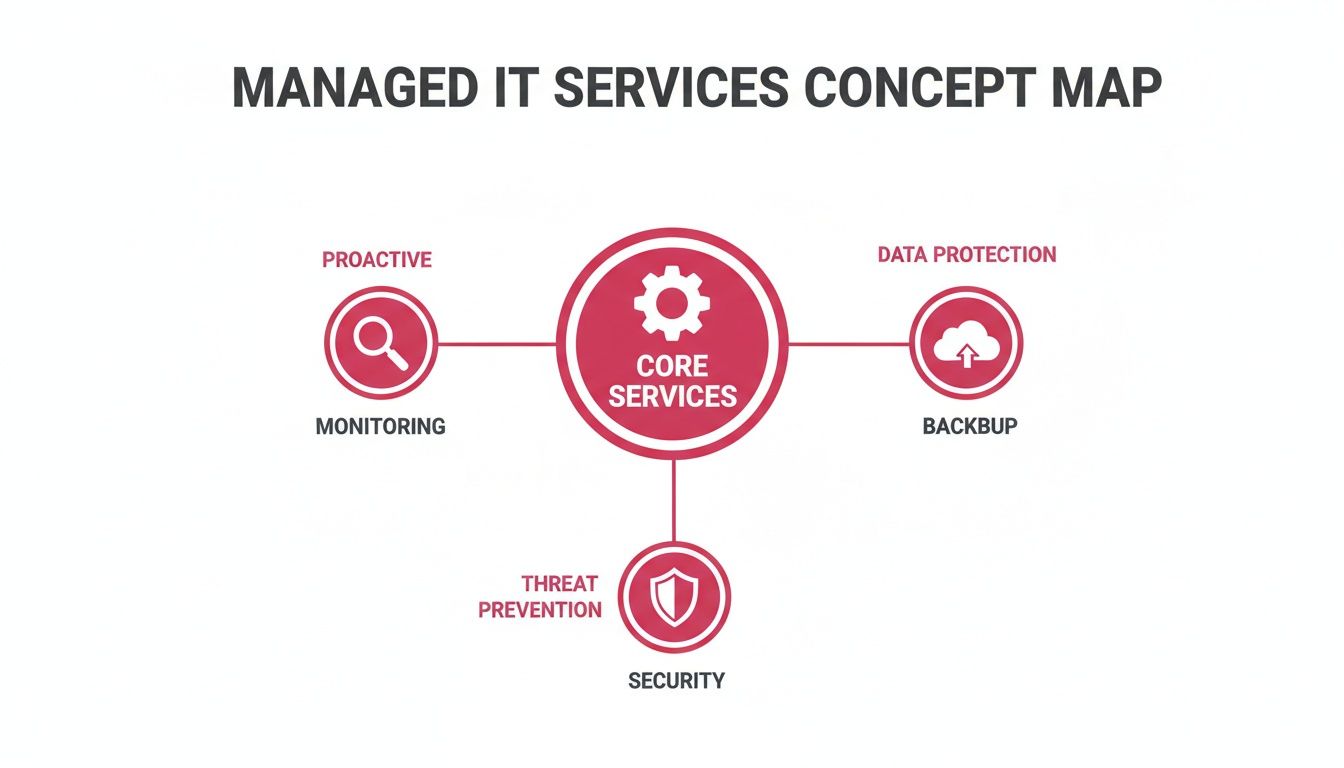
The key thing to grasp is that these services are not separate functions. They’re an interconnected system where each part supports the others, creating a truly resilient business.
Achieving Predictable and Controlled Costs
One of the first things you will notice is the end of chaotic, reactive IT spending. With the old break-fix model, you never know what your IT costs will be from one month to the next. A critical server failure can land a four-figure bill on your desk out of nowhere, completely derailing your budget.
Managed IT services replace that volatility with a single, predictable monthly fee. This operational expense covers everything from routine checks and monitoring to emergency support, making your financial forecasting far more accurate. You stop paying for problems and start investing in prevention and stability, which always costs less in the long run.
A study on IT spending found that businesses can slash unexpected IT costs by as much as 40% by switching to a managed services model. This is because proactive maintenance stops expensive, emergency repairs before they happen.
Think of an accountancy firm in Wiltshire. They can budget for their IT support with complete confidence for the entire year. They know that whether they need a minor software update or urgent help during the chaos of tax season, the cost is fixed. This eliminates financial surprises and allows them to put their resources to better use.
Enhancing Your Security Posture
In a world of constant cyber threats, strong security is not just a good idea—it is essential for survival. A single data breach can lead to devastating financial losses, hefty regulatory fines, and permanent damage to your reputation. A managed service provider becomes your dedicated security partner.
This goes far beyond simply installing antivirus software. It’s a comprehensive defence strategy that includes:
- Proactive Patch Management: We ensure all your systems and software are consistently updated, closing security loopholes before criminals can find them.
- Continuous Threat Monitoring: Our team keeps a close watch on your network 24/7 for any suspicious activity, allowing us to spot and neutralise threats before they cause damage.
- Employee Security Training: We help educate your team to recognise phishing emails and other scams, turning your staff into your strongest line of defence.
This constant vigilance drastically reduces your risk, protecting your clients' data and keeping your business running.
Boosting Team Productivity and Efficiency
Every minute your systems are down is a minute your business is losing money. Unplanned downtime directly hits your team's ability to serve customers and bring in revenue. Managed IT services are designed from the ground up to maximise uptime and keep your staff working effectively.
By proactively monitoring and maintaining your systems, we fix potential problems before they ever cause a disruption. This preventative approach minimises the frustrating slowdowns and outages that grind work to a halt.
Here’s a practical example:
Dorset Manufacturing Firm Case Study: A manufacturing company in Dorset was plagued by frequent downtime with its production line control systems, causing delays and hurting output. After switching to our managed service, their systems were monitored and maintained proactively. The result? They reduced production downtime by 30% within six months, leading to a direct increase in output and profitability.
This shows that reliable IT isn't just a background utility; it is a critical driver of operational excellence.
Accessing Specialised Expertise on Demand
Finally, partnering with a managed services provider gives your SME access to a level of expertise that would be practically impossible to hire in-house. Building an internal IT team with specialists in cyber security, cloud computing, network infrastructure, and disaster recovery is incredibly expensive and difficult.
With a managed IT service, you get an entire team of certified experts for a fraction of what it costs to hire a single senior IT employee. This means that no matter what technical challenge comes your way, you have a specialist ready to solve it quickly and correctly. It frees you up to do what you do best: run and grow your business.
Understanding Costs and Contracts: A Plain-English Guide
When you're looking to invest in your business's technology, understanding the costs involved is paramount. Unlike the old 'break-fix' model where you get a surprise bill every time something goes wrong, professional IT support & managed services bring clarity and predictability to your budget. You know exactly what you are paying for and what level of support to expect.
The aim is to find a partnership that feels right for your business today and has the flexibility to grow with you tomorrow. Let's walk through the typical pricing structures and the all-important contract that underpins it all.
How Managed IT Services are Priced
Every business is different, so IT providers usually offer a few ways to structure the costs. A good partner will sit down with you to figure out which approach makes the most financial sense for your specific setup.
You will generally come across three main models:
- Per-User Pricing: This is exactly what it sounds like—a simple, flat monthly fee for each person on your team. It is incredibly popular because it is so predictable. As your team grows or shrinks, your IT costs adjust accordingly. This model usually covers all the devices an individual uses, like their PC, laptop, and work mobile.
- Per-Device Pricing: Here, the cost is tied to each piece of hardware being looked after. Think servers, workstations, printers, and firewalls. This can be a great fit for businesses that have more equipment than people, such as a manufacturing plant in Wiltshire or a Hampshire-based logistics company with shared computer hubs.
- Tiered Packages: Many IT firms offer service bundles—often labelled something like Bronze, Silver, and Gold. The basic tier might cover the essentials like monitoring and remote help, while the premium packages roll in more comprehensive services like on-site support, strategic tech planning, and advanced cyber-security.
Imagine a growing Somerset-based legal practice. The per-user model is a perfect fit. When they bring on a new solicitor, their IT costs scale in a perfectly predictable way, keeping their budget neat and tidy.
Getting to Grips with the Service Level Agreement
While the pricing model tells you how you will pay, the Service Level Agreement (SLA) spells out exactly what you are paying for. Honestly, this is the most critical part of the whole contract. It is the provider's promise to you, put in writing.
Think of the SLA as the official rulebook for your relationship. It turns vague assurances into solid, measurable commitments, ensuring everyone is on the same page about what great service actually looks like.
A detailed, easy-to-understand SLA is a hallmark of a professional IT partner. It should be written in plain English, with no confusing jargon or wiggle room.
What to Look For in Your SLA
When you are reading through an SLA, you need to look past the marketing fluff and focus on the guarantees that directly affect your day-to-day operations. A well-written SLA is your peace of mind, your assurance that help will be there when you need it most.
Here are the non-negotiables to look for:
- Guaranteed Response and Resolution Times: This is the heart of the agreement. It needs to state, in black and white, how quickly the provider will acknowledge your problem (response time) and how long they have to fix it (resolution time). These are usually tied to how severe the issue is. For example, a "critical" server outage should get a response in 15 minutes, whereas a minor printer glitch might have a four-hour window.
- System Uptime Guarantees: If your provider is managing your cloud services or network, the SLA must promise a specific level of uptime—typically 99.9% or higher. This puts the onus on them to keep your systems running, because if they fail to do so, there are often financial penalties.
- Clear Definitions of Issue Priority: The SLA should have a simple system for classifying problems (e.g., Critical, High, Medium, Low) with clear examples for each category. This avoids any arguments about how urgent an issue is. A company-wide email failure is critical; one person struggling to log in is not.
- Scope of Services: The document should act as a checklist, listing every single service included in your fee—from proactive checks and backups to cyber-security updates and on-site visits. Just as importantly, it should also clarify what is not covered to prevent any misunderstandings down the line.
By taking the time to review these details, you are making sure your new IT partner is contractually bound to deliver the responsive, high-quality service your business needs to thrive.
How to Choose the Right IT Support Partner

Picking a company for your IT support & managed services is one of the biggest calls you will make for your business. This is not just about finding someone to fix a misbehaving printer. It’s about choosing a long-term strategic partner who will safeguard your data, keep your team productive, and genuinely support your growth.
Get it right, and your IT provider becomes a seamless extension of your own team—someone who understands where you are headed and works proactively to make sure your technology helps you get there.
To find that perfect fit, you need to look past the glossy brochures and dig into what really matters. You are looking for a provider with a solid track record, the right technical chops, and a company culture that clicks with your own.
Assess Local Presence and Industry Experience
While a lot of IT support can happen remotely these days, you cannot beat having someone local. When a critical server goes down or your internet connection dies, you need an engineer who can get on-site fast, not someone stuck in traffic three counties away. Look for providers with a real office and engineers based right here in Dorset, Somerset, Wiltshire, or Hampshire.
Just as important is their experience with businesses like yours. An IT company that mainly looks after retail shops will have a completely different skillset to one that understands the complex compliance needs of a law firm or the 24/7 demands of a manufacturing plant.
A provider with deep experience in your sector will not just solve technical problems; they will understand your specific operational challenges, regulatory requirements, and business objectives. This shared understanding is the foundation of a true strategic partnership.
Always ask for case studies or, even better, to speak to a few of their clients in your industry. It is the only way to get a real feel for how they operate and see proof that they can deliver for a business with your specific needs. To see what separates the good from the great, it is worth reading up on what to look for in managed IT service companies.
Verify Technical Certifications and Expertise
Technology changes in the blink of an eye, so you need a partner who invests in keeping their skills sharp. Do not be shy about asking to see their team's qualifications and the company's official accreditations. These are not just fancy badges; they are proof that a provider knows their stuff in the areas that matter most.
Look for recognised industry credentials in:
- Cyber Security: Certifications like CompTIA Security+ or Cyber Essentials show a serious commitment to protecting your business from online threats.
- Cloud Technology: Accreditations from giants like Microsoft (for Azure) or VMware prove they have the expertise to manage modern cloud systems properly.
- Networking: Qualifications from vendors like Cisco confirm they can build and maintain the stable, secure network your business relies on.
A team that values continuous professional development is a team you can trust to give you sound, future-proof advice.
Critical Questions to Ask Potential Providers
Once you have a shortlist, it is time to get down to brass tacks. The answers to these questions will tell you a lot about their service quality and whether they truly put their customers first. Any provider worth their salt will welcome this level of detail.
Key questions to guide your evaluation:
-
How do you handle an out-of-hours emergency?
- What you're looking for: A clear, documented process for when things go wrong outside the usual 9-to-5. You need to know exactly who to call and what their guaranteed response time is.
-
Can you walk me through your client onboarding process?
- What you're looking for: A structured, methodical plan designed to minimise disruption. They should talk about an initial audit, a detailed migration schedule, and keeping you in the loop every step of the way.
-
How do you measure and report on your performance?
- What you're looking for: They should offer regular, easy-to-read reports on things like system health, security status, and how quickly they resolved support tickets. This demonstrates accountability.
-
Who will be my day-to-day point of contact?
- What you're looking for: A dedicated account manager or a small, familiar team. The last thing you want is to feel like just another ticket number in a massive, impersonal helpdesk queue.
Taking the time to do this homework ensures you end up with a partner who not only has the right skills but also shares your vision. It is a decision that will pay you back with better security, improved efficiency, and priceless peace of mind.
Common Questions We Hear About Managed IT Services
Choosing to bring in an external partner to manage your technology is a big decision, and it’s completely natural to have a few questions. For many business owners, the thought of handing over the keys to their IT systems can feel a little unnerving. But a good partnership for IT support & managed services is all about empowering your business, not taking control away from you.
Let’s run through some of the most common concerns we hear from businesses across Dorset, Somerset, Wiltshire, and Hampshire. We will give you clear, straightforward answers to help you feel confident about what’s involved.
Will I Lose Control of My IT If I Outsource?
This is easily the biggest myth we have to bust. The truth is, a quality managed services partnership gives you more strategic control over your IT, not less. While we handle the nitty-gritty of keeping things running smoothly day-to-day, you stay firmly in charge of the overall strategy.
You will get clear, regular reports on your system’s health, security status, and performance. This kind of insight often goes deeper than an internal team can provide, giving you the data you need to make smart, informed decisions about where to invest in technology for the future.
Think of your provider as an expert co-pilot. You’re still the captain who decides the destination and steers the ship. We are just the specialist sitting beside you, making sure the engines run flawlessly and navigating any technical turbulence along the way.
Is My Business Too Small for Managed Services?
It is a common assumption that managed services are only for big corporations, but in our experience, it is the smaller and medium-sized businesses that often see the biggest benefits. For most SMEs, hiring a full-time, in-house IT department with all the varied skills needed for modern cyber security, cloud systems, and networking simply is not feasible.
An MSP gives you access to an entire team of certified specialists for a predictable monthly fee. In many cases, this costs less than the salary of a single full-time IT generalist. It’s a way to level the playing field, giving your business the kind of enterprise-grade technology, security, and support that would otherwise be out of reach.
What Is the Onboarding Process Like?
Any professional provider will make sure the switch to managed services is a smooth, carefully planned process. The whole point is to integrate with your business with as little disruption as possible.
A typical onboarding journey looks something like this:
- A Thorough IT Audit: We start by getting under the bonnet of your current setup. This means assessing everything—hardware, software, security, network—to see what’s working well and where there are gaps.
- Creating a Strategic Plan: Based on that audit, we will draw up a detailed transition plan and agree it with you. Any critical jobs, like moving data or updating a server, are scheduled outside your core business hours to avoid downtime.
- Deployment and Setup: Next, we get to work. We’ll roll out our monitoring tools, configure security protocols, migrate your data, and get your backup systems in place. It is a methodical, step-by-step implementation.
- Team Training and Handover: Finally, we will walk your staff through any new systems and show them exactly how to get in touch for support. The goal is a seamless handover where your team feels confident and supported from day one.
How Quickly Can I Expect a Response to Problems?
This is not left to chance—response times are guaranteed in your Service Level Agreement (SLA). The SLA is a formal part of our contract that clearly defines how quickly we’ll respond and resolve issues, all based on how critical the problem is.
If a major system goes down and stops your business in its tracks, the response will be within minutes. For a lower-priority task, like setting up a new starter with some software, it might be a few hours. You always know exactly what to expect.
But the real value of proper IT support & managed services is that our proactive monitoring often spots and fixes problems before you or your team even notice them. This preventative approach is what stops small glitches from ever turning into major business disruptions.
Ready to see how a proactive IT partnership could strengthen your business? The team at SES Computers has been providing expert IT support and managed services to businesses like yours for over 30 years. Find out how we can help you.