A broadband leased line is a dedicated, private internet connection that is exclusively for your business. Think of it as your own private road to the internet. Unlike standard business broadband where you share the line with other local businesses, a leased line is a direct, uncontended link that guarantees your speeds and reliability are always consistent.
What a Broadband Leased Line Really Means for Your Business
Let's stick with that road analogy for a moment. Imagine your typical business broadband connection is the M5 on a bank holiday weekend. It's congested, unpredictable, and you are sharing it with everyone else. One minute you are moving, the next you are stuck in a jam, and it is completely out of your control.
A broadband leased line, on the other hand, is your own private, three-lane motorway, built just for you. There is no other traffic, no congestion, and no unexpected slowdowns. You just get a clear, fast, and reliable route from your office straight to the internet, every single time.
This is not just an IT expense; it's a strategic investment in your operational stability. It becomes the bedrock of your company's network infrastructure. If you are curious about the bigger picture, we have a guide that breaks down what network infrastructure is and why it is so fundamental to your success.
The Power of an Uncontended Connection
The single most important feature of a leased line is that it's uncontended. This simply means the bandwidth you pay for is all yours. If you sign up for a 100Mbps connection, you get the full 100Mbps, 100% of the time.
A leased line is not about getting 'faster' internet. It is about getting guaranteed, consistent, and predictable performance that your business can rely on, day in and day out.
This completely removes the frustrating performance dips you see with shared broadband, especially during peak business hours. For a professional services firm, such as a law practice in Dorset, this means no more dropped video calls during a critical client consultation or painfully slow file uploads just because the rest of the business park is online.
Symmetrical Speeds Explained
Another game-changing benefit is symmetrical speeds. This means your upload speed is exactly the same as your download speed.
- Download Speed: This is how quickly you can pull data from the internet – things like loading websites, receiving emails, or streaming videos.
- Upload Speed: This is how quickly you can send data to the internet – crucial for sending large files, backing up data to the cloud, or hosting a high-quality video conference.
Standard broadband is almost always asymmetrical, offering decent download speeds but cripplingly slow uploads. For any modern professional services business, this is a major bottleneck. A wealth management firm in Wiltshire, for example, can use a leased line to upload large, complex financial planning documents to a secure client portal just as fast as it can download market data, keeping workflows smooth and staff productive.
Leased Line vs Business Broadband: A Practical Comparison
The private motorway analogy is a great starting point, but the real-world advantages of a broadband leased line truly come alive when you put it side-by-side with a standard business fibre connection like Fibre-to-the-Premises (FTTP). The differences are about far more than just speed; they are about reliability, guarantees, and the kind of rock-solid performance you can build a business on.
For many professional services businesses, the symmetric speeds of a leased line are not a luxury—they are an operational necessity. Picture an accountancy practice in Hampshire that runs all its client calls through a VoIP phone system. With a leased line, every call stays crystal-clear, even when the rest of the team is busy uploading massive financial reports to the cloud for a deadline.
That is because the upload speed is just as fast as the download speed, and it is guaranteed. A standard business broadband package, on the other hand, might offer impressive download speeds but only a fraction of that for uploads. This imbalance is exactly what causes VoIP calls to stutter and file transfers to drag on during peak business hours.
The Critical Role of a Service Level Agreement
Perhaps the single biggest difference, and the one that provides real peace of mind, is the Service Level Agreement (SLA). This is not just marketing fluff; it's a legally binding contract that puts guarantees on performance, uptime, and how quickly any problems will be fixed.
Think of it as your business's insurance policy against the crippling cost of downtime. If something does go wrong, your provider is on the hook to get it sorted within a specific, and usually very short, timeframe—often just a matter of hours.
A standard business broadband plan is typically fixed on a "best endeavours" basis, meaning you could be waiting days for an engineer. A leased line SLA, however, contractually guarantees uptime and a 4-6 hour fix time, safeguarding your revenue and reputation.
For a solicitors' firm in Somerset dealing with time-sensitive client conveyancing work, that guarantee is non-negotiable. It ensures critical systems stay online and the firm remains productive, no matter what.
Leased Line vs Business Broadband Head-to-Head Comparison
To really simplify the decision, it helps to see the key differences between a leased line and a typical business fibre (FTTP) connection laid out plainly.
| Feature | Broadband Leased Line | Standard Business Broadband (FTTP) |
|---|---|---|
| Connection Type | Dedicated & Uncontended: Your own private fibre connection. You do not share your bandwidth with anyone. | Shared & Contended: The bandwidth is shared with other businesses and homes in your local area. |
| Speed Guarantee | Guaranteed Symmetrical Speeds: A 100Mbps upload is just as fast as your 100Mbps download. | Asymmetrical Speeds: Download speeds are much faster than uploads (e.g., 1Gbps down, 220Mbps up). |
| Performance | Consistent & Predictable: Your connection speed stays stable, even during the busiest parts of the day. | Variable Performance: Speeds can drop noticeably during peak times when your neighbours are also online. |
| Service Guarantee | Robust SLA: You get a contractually guaranteed uptime (often 99.9%+) and a rapid fix time (typically 4-6 hours). | No SLA: Faults are fixed on a "best effort" basis, which can sometimes take days. |
| Ideal For | Critical Operations: Essential for professional services that depend on VoIP, cloud apps, large data transfers, and constant connectivity. | General Use: Suitable for smaller businesses with less critical needs, like basic web browsing and email. |
Ultimately, while both are high-speed internet services, they are designed for completely different purposes. Business broadband is a fantastic tool for general day-to-day use, but a leased line is a professional utility for organisations where connectivity is mission-critical.
Real-World Applications: How UK Professional Services Rely on Leased Lines
It is one thing to talk about technical specs, but where a broadband leased line truly proves its worth is in the day-to-day running of a business. For countless UK professional services firms, this dedicated connection is not just an internet pipe; it's the very foundation of their operations, driving efficiency and ensuring they can deliver for their clients, day in and day out.
A leased line is what powers the essential tools modern businesses cannot live without. It provides the rock-solid, high-performance platform needed for everything from crystal-clear client calls to secure cloud backups and robust cybersecurity.
Powering Mission-Critical Operations
Imagine an architectural practice in Dorset using large, cloud-based CAD software to collaborate on building designs. If their internet connection drops, productivity grinds to a halt, project deadlines are missed, and money is lost by the minute. A leased line gives them that constant, dependable link to their cloud platform, so the flow of crucial data never skips a beat. The symmetric speeds are also essential for uploading complex 3D models back to the system without a bottleneck.
Or think about a financial advisory firm in Somerset. Their Voice over IP (VoIP) phone system is not a convenience—it's a critical tool for client communication and regulatory compliance, as all calls must be recorded.
A standard broadband connection often struggles with jitter and latency, which can lead to garbled audio or dropped calls. A leased line removes that uncertainty, ensuring every urgent call is perfectly clear and stable. In their line of work, that is simply non-negotiable.
This same logic applies to professional services firms all across Wiltshire and Hampshire, who depend on leased lines for a whole host of critical functions.
- Secure Off-Site Data Backups: An accountancy practice has to back up huge volumes of sensitive client data every single night. A leased line’s guaranteed upload speed means these enormous backup jobs finish quickly and reliably, without impacting the team's work during the day.
- Stable Hosted Desktop Environments: Many legal and financial firms now use hosted desktops, where staff access their entire work environment from a remote data centre. This setup demands a connection with consistently low latency to avoid the frustrating lag that kills productivity—something a leased line is perfectly built for.
- Advanced Cybersecurity Measures: Modern security tools, like real-time threat monitoring and secure remote access for staff, need a fast and stable connection to work properly. A leased line provides the bandwidth to run these heavy-duty security layers without slowing down the rest of the business.
In all these cases, the leased line is doing far more than just providing internet access. It is safeguarding daily operations and reinforcing the company's ability to serve its clients. It transforms connectivity from a potential weak link into a source of genuine business resilience.
Understanding Leased Line Costs and ROI in the UK
It is easy to look at the monthly figure for a leased line and see it as just another business expense. But that's missing the point. A dedicated leased line is much more of a strategic investment in your business’s continuity and future growth. The price tag you see is shaped by a few practical factors.
The two biggest drivers of cost are always going to be the speed you need and your physical location. A business in a well-connected city centre will naturally find costs lower than a company in a more rural spot, where more groundwork might be needed to get the fibre to your door. The length of your contract also makes a difference – committing to a longer term will usually bring the monthly price down.
This infographic shows just how reliant key business functions are on the kind of solid, dependable connectivity that a leased line delivers.
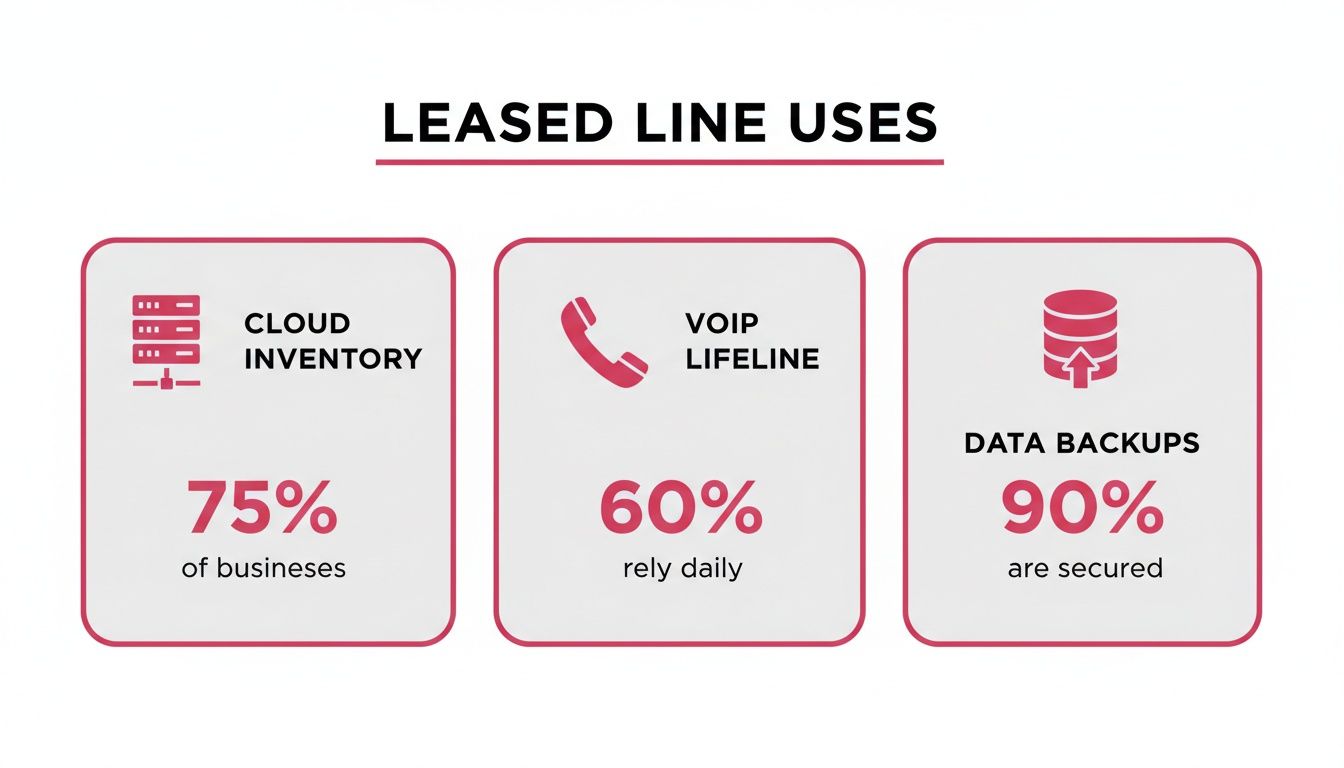
From managing cloud inventory and daily phone calls to securing vital data backups, it is clear that a stable connection is not a luxury; it's the bedrock of modern operations.
Breaking Down the Numbers
The monthly cost for a broadband leased line in the UK is often more affordable than many business owners expect. For businesses in urban areas, you can find entry-level 100Mbps leased lines starting from around £175–£270 per month. If you need more serious performance, a full 1Gbps symmetric line will typically land somewhere between £300–£450 monthly.
These figures really snap into focus when you consider the alternative. Ofcom data suggests that the average cost of internet downtime for a business is a staggering £4,200 per hour. Suddenly, the monthly cost of a leased line seems like a very sensible insurance premium. Better yet, a massive 87% of organisations report a productivity jump of 12–18% after making the switch, simply because file transfers are faster and cloud apps no longer lag.
Calculating the True Return on Investment
Thinking about the cost in the right way is crucial. A leased line is not just about getting faster internet; it's an insurance policy against the financial and reputational disaster that an outage can cause. If your day-to-day work relies on VoIP calls, cloud software, or processing online payments, any downtime means lost revenue and unhappy clients.
The real return on investment (ROI) is not measured in saved seconds on a download, but in the hours of productivity and thousands of pounds of revenue you do not lose when your connection remains stable.
Looking beyond the initial setup, the long-term financial sense it makes is a core part of effective IT cost reduction strategies. Once you factor in the value of your team working without constant interruptions and the peace of mind that comes with a solid Service Level Agreement (SLA), the cost is no longer just a line item on a budget. It becomes a fundamental pillar supporting your business's resilience and profitability.
Getting Your Leased Line Installed: What to Expect
So, you have decided a broadband leased line is the right move for your business. Excellent. The next step is getting it installed, and it is important to understand this is not like switching on a home broadband connection. This is a proper engineering project.
Let's be realistic from the start: the typical lead time for a leased line installation is anywhere from 45 to 90 working days. This is not just red tape; it's the time needed to plan and physically run a dedicated fibre optic cable from the network exchange right to your door.
What Happens After You Sign on the Dotted Line
Once the contract is signed, a well-defined process kicks off. It is a journey with several key stages, all designed to ensure your connection is solid and reliable from day one.
-
The Desk-Based Survey: First, the provider's planners get to work. They will use detailed network maps to figure out the best and most efficient route for the new fibre cable to travel from their nearest network point to your office.
-
The On-Site Survey: Next, an engineer will visit your premises. This is a crucial step. They will pinpoint the exact spot where the cable will enter your building, check for any physical obstacles, and determine what kind of work is needed – whether that is using existing ducts or needing to do some digging.
-
The Physical Installation: This is usually the longest part of the process. It can involve civil engineering work like digging trenches or laying new ducting in the pavement. This work requires careful planning and often needs permits from local councils, which is a big reason for the extended lead time.
Local Availability in Dorset, Somerset, Wiltshire, and Hampshire
For professional services firms operating across the South West, the good news is that getting a leased line is more achievable than ever. Thanks to major national infrastructure projects, the full-fibre network is expanding rapidly. This means dedicated connections are becoming more available and affordable, even for businesses in semi-rural areas that were previously left behind.
This regional expansion is a massive advantage for local companies needing seriously dependable internet. A key part of the process is knowing how to choose an internet provider with genuine local knowledge and presence.
The UK-wide push for full-fibre is transforming the broadband leased line market. In May 2020, full-fibre was available to just 14% of the country. By July 2025, that figure is expected to hit 78%, with forecasts suggesting over 90% of businesses will have access by the end of 2026. This has also shifted what businesses are asking for; just three years ago, a 100Mbps leased line was the standard order. Now, it is 1Gbps. You can read more about the growth of UK fibre connectivity on ispreview.co.uk.
Integrating Your Leased Line into a Managed IT Strategy
A broadband leased line is far more than just a quick internet connection. We see it as the bedrock of a truly resilient, modern IT strategy. When we work with a client to integrate a leased line, it becomes the central pillar that supports and enhances every other managed service we deliver. It turns your technology from a simple cost centre into a genuine strategic advantage.
This dedicated, private connection is what unlocks the true potential of your entire IT infrastructure. Its guaranteed performance means all your critical systems can run at their absolute best, free from the bottlenecks and frustrating unpredictability that often come with shared business broadband.
Empowering Your Core Business Services
Think about the tangible impact on your day-to-day operations. The symmetrical speeds and low latency are absolutely vital for running a crystal-clear 3CX VoIP telephone system. This ensures you never drop an important client call because of a choppy connection.
That same reliability is crucial for protecting your data. Our automated cloud backup solutions can run seamlessly in the background over a leased line, transferring huge amounts of data quickly and securely without ever slowing your team down. It provides peace of mind that your business information is always safe.
A leased line is not just an isolated upgrade. It is the critical component that ensures every other part of your managed IT service—from cybersecurity to cloud applications—can perform as intended, 24/7.
A Foundation for Security and Growth
The stability of a leased line is also fundamental to strong cybersecurity. Our 24/7 monitoring services depend on a constant, uninterrupted data stream to spot and react to threats in real time. This dependable connection is what underpins your entire security posture and helps you maintain regulatory compliance.
Beyond security, its powerful bandwidth supports the very projects that push your business forward. A complex enterprise Microsoft 365 migration, for example, becomes a much smoother and faster process. To get a better feel for how we manage all this traffic, you can learn more about what Quality of Service is in our guide.
Ultimately, a professionally managed leased line helps you avoid the costly downtime that plagues standard broadband. UK firms often report efficiency gains of 12–18% after making the switch, saving thousands each year by sidestepping disruptive outages. To find out more, you can discover insights about leased line reliability on amvia.co.uk.
Frequently Asked Questions About Leased Lines
We find that when businesses are thinking about a broadband leased line, the same questions tend to pop up. To help you get the clarity you need, we have put together straightforward answers to the things we get asked most often.
How Long Does a Leased Line Installation Actually Take?
It is important to set expectations here: you should budget for anywhere between 45 and 90 working days. This is a far cry from a typical broadband setup; think of it more as a dedicated engineering project for your business.
The whole process involves a proper site survey, getting the right permissions from local councils for any necessary street works, and then the physical job of running a brand new fibre optic cable right to your door. The final timeline really depends on where your building is and how close you are to the existing network.
Is a Leased Line Genuinely Worth the Extra Cost?
If your business grinds to a halt without the internet, then yes, absolutely. While the monthly cost is certainly higher than a standard business fibre package, what you're really paying for is guaranteed performance and rock-solid reliability.
The real value is not just about the fast, symmetrical speeds. It is the legally binding Service Level Agreement (SLA) that promises near-perfect uptime and guarantees a swift fix if things go wrong. When you calculate the cost of lost business and staff sitting idle during an outage, the investment makes perfect sense.
Imagine a busy accountancy firm in Dorset during tax season. They simply cannot afford for their cloud software or VoIP phone system to fail. For them, a leased line is a critical insurance policy that keeps the business running smoothly.
Can I Get a Leased Line in a Rural Area?
More than likely, yes. Availability across the rural parts of Dorset, Somerset, Wiltshire, and Hampshire is getting better all the time. As the national fibre network expands, leased lines are becoming a realistic option for more businesses, not just those in town centres.
Installation in a more remote spot might involve a higher one-off setup charge because of the extra groundwork needed, but it is very achievable for most. We can only give a definite answer after an initial site survey, which maps out the route and details any construction work. This check gives you a clear, no-obligation picture of what's involved from the start.
A reliable leased line is the foundation of a modern, secure IT strategy. SES Computers integrates this superior connectivity into our managed IT support, ensuring your business stays productive and protected. Contact us today to discuss your requirements.