When you get down to it, the real difference between Cat7 and Cat8 cabling boils down to performance versus application. Cat7 cable offers a very respectable 10Gbps speed over a full 100 metres, making it a solid, reliable choice for wiring up a typical office. For instance, a law firm in London could use Cat7 to connect every paralegal's workstation, ensuring fast access to large case files and smooth video conferencing with clients. In contrast, Cat8 delivers an incredible 40Gbps, but only over a much shorter distance of 30 metres.
This fundamental trade-off means they are built for entirely different jobs. Your decision hinges on a simple question: do you need a dependable, long-distance connection for everyday office use, or are you building a high-speed backbone for your core server hardware?
Understanding the Core Differences
Choosing the right network cable is a foundational decision for any UK business. It is the kind of choice that affects everything from the clarity of your VoIP calls to the speed of your cloud backups. Thinking about Cat7 vs Cat8 is not just about grabbing the latest and greatest; it is a strategic investment that will define your network's performance and reliability for years to come.
A well-thought-out cabling installation is the central nervous system of your entire operation, ensuring data moves smoothly between workstations, servers, and switches. To make the right call, it is essential to understand what network infrastructure truly is and how it supports your business goals.
To really see where each cable shines, it helps to put their specifications side-by-side. Cat7 has been a highly capable standard for some time, but Cat8 was engineered from the ground up to handle the immense bandwidth demands of modern data centres.
Cat7 vs Cat8 At-a-Glance Specification Comparison
This table offers a quick snapshot of the key technical differences between Cat7 and Cat8, highlighting their distinct capabilities at a glance.
| Specification | Category 7 (Cat7) | Category 8 (Cat8) |
|---|---|---|
| Max Bandwidth | 600 MHz | 2000 MHz |
| Max Data Rate | 10 Gbps | 25/40 Gbps |
| Max Channel Length | 100 metres | 30 metres |
| Shielding Type | S/FTP (Screened/Foiled Twisted Pair) | S/FTP (Screened/Foiled Twisted Pair) |
| Primary Use Case | General office, workstations, 10G LAN | Data centres, server-to-server links |
| Connector Type | GG45 / TERA / RJ45 Compatible | RJ45 |
As the numbers show, the core trade-off is clear. Cat7 provides excellent speed over the longer distances needed for a standard office layout, while Cat8 makes a deliberate sacrifice on length to achieve a monumental leap in data throughput. This specialisation firmly places them in different roles within a business network.
A Closer Look at the Technical Specifications
To really get to the heart of the Cat7 vs Cat8 debate, we need to go deeper than just the advertised speeds. The true differentiators are the cable's frequency (its data-handling capacity) and the quality of its shielding. These two factors are what determine how fast and reliable your network will actually be in a busy commercial environment.
Think of a cable's frequency, measured in megahertz (MHz), as the number of lanes on a motorway. More lanes mean more traffic can flow at high speed without causing a jam. Cat7 cabling operates at a very capable 600 MHz, which is plenty for delivering 10Gbps speeds. But Cat8 blows this out of the water, operating at a massive 2000 MHz (2 GHz). This is not just an incremental step up; it is a monumental leap in capacity that enables far greater data throughput.
Frequency and How It Feels in the Real World
That massive jump in frequency is not just a number on a spec sheet; it translates into a tangible difference in performance that you can feel day-to-day. For any business that depends on real-time applications, this is where the choice really matters.
Imagine a professional services firm in Hampshire that uses a 3CX VoIP system to speak with clients and a virtual desktop setup for its hybrid team.
- With Cat7: The 600 MHz bandwidth is perfectly fine for standard VoIP calls and VDI sessions. It provides a clear, stable connection for most typical office work. A call centre, for example, would find this more than adequate for their daily operations.
- With Cat8: The 2000 MHz bandwidth offers enormous headroom. This dramatically cuts down latency (the tiny delays in data transfer), making VoIP calls exceptionally clear and free from jitter. The virtual desktop experience becomes incredibly fluid and responsive, even when the network is under heavy load.
For any application where even milliseconds count—think financial data processing or high-definition video conferencing—Cat8's superior frequency provides an undeniable edge.
Why Shielding is So Important
Both Cat7 and Cat8 cables use a high-quality shielding method known as Screened/Foiled Twisted Pair (S/FTP). This means each pair of internal wires is wrapped in its own foil shield, and then the entire bundle of four pairs is wrapped in a tough, braided outer screen. This construction is your best defence against electromagnetic interference (EMI)—the electrical "noise" generated by things like fluorescent lights, power lines, and heavy machinery.
While both cable types are well-shielded, the standards for Cat8 are far more rigorous to support its 2 GHz frequency. This superior shielding is crucial for preventing "crosstalk"—where the signal from one cable interferes with another—especially in tightly packed spaces like a server rack. If your main concern is upgrading a standard office, you might find our detailed guide on Cat6 vs Cat8 cabling useful for seeing how these standards compare.
We are already seeing a clear shift in the market. UK SMEs, particularly in sectors like retail and education across Somerset and Dorset, are increasingly specifying Cat8 for new enterprise networks. This is part of a wider trend that’s seeing the market grow at a 13.6% CAGR between 2023-2032. The driving force is Cat8’s ability to deliver the low-latency performance needed for hosted desktops and complex VMware migrations. One recent analysis even noted a 25% rise in Cat8 demand since 2023, fuelled in part by a 40% growth in Power over Ethernet (PoE) adoption for devices like VoIP phones and security cameras.
Evaluating Performance Over Distance
A cable's real-world value often comes down to its limitations, especially how well it performs over distance. When you are weighing up Cat7 vs Cat8, the maximum channel length is a critical detail that really defines where each cable belongs in a professional network. This is not just a minor spec difference; it fundamentally separates their roles.
Cat8 cabling was purpose-built for one thing: incredibly fast, short-range connections. It can push that staggering 40Gbps speed, but only up to a maximum channel length of 30 metres. This makes it an absolute powerhouse for connecting high-performance equipment in a small, contained area. For example, linking servers to top-of-rack switches or connecting core network gear in the same communications room.
Cat7, by contrast, offers its solid 10Gbps performance over the standard 100-metre distance we have come to expect from network cabling. This longer reach makes it a much more flexible and practical choice for the horizontal cabling that wires up a typical office. It can comfortably connect workstations, VoIP phones, and access points across an entire floor without any signal drop-off, providing the reliable connectivity you need where longer runs are essential.
Connectors and Compatibility Concerns
Beyond raw speed and distance, the physical connectors each cable uses have major practical consequences for any installation. This is another area where the practical differences between Cat7 and Cat8 really show.
Cat8 sticks with the familiar, industry-standard RJ45 connector. This is a massive plus. It guarantees out-of-the-box compatibility with virtually all existing network hardware—from switches and servers to workstations and wall plates. This standardisation makes network upgrades straightforward and avoids the headache of sourcing special adaptors or niche equipment.
Cat7, on the other hand, was developed with the less common GG45 connector in mind. While it is backwards-compatible with standard RJ45 ports, you often need matching GG45 hardware to get the full benefit of its advanced shielding. In most business environments, this hardware just is not common, which can add needless complexity and potential compatibility headaches to a project. To understand more about how these factors relate, you can explore what network bandwidth is and how it affects performance.
The core takeaway is straightforward: Cat8's 30-metre limit makes it a specialist for the data centre, while Cat7's 100-metre reach makes it a generalist for the office floor. The universal RJ45 connector on Cat8 further enhances its practicality for modern, high-density environments.
While these cables are champions of wired performance, sometimes you need a wireless solution. For those scenarios, it is worth looking into optimizing wireless network performance over distance with devices like Wi-Fi range extenders.
Practical Use Cases for UK Businesses
When you move beyond the technical specifications, the real question is where do Cat7 and Cat8 actually fit into a modern business? It’s not about picking the “best” cable, but the right one for the job. Getting this wrong can mean overspending on infrastructure you will never fully use.
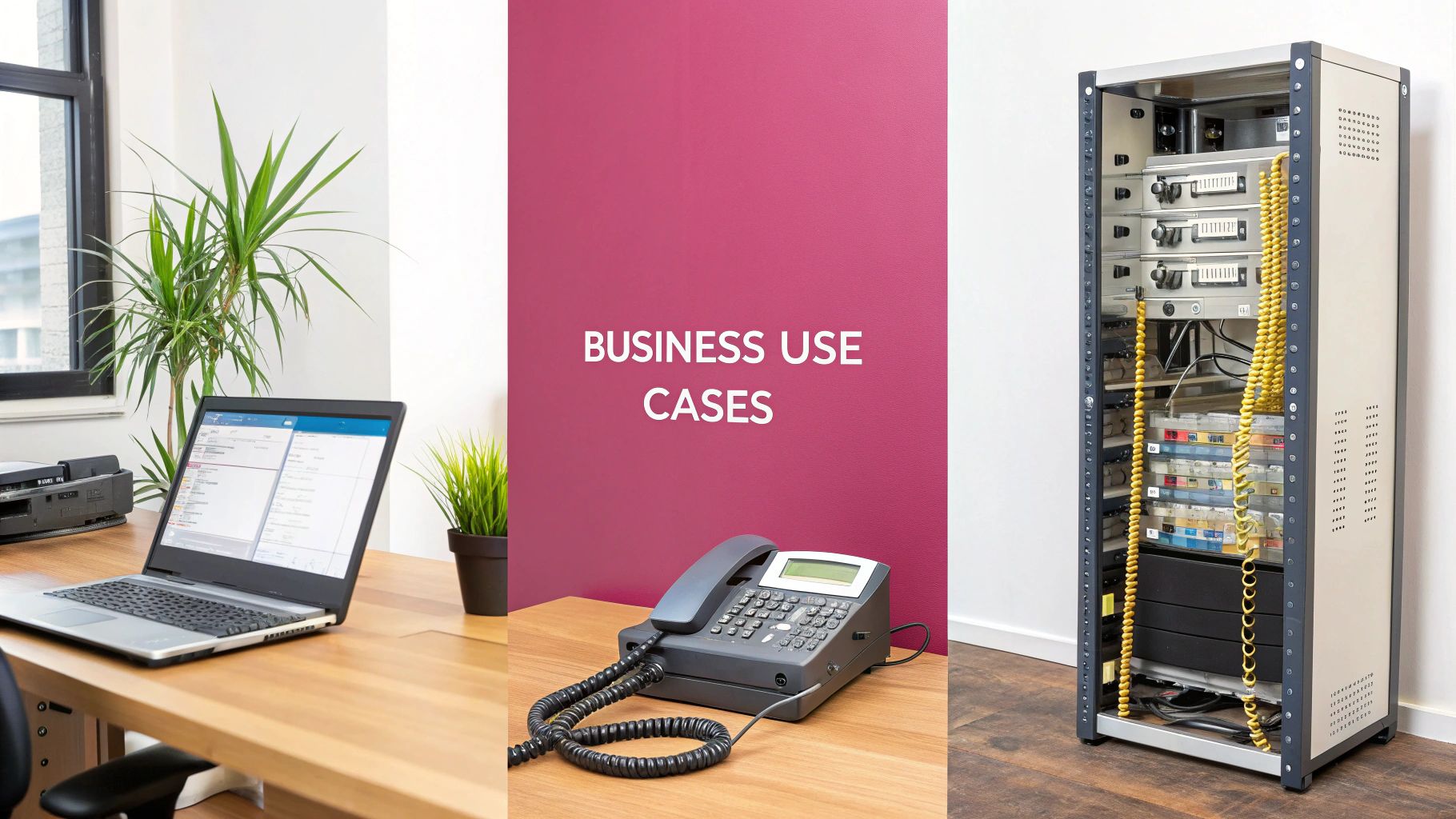
For most day-to-day office environments, Cat7 is the undisputed workhorse. It delivers a solid 10Gbps performance, which is frankly more than enough for the vast majority of UK businesses. It provides a reliable, fast connection for all the essential tools your team relies on.
Cat7 for Everyday Office Operations
Think about a typical professional services firm in Somerset. Their network has to support a team using a standard mix of business software and devices. Cat7 is the perfect fit here.
- Workstations and Laptops: It easily handles connecting desktops and laptops for accessing cloud software, managing emails, and collaborating on shared documents.
- VoIP Phone Systems: For crystal-clear client calls on systems like 3CX, a stable network is non-negotiable, and Cat7 provides that stability.
- Network Printers and Scanners: It ensures that sending large print jobs or scanning documents does not grind your network to a halt.
In this scenario, Cat7 delivers all the performance needed at a sensible price point. It effectively future-proofs the office for years of 10Gbps operation without the unnecessary expense of running a higher-spec cable to every desk.
Cat8 for High-Density and Core Infrastructure
Cat8, by contrast, is a specialist. It is built for short, incredibly high-speed connections within your core IT infrastructure—think inside a communications cabinet or between server racks. Its entire purpose is to manage enormous data throughput where it counts the most.
The decision is less about which cable is "better" and more about which is appropriate for the task. Cat7 is for the widespread office floor; Cat8 is for the concentrated power of your server rack.
A great example is a manufacturing company in Wiltshire using Industrial Internet of Things (IIoT) sensors on its production line. These sensors generate a constant, massive stream of data that needs real-time analysis to keep things running efficiently. This is where Cat8 shines.
- Switch-to-Server Links: A 40Gbps link from a core network switch to a physical server eliminates data bottlenecks completely.
- Storage Area Network (SAN) Connections: Guarantees blistering-fast access to centralised data storage, crucial for business-critical applications.
- Inter-Switch Uplinks: Creates an ultra-high-capacity backbone by linking multiple switches together within a communications rack.
This is precisely where the Cat7 vs Cat8 discussion becomes critical. The growth of Industry 4.0 in UK manufacturing hubs like Dorset and Hampshire has accelerated this need. The adoption of high-category cables in these settings surged by 28% between 2022 and 2025, with Cat8 leading the charge. This transition is vital for factories where smart sensors have been shown to reduce downtime by 35% after deploying Cat8. You can find more insights in the UK industrial ethernet cables market report.
Comparing Cost and Future-Proofing
When you are investing in your network infrastructure, it is about more than just the price per metre on a spool of cable. A truly smart decision on Cat7 vs Cat8 means looking at the total cost of ownership—the cable, the compatible hardware like switches, and what it is worth to your business down the line.
There’s no getting around it: Cat8 cable costs more upfront. The advanced materials and incredibly tight manufacturing tolerances needed to handle frequencies up to 2000 MHz mean the raw cable is simply more expensive to produce. That’s a straightforward budget consideration for any project.
But for a business that is planning for serious data growth, Cat8 is the clear long-term play. Its ability to handle 25GBASE-T and 40GBASE-T speeds means it is ready for the next wave of network hardware. It is an investment that could save you from a complete, and costly, infrastructure rip-and-replace in just a few years.
The True Cost of Installation
Looking beyond the cable itself, you have to think about the hardware it plugs into. To get anything out of Cat8's massive potential, you need switches and network interface cards (NICs) that can actually run at 25Gbps or 40Gbps. This gear is becoming more accessible, but it still commands a premium over the 10Gbps equipment that runs perfectly with Cat7.
Let's look at two practical scenarios:
-
The Cat7 Scenario: Imagine a Somerset-based accounting firm wiring a new office floor for 50 people. All they really need is solid 10Gbps connectivity for workstations and VoIP phones. Here, a full Cat7 installation is a brilliant choice—it is cost-effective, delivers more than enough performance, and handles all their needs for the foreseeable future.
-
The Cat8 Scenario: Now, think about a Wiltshire data centre upgrading its server room. They are linking new, high-performance servers to a core switch. Using Cat8 for these short, mission-critical connections provides the huge bandwidth they need right now and prepares them for the next five to ten years of hardware upgrades. The higher initial cost is easily justified by the long-term strategic value.
While Cat7 offers a powerful and budget-friendly solution for today's 10Gbps networks, Cat8 is a strategic investment in tomorrow's performance demands. The choice really hinges on your IT roadmap and how you see your operations growing.
Aligning Investment with Your IT Roadmap
The UK's Ethernet cable market is growing, but it is not uniform. Projections for Western Europe point to an 11% growth in the commercial sector, which includes business hubs across Dorset and Hampshire. This growth is heavily influenced by data centres, where Cat8 is expected to gain a 42% preference by 2025.
Interestingly, in sectors like education, Cat8's backward compatibility with existing Cat7 infrastructure has already saved some institutions 15-20% on rewiring costs during expansions, all while meeting UKCA standards. You can discover more insights about the evolving network cable market and its regional impact.
So, what is the bottom line? If your IT roadmap has no solid plans to move beyond 10Gbps in the next five years, a high-quality Cat7 installation is the smarter, more cost-effective choice. It gives you fantastic performance without forcing a costly upgrade of all your switches and NICs, freeing up budget for other critical projects.
Making the Right Choice for Your Network
When it comes down to it, the Cat7 vs Cat8 debate is not about picking the newest technology. It is a practical decision based on your specific needs, your operational environment, and where you see your business heading in the next few years.
For the vast majority of UK businesses, the immediate goal is solid, reliable connectivity across an office. If you need a robust 10Gbps network to support workstations, VoIP systems, and everyday office traffic, Cat7 is more than capable. It delivers excellent performance and shielding over the full 100-metre runs common in horizontal cabling.
But for operations where data throughput is absolutely critical, Cat8 is really the only contender.
Situational Recommendations
Let's look at a couple of real-world scenarios:
- For a Data Centre or Server Room: You should be looking at Cat8. Its ability to handle 40Gbps speeds is essential for connecting high-speed switches to servers. It creates a powerful network backbone that prevents data bottlenecks right where they are most likely to occur. A practical example is connecting a new high-performance blade server directly to a 40G core switch in a financial services data centre.
- For a New Office Build-Out: Cat7 (or even a high-quality Cat6a) is the smarter choice here. You get future-ready 10Gbps connectivity to every desk without the significant expense of Cat8-compatible hardware, which would be complete overkill for standard user workstations. For example, a new marketing agency floor plan would be perfectly served by Cat7 cabling to each hot desk and meeting room.
This decision path helps to clarify the choice between meeting today's 10Gbps needs and making a long-term investment for speeds well beyond that.
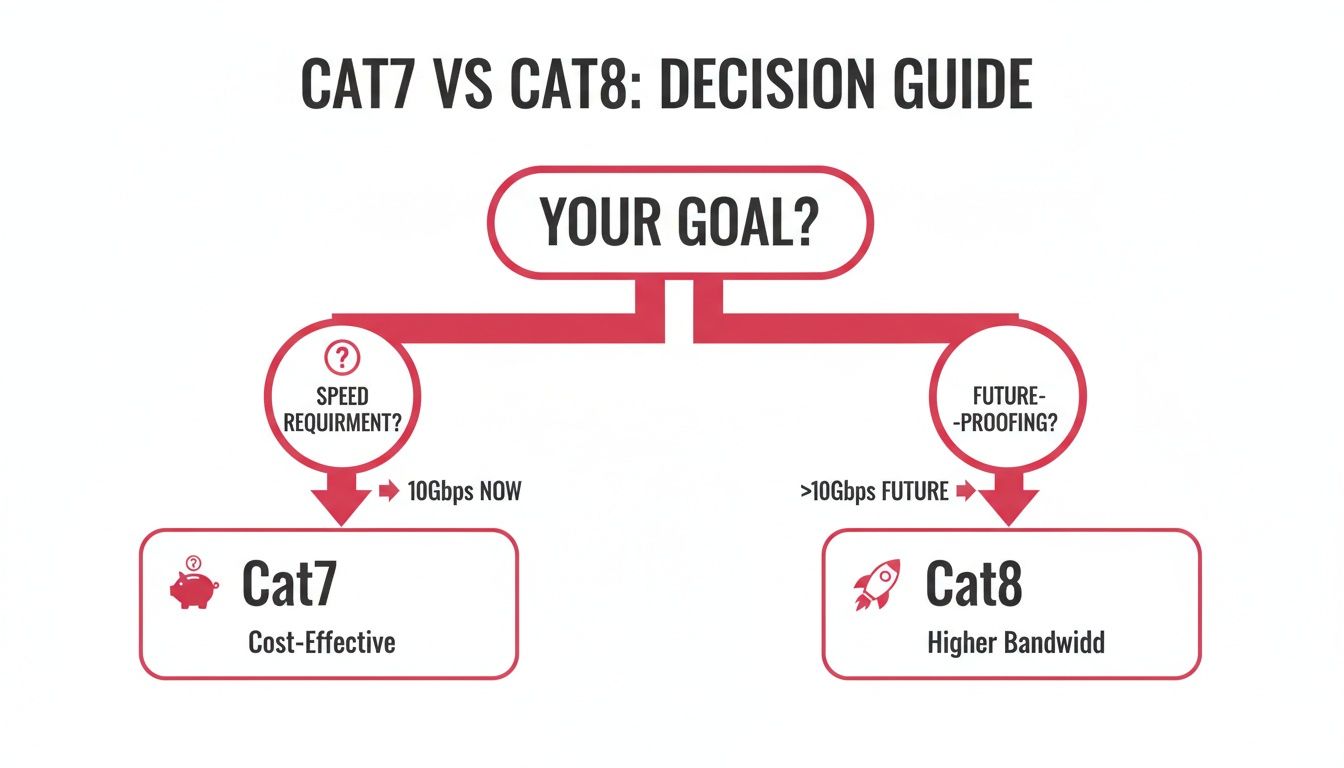
To put it simply, Cat7 is the cost-effective, high-performance standard for today’s 10Gbps office networks. Cat8 is the strategic investment for tomorrow's data-intensive environments.
Frequently Asked Questions
When you are looking at a network upgrade, the technical details can throw up a lot of practical questions. Here, we tackle some of the most common queries we hear from UK businesses trying to decide between Cat7 and Cat8 cabling.
Is Cat7 Obsolete Because of Cat8?
Not at all. Think of it this way: Cat7 is still an incredibly capable standard for delivering a solid 10Gbps over the full 100-metre distance. For the vast majority of UK businesses, that is more than enough bandwidth for workstations, VoIP systems, and everyday office networking. It remains an excellent, reliable choice.
Cat8 was never designed to replace Cat7 everywhere. It was developed for a very specific job: extremely high-speed connections over very short distances, like linking servers to a switch inside a single data centre rack. It is a specialist tool for a specialist environment.
Can I Mix Cat7 and Cat8 Cables in My Network?
Yes, you absolutely can. Ethernet is built to be backward-compatible, so you will not break anything by mixing them. If you plug a Cat8 patch lead into a network that is wired for Cat7 (or even Cat6a), the connection will simply operate at the maximum speed that both ends can handle.
The key thing to remember, though, is that you only get the benefit of the fastest component if the entire chain supports it. To see genuine Cat8 speeds of 25Gbps or 40Gbps, every single piece of that connection—the server's network card, the switch port, and the cable—must be Cat8-rated. Mixing is fine for compatibility, but it will not magically speed up your older hardware.
Do I Need New Equipment to Use Cat8 Cables?
To get the performance Cat8 was built for, then yes, you will need new network hardware. Your switches and network interface cards (NICs) must specifically support the 25GBASE-T or 40GBASE-T standards. If you plug a Cat8 cable into older 10Gbps equipment, it will work perfectly, but it will only run at 10Gbps.
The upside is that Cat8 uses the familiar RJ45 connector. This means it physically fits into all your existing network ports, which is great for a staged upgrade. You could install the future-proof Cat8 cabling now and then upgrade the active hardware later when your business actually needs those top-tier speeds.
Choosing the right cabling is a fundamental part of building a network that is not just fast, but also resilient. For expert guidance on planning and installing an infrastructure that will support your business for years to come, get in touch with SES Computers. You can learn more about our managed IT support and network installation services at https://www.sescomputers.com.