The fast-approaching 2025 PSTN switch-off is far more than a technical deadline—it's a critical moment for your business. This nationwide digital upgrade means the old copper phone lines you've relied on for decades are about to become a thing of the past. Making the move to a voice over ip for business system isn't just an option; it's the necessary next step to keep your communications running.
Why Your Business Telephony Needs a Digital Upgrade
For professional services firms across Dorset, Somerset, Wiltshire, and Hampshire, now is the time to rethink your phone system. Sticking with the old Public Switched Telephone Network (PSTN) is a bit like relying on a manual ledger in the age of accounting software. It has a certain familiarity, sure, but it's becoming less reliable, more expensive, and lacks the features modern business demands.
Voice over IP (VoIP), on the other hand, is the modern, high-performance equivalent. It works over your internet connection, delivering the kind of flexibility and advanced features that today's professional environment demands.
The Clock Is Ticking on the Digital Switchover
The UK's VoIP market is growing at a staggering pace, with forecasts showing a projected surge of USD 5.3 billion between 2024 and 2029. A huge part of this growth is down to the 2025 PSTN switch-off, which is pushing businesses to modernise. For a law firm or an accountancy practice, this isn't just about compliance; it's a genuine opportunity to slash operational costs and make your practice more efficient.
This move is part of a much bigger picture. To get a sense of how communication technology has changed, it’s worth looking into the evolution of customer service and seeing how far we've come from basic call centres.
For over 30 years, SES Computers has been the go-to IT partner for local professional firms right here in the region. We know the specific challenges professional services face and we’re here to guide you through this essential transition, making sure your upgrade is smooth and genuinely beneficial.
Getting Ready for a More Flexible Future
Switching to VoIP is more than just ticking a box for the switchover; it's a smart investment in your company's future. By embracing this technology, you're building a more resilient and agile business. For a professional service, the main benefits speak for themselves:
- Future-Proofing Your Practice: You’ll secure your communications against becoming obsolete and be ready for whatever new technology comes next.
- Improving How You Talk to Clients: Deliver a more professional and responsive service with features like intelligent call routing, auto-attendants, and integration with your practice management software.
- Building a Modern Workplace: Give your team the tools they need to work effectively from anywhere—the office, home, or even court—perfectly supporting the shift towards flexible and remote working.
How Does VoIP Actually Work for Your Business?
At its heart, Voice over IP (VoIP) is simply a modern, smarter way to handle your business calls. Instead of using the old-fashioned copper wires of the traditional phone network (the PSTN), VoIP technology sends your voice conversations over your existing internet connection.
Think of it like the difference between sending a letter and sending an email. Both get the message across, but email is faster, cheaper, and lets you do so much more, like attaching documents securely. In much the same way, a voice over ip for business system doesn't just make calls; it opens up a world of powerful features that old phone systems can't touch.
From Your Voice to Digital Data
When you speak into a VoIP phone, your voice is instantly converted into tiny digital packages of information, known as data packets. These packets travel across the internet to the person you're calling, where their phone puts them back together into clear audio.
The whole process happens in the blink of an eye. Because it uses the broadband connection you already pay for, it sidesteps the traditional phone companies and their associated costs, giving your business a far more flexible and cost-effective communications tool.
A Few Key Ideas, Explained Simply
The technology behind it all might sound complicated, but as a business owner, you only need to get your head around a couple of key concepts. Understanding these will show you exactly how a VoIP system is built to support a practice like yours in Dorset or Somerset.
- Hosted PBX: This is the control centre of your phone system, but instead of being a bulky box in a server room, it lives securely in the cloud. A provider like SES Computers manages all the hardware and software for you, so you get top-tier features without the maintenance headaches. For a busy solicitor's office, this means no IT distractions, just a powerful system that works.
- SIP Trunking: Think of SIP trunks as the digital version of old-fashioned telephone lines. They are the virtual pathways that connect your cloud phone system to the rest of the world, allowing you to make and receive calls to any landline or mobile, anywhere.
The real game-changer for your business isn't just the tech itself, but what it allows you to do. VoIP turns your phone from a simple utility into a strategic business asset that supports flexible working, enhances client service, and grows right alongside your company.
Your Internet Connection is Key
Since VoIP runs over your internet connection, the quality of that connection is important. The good news is that modern systems are incredibly efficient, and a single voice call uses very little bandwidth.
The most critical piece of the puzzle for ensuring crystal-clear calls is your router. A properly configured router will always prioritise your voice traffic over less important data like emails or web browsing. You can find out more about the specifics by reading up on the role of a voice over ip router. Getting this right guarantees your calls remain professional and reliable, without any frustrating dropouts or glitches.
The Tangible Benefits of VoIP for Professional Services
Right, let's move past the technical jargon. What does switching to a voice over ip for business system actually mean for your day-to-day operations? For professional services firms across Wiltshire and Hampshire, the benefits aren't just theoretical – they show up as real savings, greater agility, and a much sharper client experience. This isn't just swapping out old phone lines; it's a fundamental upgrade to how you communicate.
Slash Your Overheads
The most immediate and welcome change you'll notice is the impact on your outgoings. Old-school phone systems are notorious for their hidden costs: steep line rental fees, expensive hardware maintenance, and eye-watering bills for any calls made outside your local area. VoIP completely changes the game by running over the internet connection you're already paying for.
This simple shift is how VoIP delivers such significant cost savings for UK SMEs. We're not talking about trimming a few pounds here and there. Small businesses often see their phone bills shrink by a staggering 70-80%, while medium-sized firms can expect to save 50-75%. For a financial advisory firm, for example, redirecting these savings from operational costs into business development is a significant win. You can dig deeper into the numbers by exploring the latest findings on VoIP cost benefits.
Work From Anywhere, Seamlessly
Business today happens everywhere, not just in a single office. You might have team members working from home in Dorset, visiting clients in Somerset, or spread across multiple sites. A modern business VoIP system ties everyone together, allowing them to make and receive calls on their main business number from a laptop or a mobile app. It means you present a consistent, professional front, no matter where your team is.
This kind of flexibility is a huge advantage for professional services. For example, a solicitor in Dorset can take a client call on their business number via a mobile app while at court, ensuring they never miss an important conversation. They appear as if they are in the office, maintaining a professional image at all times.
The ability to scale your phone system up or down in an instant is a game-changer. Imagine you’re a Wiltshire-based accountancy firm heading into tax season. You can add extra lines in minutes to handle the inevitable surge in client calls. Once things quieten down, you scale back just as easily. You only ever pay for what you actually use.
Traditional Phone Lines vs Business VoIP: A Clear Comparison
To really grasp the practical difference, it helps to put the old and new systems side-by-side. The table below cuts through the noise and shows how a VoIP solution transforms everyday business operations.
| Feature | Traditional PSTN System | Modern VoIP Solution |
|---|---|---|
| Setup & Installation | Requires a physical line installation by an engineer, which can be slow and disruptive. | Minimal physical setup; often configured remotely and activated quickly over your broadband. |
| Adding New Users | Involves ordering new lines, scheduling installations, and buying more hardware. | A new user can be added in minutes through a simple online control panel. No waiting. |
| Remote Working | Very limited. Calls must be physically forwarded, which is clumsy and often costly. | Seamless. Staff use their business number on any device, anywhere with an internet connection. |
| Advanced Features | Basic features only. Anything advanced (like call recording) requires expensive, extra hardware. | A rich set of features like call routing, auto-attendant, and CRM integration are built-in. |
As you can see, the operational gains are immediate and clear. A modern VoIP system is built for the way businesses work today—flexibly, remotely, and efficiently.
Punch Above Your Weight
Finally, a voice over ip for business system helps smaller firms project the polished image of a much larger company. Features like a professional auto-attendant ("Press 1 for Sales, Press 2 for Support") ensure every call is answered and directed correctly, preventing missed calls and lost opportunities.
Intelligent call routing is another powerful tool. Let’s go back to that Wiltshire accountancy firm during tax season. Instead of clients getting a frustrating busy tone, calls can be automatically sent to the next available accountant, or even to a designated mobile if the office is swamped. It’s this kind of smooth, professional experience that builds real trust and keeps clients happy.
Your Step-by-Step Plan for a Smooth VoIP Migration
Switching your business over to a VoIP system isn't something to be nervous about. With a bit of planning, the whole process can be surprisingly smooth, letting you tap into the benefits almost immediately without causing any chaos for your day-to-day operations. The trick is to break it down into a few clear, manageable stages.
A well-thought-out migration plan gives you control, minimises any risks, and makes sure you get the best possible return on your investment from day one. Let’s walk through the key steps for a successful VoIP deployment, from sizing up what you have now to getting your team comfortable with the new tech.
This infographic shows the core benefits that drive a VoIP migration project forward.
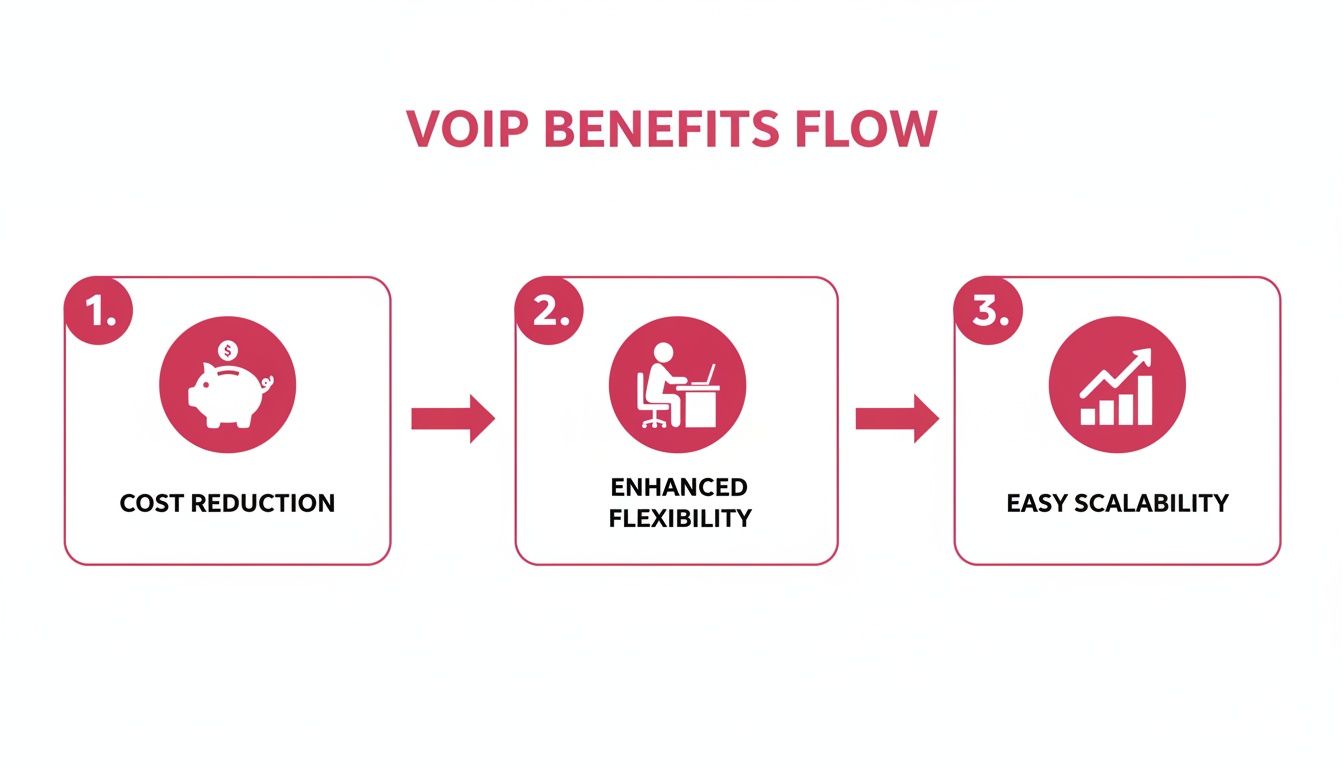
As you can see, the move to VoIP isn't just about saving money on calls; it’s about making your entire business more agile and adaptable.
Phase 1: Assess Your Current Setup
Before you can plan your route, you need to know exactly where you're starting from. This first phase is all about auditing your current phone system and getting a really clear picture of what your business actually needs. It’s a vital step that helps you sidestep any nasty surprises down the line.
Start by digging out your recent phone bills. You need a solid understanding of what you're currently spending on line rentals, call charges, and any ongoing maintenance contracts. This number is your baseline, and it's essential for properly calculating how much you'll save later on.
Next, it's time to look at your internet connection. Since VoIP relies entirely on your broadband, its performance is non-negotiable. Here’s a quick checklist to work through:
- Bandwidth Test: Run a few speed tests at different times of the day. A single VoIP call only needs about 100 kbps, but you have to account for everyone making calls at once, on top of all your usual internet traffic.
- Network Hardware: Take a look at your routers and switches. Is the equipment modern enough to handle voice traffic without breaking a sweat? Older gear might need an upgrade to guarantee good call quality.
- Quality of Service (QoS): This is a critical setting on your router that tells it to prioritise voice data over everything else (like big file downloads or emails). To get your head around why this is so important, have a read of our guide on what Quality of Service is and how it ensures your calls are always crystal-clear.
Phase 2: Plan the Migration and Select a Partner
Once your assessment is done, you can start mapping out the migration itself. This is where you'll define your goals, set a realistic timeline, and, crucially, choose the right technology partner to see you through it. A good partner doesn't just sell you a box; they make sure the system is a perfect fit for your business.
When you're weighing up potential providers, look past the initial price. For professional services in Dorset, Somerset, Wiltshire, or Hampshire, a local partner brings huge advantages to the table. They’ll have a genuine understanding of the regional broadband landscape and can provide fast, on-site support if you ever need it.
Selecting a partner like SES Computers, who provides UK-hosted infrastructure, is a critical consideration for any professional services firm. This ensures your call data is stored securely within the UK, meeting strict GDPR and data sovereignty requirements for compliance.
Your vendor selection checklist should include these questions:
- Local Expertise: Do they have a solid track record with local professional firms in your sector?
- UK-Hosted Infrastructure: Can they guarantee your data will be stored in UK data centres?
- Comprehensive Support: What are their service level agreements (SLAs) for support calls and fixing problems?
- Scalability: Will their system let you add or remove users easily as your business grows or changes?
Phase 3: Implement and Train
With your partner and solution chosen, you're onto the final phase: implementation and training. Your provider should handle all the technical heavy lifting, which includes porting your existing phone numbers across to the new system. This is a seamless background process that means your clients won't notice a thing.
Of course, the best technology in the world is only useful if your team knows how to use it. Proper, hands-on training is what really unlocks the power of your new VoIP system. A good session should go beyond the basics of making and taking calls. It needs to cover the features that genuinely boost productivity, like setting up conference calls, using the mobile app when out of the office, and integrating with your practice management software.
How to Choose the Right VoIP Partner in Your Region
Picking the right provider is probably the single most important decision you’ll make when moving to a voice over ip for business system. The technology itself is solid, but how it performs—its reliability, its value—is all down to the partner you choose. This is about so much more than just comparing monthly costs; it's about finding someone who gets your business and understands your local area.
A successful VoIP setup relies on three things: quality support, genuine industry experience, and robust security. For professional services across Hampshire, Somerset, and the surrounding counties, getting these right is absolutely vital.
Look Beyond Price and Assess True Value
It’s tempting to go for the cheapest quote, especially when big national providers are throwing out glossy marketing campaigns. But the cheapest option is rarely the best value. A great partner does more than just give you a dial tone; they deliver a complete service that’s built to support how you actually work.
When you’re weighing up potential providers, your checklist needs to focus on substance, not superficial savings. A local partner, for example, can offer a level of responsiveness that a faceless national call centre just can’t touch. When a problem crops up, you want to be on the phone with someone who knows your setup and understands the local infrastructure, not an agent reading from a script hundreds of miles away.
Your VoIP partner isn’t just another supplier; they are a critical extension of your IT infrastructure. Their reliability directly impacts your client communications, your team's efficiency, and even your ability to meet regulatory standards. Choosing wisely is an investment in your business's future.
Key Criteria for Vetting VoIP Providers
To make a smart choice, you need a clear set of criteria. The right partner will have confident, straight-up answers to these questions.
- UK-Based Support and Hosting: Where is their support team actually based? Are their servers in UK data centres? For data sovereignty and GDPR compliance, this is a deal-breaker, and it’s something we at SES Computers take very seriously.
- Proven Sector Experience: Ask for case studies. Have they worked with businesses like yours before? A provider with experience in the legal sector will understand the need for compliant call recording, while one familiar with financial services will know the importance of mobile features for advisors on client visits.
- Robust Security Credentials: How do they protect you? They should be able to walk you through their approach to cybersecurity, including 24/7 monitoring, encryption, and how they handle potential threats to keep your conversations private.
- Clear Service Level Agreements (SLAs): The SLA is your guarantee. It should spell out promised uptime, support response times, and what happens when things go wrong. If an SLA is vague or they don’t have one, that’s a massive red flag.
The Local Advantage for South West SMEs
The argument for a regional partner gets even stronger when you think about the realities of doing business in Dorset, Somerset, Wiltshire, and Hampshire. A local provider like SES Computers is part of the community; we have a genuine stake in seeing you succeed. That translates into a more personal, more accountable service.
We know all about the specific connectivity challenges that can pop up in the more rural parts of our region. We can build in managed internet solutions to make sure your call quality is always crystal clear. That kind of local expertise ensures your voice over ip for business system is built on a rock-solid foundation. To see what the market looks like, you can explore our guide to some of the best VoIP providers in the UK.
The switch to VoIP is happening fast. Projections show that over 60% of UK SMEs will have moved over by 2025. This trend really underscores the need to find a reliable partner to guide you through this critical transition.
In the end, choosing a provider comes down to trust. You need a partner who will take the time to understand your goals and build a system that helps you hit them, all backed by dependable, local support you know you can count on.
More Than Just a Phone: The Advanced Features That Fuel Growth

Once you look past the basic function of making calls, you’ll find that a modern voice over ip for business system is a completely different beast to your old phone lines. It's a powerful communications hub, loaded with features that can genuinely boost your team's output, elevate your customer service, and support real business growth.
These tools aren't just novelties; they turn your phone system from a necessary expense into a strategic advantage. By handling routine tasks and offering smarter ways to work, they help your business punch above its weight and deliver the kind of polished service that makes you stand out.
Your Digital Receptionist: Automate and Impress
An auto-attendant is one of the most popular and impactful features, acting as a digital receptionist for your business. It greets every caller with a professional, pre-recorded message and gives them a clear menu to get where they need to go ("Press one for Conveyancing, two for Accounts…").
Right away, this means no call goes unanswered, even when you're all out of the office. But more than that, it gets clients to the right person on the first try. That simple act eliminates the frustration of being passed around and instantly makes your company look organised and efficient.
A practical example: consider a busy architect's practice in Dorset. An auto-attendant could route urgent calls from contractors on-site straight to the project manager's mobile, while funnelling new client enquiries directly to the business development team. It keeps the whole operation running smoothly.
Link Your CRM for Smarter Conversations
This is where a good VoIP system really starts to shine. By integrating with your Customer Relationship Management (CRM) or practice management software, it can transform how you handle calls. When a client rings, their entire profile and contact history can automatically appear on your screen before you’ve even picked up the phone.
Suddenly, every conversation is loaded with context. Your team knows exactly who they're talking to and what they might need, whether it's a solicitor seeing a case history or a support engineer reviewing a previous issue. It’s a game-changer for providing a truly personal service.
- Here’s how it works: A partner at a Wiltshire-based accountancy firm gets a call. The CRM integration instantly shows them the client’s file, recent queries and key deadlines. They can answer with a personal greeting and dive straight into a meaningful conversation, making the client feel valued and understood.
Use Call Recording for Training and Compliance
For any business serious about quality, staff training, or meeting industry rules, call recording is essential. A VoIP system allows you to automatically record calls for certain teams or individuals, with the recordings stored securely in the cloud for you to access later.
It’s an invaluable tool for getting new starters up to speed, as managers can listen back to real conversations and offer helpful, specific feedback. It also provides a concrete record of what was said, which can be crucial for settling disputes or proving you've met strict regulatory standards.
- A real-world example: For a financial advisor in Somerset, compliant call recording isn't a luxury; it's a regulatory necessity. It creates a vital audit trail that helps them satisfy FCA obligations, protecting both their clients and their business by ensuring every important conversation is documented.
VoIP is far more than just a new way to make calls. It’s a platform designed for a more efficient, professional, and responsive way of doing business.
Your VoIP Questions Answered
Switching up core technology always brings a few questions to the table, and that's especially true for something as crucial as your phone system. To help you feel completely confident about making the move, we’ve answered the most common queries we hear from businesses across Dorset, Somerset, Wiltshire, and Hampshire.
Making a smart decision starts with having all the facts. Let's clear up a few things so you can move forward with your voice over ip for business project.
Will VoIP Work With Our Slower Internet in Rural Hampshire?
This is a really common question, especially for businesses outside the main towns. The good news is that modern VoIP systems are incredibly efficient. A single call typically uses less than 100 kbps of bandwidth, which is well within the capabilities of most standard business broadband connections.
The first thing we do is check your current broadband, with no obligation. If it needs a boost, SES Computers can set you up with the right managed internet solution—whether that’s superfast broadband, fibre, or a dedicated leased line. We make sure your connection is rock-solid for crystal-clear calls, no matter where you are.
You don't necessarily need a lightning-fast leased line for VoIP. What's far more important is a stable, well-managed connection. We simply prioritise voice traffic on your network, and that's what delivers the reliability you need.
Is Cloud Telephony Secure Enough for Our Accountancy Firm?
Absolutely. We know that for professional services like yours, handling sensitive client data means security and compliance are paramount. A professionally managed VoIP solution from a partner like SES Computers is actually often more secure than an old system sat in your office.
Our systems are hosted in secure, UK-based data centres, which takes care of data sovereignty and GDPR compliance right away. We then add 24/7 cybersecurity monitoring on top, ensuring your conversations and data are locked down to the highest standards. For us, security is a core feature, not an optional extra.
Can We Keep Our Existing Business Phone Numbers?
Yes, of course. We can almost always bring your existing business numbers over to the new VoIP system. The technical term for this is 'number porting', and it’s a standard, straightforward process.
We handle everything for you, working with your old provider to make the switch completely seamless. There’s no downtime and no disruption. Your clients will keep calling the same familiar numbers, and the only difference they'll notice is a better, more professional experience when they get in touch.
Ready to modernise your business communications with a reliable, local expert? Contact SES Computers today to book your no-obligation consultation and discover how a VoIP system can transform your operations. Find out more at https://www.sescomputers.com.