Think of a standard broadband connection like a busy public A-road during rush hour. Your speed is at the mercy of everyone else on the road. Now, imagine having your own private, single-lane motorway, clear and direct, straight to your destination. That’s the difference a business leased line makes.
What Is a Business Leased Line, Really?
For many professional services firms across Dorset and Hampshire, the daily reality of standard internet is pure frustration. Glitching video calls with clients, painfully slow cloud software, and the constant worry of downtime can bring productivity grinding to a halt. A business leased line is specifically engineered to solve these problems by giving you a superior, private connection.
It’s a dedicated fibre optic cable that connects your office directly to the provider's network. Crucially, you don't share this capacity with anyone else. This fundamental difference is what elevates a leased line from a simple utility to a critical business asset, ensuring the performance you pay for is exactly what you get.
The Three Pillars of Leased Line Performance
The guaranteed performance of a leased line is built on three core principles. Getting your head around these makes it clear why it's a world away from conventional broadband.
- Uncontended Bandwidth: The speed you sign up for is the speed you get, 24/7. If you have a 1Gbps line, that full gigabit is exclusively yours. It doesn’t matter if every other business in your area is online at once.
- Symmetrical Speeds: Your upload speed is identical to your download speed. This is a game-changer for modern businesses that rely on sending large files, conducting crystal-clear video conferences with clients, or using cloud-based phone systems.
- Service Level Agreement (SLA): This is your contractual guarantee. It promises near-perfect uptime (often 99.9% or higher) and spells out rapid, prioritised repair times, typically within just a few hours.
A business leased line removes the guesswork and unpredictability of shared connections. It provides the stability and resilience needed for professional operations that simply cannot function without constant, high-quality internet access.
The financial hit from unreliable internet can be eye-watering. For a typical SME, even a short outage can be incredibly costly. According to Ofcom data, the average cost of downtime for UK businesses is a staggering £4,200 per hour, with potential annual losses from shared connections easily reaching tens of thousands. For more on this, you can dig into the costs of business downtime on Amvia.co.uk.
This is exactly why investing in a business leased line isn't just an expense; it’s a form of operational insurance.
The Technical Edge of a Dedicated Connection
While the idea of a private digital motorway is a great starting point, the real muscle of a business leased line is found in its technical specifications. These aren't just abstract terms; they translate into tangible, day-to-day advantages that make a genuine difference to your operations. Understanding what’s under the bonnet is key to seeing why this is a strategic asset, not just another utility bill.
Four core elements give a leased line its superior performance: symmetrical speeds, uncontended bandwidth, low latency, and a robust Service Level Agreement (SLA). Each one directly tackles a common frustration that professional services firms on standard broadband know all too well.
Unlocking Symmetrical Speeds
Most internet connections are asymmetrical, meaning they're built to download much faster than they upload. A leased line, on the other hand, gives you symmetrical speeds – your upload and download speeds are identical.
Consider an architectural practice in Wiltshire needing to send large CAD files to a client for review. On a typical broadband connection, that upload could take several frustrating minutes, creating a real bottleneck. With a symmetrical leased line, the same file is uploaded in a fraction of the time, helping you meet deadlines without stress.
The Power of Uncontended Bandwidth
The phrase uncontended bandwidth is where leased lines really pull away from the pack. It means the speed you pay for is exclusively yours. So, if you invest in a 1Gbps connection, you get 1Gbps all day, every day. It's that simple.
Your performance isn't affected by what neighbouring businesses are doing. This is the crucial difference between smooth, predictable operations and the infuriating slowdowns that hit shared networks during peak business hours. It's what makes things like unlimited dedicated hosting with no bandwidth limits a reality, ensuring consistent performance for any servers or applications you host.
Why Low Latency Matters
Latency is the tiny delay between sending a command and the data transfer actually starting. We’re talking milliseconds, but high latency creates noticeable lag and jitter, which is disastrous for any real-time application.
A business leased line is engineered for exceptionally low latency, which is absolutely vital for:
- Crystal-Clear VoIP Calls: Low latency gets rid of those awkward delays and garbled words on calls, making systems like 3CX completely reliable for client communication.
- Responsive Hosted Desktops: If your firm uses Desktop as a Service (DaaS), low latency makes the remote environment feel just as quick and responsive as a local PC.
- Seamless Video Conferencing: It prevents the freezing and stuttering that can completely undermine a professional client meeting or a multi-party legal deposition.
The Service Level Agreement Guarantee
Perhaps the single most important advantage is the Service Level Agreement (SLA). This isn't just a marketing promise; it's a legally binding contract that guarantees your connection's performance and reliability. It turns your internet from a 'best effort' utility into an accountable, business-critical service.
An SLA translates technical specifications into a business guarantee. It offers peace of mind by contractually obligating your provider to deliver near-perfect uptime and rapid, prioritised support when you need it most.
The rapid rollout of full-fibre infrastructure is making these guarantees more accessible than ever. With projections showing that 90% of UK businesses will soon have full-fibre access, we're seeing average leased line orders climb from 100Mbps towards 1Gbps. It's now standard for providers to offer SLAs with 99.9% uptime guarantees and 4-hour repair targets – a world away from standard broadband support.
At SES Computers, we integrate these powerful connections into our managed solutions, ensuring they provide the perfect foundation for services like DaaS, virtual servers, and 3CX VoIP. This commitment is crucial for any operation that simply cannot afford to go offline.
Calculating the Real Return on Your Investment
It's easy to look at a leased line as just another monthly expense, but that’s a real mistake. A better way to think of it is as a strategic investment—one that pays dividends in operational resilience, team productivity, and future growth. To see its true value, you have to look past the invoice and calculate the return by weighing up the costs it prevents and the efficiencies it unlocks.
The most obvious starting point is the cost of downtime. An unreliable internet connection isn’t just an annoyance; it can bring your entire business to a grinding halt. When your team can’t access cloud-based practice management software, help clients, or process payments, the financial impact adds up fast. In many cases, preventing just a single day of internet failure can pay for the entire annual cost of the leased line service.
Quantifying the Productivity Gains
Beyond stopping those big, catastrophic outages, a dedicated connection gives you noticeable productivity boosts every single day. A slow, laggy internet connection creates thousands of tiny delays that stack up over time, quietly chipping away at your team's efficiency and, ultimately, your bottom line.
Think about an accountancy practice here in Hampshire with a team of ten. If a slow connection costs each employee just 15 minutes a day—waiting for cloud accounting software to respond or for large spreadsheets to sync—that’s 2.5 hours of lost billable time, every single day. Over a year, that adds up to hundreds of hours of productivity that a business leased line would have given back.
A leased line transforms your connectivity from a potential bottleneck into a powerful enabler. It ensures your technology stack works for you, not against you, allowing your team to perform at its peak without being held back by poor internet.
The data backs this up. Post-migration surveys of UK organisations that made the switch show some compelling results. A massive 87% reported measurable improvements in productivity, with efficiency gains averaging between 12–18% thanks to quicker file transfers and more responsive apps. A quick ROI calculation shows just how valuable this is: preventing just 30 hours of downtime a year can save a business £126,000, which absolutely dwarfs the rough £6,300 annual cost of an entry-level 100Mbps leased line. As UK connectivity experts have found, this delivers a staggering ROI of over 1,900% before you even start counting the daily productivity gains.
Building Client Trust and Enhancing Security
The benefits don't just stop at your internal operations; they have a direct impact on your client relationships and your security. In a world where so much business is done through remote meetings and digital services, a stable connection is a sign of professionalism.
Let's face it, a crystal-clear, uninterrupted video conference builds far more client trust than one that’s constantly freezing with garbled audio. For any professional services firm—be it accountants, solicitors, or consultants—that relies on remote support or virtual consultations, this kind of reliability is non-negotiable. It shows you've invested in the right infrastructure to serve them properly.
On top of that, a leased line is simply a more secure connection. Because the line is private and not shared with any other businesses, it presents a much smaller target for potential cyber threats. This enhanced security is a critical selling point for any business handling sensitive client data, from legal practices to financial advisers. When you add it all up, the case for a leased line becomes incredibly clear and compelling.
Ultimately, the decision between a standard connection and a dedicated one is a business choice. To better understand the fundamental differences, you can check out our guide on leased lines vs broadband, which breaks down the pros and cons of each.
How a Leased Line Powers Your Industry
It’s one thing to talk about the technical specs of a business leased line, but it’s another thing entirely to see how it solves real-world problems. For professional services firms across Dorset and Somerset, a dedicated connection isn't some abstract luxury; it's the engine that keeps daily operations running smoothly. Switching from a shared, unpredictable connection to a private, guaranteed one makes the tools you rely on every day finally work as they should.
While every professional sector has its own unique pressures, the solution often comes down to the same core requirement: a rock-solid internet connection. A business leased line provides that stable foundation, allowing modern software and communication systems to perform without a hitch.
Let's look at a few examples of this in action.
Accountancy and Financial Services
For any accountancy firm, tax season is the ultimate stress test. The entire practice depends on having constant, reliable access to cloud platforms like Sage, Xero, or QuickBooks. A standard broadband connection that drops out or slows down at a critical moment isn't just an inconvenience—it's a serious business risk that can lead to missed deadlines and unhappy clients.
A leased line completely removes that risk by guaranteeing your connection. Picture your team on deadline day, trying to finalise and submit dozens of tax returns. With a dedicated line, there are no slowdowns, no dropped connections to the portal, and no frustrating lag. Just a smooth, efficient workflow when it matters most. Plus, with symmetrical speeds, uploading hefty financial reports or client data packs takes seconds, not minutes.
The reliability of a business leased line transforms cloud accounting software from a convenient tool into an indispensable asset. It ensures that your firm’s productivity is never compromised by external network congestion, especially during your busiest periods.
Care Providers and Healthcare
In the care sector, dependable communication and instant access to information can be critical. Digital care plans need to be available in real-time, and phone systems must be absolutely reliable for coordinating patient care and handling emergencies. A patchy internet connection is simply not an option.
This is where a leased line provides the resilience you need. It ensures care staff can always access and update digital records from any location, guaranteeing continuity of care. It also offers the flawless stability needed for Voice over IP (VoIP) phone systems. Many industries now depend on VoIP, and for crystal-clear calls and reliable service, good bandwidth is non-negotiable. You can learn more about determining your precise bandwidth requirements for VoIP to see just how a dedicated line supports this essential technology.
Legal Practices and Professional Services
For a legal practice, confidentiality and clarity are everything. A huge part of modern legal work involves secure video consultations with clients and transferring large, sensitive case files. A standard broadband connection introduces unacceptable risks, like a call dropping mid-way through a sensitive client discussion or painfully slow uploads of critical evidence.
A leased line delivers the performance and security this sector demands. Its low latency ensures video calls are as clear and stable as meeting face-to-face, helping build client trust. The symmetrical speeds make sending and receiving multi-gigabyte files effortless, while the private nature of the connection adds a layer of security that’s vital when handling confidential information. This is the kind of infrastructure a modern law firm needs to operate efficiently and securely.
The Leased Line Installation Process and Timelines
Getting a business leased line up and running isn't like flipping a switch on your home broadband. It’s a full-blown engineering project that involves physical work, detailed planning, and careful coordination. Knowing what's involved from day one is key to setting realistic expectations for your business.
The whole process kicks off with a site survey. Engineers visit your premises to figure out the best route to bring a brand new, dedicated fibre optic cable directly into your building. They'll look for existing underground ducting and pinpoint any roadblocks—literally, sometimes—like roads or private land that need to be crossed. This is the feasibility stage.
Based on that survey, you'll receive a formal quote and can place your order. Once that's done, the real behind-the-scenes work starts with securing all the necessary permissions, a process known as getting wayleave agreements.
Navigating Wayleave and Physical Installation
So, what's a wayleave? It’s simply a legal agreement giving the network provider permission to install and manage their equipment on land they don't own. This could mean getting sign-off from your landlord, a neighbouring business, or even the local council.
Honestly, this part of the timeline can be the most unpredictable. Chasing these permissions is often the single biggest cause of delays in getting a leased line installed.
The infographic below breaks down the typical stages and how long you can expect them to take.
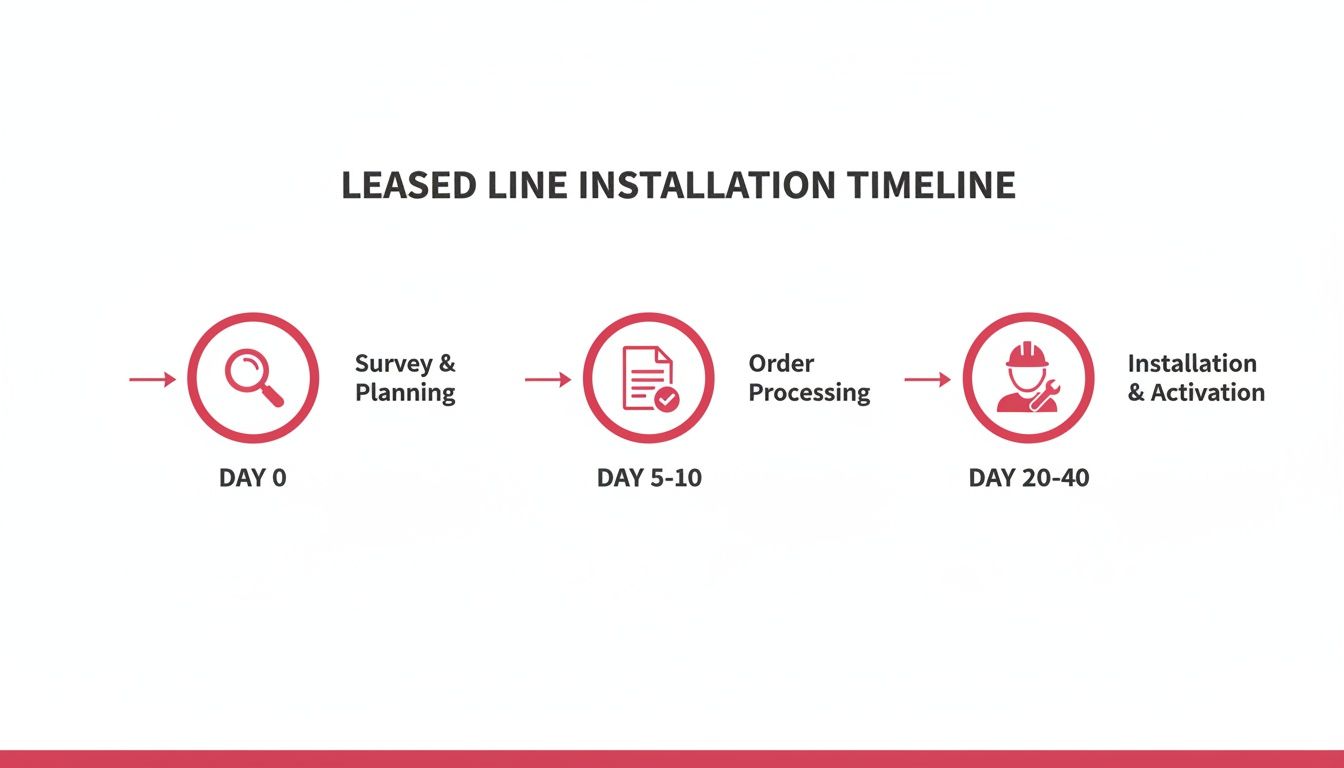
As you can see, the process is split into distinct survey, admin, and engineering phases, all of which add up to the final delivery date.
Once all the paperwork is sorted, the physical work can begin. This might involve 'civils'—digging trenches to lay new ducting if there isn't any already. Finally, the engineers will pull the fibre into your building, install the termination equipment, and run a battery of tests to make absolutely sure the connection is performing exactly as promised.
You should budget anywhere from 30 to 90 working days for the entire installation. This window really depends on the complexity of the route, whether any new digging is needed, and how quickly those wayleave agreements can be sorted out.
Your Managed IT Partner's Role
Trying to manage all this yourself can quickly become a headache. This is exactly where having an IT partner like SES Computers makes a world of difference. We take on the entire project management for you, becoming your single point of contact from start to finish.
Here’s what we handle:
- Managing Communication: We do all the talking with the network carrier, cutting through the technical jargon and giving you clear, regular updates.
- Overseeing Logistics: We coordinate the site surveys, keep on top of the wayleave progress, and make sure engineering visits are booked in efficiently.
- Ensuring Smooth Implementation: Our team manages the final setup and testing, ensuring the handover of your new leased line is completely seamless.
By taking the entire process off your hands, we remove the administrative burden and let you focus on your business. This expert oversight is a core part of our service, designed to get your connection delivered with minimal fuss. If you're weighing up different solutions, our guide on how to choose an internet provider provides some great additional advice.
Why a Local Partner Makes All the Difference
A leased line gives you the raw ingredient for incredible connectivity – that dedicated, high-speed fibre cable running straight to your door. But unlocking the real value of that investment? That comes down to how it’s managed, monitored, and supported by people who actually understand what your business needs to do every day.
You could go to a big national carrier, and they'll get you connected. But partnering with a local IT provider transforms that connection from a simple utility into a rock-solid business asset.
It’s about ditching the impersonal call centre experience for a single, accountable partner. For professional services firms across Dorset, Wiltshire, and Hampshire, it means you can pick up the phone and speak to an engineer who not only knows their stuff but also knows your local area and maybe even your business. It's the difference between being a ticket number and having a team that knows your setup inside and out.
It's More Than Just a Fibre Cable
An experienced local partner like SES Computers picks up where the big carrier’s responsibility ends. The leased line itself is the foundation, but a proper, fully managed solution builds on top of it with essential layers of security, proactive monitoring, and integrated support that modern businesses can't do without.
What does that actually look like?
- Proactive 24/7 Monitoring: We don't wait for you to tell us something's wrong. Our systems watch your connection around the clock, spotting potential issues like latency spikes or packet loss long before you'd ever notice. It’s about preventing problems, not just fixing them.
- Integrated Cybersecurity: The connection is secured from day one. We don't just hand you a cable; we manage the firewall and put robust security measures in place to make sure your private line stays private and protected from threats.
- Seamless IT Support: Your internet connection doesn't exist in a bubble; it powers everything else. We make sure it plays nicely with all your other critical systems, whether that's your 3CX phone system, hosted desktops, or cloud backup solutions.
When you choose a local managed service provider, you get one single point of contact for your entire digital infrastructure. If there's an issue, there's no finger-pointing between your IT support and your internet provider. There's just one team, with one goal: getting you back up and running, fast.
The Local Expertise Advantage
When your entire business relies on its internet connection, you can't afford to wait for slow or ineffective support. With decades of experience helping businesses in the region, SES Computers offers a level of responsiveness that large, remote providers just can't match. If a problem needs someone on-site, our engineers are local and can be there quickly.
This combination of proximity and a genuine understanding of your business turns your leased line from a powerful tool into a genuine strategic advantage. It ensures the reliability promised on paper is backed up by expert, accessible people, giving you the peace of mind to focus on what you do best: running your business.
Leased Line FAQs: Your Questions Answered
It's one thing to understand the benefits on paper, but it's another to sign on the dotted line. You’re bound to have questions before committing to a leased line, and that's perfectly normal. Let's tackle some of the most common ones we hear from business owners.
So, What's the Actual Cost of a Business Leased Line?
This is usually the first question out of the gate, but the answer isn't a simple one-size-fits-all number. The price really boils down to a few key variables:
- Your Need for Speed: A 100Mbps connection will naturally cost less than a full-blown 1Gbps powerhouse.
- Your Location: How close you are to the local network exchange matters. A business in a remote, rural spot might face higher setup costs than one in a town centre.
- Contract Term: Like most services, commitment pays off. Signing up for a three or five-year term will almost always get you a better monthly rate than a shorter one-year deal.
As a rough guide, you can expect an entry-level 100Mbps leased line in the UK to start somewhere in the £150 to £300 per month range. If you need top-tier 1Gbps speeds, you should probably budget for £400 to £800 per month.
What Happens If the Connection Goes Down?
This is where a leased line truly shows its value, and it all comes down to the Service Level Agreement (SLA). With standard broadband, you're on a "best effort" basis for fixes. With a leased line, you have a rock-solid, contractual guarantee.
In the highly unlikely event of an outage, your connection becomes the top priority. A typical SLA will guarantee a fix time of just four to five hours, any time of day, any day of the year. Paired with proactive monitoring from a managed IT partner, we often know there’s an issue and are already working on it before you even pick up the phone.
Isn't a Leased Line Just a Fancy Name for Full Fibre?
Not at all, and it's a vital difference to understand. While both technologies use fibre optic cables, how they work is worlds apart. Full Fibre to the Premises (FTTP) is still a shared service. It’s incredibly fast, but you're sharing that main cable with other homes and businesses in your area, so your speeds can still fluctuate during busy periods.
A business leased line is a private, dedicated circuit. The connection from your office to the exchange is exclusively yours and no one else’s. Think of it like this: FTTP is a multi-lane motorway, while a leased line is your own private, clear road straight to your destination. That’s what guarantees those symmetrical, uncontended speeds that shared connections can never promise.
Ready to secure the reliable, high-performance internet your business deserves? SES Computers delivers fully managed business leased line solutions across Dorset, Wiltshire, and Hampshire. We handle the entire process, from survey to installation, and provide the proactive local support you need. Upgrade your business connectivity today.