Choosing the right network cabling is one of those foundational network infrastructure decisions that can impact your business for years. When it comes to Cat6 versus Cat8, however, the choice for most UK professional services firms is surprisingly clear-cut.
For the vast majority of office environments, Cat6 provides a reliable, cost-effective solution that handles everything you can throw at it. For example, a busy solicitor's office can run its entire operation—case management software, VoIP calls, and secure document transfers—flawlessly on a Cat6 network. On the other hand, Cat8 is a highly specialised cable built for one specific job: connecting high-speed equipment over short distances inside a data centre. This guide will help you understand the practical differences so you can make a sensible investment based on your real-world needs.
Unpacking the Core Differences
Picking the right Ethernet cable is not about finding the "best" one on paper; it is about matching the technology to the task at hand. Cat6 and Cat8 were engineered for entirely different worlds and performance demands.
Think of Cat6 as the established workhorse for businesses across Dorset, Somerset, Wiltshire, and Hampshire. It delivers more than enough bandwidth for all your typical office needs—connecting PCs, VoIP phones, printers, and CCTV systems. For instance, an accountancy practice can connect dozens of workstations, network printers, and phones using Cat6, ensuring smooth access to cloud accounting platforms and client files without any bottlenecks. Its superb balance of performance and price makes it the go-to standard for most new structured cabling installations.
Cat8, in contrast, is an industrial-grade solution designed for the intense, high-throughput environment of a modern data centre. Its sole purpose is to shuttle massive amounts of data between servers and switches in the same rack. A practical example would be linking a high-speed database server directly to a core network switch, a task requiring immense bandwidth over a very short distance. Deploying Cat8 in a standard office would be like using a Formula 1 car for the weekly shop—an expensive exercise with no real-world benefit.
Core Differences Cat6 and Cat8 At a Glance
To cut through the technical jargon, here’s a quick summary of the most important distinctions. This table is designed to give busy professionals a high-level overview of where each cable fits.
| Attribute | Cat6 Cabling | Cat8 Cabling |
|---|---|---|
| Primary Use Case | Standard office and professional services environments | Data centres and server rooms |
| Max Data Rate | 10 Gbps (up to 55 metres) | 40 Gbps (up to 30 metres) |
| Max Bandwidth | 250 MHz | 2000 MHz |
| Typical Distance | Up to 100 metres for 1 Gbps | Up to 30 metres |
| Shielding | Available in UTP (Unshielded) & STP (Shielded) | S/FTP (Shielded/Foiled Twisted Pair) only |
| Cost | Cost-effective and widely available | Premium price, specialised hardware required |
As you can see, the specifications tell a clear story. Cat6 is versatile and built for the distances and speeds found in everyday business premises, while Cat8 is a short-range specialist for connecting core network hardware.
Comparing Technical Performance and Capabilities
When you put Cat6 and Cat8 side-by-side, you are looking at two cables built for entirely different worlds. Yes, they both move data across a network, but their core specifications—speed, bandwidth, distance, and even how they are built—are miles apart. Getting these distinctions right is absolutely crucial if you want to make a smart investment in your business's network infrastructure.
The performance gap is massive. Cat6 cable supports data speeds up to 10 Gbps with a bandwidth of 250 MHz, and it can hit that top speed over runs of up to 55 metres. Cat8, on the other hand, is an absolute monster, designed for speeds up to 40 Gbps with a colossal 2000 MHz of bandwidth. The catch? It can only do this over a very short distance of 30 metres.
This specialised design tells you everything you need to know. Cat8 is purpose-built for high-density data centres and server rooms, a fact backed up by recent industry analysis.
Analysing Bandwidth and Data Rate
Think of bandwidth as the number of lanes on a motorway. Cat6 gives you a decent multi-lane road, perfectly capable of handling the daily traffic of a typical professional office—emails, large PDF document transfers, VoIP calls—without causing any jams. Its 250 MHz frequency is more than enough for these everyday tasks.
Cat8, with its 2000 MHz frequency, is more like a multi-level superhighway built just for supercars. This incredible capacity is essential for the huge data streams flowing between servers and switches in a data centre, but it offers zero practical benefit for connecting a desktop PC in an architect's office. A standard computer simply cannot produce enough data to even begin to use that kind of capacity.
A key takeaway is that installing a cable with more bandwidth than your devices can use is like opening a 20-lane motorway for a village with only 100 cars. The extra lanes remain empty, offering no speed advantage while costing significantly more to build and maintain.
This is why understanding what you actually need is so important. The maximum data rate, or speed, is tied directly to this bandwidth.
- Cat6 Speed: Delivers a reliable 1 Gbps over a full 100-metre channel, the standard for most office connections. It can push up to 10 Gbps, but only on shorter runs of up to 55 metres, which makes it a really versatile and practical choice.
- Cat8 Speed: Built for next-generation 25GBASE-T and 40GBASE-T applications, it handles astonishing speeds of 25 Gbps or 40 Gbps. This is critical for connecting core network hardware but is complete overkill for end-user devices.
For a professional services firm in Wiltshire or Hampshire, the 1 Gbps speed of Cat6 is the perfect fit for connecting workstations, printers, and Wi-Fi access points. It ensures everything runs smoothly without over-investing in capacity you will never use. Remember, a faster cable will not fix a slow network if the bottleneck is somewhere else. To dig deeper into how data speed is affected by your network, have a look at our guide on what is network latency.
The Critical Role of Shielding and Distance
The physical construction of these cables also sets them apart. Cat6 is available in both unshielded (UTP) and shielded (STP) versions, so it can be adapted to different office environments. For most commercial installations, a professionally installed UTP Cat6 cable provides all the protection you need from interference.
Cat8 is a different beast entirely. It only comes in a heavily shielded format known as S/FTP (Screened/Foiled Twisted Pair). Each pair of copper wires is wrapped in foil, and then the entire bundle of four pairs is wrapped in a dense braid screen.
This extreme shielding is not optional; it is essential. The incredibly high frequency of Cat8 makes it highly susceptible to crosstalk and electromagnetic interference (EMI). This level of protection is vital in electrically 'noisy' data centre racks, where dozens of high-power cables are crammed together.
This brings us to the biggest practical limitation: distance.
- Cat6: Maintains its performance over a channel length of up to 100 metres.
- Cat8: Is strictly limited to a maximum channel length of 30 metres.
This distance constraint single-handedly defines where Cat8 belongs. It was engineered purely for short-haul links, like connecting servers in a 'top-of-rack' or 'end-of-row' layout within a single room or cabinet. It was never intended for cabling an entire office floor. For any connection longer than 30 metres that needs more than 10 Gbps, fibre optic cabling is the undisputed industry standard.
Practical Applications: Where Does Each Cable Actually Fit?
Talking about specifications is one thing, but figuring out where these cables belong in a real-world business is what truly matters. When you are deciding between Cat6 and Cat8, you are not just choosing a cable; you are choosing the right tool for a specific job. For most UK businesses, the roles these two cables play could not be more different.
Think of Cat6 as the reliable workhorse of the modern office. It is the standard for a reason – it is versatile, cost-effective, and more than capable of handling the day-to-day demands of connecting the devices that keep your business running. It forms the bedrock of a solid, dependable local area network (LAN).
Cat8, on the other hand, is a specialist tool. It is designed for one very specific, high-intensity environment: the data centre. It is not a general-purpose cable or a simple "upgrade" for your office desks. It is a precision instrument built for the very heart of the network.
Cat6: The Go-To Standard for Office Productivity
For the vast majority of businesses we work with across Dorset, Somerset, Wiltshire, and Hampshire, a professionally installed Cat6 network is the most practical and financially sensible choice. It provides all the performance you need for standard office tasks, ensuring things run smoothly without breaking the bank.
Take a typical accounting firm in Salisbury. Their network traffic is a constant stream of emails, cloud accounting software, VoIP calls, and print jobs. A Cat6 infrastructure handles this with ease, delivering a solid 1 Gbps connection to every desk, which is more than enough for these tasks.
Here’s where Cat6 really proves its worth in a professional office setting:
- Connecting Workstations: It provides dependable network and internet access for all your team's PCs and laptops, ensuring quick access to client records and cloud applications.
- VoIP Telephony: A stable Cat6 connection is crucial for the crystal-clear voice quality your business phone system needs for client calls.
- PoE Devices: It’s perfect for powering devices like CCTV cameras, wireless access points (WAPs), and door entry systems with a single cable, simplifying installation.
- Shared Peripherals: It flawlessly links network printers, scanners, and local servers so everyone in the office can access them without a hitch.
For any professional services firm, from solicitors in Winchester to architects in Bournemouth, Cat6 hits the sweet spot. It comfortably supports all the tools you use today and has plenty of capacity for what is coming next, all without the significant cost of higher-specification cabling.
Cat8: The Data Centre Specialist
You will almost never see Cat8 cable running to a desk. Its home is exclusively within the four walls of a comms room or data centre. The whole point of its design—unbelievable speed over a very short distance—makes it perfect for the high-traffic links between your core network hardware. It is built for the network’s engine room, not the passenger cabins.
Imagine a local web hosting company in the Southampton area. Inside their server racks, they need to shift huge volumes of data between servers and high-speed switches constantly. This is the exact scenario Cat8 was created for.
Its main job is to handle Top-of-Rack (ToR) or End-of-Row (EoR) connections, linking a server directly to the switch in the same cabinet. These cable runs are usually under 10 metres and need massive bandwidth to stop data from getting stuck in a bottleneck. For example, linking a 40 Gigabit switch to a high-speed storage array for rapid data backups is a perfect use case. Cat8 delivers the immense 40 Gbps speeds required to keep these critical data pathways flowing freely.
What About the In-Betweens? Cat6a and Fibre
The choice is not always a straight fight between Cat6 and Cat8. Sometimes, the best solution lies in the middle ground, and knowing when to opt for Cat6a or fibre optic cabling is key to designing a network that is truly fit for purpose.
Cat6a (Augmented Category 6) is the logical next step up from Cat6, especially if you have an eye on the future.
- When to use it: We recommend Cat6a if you anticipate needing 10 Gbps speeds to your workstations within the next 5-7 years. This is especially true for businesses that work with massive files, like graphic design studios, video editing houses, or architectural firms.
- Practical Example: A creative agency in Dorset that regularly transfers huge video files between edit suites and a central server would see a real, tangible benefit from Cat6a. It guarantees full 10 Gbps performance over the standard 100-metre distance, dramatically speeding up their workflow.
Fibre Optic Cabling plays a completely different role. It is the undisputed champion when you need high speeds over long distances or need to connect different buildings and comms cabinets.
- When to use it: Fibre is the only real choice for network backbone links. This could be connecting your main comms room to a secondary cabinet on another floor, or linking up to an adjacent building. It is also the standard for any cable run that needs to go beyond 100 metres.
- Practical Example: A manufacturing plant in Hampshire with a separate office block would use fibre to connect the two buildings. This ensures a lightning-fast, interference-proof link that a copper cable simply could not provide over that distance.
Analysing the Total Cost of Installation
When you are planning a new network, looking at the price per metre of cable is just the tip of the iceberg. To make a smart business decision, you need to consider the total cost of ownership (TCO). This means factoring in everything: the cable, the connectors, the specialised labour, and even the testing equipment. And it is here, in the cold light of day, that the cost difference between Cat6 and Cat8 becomes starkly clear.
It is not just the cable itself. Every single component required for a Cat8 setup comes with a premium price tag. We are talking about everything from the RJ45 connectors and patch panels right down to the faceplates. These parts are specifically engineered to handle the massive 2000 MHz frequencies of Cat8 and feature incredibly heavy-duty shielding. This makes them considerably more expensive than their common, off-the-shelf Cat6 equivalents.
Comparing Material and Labour Expenses
The final bill of materials for a Cat8 project will be substantially higher than for Cat6 or even Cat6a. The cable itself might be two or three times the price, but it is the associated hardware costs that really multiply this difference across your entire network.
Take a simple 24-port Cat6 patch panel – it is a standard, cost-effective piece of kit. Its Cat8 equivalent, however, is a different beast entirely. It has to be built to maintain perfect signal integrity at 40 Gbps, making it a specialist component with a price to match. This cost gap applies to every single connection point in the building.
This is not just our experience; it is backed up by the wider market. Cat6a remains the go-to for over 60% of new commercial network installations in the UK simply because it hits the sweet spot between performance and cost. The high price of Cat8 cabling and its components is a major roadblock for anyone outside of the data centre world.
The Hidden Costs of Specialised Installation
The financial reality of Cat8 extends far beyond the parts list. Installing Cat8 cabling is not your average networking job; it is a highly specialised skill that demands a greater level of expertise and, you guessed it, higher labour costs.
The cable itself is thicker, more rigid, and has a much less forgiving bend radius, which makes it a real challenge to work with. Technicians need meticulous training to handle and terminate these cables without damaging them and killing performance. Even the slightest mistake during termination can cause significant signal loss, meaning the cable fails to meet the stringent 40GBASE-T standard.
This brings several key cost factors into play:
- Certified Technicians: You simply cannot have a generalist install Cat8. It requires engineers with specific, up-to-date training in high-frequency cabling, and that expertise comes at a premium.
- Advanced Testing Equipment: Your standard network tester will not cut it. To certify a Cat8 installation, you need advanced field testers capable of validating performance up to 2000 MHz, which are incredibly expensive pieces of equipment.
- Longer Installation Time: The difficult nature of the cable, combined with the rigorous testing it demands, means projects take longer. More time on site naturally means higher labour costs.
For most businesses, money is better spent on the connection coming into the building. Looking into your options, like those we cover in our guide to leased line vs broadband, will deliver a far better return on investment than over-specifying your internal network cabling.
Choosing Cat8 for a standard office provides absolutely no tangible benefit over a professionally installed Cat6a system. What it does do is dramatically inflate every single part of the project budget—from materials and labour to the final certification. It is a huge investment with zero return for day-to-day business operations.
When all is said and done, the total cost of a Cat8 installation makes it an impractical and financially questionable choice for any application outside of a dedicated data centre or communications room. For professional services firms here in Dorset, Hampshire, Wiltshire, and Somerset, focusing on a high-quality Cat6 or Cat6a installation ensures you get all the performance you actually need, without paying a fortune for capabilities you will never use.
Planning Your Network for Tomorrow, Today
When you are planning a network infrastructure, you are trying to hit a moving target. It is a balancing act between what your business needs right now and what it will demand down the line. For most small and medium-sized businesses, 'future-ready' does not mean ripping everything out and installing the most powerful cable on the market. It is about making a smart, strategic investment that pays dividends in reliable performance for years to come.
For the vast majority of UK offices, a professionally installed Cat6 or Cat6a system already offers more than enough bandwidth for any application you can throw at it over the next decade. The real conversation around Cat6 vs Cat8 is not about replacing one with the other; it is about understanding where each one fits.
The Core vs. The Edge: A Smarter Way to Build
A great way to design a scalable network is to think of it in two distinct parts: the 'core' and the 'edge'.
- The Network Edge: This is where your people and devices live. Think of every desktop PC, VoIP phone, printer, and wireless access point in your office. For these runs, Cat6 or Cat6a is the perfect fit, delivering all the speed and reliability you will ever need.
- The Network Core: This is the heart of your operation, usually tucked away in your comms room or server cabinet. It is where your high-traffic switches and servers are constantly talking. This, and only this, is where Cat8 even enters the conversation for a typical business.
Let’s put that into perspective. Imagine an accountancy firm in Dorset. Their future-ready strategy would likely involve running Cat6a to every workstation to ensure smooth handling of massive spreadsheets and cloud apps. But inside their server cabinet? They might use a few short 0.5-metre Cat8 patch leads to link their main switch directly to their local backup server. This ensures data backups fly across without creating a bottleneck for the rest of the office.
It is a hybrid approach that gives you the best of both worlds: performance where it counts, without breaking the bank.
A Quick Word on Backward Compatibility
A question we get all the time is, "Can I mix and match these cables?" The short answer is yes, but it comes with a big catch. Backward compatibility simply means the plug fits. A Cat8 cable uses the same RJ45 connector as a Cat6 cable, so you can physically connect them.
The problem is, your network is only ever as fast as its slowest part.
If you plug a Cat8 patch lead from a server into a switch that is connected to a Cat6 network channel, the whole link drops down to Cat6 performance. You will not see any of the speed or bandwidth benefits of Cat8, but you will have certainly paid the premium for it.
This is a critical lesson for any business planning a network upgrade. You cannot just plug in a better cable and expect a magical performance boost. Real gains come from a professionally designed and certified system where every single component—from the cable in the wall to the patch panel and faceplate—is rated for the same standard.
So, What Does a Genuinely Scalable Network Look Like?
For a professional services firm in Hampshire or Wiltshire, a truly future-ready network is not about running Cat8 to every desk. It is about making intelligent choices based on how your business actually works.
- Invest in Cat6a for Your Workspaces: For any new office cabling project, Cat6a hits the sweet spot between cost and capability. It guarantees 10 Gbps performance over the full 100-metre distance, giving you a massive runway for future growth.
- Use Cat8 Tactically in the Comms Room: Keep Cat8 for very specific, short-run jobs inside your main comms cabinet. A classic example is connecting a 40G switch to a high-speed storage array.
- Plan for Fibre Between Buildings: When you need to connect comms rooms on different floors or link up separate buildings on your site, fibre optic cable is still the undisputed champion for both speed and distance.
By taking this measured approach, you end up with a high-performance network that is genuinely ready for what is next, all without wasting a penny of your budget on specifications you do not need.
Making a Clear Recommendation for Your Business
After breaking down the technical specifications, real-world uses, and total cost of ownership, the choice between Cat6 and Cat8 becomes surprisingly clear for most businesses. This is not about picking the "best" cable in theory, but about investing smartly in the right technology for your specific environment. Spending a premium on capacity you will never use just diverts money from other parts of your business where it could make a real difference.
For over 95% of standard office environments across Dorset, Somerset, Wiltshire, and Hampshire, a professionally installed Cat6 or Cat6a network is the clear and sensible choice. This approach strikes the perfect balance between performance, longevity, and cost. It has more than enough power to handle everything you need today—from VoIP and cloud services to CCTV—while leaving plenty of headroom for the future, all without the eye-watering cost of a specialist installation.
The golden rule of network design is simple: match the infrastructure to the workload. For everyday business operations, Cat6a gives you a 10 Gbps runway you are unlikely to outgrow in the next decade. Choosing Cat8 for office desks is an investment with zero practical return.
A Simple Decision Framework
Your choice really boils down to one simple question: where is the cable going? This diagram shows the two distinct strategic paths for your cabling investment.
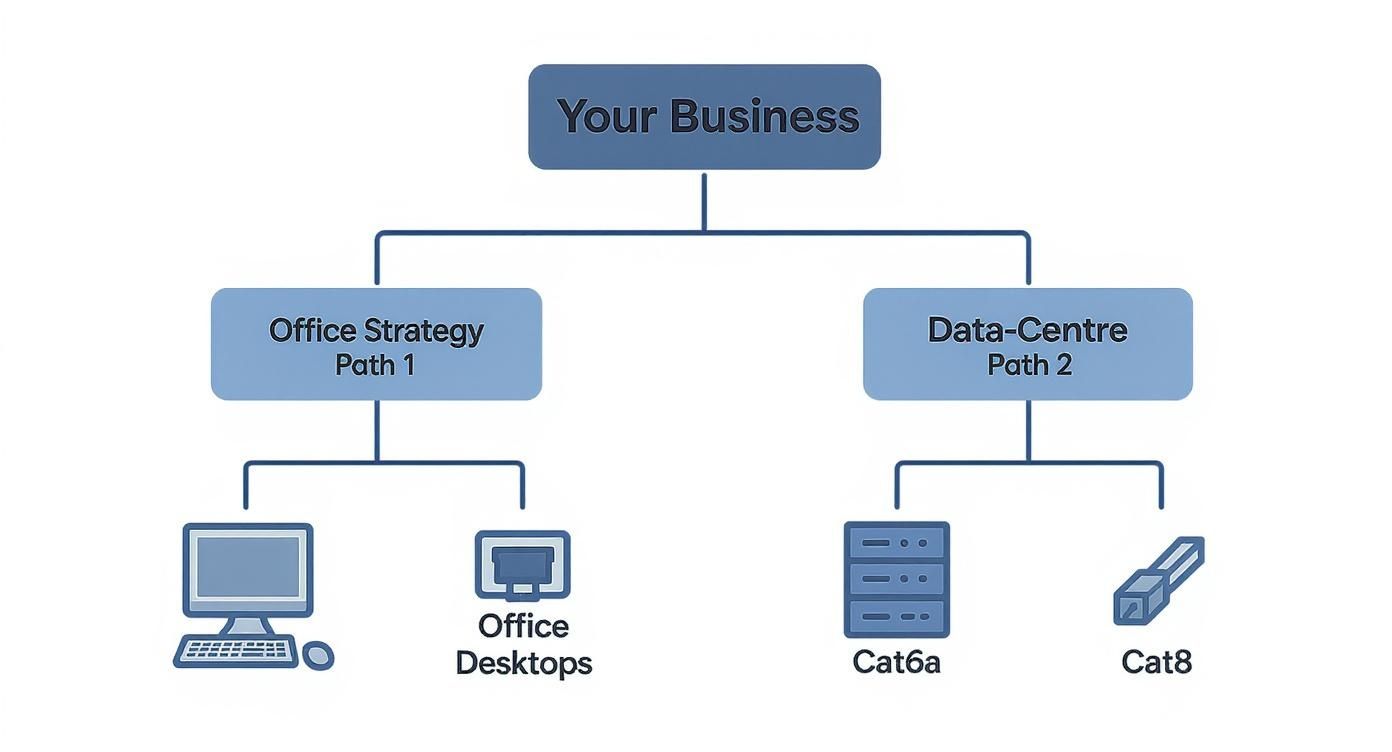
As you can see, the application defines the technology. Cat6a is the workhorse for connecting your team's devices, while Cat8 is a specialist tool, reserved for the high-density, high-speed world of the server room.
When Is Cat8 the Right Choice?
Let us be clear: Cat8 is an incredible piece of engineering. But its role is extremely specific and rarely seen outside of large-scale data centres. It is the right choice only when you are connecting top-tier equipment over very short distances, typically within the same server rack or communications cabinet.
Think of these very specific, limited scenarios:
- Top-of-Rack (ToR) Switching: Connecting multiple servers in a cabinet to a 25G or 40G network switch.
- Switch-to-Switch Links: Creating lightning-fast backbone connections between core network switches that are physically close to each other.
- High-Performance Computing: Fuelling data-heavy applications where every microsecond of latency between servers is critical.
For any professional services firm in our local area, unless you happen to run an on-site data centre with these exact demands, Cat8 is simply not a practical or necessary investment. A well-designed Cat6a network, perhaps with fibre optic cabling for building-to-building links, will deliver far better value and all the performance your business needs to thrive. The key is getting expert advice to ensure your network foundation is built right, right from the start.
Frequently Asked Questions
When it comes to network cabling, business owners and IT managers often have very practical questions. Getting these details right is crucial before you commit to an infrastructure investment, so let us tackle some of the most common queries we hear about Cat6 and Cat8 cabling.
Can I Use a Cat8 Cable for My Home Office?
Technically, yes, you can plug a Cat8 cable into your home office setup. But in reality, it is complete overkill and will not make a blind bit of difference to your internet speed. Your connection is bottlenecked by your broadband provider, long before the cable from your router to your computer becomes a factor.
A good quality Cat6 or Cat6a cable is more than enough for even the most demanding home office, easily handling a gigabit fibre connection for things like 4K video calls. The unique benefits of Cat8 only come into play within the specialised, high-frequency environment of a data centre.
Is Cat6a a Better Choice Than Cat6 for a New Office?
For most new office fit-outs we see, Cat6a really hits the sweet spot. It comfortably delivers 10 Gbps speeds over the full 100-metre distance, which is something Cat6 can only manage over much shorter runs. This capability alone makes it a far more future-proof choice.
Think about it this way: if you can see your team needing 10 Gbps speeds at their desks in the next five to seven years to handle massive files or data-heavy applications, then investing in Cat6a now is a wise move. It gives you fantastic performance longevity without the significant cost and installation challenges of Cat8.
Why Is Professional Network Certification So Important?
Proper certification is not just a "nice-to-have"; it is your absolute guarantee that the network will perform as advertised. Professional installers use highly specialised testers to check that every single cable run meets the strict TIA/ISO standards for its category. This is the only way to catch subtle but critical installation faults, like a poorly terminated connector or hidden cable damage.
Without that official certification report, you are just hoping your network can support the speeds you have paid for. Crucially, this documentation is almost always required to validate the manufacturer's warranty on the cabling, protecting your investment for years to come.
A solid, dependable network is the central nervous system of any modern business. For expert guidance on designing and installing the right structured cabling for your organisation, get in touch with SES Computers. See our professional IT support and services for businesses across Dorset, Hampshire, Wiltshire, and Somerset.