For many businesses, the biggest draw of VoIP is how it completely modernises their communications. It swaps out expensive, rigid landline systems for a flexible, internet-based alternative. This isn't just a technical tweak; it's a strategic move that brings significant cost savings, better features, and seamless support for modern remote working. With the UK's old phone network being switched off, moving to VoIP is no longer just an option—it's a necessary step forward.
The End of the Landline and What It Means for You
The fast-approaching UK PSTN (Public Switched Telephone Network) switch-off is set to fundamentally change how businesses communicate. Think of it like the switch from analogue to digital TV—a vital evolution that opens up a world of better capabilities. This transition finally moves your operations away from dated copper wires and into a flexible, digital future powered by the internet.
For professional services firms across Dorset, Somerset, and Hampshire, it's crucial to see this as a strategic opportunity. It’s a chance to build a more resilient, efficient, and modern business that’s truly ready for the future of work. By adopting VoIP now, you’re not just meeting a deadline; you’re gaining a competitive edge.
Why the Old System Is Failing
The traditional copper wire network is becoming more fragile and costly to maintain by the day. The government's structured migration has set a firm deadline: all devices that rely on the PSTN must be fully transitioned by January 2027. This urgency is thrown into sharp relief by the system's declining reliability. In fact, 2024 saw a staggering 45% increase in PSTN incidents, highlighting the growing risks of relying on this ageing infrastructure.
This isn't just an administrative tick-box exercise; it's a critical business upgrade. Sticking with an outdated system exposes your company to potential service disruptions and severely limits your ability to meet modern client expectations.
Embracing a New Way of Working
Moving away from the landline opens the door to far more dynamic and agile ways of communicating—methods that are a much better fit for today's business world. Instead of being chained to a physical desk, your team can connect from anywhere, using any device they choose.
This newfound flexibility allows for powerful improvements in how you operate. For example, a legal practice can implement advanced tools to manage calls more effectively. The decline of the landline signals a shift towards tools like a VoIP virtual receptionist to handle client enquiries professionally without needing dedicated staff. This is just one of the benefits of VoIP that helps small and medium enterprises level the playing field and compete with larger organisations.
How VoIP Can Dramatically Cut Your Communication Costs
For most small and medium-sized businesses, the number one reason to even consider switching phone systems is the promise of serious, measurable savings. But let's move past the vague claims and get into exactly where your business saves money and how those savings really add up.
Think of your old phone system like a clunky, power-hungry server humming away in a comms cabinet—it costs a fortune to buy, it’s a pain to upgrade, and you need a specialist on standby just to keep it running. A modern VoIP system is more like a flexible cloud service. You pay for what you use, and it adapts as you grow.
This fundamental shift from hardware to software brings financial relief by targeting several key expenses that constantly chip away at the budgets of professional services firms and other SMEs.
Say Goodbye to Outdated Hardware and Surprise Maintenance Fees
One of the first and most noticeable savings is the removal of that expensive on-site PBX (Private Branch Exchange) box. These traditional systems don't just hit you with a big upfront cost for purchase and installation; they also chain you to ongoing maintenance contracts and costly engineer call-out fees.
With a hosted VoIP system, all the complex routing and switching technology is handled off-site in highly secure, UK-based data centres. No more surprise repair bills. No more pricey service agreements. Instead, your business pays a simple, predictable monthly fee per user. For example, an architectural practice no longer needs to budget for an emergency engineer visit when a physical line fails; that entire risk is managed by the provider. This clever move transforms a hefty capital expense into a much more manageable operational one. To get a better handle on this model, you can read more about the benefits of hosted VoIP phone systems in our detailed guide.
Slashing Your Call Charges and Line Rental Bills
Traditional phone lines force you to pay for every single physical line rental, a cost that stacks up quickly as your team expands. VoIP sidesteps this completely by using your existing internet connection. You no longer need separate infrastructures for voice and data, which immediately consolidates your outgoings.
Better yet, the cost of making calls plummets. Here's a quick breakdown:
- Free Internal Calls: Any call between your employees or different office locations costs nothing, even if you have one team in Dorset and another in London.
- Cheaper External Calls: Rates for local, national, and especially international calls are a fraction of what traditional providers charge. A law firm in Somerset calling a client in New York, for example, could easily see the cost of that specific call drop by over 80%.
For UK businesses, the financial impact is often profound. Real-world data consistently shows that small businesses can reduce their overall telecoms bill by 70-80% when they switch from a traditional phone system to VoIP. This isn't just a minor saving; it's a game-changing benefit that directly boosts your bottom line.
A Clear Financial Comparison
To bring these savings to life, let’s compare the typical monthly costs for a 10-employee professional services firm here in the South West. The difference is stark.
Traditional Phone System vs Modern VoIP Cost Comparison
Here's a side-by-side breakdown of typical monthly expenses for a 10-employee professional services firm in the South West.
| Expense Category | Traditional PBX System (Monthly Cost) | SES Computers 3CX VoIP (Monthly Cost) |
|---|---|---|
| Line Rental (5 lines) | £100 – £150 | £0 (Uses your internet) |
| System Maintenance Contract | £50 – £100 | £0 (Included in subscription) |
| Local & National Calls | £80 – £120 | Included in user plan |
| International Calls (Variable) | £40 – £80 | £10 – £20 |
| Total Estimated Monthly Cost | £270 – £450 | £100 – £150 (Based on per user plan) |
As the table clearly shows, the savings are immediate and significant.
But it’s important to remember that this is about more than just the money. Exploring high-performance VoIP solutions for small businesses also opens the door to huge improvements in call quality, system reliability, and overall team productivity. By making the switch, your organisation isn’t just cutting an expense; it’s investing in a smarter, more professional way to communicate.
Enhance Flexibility for a Modern Hybrid Workforce
In today's business world, being agile isn't just a nice-to-have; it's fundamental to staying competitive. The old model of having every employee tethered to a desk phone in one office is quickly becoming a relic of the past. Perhaps the most significant advantage of VoIP is its power to completely decouple your business communications from a physical location, giving remote and hybrid teams the freedom to be professional and productive from anywhere.
With a modern VoIP system, your main business number is no longer tied to a clunky piece of hardware on a desk. Instead, it becomes a powerful app that lives on a laptop, tablet, or smartphone. This simple shift is a game-changer. It means any place with a decent internet connection—a home office in Salisbury, a co-working space in Bournemouth, or a client's site in Yeovil—instantly becomes a fully-functional extension of your office.
This very capability is a cornerstone of the digital workplace transformation that successful SMEs are getting behind. It’s all about giving your team the tools they need to do their best work, no matter where they are.
Empowering Your Team Wherever They Are
Real flexibility means your staff can handle business calls with the same professionalism on the move as they can from their desk. A VoIP softphone app on a mobile lets them make and receive calls using your main business number, look up colleagues in the company directory, and even transfer calls back to the team at HQ.
Think about these real-world scenarios for professional firms across the South West:
- A solicitor working from home can take a sensitive client call on their laptop. The client just sees the firm's main office number, maintaining that all-important professional image.
- A field-based engineer out in rural Wiltshire can finish a job and instantly transfer a customer’s follow-up question back to the support desk using their mobile app, creating a smooth, joined-up experience for the customer.
- An accountant at a conference in Hampshire stays fully connected to their team and clients. They never miss an important call and, from the caller's perspective, they might as well be in the office.
This level of mobility means business continues without a hitch, regardless of where your staff are. It removes the usual friction from remote working and turns the hybrid model from a logistical headache into a practical, efficient reality.
Building Resilience and Business Continuity
This freedom from a fixed location is also a huge plus for business continuity. If your main office suddenly becomes out-of-bounds due to flooding, power cuts, or even major travel disruption, your business doesn't have to grind to a halt.
Because your phone system is securely hosted in the cloud, your team can simply log in from home or another location and carry on as normal. For instance, if heavy snow prevents staff from getting to your Dorchester office, they can all answer calls from home as if they were at their desks. Calls get routed to their devices automatically, ensuring you stay open for business and accessible to your clients right when they need you. It's a critical benefit of VoIP that delivers real peace of mind.
The cost savings that come with VoIP, as shown below, are often what makes these improvements in flexibility possible.
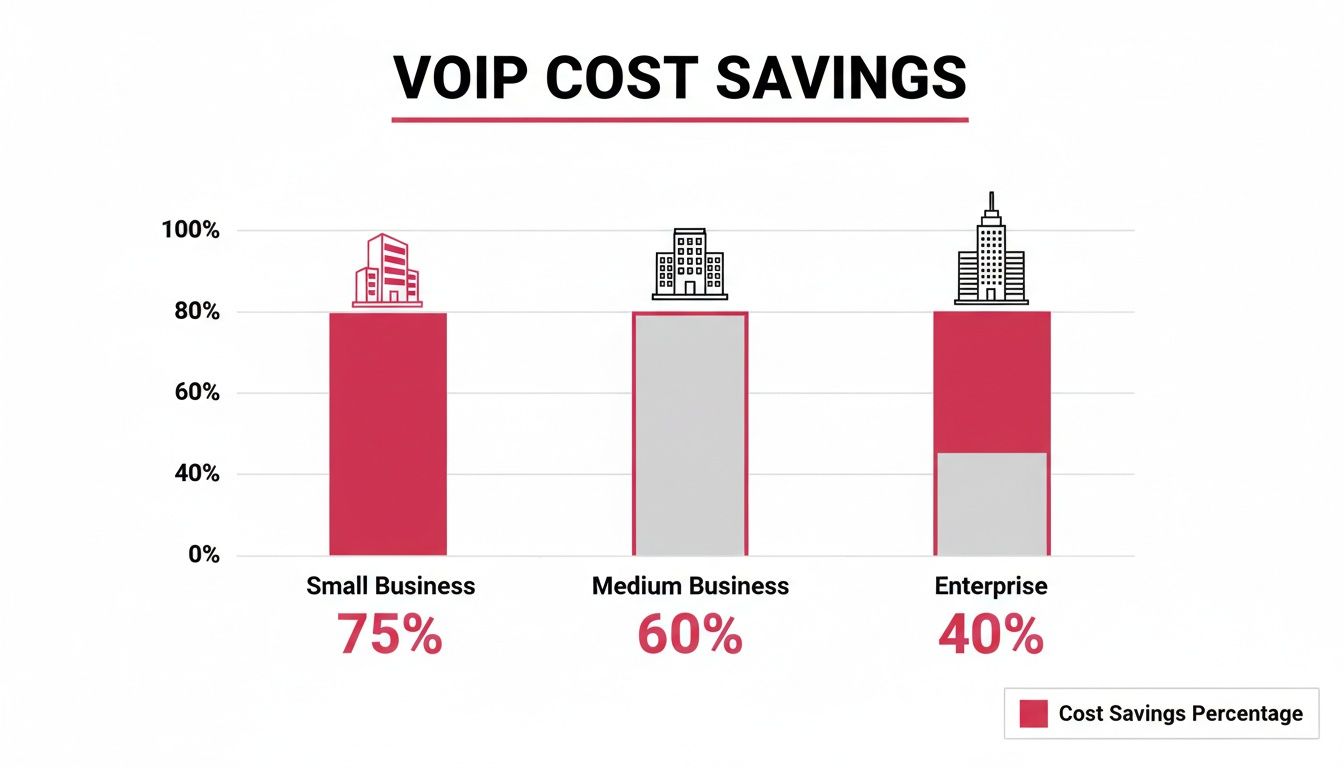
As you can see, it's the small and medium businesses that often see the biggest financial upside, freeing up cash to invest in the very tools that support a more robust and flexible way of working.
Attracting and Retaining Top Talent
Finally, don't underestimate the power of flexible working as a magnet for good people. Survey after survey shows that a decent work-life balance is a top priority for skilled professionals. By putting in a VoIP system that properly supports remote and hybrid work, you're sending a clear signal that you're a modern, forward-thinking employer.
This not only helps you attract great candidates from a much wider area but is also crucial for keeping your most valued and experienced people. Offering genuine flexibility isn't just a perk anymore; it's a core part of building a strong, loyal, and productive team for the long haul.
Give Your Business the Edge with Big-Company Features
One of the most powerful things about VoIP is that it puts enterprise-grade communication tools straight into the hands of small and medium-sized businesses. Features that used to demand a huge budget and a dedicated IT department are now accessible and affordable, levelling the playing field completely. It’s all about presenting a slick, professional image that builds trust and makes your operations smoother, no matter how big your team is.
And we're not talking about complicated technical add-ons. These are practical, everyday tools designed to solve real business problems. Whether you're juggling a high volume of calls or just want to make sure every single client gets the best possible experience, VoIP turns your phone system from a basic utility into a real strategic asset. It helps your company punch well above its weight.
Create a Smart Front Desk with IVR and Call Routing
Think of an Interactive Voice Response (IVR) system as your company's perfect digital receptionist. It's the professional, automated voice that answers every call instantly, 24/7, and guides people to the right department without a fuss. This simple tool virtually eliminates missed calls and stops clients from getting stuck in that frustrating loop of being passed from person to person.
Take a busy Dorset accountancy firm during tax season. They can set up a simple IVR menu: "Press 1 for personal tax, Press 2 for business services, Press 3 for reception." Callers immediately get routed to the specialist who can actually help them. It’s a better experience for the client and it frees up your admin team from just directing traffic.
This is all backed up by intelligent call routing, which adds another layer of clever automation. You can create simple rules based on different criteria:
- Time of Day: After 5:30 PM, automatically send calls to a specific voicemail box or an on-call mobile.
- Caller ID: Recognise a VIP client's number and route them straight to a senior partner, bypassing the main queue.
- Team Availability: Set up a "hunt group" to ring multiple people in a team at once, or one after another, until someone picks up. You'll never miss an important sales call again.
Never Let a Critical Message Slip Through the Cracks
In a fast-paced business, responsiveness is everything. VoIP has features baked in to make sure crucial information is captured and delivered right where it needs to go, even when your team is out and about. Two of the most valuable are voicemail-to-email and call recording.
Voicemail-to-email transcription is a genuine game-changer. Instead of stopping what you’re doing to dial in and check messages, the system automatically turns the audio into text and pings it straight to your inbox. A surveyor on a site in Hampshire can just glance at their phone, read a message from a client, and decide how urgent it is—no need to find a quiet spot to listen to a voicemail.
This seamless flow of information is what VoIP is all about. It integrates your phone system into everyday workflows like email, removing friction and helping your team stay organised and on the ball.
Call recording is another incredibly useful tool, both for training and for compliance. A financial advisory firm, for example, can use it to maintain meticulous records of client conversations for FCA compliance. It’s also a fantastic training aid. You can review calls with junior staff to offer constructive feedback, ensuring everyone is delivering the same high standard of service.
When you put these features together, you get a phone system that isn't just cheaper—it's smarter. It automates the routine tasks, captures the important details, and empowers your team to give every client a more professional and efficient service, every single time.
Scale Your Business Communications Effortlessly
Business growth should be an exciting prospect, not a logistical headache. Yet, with traditional phone systems, that's often what it becomes. Expanding your team used to mean a slow, expensive process of booking engineers, installing physical lines, and signing off on hefty upfront costs. VoIP completely sidesteps these old-world problems, making your communications as agile as your business.
Adding a new person to your team is now as quick and easy as adding a user to your Microsoft 365 subscription. There's no physical wiring or complex hardware involved; it's a simple software change that we can often handle remotely in minutes. That’s the kind of speed you need when you're ready to seize a new opportunity.
Built for Growth, Not Restriction
The old telephony model basically punished you for growing. Every new hire or new office meant another physical line to install and rent, tying your costs directly to your expansion. VoIP works on a totally different principle. It simply uses the internet connection you already have to carry every call.
This shift in technology means you can scale up or down with incredible ease. A marketing agency could bring on three temporary staff for a six-week project, giving them full phone system access, and then remove their accounts just as easily when the project ends. Your phone system can be updated almost instantly. This flexibility keeps your communication costs perfectly aligned with your actual business needs, freeing you from rigid contracts tied to physical copper wires.
A Practical Example of Seamless Expansion
Let’s picture a thriving retail business here in Dorset that’s ready to open a new shop in Hampshire. With a traditional phone system, they’d be looking at weeks of waiting for new lines to be installed. This could delay their grand opening or force them to rely on unprofessional-looking temporary mobiles.
With a modern VoIP solution, the story is completely different:
- Instant Setup: We can configure and activate new phone extensions for the Hampshire branch on the central system before they even open their doors.
- Full Integration: From day one, the new shop is fully connected to the main office. Staff can see who’s available across both sites and transfer calls between them seamlessly.
- Cost-Free Internal Calls: Calls between the Dorset and Hampshire locations are just internal transfers, which means they are completely free of charge. This is a huge incentive for teams to collaborate properly.
This is what effortless scalability looks like in the real world. The business expands its physical footprint without creating communication barriers or racking up huge setup costs. The phone system actually helps them grow instead of holding them back.
Removing the Financial Barriers to Growth
When it comes down to it, this is all about removing friction. It lets you focus on your growth strategy without worrying about the logistical and financial pains of an old, inflexible phone system. The ability to add a new user for a predictable, low monthly fee gets rid of the need for a big cash outlay every time you expand.
This pay-as-you-grow model makes VoIP the obvious choice for ambitious small and medium-sized businesses across the region. It gives you the powerful communication tools you need to compete and grow, all while keeping your operational costs lean and predictable. Finally, your phone system can keep up with your ambition.
Your Practical Checklist for a Smooth VoIP Migration
Moving to a new phone system can feel like a massive job, but with a bit of planning, it becomes a straightforward and manageable project. When you break the process down into simple, logical steps, you take the guesswork out of it and set your business up for a win right from the start.
This checklist is designed to walk you through the transition, making sure no important details get missed. From checking your office is technically ready to getting your team trained up, every stage is vital for a seamless switch. The goal here is to get all the benefits of VoIP without disrupting your daily work or how you talk to your clients.
Phase 1: The Pre-Migration MOT
Before you change a thing, you need to take a good look at your current setup. This groundwork makes sure your network is ready to deliver the crystal-clear call quality you're expecting from a modern phone system.
-
Audit Your Internet Connection: VoIP needs a solid, stable internet connection to work properly. We always recommend a business-grade broadband or fibre line to give you plenty of bandwidth, especially if your team is already using it for other cloud services. A quick speed and latency test can flag any potential bottlenecks before they cause trouble.
-
Review Your Network Hardware: Think of your office router as the traffic controller for all your internet data, including your phone calls. It's crucial to make sure it can prioritise voice traffic to keep your calls clear and stable. For a more detailed look, you can learn more about choosing the right Voice over IP router in our dedicated guide.
Phase 2: Planning and Configuration
Once you've confirmed your infrastructure is up to the job, it’s time to plan the nuts and bolts of your new system. This is where we shape the features to fit exactly how your business works, making sure the new tools genuinely help your team.
A well-planned migration is an invisible one. The aim is for your clients to notice no interruption, only an improvement in how professionally their calls are handled from that point forward.
A little careful thought at this stage saves a lot of headaches later and ensures your team has everything they need from day one.
- Map Out Your Ideal Call Flows: How do you want calls to be handled? Do you need a "digital receptionist" (an IVR) to guide callers to the right department? Should incoming calls to your sales line ring a group of people all at once, or one after another? Sketching this out helps us configure the system to work for you, not against you.
- Plan Your Number Porting: You absolutely want to keep your existing business number, and rightly so. We handle the entire porting process with your old provider to make sure there's zero downtime. Scheduling this cutover carefully is the key to a seamless switch.
Phase 3: Go-Live and Team Training
The final piece of the puzzle is the switch itself, followed by getting your team comfortable and confident with their new tools. A great launch isn't just about the technology—it’s about people.
- Schedule a Go-Live Date: We'll pick a time for the final switchover, usually outside of your busiest hours, to minimise any potential impact on your operations.
- Conduct Team Training: A hands-on training session is a must. We'll show your staff how to use the softphone apps on their computers and mobiles, how to transfer calls, and how to access handy new features like voicemail-to-email. This small investment in training pays for itself almost immediately in productivity and confidence.
To help you get organised, here’s a simple checklist that breaks down the key steps for getting your business ready for a successful VoIP migration.
VoIP Migration Readiness Checklist
| Phase | Action Item | Key Consideration |
|---|---|---|
| 1. Assessment | Audit Internet Speed & Stability | Is your connection business-grade? Check for low latency. |
| 1. Assessment | Evaluate Network Router/Switches | Can your hardware prioritise voice traffic (QoS)? |
| 1. Assessment | Inventory Current Phone Numbers | List all numbers you need to port to the new system. |
| 2. Planning | Design Call Routing & IVR Menus | How will calls flow? Who answers? What options do callers need? |
| 2. Planning | Confirm User & Device Requirements | How many users need a physical handset vs. a softphone app? |
| 2. Planning | Schedule Number Porting Date | Coordinate with us to ensure no service interruption. |
| 3. Execution | Schedule Go-Live & Installation | Choose a low-impact time, like an evening or weekend. |
| 3. Execution | Organise Staff Training Session | Ensure everyone knows how to use the new system effectively. |
| 3. Execution | Test All Features Post-Launch | Make test calls, check voicemails, and confirm call routing. |
Following these steps will put you on the right track for a smooth and successful transition, letting you focus on the benefits of your new system rather than the process of getting there.
Your VoIP Questions Answered
When you're thinking about moving your business phones to a modern system, a few questions always come up. It's completely normal. To help, we've put together answers to the most common queries we hear from businesses across Dorset, Somerset, and the surrounding areas.
We want to give you clear, straightforward answers so you can feel confident about making the right choice.
Can I Keep My Existing Business Phone Number?
Yes, you absolutely can. This is often the first thing people ask, and for good reason. You’ve built your business's reputation around that number, so losing it is not an option.
The process is called number porting, and it's a standard, regulated procedure that we handle from start to finish. We work with your old provider to make sure the switch happens seamlessly, without any service interruption. Your customers won't notice a thing.
Is VoIP as Reliable as a Traditional Landline?
It’s a fair question. The short answer is yes, as long as it's running on a decent business-grade internet connection. In fact, in many situations, it’s actually more resilient than an old copper landline, which can be knocked out by something as simple as a fault in the physical cable.
Think about it this way: with a cloud-hosted system, if your office has a power cut or the internet goes down, your calls aren’t lost. They can be automatically forwarded to mobile phones or even a different office. This kind of built-in disaster recovery is something a traditional phone line just can't do.
What About Call Quality?
Let's be honest, in the early days of VoIP, call quality could be patchy. But that was a long time ago. The technology has come a huge way since then. With a solid business broadband or fibre connection, the quality is consistently crystal-clear. It’s often better than a landline, thanks to something called HD Voice.
The trick is to make sure your network prioritises the voice traffic over other data. This is a standard setting on most business routers, and it’s something we’ll help you get right. It simply stops a big download from ever interfering with your call clarity.
How Hard Is It for My Team to Learn a New System?
Much easier than you might think. Modern VoIP systems are designed to be incredibly intuitive. Most of your team will manage their calls through a simple app on their computer (a softphone) or a mobile app that feels just like any other app they use every day.
We don't just drop the system on you and leave. We provide proper hands-on training to make sure everyone feels comfortable right from the start. They’ll quickly get to grips with handy features like voicemail-to-email and being able to take a call from anywhere – things that genuinely make their work easier.
Ready to see how a modern phone system could work for your business? SES Computers offers expert advice and fully managed 3CX VoIP solutions for businesses across Dorset, Somerset, Wiltshire, and Hampshire. Get in touch with our local team today to talk through what you need.