When a crisis hits, you need more than just good intentions. A business continuity consultancy provides the expert, impartial guidance needed to prepare for, respond to, and recover from any kind of disruption. It’s about building a comprehensive strategy that protects your people, processes, and reputation, ensuring your essential operations can carry on no matter what.
Why Business Continuity Is Your Strategic Defence
Think of your business as a high-performance vehicle. A basic backup plan is like having a spare tyre in the boot—great for a single, predictable problem. But what if the engine seizes, the fuel runs dry, or the road ahead is completely washed out?
That's where business continuity consultancy comes in. It’s your expert pit crew, ready for anything. It’s not about fixing one flat tyre; it's about anticipating every potential hazard to keep you in the race. This kind of proactive partnership is designed to protect your operations from a whole range of threats—threats that are very real for UK SMEs today.
Moving Beyond Simple Backups
It’s a common mistake to think that having data backups is the same as having a proper continuity plan. Backups are crucial, of course, but they are purely reactive. They help you get your data back after it’s gone, but they do nothing to manage the wider operational chaos.
Let's imagine a local accountancy firm in Wiltshire gets hit by a ransomware attack right in the middle of tax return season. A backup might restore their client files, but a continuity plan answers the questions that really matter in the moment:
- How do we tell our clients what’s happened without losing their trust?
- Where and how can our team keep working if the office network is down?
- Which services need to be back online first to hit critical deadlines?
- What are our legal obligations for reporting the breach under GDPR?
A business continuity consultant helps you answer these questions before a crisis, building a clear, actionable playbook for your team to follow.
A business continuity plan is the strategy for keeping your entire organisation running. A disaster recovery plan is the technical chapter within that strategy, focused purely on restoring your IT systems and data. An expert consultant ensures both are perfectly synchronised.
This strategic view turns resilience from a simple IT chore into a fundamental business function. It involves digging into everything from your supply chain vulnerabilities to staff availability, making sure every part of your business has a solid fallback.
For any professional services firm, where reputation and client data are everything, this level of preparedness isn't a luxury—it's essential for survival. When you work with a business continuity consultancy, you aren’t just buying a plan. You're investing in the long-term health and stability of your entire organisation, protecting your revenue, client loyalty, and hard-earned reputation.
The Core Services of a Continuity Consultant
A business continuity consultancy does more than just write a document; they work with you to turn the idea of resilience into a practical, working reality. It’s a methodical process, starting with a deep dive into your operational risks and culminating in a robust defence strategy that's tested and refined over time.
This isn't about ticking a box. It's about embedding a culture of preparedness right into the heart of your organisation.
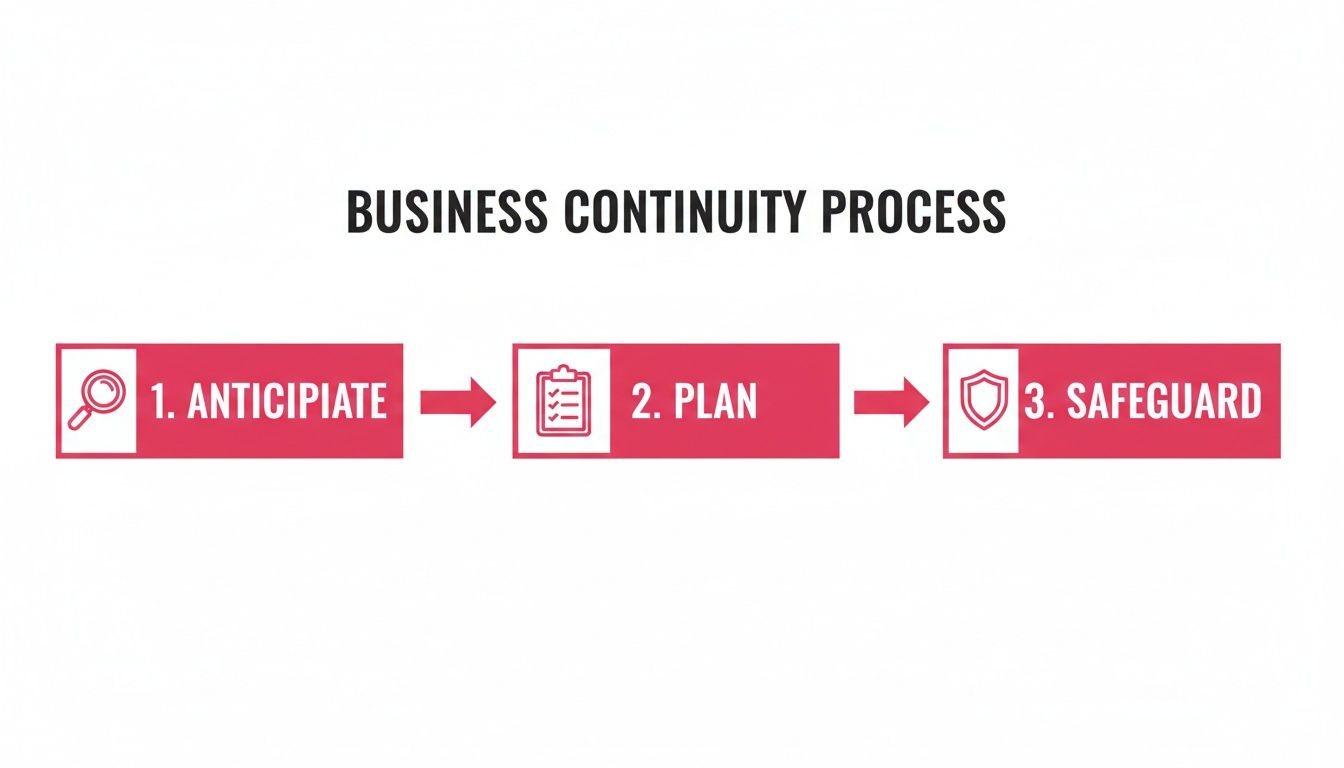
As this shows, genuine continuity is an active cycle. You anticipate what could go wrong, plan your response, and then put safeguards in place to protect your operations. It’s a living process, not a one-off fix.
To understand how this works in practice, let's break down the key services involved. The table below gives a snapshot of the primary activities a consultant undertakes.
Key Services in Business Continuity Consultancy
| Service | Purpose | Practical Example for a Professional Services Firm |
|---|---|---|
| Risk Assessment | To identify and evaluate specific threats that could disrupt your business, from natural disasters to cyber attacks. | A consultant identifies that a Dorset-based legal firm's office is in a high-risk flood zone and also faces increasing phishing attempts targeting client funds. |
| Business Impact Analysis (BIA) | To pinpoint critical business functions and determine the maximum acceptable downtime for each before serious damage occurs. | The BIA for an accountancy firm reveals that its payroll processing service is critical and cannot be down for more than two hours at month-end. |
| Plan Development (BCP/DRP) | To create a strategic (BCP) and technical (DRP) playbook detailing step-by-step recovery procedures for people and IT systems. | A detailed BCP is created for a marketing agency, outlining remote working protocols, while the DRP details how to restore access to its shared creative asset server. |
| Implementation & Testing | To put the necessary technology in place and then rigorously test the plans through realistic simulations to find weaknesses. | A simulated power outage is run, forcing the team to activate their plan, failover to a secondary internet line, and communicate effectively with clients. |
These services form a structured journey, starting with understanding the threats and ending with a team that's ready and able to respond.
Risk Assessment and Business Impact Analysis
Everything starts with two foundational steps: the Risk Assessment and the Business Impact Analysis (BIA).
Think of the risk assessment as your strategic reconnaissance. The consultant scouts the terrain for every potential hazard, from localised flooding in Wiltshire to the specific cyber threats targeting professional services firms in Hampshire. It’s all about knowing what you’re up against.
Once the threats are clear, the BIA figures out which parts of your business are most vulnerable. It asks the tough but essential questions. What processes must keep running for the business to survive? What's the absolute maximum downtime you can tolerate for each one before you start losing serious money or damaging your reputation?
The BIA is arguably the most important step. It provides the objective data needed to prioritise recovery efforts, ensuring that in a crisis, you focus your resources on what truly matters most to keep the business viable.
Developing Bespoke Continuity Plans
With a clear picture of your risks and priorities, the consultant can now build your playbook. This usually involves two distinct but interconnected plans:
Business Continuity Plan (BCP): This is your human-centric guide. It outlines how your people will continue to work, communicate with clients, and manage essential tasks during a disruption. For instance, it might detail how an architectural practice’s staff can seamlessly switch to remote working, including how to securely access large project files and divert office phone lines without missing a beat.
Disaster Recovery Plan (DRP): This is the technical blueprint focused purely on your IT infrastructure. The DRP is a highly detailed, step-by-step guide for recovering systems, applications, and data. It covers everything from restoring servers from backups to re-establishing network connectivity. You can learn more about the technical side by reading our guide on IT disaster recovery solutions.
The demand for this kind of strategic planning is soaring. The UK Business Continuity Management (BCM) Solutions market is valued at USD 6.8 billion in 2025 and is projected to hit USD 17.5 billion by 2033. For SMEs, where a single hour of downtime can cost an average of £12,500, getting this right is no longer a luxury—it's essential for survival.
Implementation and Rigorous Testing
A plan is only a document until it’s backed by the right tools and practice. During implementation, the consultant helps you put the necessary technology in place. This often includes things like automated cloud backups to UK-hosted data centres, secure hosted desktops, and resilient VoIP phone systems that can work from anywhere.
Finally, and most critically, the plan must be tested. A good consultant facilitates exercises that simulate real-world disasters in a safe, controlled environment. This isn't about passing a test; it's a vital opportunity to find gaps and weaknesses before a real crisis does.
Practical Testing Scenario: Simulated Ransomware Attack
- Objective: Test an accountancy firm’s response to a sudden, complete loss of access to their primary server and client database.
- Action: The team must activate their BCP. This involves notifying key stakeholders, switching to their DRP to failover to a cloud-based replica of their systems, and communicating with clients about a "technical issue" without causing panic.
- Outcome: The exercise reveals that while the technical recovery was successful, the client communication plan needed refinement. This insight allows the firm to improve its procedures, strengthening its overall resilience for a genuine incident.
Calculating the Real Cost of Unplanned Downtime
What does an hour of paralysis truly cost your business? It’s easy to file operational disruptions under ‘abstract risks’, but the financial fallout is alarmingly real and immediate. To properly understand the value of business continuity consultancy, we need to move beyond theory and build a tangible picture of what downtime actually costs. It reframes this service from a simple expense into a crucial investment in your financial stability.

The first hit you'll feel is from the direct costs—the obvious, easily quantifiable losses that show up on the balance sheet almost instantly.
But the real danger often lurks in the indirect costs. These are much harder to measure but can inflict far greater, longer-lasting damage.
Direct Financial Costs
These are the pounds and pence that vanish from your business the moment a critical system goes offline. Calculating them gives you a baseline for the immediate financial haemorrhage.
- Lost Revenue: This is the most straightforward cost. If your consultancy team cannot access project files or your e-commerce site is down, you simply aren't making money. Every minute of an outage translates directly into lost billable hours or sales.
- Wasted Staff Wages: Your team might be at their desks and ready to work, but if their tools are unavailable, you are paying for unproductive hours. Ten employees unable to work, even at an average wage, quickly becomes a significant sunk cost.
- Emergency IT Support: Getting systems back online often requires calling in specialists for emergency, out-of-hours support. This always comes at a premium rate compared to scheduled, proactive maintenance.
The Hidden Indirect Costs
Beyond the immediate financial sting, the indirect costs begin to quietly mount, eroding your company’s value and future prospects. These are precisely the consequences that a solid business continuity plan is designed to mitigate.
Downtime is more than a technical problem; it’s a business problem with cascading financial consequences. The initial outage is just the tip of the iceberg, with reputational damage and lost opportunities lurking beneath the surface.
Think about these less obvious but highly destructive impacts:
- Reputational Damage: Trust is hard-won and easily lost. An outage that affects customer service or data security can permanently tarnish your reputation, making it much harder to attract new clients down the line.
- Customer Churn: Frustrated customers who cannot access your services will quickly look for more reliable alternatives. A single significant outage can be enough to drive away loyal clientele for good.
- Regulatory Fines: For businesses handling sensitive information, downtime can lead to data breaches or a failure to comply with regulations like GDPR. This can result in substantial, business-crippling financial penalties.
A Practical Scenario: The Costs in Action
Imagine a Somerset-based solicitors' firm. Their entire operation hinges on case management software that tracks client files, deadlines, and billing. One morning, a server failure takes the whole system offline.
The direct costs hit immediately: solicitors cannot access case files, deadlines are at risk, and administrative staff are paid to field calls from anxious clients.
The indirect costs spiral just as quickly. Court deadlines could be missed, damaging their hard-earned reputation for reliability. One major commercial client, completely frustrated by the delay, decides to switch to a competitor. That represents a permanent loss of all future revenue from that account. The true cost of this single outage could easily run into tens of thousands of pounds, far exceeding the price of the failed server.
The urgency to prevent such scenarios is clear. The UK Disaster Recovery as a Service (DRaaS) market alone grew to USD 356.18 million in 2024 and is expected to reach USD 2.7 billion by 2033. This growth reflects a stark reality: 43% of UK businesses hit by major outages in 2024 lost over £50,000, with SMEs suffering disproportionately. As you consider the financial side of a continuity plan, it's also vital to understand the real cost of Azure Backup and other essential components.
Navigating UK Compliance and Regulatory Demands
For many UK businesses, especially those in professional services, keeping the lights on isn't just good practice—it's often a legal and regulatory minefield. If you cannot protect and access your data, you could be facing some serious penalties. This is precisely why compliance is such a huge driver for bringing in a business continuity consultancy. A good consultant helps you chart a course through these complex waters, building a resilient framework that keeps both auditors and regulators happy.
Data protection is a perfect example. The General Data Protection Regulation (GDPR) isn’t just about stopping data breaches; it’s also about ensuring the ongoing availability and integrity of personal data. A simple system outage that locks you out of client information? That could easily be seen as a compliance failure.
Demonstrating Due Diligence to Regulators
When things go wrong, a robust and, most importantly, a tested continuity plan is your best defence. It’s your proof of due diligence. If auditors or regulators like the Information Commissioner's Office (ICO) come knocking after an incident, they’ll want to see evidence that you took reasonable steps to prevent and manage the disruption. A documented plan shows you were proactive, not just reacting to a crisis.
Let's take a law firm as a practical example. Imagine their main server goes down, and all their client case files become inaccessible. Without a plan, it's utter chaos. With one, they can confidently show:
- A Clear Recovery Process: The firm can present a step-by-step procedure for restoring access from backups, all within a pre-agreed timeframe.
- Mitigation of Harm: By getting back on their feet quickly, they limit the damage to client cases and legal deadlines, demonstrating a real commitment to protecting their clients' interests.
- Proactive Planning: The very existence of the plan proves they thought ahead, anticipating these kinds of risks and investing in protecting their data and operations.
This kind of demonstrable preparedness can make all the difference, potentially lessening the blow of fines or other penalties after a breach.
In the eyes of a regulator, an untested business continuity plan is merely a document of intent. A regularly tested plan is a clear demonstration of capability and a commitment to protecting stakeholder interests.
Sector-Specific Obligations
On top of GDPR, many professional sectors have their own strict rules. A skilled business continuity consultancy will know these nuances inside and out and can help shape your strategy to fit.
Firms in financial services, for instance, have the Financial Conduct Authority (FCA) breathing down their necks, demanding proof of operational resilience. In healthcare, providers have an absolute duty to ensure patient data is always available for safe and effective care. Falling short of these industry-specific standards can lead to losing your accreditation, not to mention hefty financial penalties. What's more, any solid business continuity strategy must also address the critical need for secure communication compliance to satisfy these legal and industry benchmarks.
Ultimately, getting this right is about far more than just dodging fines. To get a better handle on the basics, you can read our detailed guide on what is regulatory compliance. A consultant brings the expertise needed to perfectly align your operational resilience with your legal duties, giving you the peace of mind that your business is not only ready for disruption but also fully compliant.
How We Deliver Localised Business Continuity
A business continuity plan on paper is one thing. Having a practical, tech-driven strategy managed by a local team that genuinely understands your world is another entirely. With over 30 years of experience supporting businesses across Dorset, Somerset, Wiltshire, and Hampshire, we do not treat business continuity as a theoretical exercise. We build resilience directly into the IT infrastructure we manage for you every single day.
This approach means your continuity plan isn't just a document gathering dust; it's a living, breathing safety net grounded in proven systems. We weave the principles of robust continuity directly into our core IT support, ensuring your plan is always ready to kick in automatically when you need it most.
Our solutions are built to solve the specific challenges we see businesses facing right here in the South West, blending our local insight with powerful, reliable technology.
UK-Hosted Infrastructure for Data Sovereignty
Knowing precisely where your critical data lives is a cornerstone of any solid continuity plan. That's why all our cloud services, from virtual servers to hosted desktops, are located in secure UK data centres.
This isn’t a minor detail; it’s a major strategic advantage. It guarantees data sovereignty, helping you effortlessly meet strict UK compliance regulations like GDPR. Should a crisis hit, you’ll have complete confidence that your data is protected under UK law and can be accessed without any cross-border headaches.
Your data’s physical location really matters. By keeping it in the UK, we strip away a huge layer of regulatory risk and complexity from your recovery plan, making the whole process smoother and more compliant from the start.
This localised foundation gives you peace of mind and simplifies your compliance workload, making your entire resilience strategy stronger.
Automated Cloud Backups and Rapid Recovery
Let's be honest, human error is one of the biggest risks during a crisis. That’s why we engineer our continuity solutions around smart automation. Our cloud backup systems work tirelessly in the background, creating secure copies of your essential data without anyone needing to lift a finger.
This ensures your recovery point is always as recent as possible. But more importantly, it enables lightning-fast restoration. Instead of waiting days to rebuild a failed server, we can get your systems back online from clean, up-to-date backups in a fraction of the time, massively reducing the financial and operational hit of downtime.
The demand for this kind of immediate recovery is skyrocketing. In the UK, the Disaster Recovery as a Service (DRaaS) market—a key part of modern business continuity consultancy—hit USD 356.18 million in 2024. Experts project it will soar to USD 2,711.63 million by 2033, powered by an incredible annual growth rate of 25.30%. This shift shows just how vital services like ours are for SMEs who simply cannot afford to be offline. You can read more about the trends shaping the business continuity market.
24/7 Monitoring for Proactive Defence
The absolute best way to handle a disaster is to stop it from ever happening. Our 24/7 cybersecurity monitoring is your digital watchdog, constantly scanning your systems for threats, anomalies, and vulnerabilities.
This proactive philosophy is central to how we approach business continuity. By spotting and shutting down threats like malware or suspicious network activity before they can escalate, we prevent countless potential disruptions. It turns continuity from a purely reactive measure into a powerful, proactive defence for your business.
Practical Example: A Local Solicitors' Seamless Recovery
Imagine a solicitors' firm in Dorset whose entire case management system is managed by a single, critical server. On a Tuesday morning, that server suffers a catastrophic hardware failure. Operations grind to a halt.
- The Problem: Every minute of downtime costs thousands in lost billable hours and risks missing client deadlines.
- The Solution: Because the firm uses our integrated continuity services, their entire system was already replicated on our hosted virtual servers. Our monitoring systems flagged the failure the second it happened.
- The Outcome: We triggered an immediate failover, switching their operations to the virtual server. The case management system was back up and running in under an hour, so smoothly that most staff did not even notice the switch. Work carried on as normal while we arranged the repair of their on-site hardware.
This real-world scenario shows how our integrated tech and local expertise come together to create a truly resilient business. It’s not just about planning for a crisis; it’s about having the systems in place to make recovery a swift, controlled, and almost invisible process.
Choosing the Right Business Continuity Partner
Picking a business continuity partner isn't like choosing any other supplier. You’re not just buying a service; you're entrusting someone with the very survival of your business. This is about finding a long-term ally, and the right choice brings genuine peace of mind, while the wrong one creates a dangerous, false sense of security.
So, how do you sort the average providers from the true strategic partners? It comes down to looking beyond the sales pitch and assessing their technical skills, their grasp of your industry, and—just as importantly—how well they fit with your company culture. This isn't just about ticking boxes; it's about finding a team that's genuinely invested in your success.
Key Criteria for Your Selection Process
When you start looking at potential partners, focus on the evidence. A polished presentation is one thing, but a proven track record is what really counts. You need a structured way to evaluate their capabilities to make a decision you can stand by.
It all starts with asking the right questions and insisting on clear, concrete answers. Your mission is to build a complete picture of how they work and the real value they'll bring to your organisation.
Here are a few points to zero in on:
- Proven Industry Experience: A continuity plan for a local accounting firm will look nothing like one for a manufacturing plant. You need a business continuity consultancy that has actually worked in your sector. They’ll already know the operational hurdles and regulatory headaches you face.
- Local Presence and Support: When things go wrong, the last thing you want is a faceless national call centre. A partner with a solid presence in your area, whether that's across Hampshire or Dorset, can offer a faster, more personal response because they understand the local landscape.
- Technical Capability: Can they actually handle your IT setup? You need to confirm they have real expertise in modern cloud systems, data sovereignty (especially with UK-based hosting), and cybersecurity. Their technical skills must be up to the job, both for today and for where your business is heading.
Ultimately, choosing a partner is an act of trust. Look for a consultancy that values clear, straightforward communication and keeps you in the loop, making you feel confident and in control from start to finish.
Questions to Ask a Potential Partner
To get past the marketing jargon and see what a firm is really made of, you have to be direct. This is your chance to test their claims and see if they’re truly the right fit for your business.
Before you even think about signing a contract, make sure you get solid answers to these questions:
- Can you show me case studies or references from businesses like mine? This is the single best way to judge their relevant experience and see the results they've delivered for companies facing similar challenges.
- How do you handle the testing and upkeep of continuity plans? A plan is useless if it just sits on a shelf. Their process for testing and updating reveals a lot about their commitment to your ongoing resilience.
- What does your support actually look like during a real incident? You need to know exactly who you'll be talking to in a crisis, what their response times are, and what steps they'll take.
Following a measured approach like this will help you confidently choose a business continuity consultancy that doesn’t just protect your business, but becomes a valuable partner for the long haul.
Frequently Asked Questions
Taking the plunge with a business continuity consultant can feel like a big decision, especially for smaller businesses. To help clear things up, we've answered some of the questions we hear most often from UK business owners.
Is My Small Business Really a Target for Major Disruptions?
Unfortunately, yes. In fact, smaller businesses are often more exposed because they do not have the deep pockets or spare resources to absorb the shock of unexpected downtime. A single server failure or a targeted cyber-attack can cause serious, sometimes irreversible, damage to an SME.
A good consultant does not try to sell you an overly complex, enterprise-level solution. Instead, they focus on what's practical and essential for your business. It's all about protecting your most critical functions first—whether that's securing sensitive client data for a law firm or making sure an online shop can keep taking orders no matter what. The goal is an effective, affordable plan that protects what truly matters.
What’s the Difference Between a BCP and a DRP?
This is a common question, and it's easy to get them mixed up. The simplest way to think about it is this: the Business Continuity Plan (BCP) is your master strategy for keeping the entire business running. It's about the people, the processes, and where you'll work from if you cannot get into the office.
The BCP is the plan that outlines how your team will work from home and keep communicating with clients if the office floods. The Disaster Recovery Plan (DRP) is a highly technical chapter within that BCP, focused entirely on getting your IT systems and data back online after a disaster.
A seasoned consultant will make sure these two plans are built to work together perfectly. Your BCP guides your people, and the DRP guides the technology that supports them.
How Often Should We Test Our Business Continuity Plan?
A plan that has not been tested is just a document gathering dust. As a rule of thumb, you should test your plan at least once a year. This does not always have to be a full-blown simulation. You could run a major test every couple of years, but supplement it with smaller, quarterly 'tabletop' exercises where your team simply talks through their response to a specific scenario.
What's absolutely crucial is that the plan gets reviewed any time your business changes in a meaningful way. Bringing in new core software, moving to a new office, or even a change in key staff should trigger a review. A good partner helps you stay on top of this, ensuring your plan is always a true reflection of your business. For a more detailed look, our business continuity planning checklist is a great resource.
This cycle of testing and updating is what turns your plan from a static document into a living, reliable tool. It builds muscle memory and gives your team the confidence to act decisively, not panic, when a real crisis hits. That kind of readiness is invaluable.