At its heart, the difference between Cat 6 and Cat 7 cabling boils down to a classic business dilemma: balancing current needs and budget against future-proofing and performance. Cat 6 is the workhorse solution for most businesses, delivering reliable data speeds up to 10Gbps over shorter runs. For example, it is perfectly adequate for a small office where all workstations are within 50 metres of the communications cabinet. Cat 7, on the other hand, is a more strategic, long-term investment, offering superior shielding and a guaranteed 10Gbps over much longer distances, making it ideal for a multi-storey building or a large factory floor.
Choosing Your Future Network Backbone
For professional service firms across Dorset, Somerset, and Hampshire, picking the right network cabling is not just a technical detail—it is a foundational business decision. This choice directly impacts everything from the clarity of your VoIP calls to the speed of your cloud backups. It is an investment in your company's day-to-day stability and its capacity to grow without disruption. For instance, a law firm handling large digital case files cannot afford a network bottleneck when deadlines are looming.
This guide tackles the essential question: when is Cat 6 good enough, and when does investing in Cat 7 give you a genuine strategic advantage? We will cut through the jargon to compare performance, cost, and practicality in real-world business scenarios.
Quick Comparison: Cat 6 vs Cat 7 Key Differences
Before we delve into the details, a quick side-by-side look at the core specifications can help frame the conversation. This table highlights the most important distinctions between Cat 6 and Cat 7.
| Specification | Cat 6 | Cat 7 |
|---|---|---|
| Max Data Rate | 10 Gbps (up to 55m) | 10 Gbps (up to 100m) |
| Max Frequency | 250 MHz | 600 MHz |
| Shielding | UTP (Unshielded) or F/UTP (Foiled) | S/FTP (Individually Shielded Pairs) |
| Typical Connector | RJ45 | GG45 / TERA (RJ45 Compatible) |
| Best For | Standard office, retail, VoIP | Data centres, EMI-heavy environments |
As you can see, while both standards support the same top speed, Cat 7’s enhanced shielding and higher frequency deliver greater performance stability, especially in noisy or demanding environments.
The decision often hinges on balancing today's requirements with tomorrow's ambitions. A bit of foresight now can prevent a costly and disruptive network overhaul as your business expands.
The cost-versus-performance dynamic in the UK market presents a clear picture for SMEs. Budget realities often clash with escalating data demands. Current Ethernet cable forecasts show Cat 6 holding a commanding 60-65% market share in small office installations. In contrast, Cat 7 accounts for just 10-15% but is the fastest-growing segment, expanding at 11% YoY, largely driven by new data centre projects.
When planning for the long haul, it’s crucial to consider major infrastructure decisions, such as adhering to data center migration best practices. For those with even more advanced networking needs, our guide on https://www.sescomputers.com/news/what-is-dark-fibre/ may offer further insights into high-capacity solutions.
Performance and Technical Standards: What the Numbers Really Mean
When choosing between Cat 6 and Cat 7, you need to look past the marketing and understand what the technical specs mean for your day-to-day business. Getting to grips with these standards helps you match your investment to your actual needs. The two metrics that matter most are bandwidth (often called frequency) and data rate.
Think of it like a motorway. Bandwidth, measured in megahertz (MHz), is the number of lanes available. More lanes mean more traffic can flow at once without causing a jam. The data rate, measured in gigabits per second (Gbps), is the speed limit on that motorway. It determines how fast that traffic can move.
Bandwidth and Data Rate Head-to-Head
Cat 6 cabling is built to handle a frequency of up to 250 MHz, whereas Cat 7 pushes that benchmark significantly higher to 600 MHz. In simple terms, Cat 7 has more than double the capacity to handle simultaneous data streams. For a busy office running everything from cloud accounting software to VoIP calls and large file transfers, that extra headroom can be the difference between a smooth network and frustrating slowdowns.
Where it gets interesting, however, is that both cables officially support a maximum data rate of 10 Gbps. The crucial difference lies in how far they can maintain that speed.
- Cat 6 will give you 10 Gbps, but only over shorter distances—realistically, up to 55 metres. Once you go beyond that, its performance reliably steps down to 1 Gbps.
- Cat 7, with its higher bandwidth and more robust construction, is designed to deliver a consistent 10 Gbps over the full 100-metre length of the cable run.
For a small office on a single floor, the 55-metre limit of Cat 6 for 10 Gbps speeds is often perfectly fine. But if you’re wiring a larger building, like a manufacturing plant or a care home with long runs between floors and departments, Cat 7 is the only way to guarantee that top-tier speed across the entire site.
The Sticking Point: Official Standards
The world of network cabling relies on official standards to make sure everything just works together, regardless of the brand. The two main bodies setting these rules are the Telecommunications Industry Association (TIA) in North America and the International Organisation for Standardisation (ISO) worldwide.
This is a massive point of difference between Cat 6 and Cat 7. Cat 6 is a fully recognised standard by both the TIA (ANSI/TIA-568-C.2) and the ISO (Class E). This universal stamp of approval means it’s guaranteed to be compatible with almost all networking hardware sold in the UK, from the switches in your comms room to the sockets on the wall.
Cat 7, on the other hand, is an ISO standard (Class F) but is not officially recognised by the TIA. This is not just a technicality; it has real-world consequences. While Cat 7 boasts superior specs on paper, the lack of TIA backing means compatible hardware (especially connectors) is less common and can be more difficult to source. This can complicate an installation and even lead to compatibility headaches if your installer is not on the ball.
For businesses looking beyond 10 Gbps, it is also worth seeing how these standards stack up against the next generation; you can learn more in our article exploring Cat 7 vs Cat 8 cabling. This lack of universal recognition is a primary reason why many UK businesses opt for its successor, Cat 6a, when they need guaranteed 10 Gbps performance.
How Shielding Impacts Network Reliability
When you move past the headline figures for speed and distance, you find the most meaningful difference between Cat 6 and Cat 7: how they are built. A cable’s physical construction is what determines its resilience against interference, which is a massive factor in day-to-day network stability. This is where shielding enters the conversation, and it’s often the deciding factor.
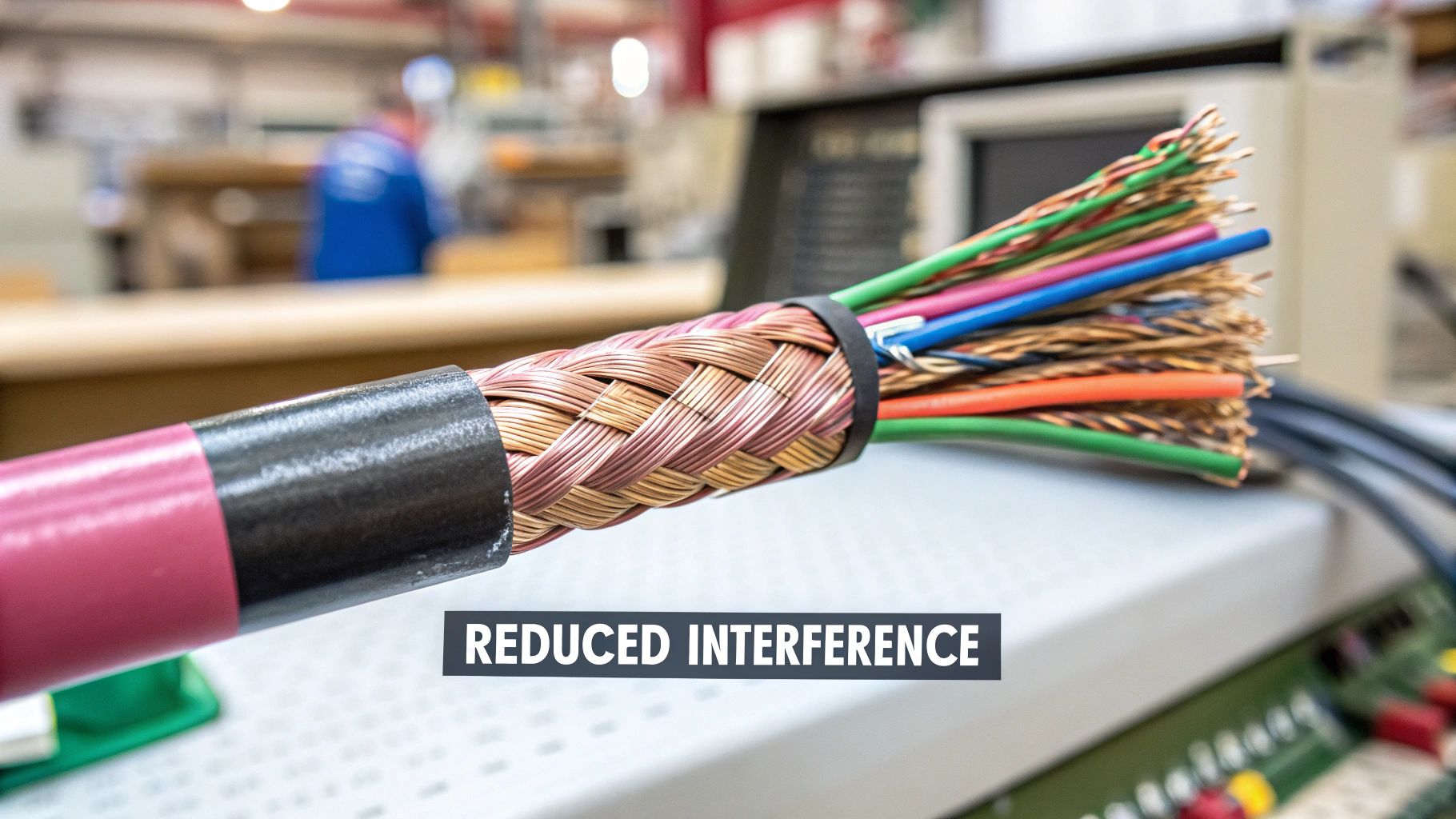
Most standard Cat 6 cables you will encounter are Unshielded Twisted Pair (UTP). The design is simple and effective for most situations; the four pairs of copper wires are twisted together, and these twists provide a basic defence against interference from the other pairs in the cable (a phenomenon known as crosstalk). For a typical professional services office, this is often perfectly fine.
Cat 7, on the other hand, takes a much more serious approach to protection. It uses a construction called Screened/Foiled Twisted Pair (S/FTP), which is a significant step up in defending your data from noise.
Understanding S/FTP Construction in Cat 7
The shielding in Cat 7 is not just a minor tweak; it is a complete redesign aimed at signal integrity. Here’s what’s going on inside the cable:
- Individual Pair Shielding: Each of the four twisted wire pairs is wrapped in its own layer of foil shielding. This essentially isolates every pair, dramatically cutting down on internal crosstalk.
- Overall Braided Screen: After each pair is individually shielded, all four are bundled together and encased in an outer braided screen, usually made of copper. This outer shield acts as a powerful barrier against external electromagnetic interference (EMI).
This double-layered defence makes Cat 7 incredibly robust, especially in environments where other electrical signals could cause havoc on your network.
A Practical Example in a Wiltshire Manufacturing Firm
Let us put this into a real-world context. Imagine a manufacturing business here in Wiltshire. The factory floor is an electrically hostile place—full of heavy machinery, motors, and power converters all pumping out significant EMI. This "electrical noise" can easily corrupt the data travelling through a standard UTP Cat 6 cable.
What does that look like in practice? It means packet loss, dropped connections, and frustrating slowdowns. For business-critical systems like a 3CX VoIP phone system or hosted desktops, which need a rock-solid connection, these interruptions are disastrous. A dropped call with a major client or a frozen screen while accessing cloud data is not just an annoyance; it costs money.
In environments with high electrical interference, Cat 7’s superior S/FTP shielding is not a luxury—it is a requirement for maintaining network integrity and preventing costly downtime. The investment protects against data corruption and ensures operational continuity.
By installing a Cat 7 network, that manufacturing firm essentially builds a protective shield around its data. The comprehensive S/FTP design blocks the EMI from the surrounding equipment, ensuring the signals for their VoIP and cloud services stay clean and stable. It’s a perfect illustration of why the right cable for the right environment is so crucial for a reliable network. You can learn more about building a solid foundation in our guide on what is network infrastructure.
The industry has taken note of this. While Cat 6 once held a commanding 70% market share in commercial installations, projections showed that by 2026, Cat 7's advanced shielding would reduce crosstalk by up to 90%. This directly minimises downtime in EMI-heavy locations like factories, signalling a clear trend towards prioritising reliability where it is needed most.
Connectors, Compatibility, and Installation Realities
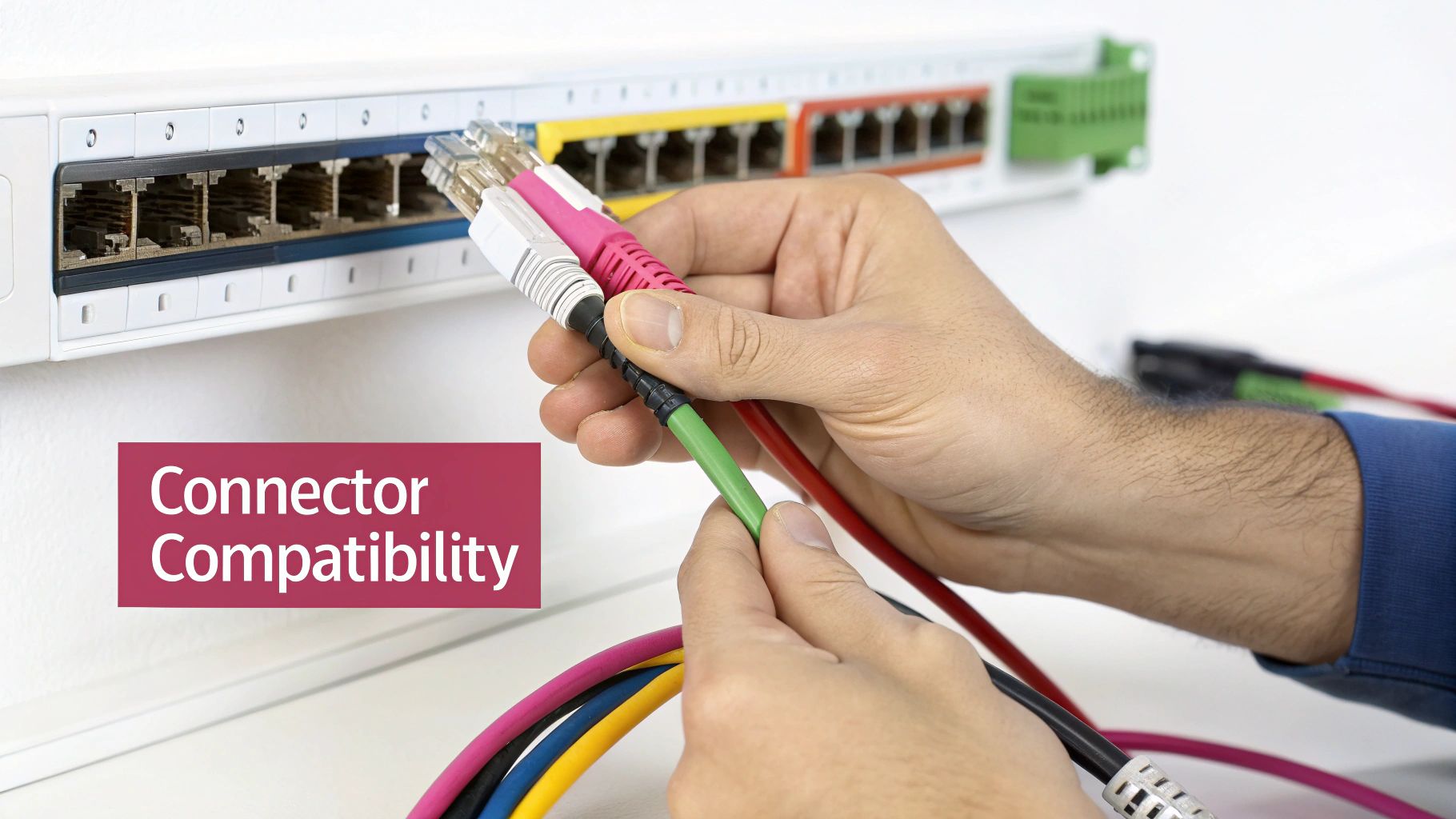
A network cable, no matter how advanced, is only as strong as its weakest link—and that often comes down to the connector. When you are weighing up Cat 6 against Cat 7, the differences in connectors and the practicalities of installation are crucial. These physical details can have a much bigger impact on your project's cost and success than theoretical speeds on a spec sheet.
Cat 6 has a huge advantage here: it’s built for the RJ45 connector. This is the plug you see everywhere, on every desktop PC, VoIP phone, printer, and network switch in your office. It is the undisputed industry standard.
Because of this, rolling out a Cat 6 network is a refreshingly simple affair. All your existing hardware, from patch panels to wall outlets, is already set up for RJ45. This compatibility makes installation faster and keeps a lid on any unexpected equipment costs.
The Cat 7 Connector Conundrum
This is where Cat 7 gets complicated for most businesses. To be officially certified to its ISO Class F standard and unlock its full performance, Cat 7 cabling demands specialised connectors like the GG45 (GigaGate 45) or TERA. These are physically and electronically different from the trusty RJ45.
You can terminate a Cat 7 cable with a shielded, high-quality RJ45 plug, but it is a compromise. You are essentially putting budget tyres on a performance car. The cable’s ability to handle higher frequencies and fend off crosstalk gets choked by the inherent design limits of the RJ45 connector, meaning you will not get the full benefit of what you paid for.
For a typical SME, this is the crux of the issue. A true, standards-compliant Cat 7 installation would mean replacing nearly everything—switches, network interface cards, and wall ports—with more expensive and harder-to-find compatible hardware. The project's complexity and cost can quickly spiral.
This is precisely why many UK businesses looking for a step up from Cat 6 often go with Cat 6a instead. It guarantees 10 Gbps performance over the full 100 metres but sticks with the universal RJ45 connector, offering a much more practical and cost-effective upgrade path.
Physical Challenges on Site
The discussion goes beyond just the plugs at the end. The physical nature of the cables themselves plays a massive role during the actual installation.
- Thickness and Rigidity: Cat 7 cables are significantly thicker and stiffer than Cat 6. This is a direct result of the heavy-duty shielding wrapped around each twisted pair and the cable as a whole.
- Installation in Existing Spaces: That extra bulk makes pulling Cat 7 cable through tight conduit or crowded trunking a real headache. In older buildings across Hampshire or Dorset, where space is often at a premium, this can add significant time and labour costs to the job.
- Termination Difficulty: Properly fitting a specialised GG45 or TERA connector is a more delicate and skilful task than crimping a standard RJ45. It is not a job for a novice; it demands an experienced installer with the right tools and training to get it right.
In the end, while Cat 7 looks impressive on paper, its practical application is a different story. You have to weigh up the hardware incompatibilities and the sheer physical difficulty of installing it properly. Without careful planning and professional execution, you risk paying a premium for performance you cannot actually use.
A Realistic Cost and ROI Analysis for SMEs
For any small or medium-sized business, the conversation around Cat 6 versus Cat 7 inevitably lands on cost. But just looking at the price-per-metre does not tell the whole story. To get a real sense of the value, you need to think about the total cost of ownership (TCO) and the long-term return you will get from your network infrastructure.
The initial bill for a Cat 7 installation will absolutely be higher. The cable itself costs more because of its complex, heavily shielded design. On top of that, you have to account for compatible hardware—specialised connectors and possibly new faceplates or patch panels—which often are not needed for a standard Cat 6 job.
And then there is the labour. Cat 7's thickness and rigidity make it tougher to pull through existing trunking. Terminating the unique connectors also takes more time and skill, which naturally adds to the upfront installation cost.
A Practical Scenario: A Dorset Accountancy Firm
Let us put this into context with a hypothetical 20-person accountancy firm in Dorset. This business absolutely depends on fast, stable access to cloud accounting software, secure client data backups, and perfect VoIP call quality. They’re planning a complete network overhaul and want it to last at least 15 years.
A breakdown of the projected costs and benefits over that time gives a much clearer picture of the real investment.
Projected Cost and ROI for a Typical SME
| Cost Factor | Cat 6 Network | Cat 7 Network |
|---|---|---|
| Initial Cabling Cost | Moderate | High |
| Compatible Hardware | Standard (Low Cost) | Specialised (Higher Cost) |
| Installation Labour | Standard | Increased (Due to complexity) |
| Projected Lifespan | ~10 Years | 15+ Years |
| Future Upgrade Needs | Likely within 10 years | Unlikely within 15 years |
| Reliability in High-Demand Use | Good | Excellent (Less downtime) |
For our Dorset firm, the Cat 6 network looks like the cheaper option on day one. But as their data needs inevitably grow, they’re almost certainly looking at a disruptive and expensive upgrade within a decade. The Cat 7 network, while costing more now, is built to handle whatever comes next, effectively taking the cost and hassle of a future replacement project off the table.
Calculating the Long-Term Return
The real ROI from a Cat 7 install is not just about dodging a future upgrade. It is measured in better productivity and lower operational risk. For an accountancy firm where every minute of downtime during tax season is critical, the superior reliability of Cat 7's shielding translates directly into business continuity. That means fewer dropped VoIP calls, faster cloud backups, and solid connections to essential software—all of which lead to a more efficient, profitable business.
This logic holds true for other regulated sectors. For a business like a care provider needing a compliant, scalable network, choosing Cat 7 can push the cable's lifespan well beyond the typical 10 years of Cat 6, to over 15 years. That longevity can save 20-30% on long-term maintenance and replacement costs, even with an initial per-metre price of around £10-£15 for Cat 7 compared to £1-£2 for Cat 6. For more insights, you can find detailed cost breakdowns in this guide to Cat 6 vs Cat 7 data cabling on cabledan.co.uk.
For any forward-thinking SME, the decision becomes a strategic one. Investing in Cat 7 is an investment in long-term operational resilience, protecting your business from the performance bottlenecks of tomorrow.
Ultimately, the higher initial cost of Cat 7 is balanced by its extended lifespan, superior performance under pressure, and the fact that you will not have to rip everything out for an upgrade in a few years. For any SME planning for growth over the next decade, that makes Cat 7 a very sound financial decision.
Making the Right Choice for Your Business
We have covered the technical specs, the cost differences, and what it takes to install them. Now, let us put it all together and move from theory to practical decision-making. The real question is not whether Cat 6 or Cat 7 is "better" overall, but which one is the right strategic fit for your business—not just for today, but for the next decade.
To help you translate this analysis into a clear choice, I have laid out a few common business scenarios. These examples should help you see where your own operations fit, making it easier to decide which cabling solution will be a genuine asset rather than a future bottleneck.
This decision tree gives you a visual guide, helping you map out whether your immediate budget or long-term return on investment is the bigger priority.
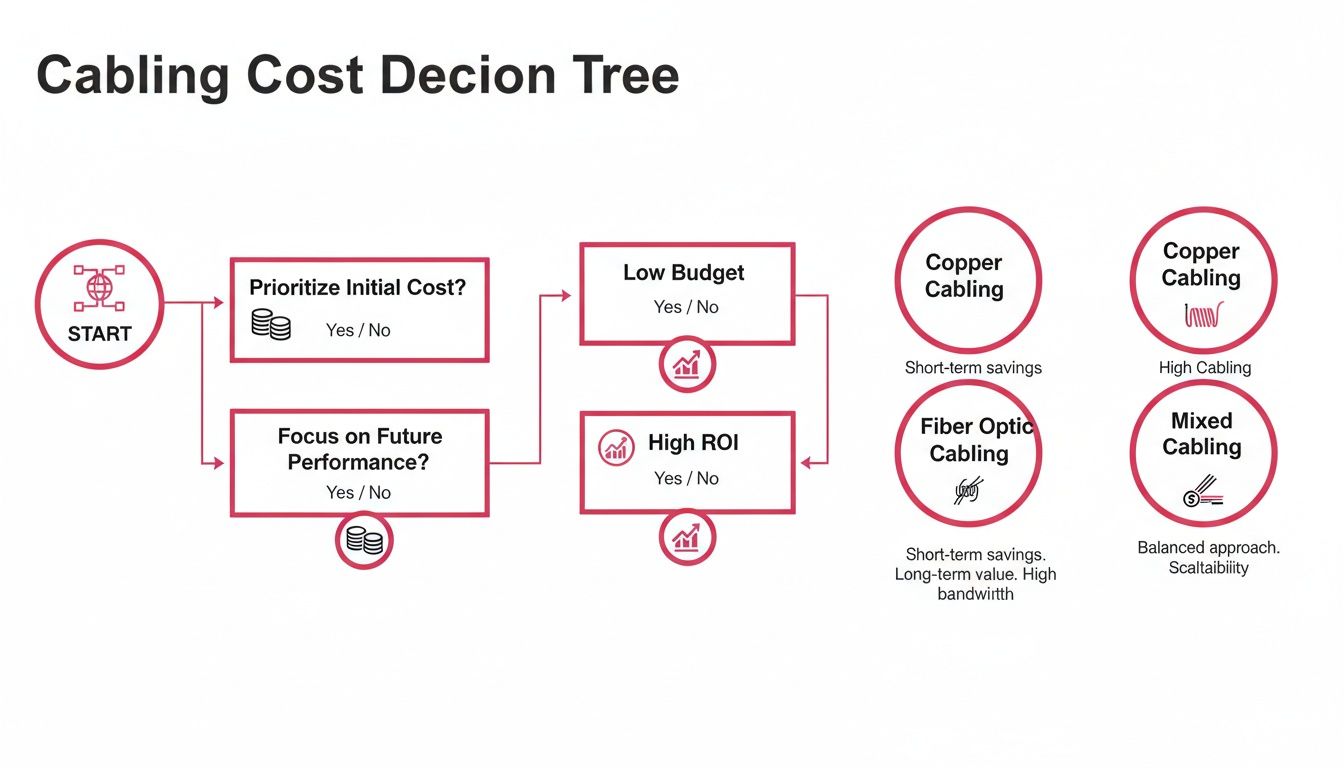
As you can see, if the upfront cost is your main concern, Cat 6 is the obvious starting point. However, if your focus is on future-proofing and getting the best long-term value, Cat 7 quickly becomes the more logical investment.
Scenario One: The Small Professional Services Firm
Picture a small solicitor's office in Hampshire. Its network is pretty straightforward: a few workstations for administrative staff and partners, a VoIP phone system, a back-office server for case files, a staff Wi-Fi network, and a basic CCTV setup. The data traffic is important but fairly predictable.
In this kind of setting, the cable runs are short and there’s very little chance of electromagnetic interference. The main priorities here are simply reliability and keeping costs down.
- Recommendation: Cat 6 or Cat 6a is the sweet spot. It handles everything the firm currently needs with plenty of capacity for future growth, such as moving to a fully cloud-based practice management system. You get all the performance you need without the extra cost and installation demands of Cat 7.
Scenario Two: The Care Provider
Now let us consider a care provider in Somerset. Here, the network is absolutely mission-critical. It has to support a crystal-clear VoIP phone system for staff and residents, uninterrupted access to cloud-based patient records, and a high-definition CCTV network for site security. Network failure simply is not an option.
The building might have long cable runs between different wings, and specialised medical equipment could create some EMI. The focus shifts from pure cost-effectiveness to absolute, guaranteed reliability and performance.
- Recommendation: This is a strong case for Cat 7. Its superior shielding protects the integrity of sensitive data and keeps VoIP calls clear, while its ability to maintain 10 Gbps over the full 100 metres guarantees performance everywhere on site. It also prepares the network for future tech like IoT sensors or advanced telehealth systems.
For any business where network stability directly affects client safety and service quality, the rock-solid reliability of Cat 7 easily justifies the higher initial cost. It’s an investment in operational resilience.
Scenario Three: The Manufacturer
Finally, imagine a research or engineering firm in Wiltshire. This business handles huge data files daily—CAD designs, complex simulations, and research data—that need to fly between powerful workstations and central servers. The workshop floor is also likely to be an electrically noisy environment, filled with heavy machinery and testing gear.
For this company, network speed directly impacts productivity. Protecting data from corruption caused by EMI is just as critical. The decision is driven by a need for maximum throughput and robustness.
- Recommendation: Cat 7 is the only logical choice here. Its 600 MHz frequency delivers the bandwidth required for moving massive files, and its S/FTP shielding is essential for maintaining signal integrity in a high-EMI environment.
Across the UK, especially in counties like Dorset, Somerset, Wiltshire, and Hampshire, we are seeing a definite shift towards more robust cabling. The growing demands from 5G rollouts and IoT technology are turning a solid IT infrastructure into a competitive necessity for SMEs. You can learn more about how regional IT trends are shaping cabling decisions on cabledan.co.uk.
Common Questions About Network Cabling
Choosing the right network cable often throws up a few practical questions. Let us clear up some of the most common queries businesses have when deciding between Cat 6 and Cat 7.
What About Cat 6a? Should I Consider It?
Absolutely. For many UK businesses, Cat 6a (Augmented Category 6) hits the sweet spot. It guarantees 10 Gbps performance over the full 100-metre distance, putting it on par with Cat 7 for speed and range.
The real advantage, though, is its practicality. Cat 6a uses the standard RJ45 connector, so it works seamlessly with all your existing network hardware. This makes it a much simpler and more cost-effective upgrade compared to a full Cat 7 installation, which really needs specialised connectors to perform at its best.
Are These Cables Backwards Compatible?
Yes, they are. You can plug a newer Cat 7 cable into older equipment designed for Cat 5e or Cat 6 without any issues. The connection will function perfectly, but it will only run at the speed of the slowest part of your network.
For instance, if you connect a Cat 7 cable to a 1 Gbps network switch, your performance will be capped at 1 Gbps. You will not cause any damage, but you also will not unlock the cable's potential until every component—switches, network cards, and ports—is upgraded to support the higher speeds.
When Do I Really Need a Professional Network Assessment?
It is wise to get a professional assessment before starting any major cabling project. An expert can spot potential pitfalls you might miss, making sure your investment actually delivers the performance you are paying for.
You should definitely call in a professional if:
- Your site has electrically "noisy" environments, like a factory floor or a workshop with heavy machinery.
- You are planning long cable runs that approach the 100-metre limit.
- The building has a complex layout or older construction that could make installation tricky.
- You rely on mission-critical systems like VoIP, high-dependency cloud services, or real-time data processing.
A proper assessment turns guesswork into a clear strategy. It ensures the cabling standard you choose is the right fit for your building's environment and your business's real-world needs, preventing expensive errors down the line.
For businesses from accountants to schools, getting this right translates into real savings. A manufacturing firm in Hampshire, for example, saw 25% less downtime after moving to Cat 7. Its superior shielding and ability to deliver up to 90W of power—compared to Cat 6's 60W maximum—drastically improved the reliability of their 3CX VoIP system, a key benefit of the ongoing trends in the UK ethernet cable market.
For over 30 years, SES Computers has been providing expert IT support and structured cabling services to businesses across Dorset, Somerset, Wiltshire, and Hampshire. If you are ready to build a network that will support your future growth, get in touch for a professional assessment. Find out how we can help at https://www.sescomputers.com.