When it comes to your network infrastructure, the Cat 6 vs Cat 7 debate is one we see all the time. Let’s cut to the chase: for well over 90% of UK businesses, Cat 6 cabling is the smart, practical choice. It strikes the perfect balance between performance and cost.
While Cat 7 might look better on paper, it's a highly specialised solution that's simply not necessary for the vast majority of office environments. For example, a law firm in Winchester doesn't need the industrial-grade shielding Cat 7 provides; Cat 6 is more than sufficient for their daily operations.
Choosing the Right Network Cable for Your Business
Picking the right Ethernet cable is a cornerstone decision for your business. It directly affects everything from how quickly your cloud-based practice management software responds to the quality of your client video calls. It's easy to think "bigger number, better cable," but the reality is far more nuanced. You're actually weighing up your immediate needs, future-proofing, and what your budget can realistically handle.
For most professional service firms we work with across Dorset and Hampshire, their day-to-day operations don't even begin to scratch the surface of what a Cat 6 network can do. It's more than capable of handling the demands of today's accountancy, legal, or financial services businesses.
In our experience, installing Cat 7 in a typical office is an overspend. The real-world performance jump is almost unnoticeable unless you're running a data centre or have a serious electromagnetic interference problem, such as on a factory floor.
To help you see the differences clearly, it's best to look at the core specifications and where each cable truly shines. This table breaks down the main distinctions at a glance.
| Feature | Category 6 (Cat 6) | Category 7 (Cat 7) |
|---|---|---|
| Typical Use Case | Standard offices, professional services, schools | Data centres, industrial settings |
| Performance | 1 Gbps up to 100m / 10 Gbps up to 55m | 10 Gbps up to 100m |
| Cost | Cost-effective and widely available | Significantly more expensive |
| Compatibility | Standard RJ45 connectors | Requires specialised GG45/TERA connectors |
Getting a handle on these trade-offs is the first step. Understanding what makes up a solid network helps put this choice into context, and it's why Cat 6 continues to be the go-to for businesses that need reliable, efficient, and cost-effective connectivity.
Comparing Technical Specifications and Performance
When weighing up Cat 6 vs Cat 7, you have to look past the marketing hype and get down to the technical nuts and bolts. These core specifications are what truly dictate how a cable will perform in a real-world business environment, influencing everything from data speed to the overall stability of your network. The differences aren't just numbers on a spec sheet; they represent practical trade-offs between cost, compatibility, and future-proofing.
The most obvious difference is in their speed and bandwidth capabilities. Cat 6 operates at a frequency of 250 MHz. This is more than enough to support 1 Gbps speeds over a full 100-metre cable run, and it can even handle 10 Gbps over shorter distances of up to 55 metres. For the vast majority of UK businesses, this capacity easily handles daily demands like VoIP calls, cloud-based software, and video conferences.
Cat 7, on the other hand, cranks the frequency up to 600 MHz. This extra headroom allows it to reliably deliver 10 Gbps speeds across the entire 100-metre distance. While that sounds impressive, it's often overkill for a standard office, where network traffic from a team of solicitors or accountants rarely gets close to saturating what Cat 6 can already provide.
A Closer Look At Shielding and Data Integrity
The way these cables handle interference is another critical point of difference. Most Cat 6 cabling is Unshielded Twisted Pair (UTP). This means the internal wires rely on their tight twists to cancel out background electronic "noise." For most professional office environments where electromagnetic interference (EMI) is low, this design is perfectly effective and keeps costs down.
Cat 7 cables, however, are built to a much stricter standard called Screened/Foiled Twisted Pair (S/FTP). Each individual pair of wires is wrapped in foil, and then an additional braided screen surrounds the entire bundle. This double-layer of protection makes Cat 7 incredibly resistant to interference.
This heavy-duty shielding is why Cat 7 is specified for electrically noisy environments like factory floors with heavy machinery or data centres packed with high-power equipment. For a typical professional services firm, this level of protection is an unnecessary expense.
To get a clearer picture of their key technical differences, here’s a side-by-side comparison.
Technical Specification Comparison Cat 6 vs Cat 7
| Specification | Category 6 (Cat 6) | Category 7 (Cat 7) |
|---|---|---|
| Frequency | 250 MHz | 600 MHz |
| Max Data Rate | 1 Gbps @ 100m / 10 Gbps @ 55m | 10 Gbps @ 100m |
| Standard Shielding | UTP (Unshielded Twisted Pair) | S/FTP (Screened/Foiled Twisted Pair) |
| Standard Connector | RJ45 | GG45 / TERA |
| TIA/EIA Recognition | Recognised | Not Recognised |
This table shows that while Cat 7 offers higher frequency and more robust shielding, its non-standard connectors and lack of official TIA/EIA recognition present significant practical challenges.
This infographic helps to visually separate the main use cases for each cable type.
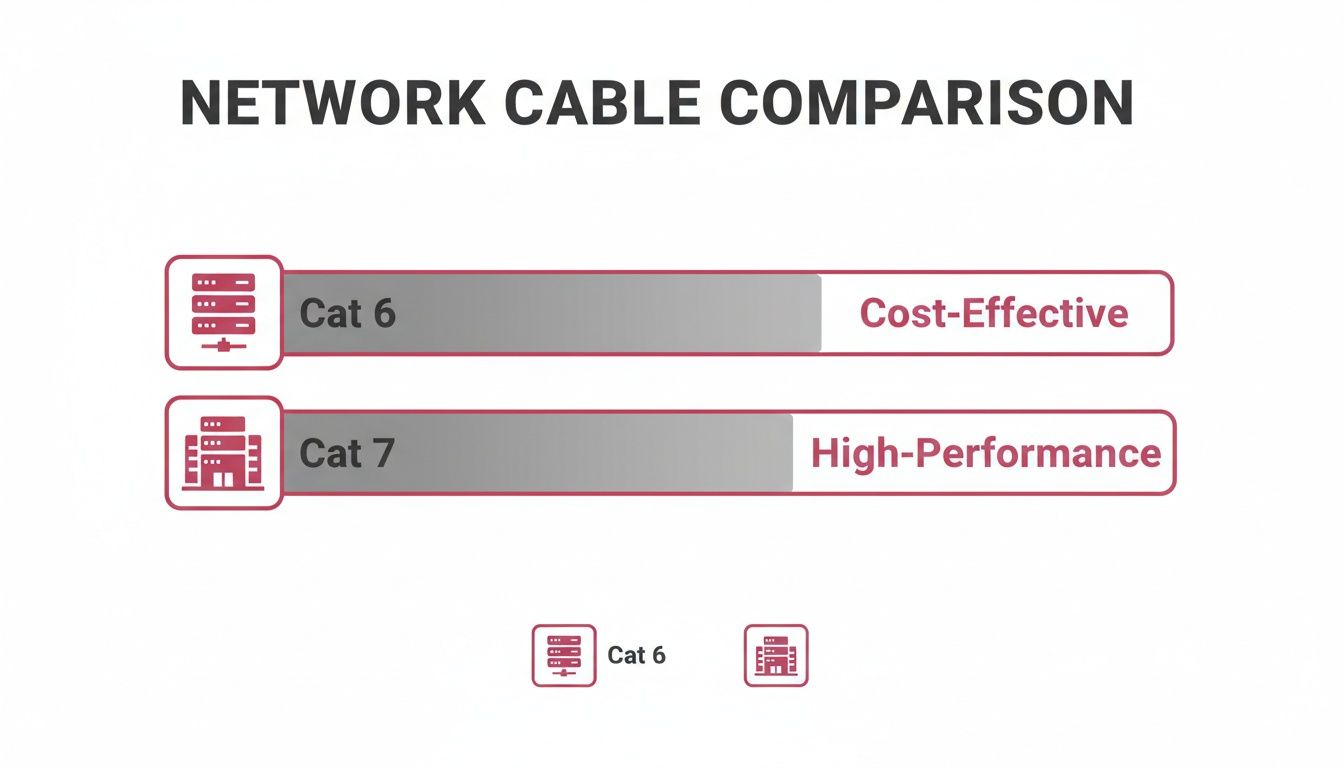
As you can see, Cat 6 is clearly positioned as the practical, cost-effective standard for everyday business needs, while Cat 7 is aimed at very specific, high-performance applications.
The Big Problem: Connectors and Compatibility
This brings us to one of the biggest sticking points: the physical connectors. Cat 6 uses the familiar RJ45 connector. It’s the universal standard you'll find on virtually every piece of network equipment, from PCs and printers to switches and routers. This guarantees simple installation and complete compatibility.
Cat 7, however, was designed to use proprietary connectors like the GG45 or TERA. Although technically superior, they are not backward compatible with the millions of RJ45 ports that make up office networks. This creates a massive headache, often requiring clunky adaptors or non-standard hardware that complicates both installation and future maintenance.
This compatibility issue is a major reason why Cat 7 was never widely adopted in commercial settings. The industry effectively skipped over it, moving instead to Cat 6a, which delivered 10 Gbps over 100 metres while sticking with the trusted RJ45 connector. To see how other modern standards compare, take a look at our guide on Cat 6 vs Cat 8 cabling solutions.
Ultimately, the technical "advantages" of Cat 7 are designed for problems that most UK businesses just don't face. This makes Cat 6 the smarter, more pragmatic choice for almost any SME network installation today.
Real-World Use Cases for UK SMEs
It’s one thing to look at technical specifications on a data sheet, but it’s another to see how they actually impact your business. When you’re weighing up Cat 6 vs Cat 7, it all comes down to how each cable performs in real-world scenarios. The right choice isn’t about chasing the highest numbers; it's about matching the technology to your genuine operational needs.
For the vast majority of small and medium-sized businesses, Cat 6 is the reliable workhorse. It delivers a solid, dependable foundation for all the daily tasks a modern company relies on, without forcing you to overspend. Think of it as the go-to standard for a reason.
Cat 7, on the other hand, is more of a specialist tool. Its advanced capabilities are designed to solve problems that most office environments will never face, making it a targeted investment for specific situations, not a blanket upgrade.
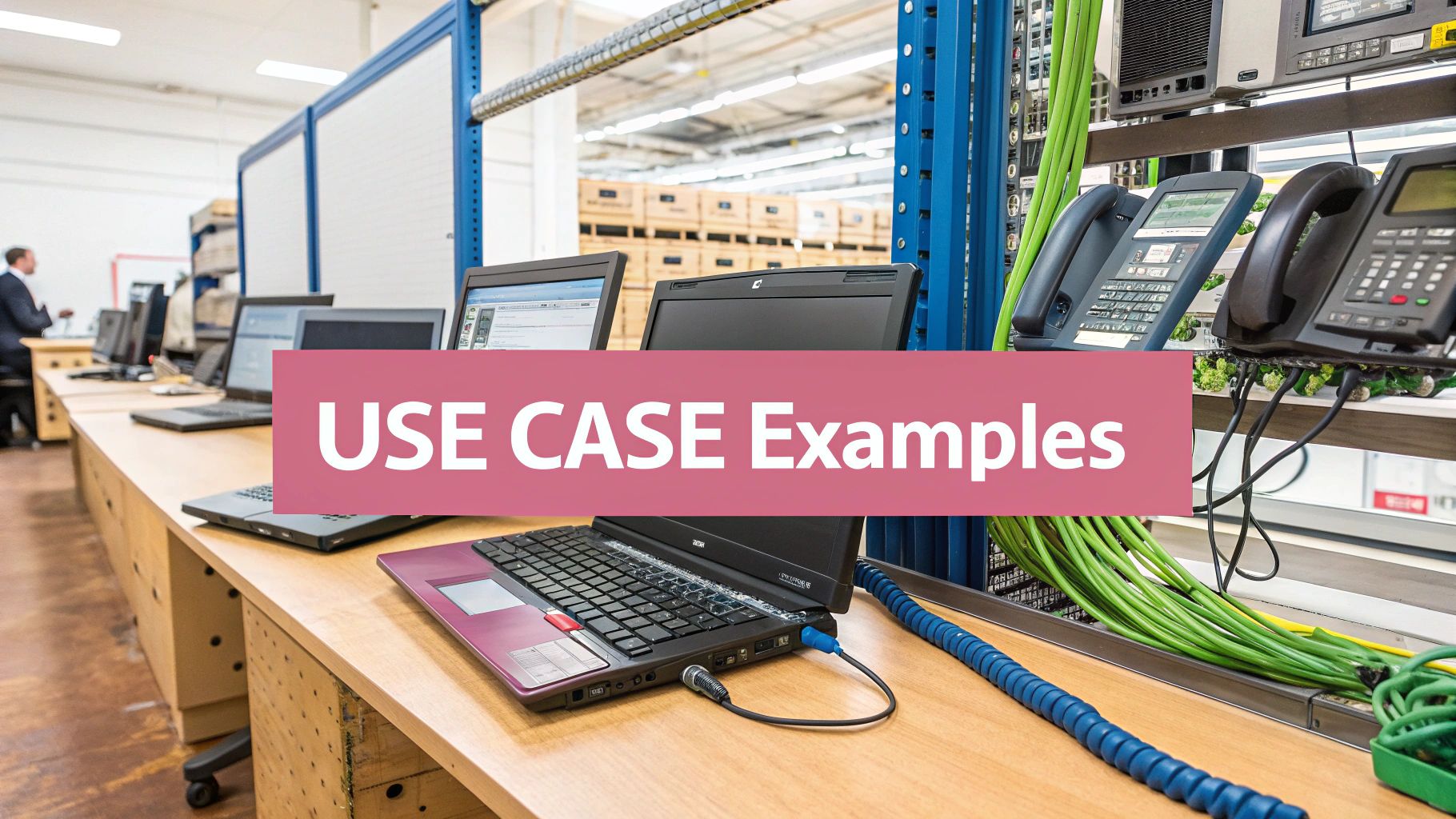
Everyday Operations with Cat 6
Picture a busy accountancy firm in Wiltshire. The team is constantly using cloud-based software like Xero or Sage, sending emails back and forth, and making client calls on a 3CX VoIP system. These are all essential, but none of them involve moving colossal amounts of data every second.
Here, a well-installed Cat 6 network is perfect. It provides more than enough bandwidth—1 Gbps—to keep VoIP calls perfectly clear, cloud apps feeling snappy, and large financial reports downloading without any frustrating lag. Choosing Cat 7 in this office would offer zero noticeable improvement for these tasks but would have a very noticeable impact on the installation bill.
Or, let’s take a marketing agency based in Dorset. Their day-to-day work might include:
- Video Conferencing: Daily catch-ups and client presentations on Microsoft Teams.
- Cloud Storage: Shifting large graphic design files and video proofs up and down from platforms like SharePoint.
- General Office Traffic: The usual mix of web browsing, emails, and admin tasks from the whole team.
Even with those occasional large file transfers, the 10 Gbps speed Cat 6 can achieve over shorter runs (up to 55 metres) is plenty to prevent any network slowdowns. The system can easily juggle multiple HD video streams and file syncs without anyone noticing a dip in performance.
Specialised Scenarios Demanding Cat 7
Now, let's look at a situation where Cat 7’s unique features become non-negotiable. Imagine a research and development facility in Hampshire that operates sensitive, high-precision diagnostic equipment. This machinery is not only data-hungry but also extremely vulnerable to electromagnetic interference (EMI) from other power sources or equipment nearby.
In this scenario, data integrity is everything. A single corrupted packet of data could completely invalidate a costly experiment. This is precisely where Cat 7's superior S/FTP shielding becomes a mission-critical feature. Its ability to shield the data signals from outside electronic ‘noise’ ensures the diagnostic tools receive clean, uncorrupted information.
For environments where signal integrity cannot be compromised—such as in manufacturing with heavy machinery, medical facilities with diagnostic imaging, or scientific labs—the investment in Cat 7's shielding is justified to prevent costly data errors and equipment malfunction.
Power over Ethernet Considerations
Power over Ethernet (PoE) has become incredibly common, powering everything from VoIP phones and wireless access points to security cameras through a single cable. It’s a clean and efficient way to set up office tech. Both Cat 6 and Cat 7 cables are fully capable of supporting PoE.
There is a subtle difference worth noting, though. The more powerful PoE standards, like PoE++ (802.3bt), can cause cables to generate a fair bit of heat, especially when bundled together. Cat 7’s thicker copper conductors and more robust shielding are better at dissipating this heat than standard Cat 6.
So, if a business is planning to deploy a large network of high-power CCTV cameras or the latest power-hungry wireless access points, Cat 7 could offer a more stable and reliable platform for power delivery. It helps reduce the long-term risk of performance issues caused by heat build-up.
Analysing Installation Costs and Long-Term Value
When weighing up Cat 6 vs Cat 7, the discussion around cost goes much deeper than just the price per metre of cable. To get a true picture, you have to look at the total cost of ownership (TCO), which covers the cable, the compatible hardware, and, critically, the specialised labour needed for a proper installation. Once you factor everything in, it becomes clear why Cat 6 is still the go-to, pragmatic choice for the vast majority of UK businesses.
The initial outlay for Cat 7 cable is certainly higher than Cat 6, but that’s just the tip of the iceberg. The real financial gap opens up during the installation itself. Cat 7 brings a level of complexity to the table that simply doesn't exist with Cat 6, and that complexity comes with a hefty price tag.
Breaking Down the Total Installation Costs
From a hands-on perspective, Cat 7 cable is a different beast to work with. It's thicker, significantly less flexible, and its internal foil shielding demands very careful handling to avoid damage. This physical rigidity alone can add a surprising amount of time to an installation, which directly translates to higher labour costs.
But the biggest challenge is the shielding. Cat 7's design mandates a specialised and meticulous grounding process at both ends of every single run. If this isn't executed perfectly by a technician who knows exactly what they're doing, the shielding can backfire. Instead of blocking interference, it can act like an antenna, potentially making network performance worse than you’d get with a standard unshielded cable. All these factors stack up to a much larger final bill.
The core issue for most SMEs is that Cat 7 installations demand not just more time but also a higher level of technical expertise. Technicians must be experienced with its unique grounding requirements and non-standard connectors, making specialised labour a significant cost factor.
Looking at the UK Ethernet cable market, the numbers tell a clear story. Cat 6 cables command a dominant 45% market share, leaving Cat 7 far behind at just 25%. This isn't surprising; it reflects the real-world needs of professional services in places like Dorset and Hampshire. While Cat 7’s performance is technically superior in high-interference settings, its higher cost—often several times more for a full installation—confines it to niche applications like data centres, not typical office environments.
Hardware Compatibility and Long-Term Value
The economic case for Cat 6 gets even stronger when you consider compatibility. It uses the standard RJ45 connector, the universal plug you'll find on virtually every switch, router, PC, and printer in your office. This means you can plug straight into your existing infrastructure without any fuss or the need for expensive adaptors.
Cat 7, on the other hand, was originally designed for proprietary GG45 or TERA connectors. This creates immediate compatibility headaches and adds another layer of expense and complexity to any project. Remember, the cabling budget is just one part of the overall cost of office fit out, a critical calculation for any UK business.
For most businesses, the supposed "long-term value" of Cat 7's high-end specs is purely theoretical. You only see those performance benefits in environments with extreme electromagnetic interference, something you're unlikely to find in a standard professional office. In reality, Cat 6 delivers the best long-term value by providing more than enough performance for today's needs and those of the near future, all at a fraction of the total installed cost.
What About Other Options, Like Cat 6a?
It's easy to get tunnel vision when comparing Cat 6 and Cat 7, but that overlooks a crucial part of the story. In the real world, network installers and IT managers rarely see it as a straight choice between those two. There’s a much more practical and popular middle ground that emerged.
That solution is Category 6a (Cat 6a). It was specifically engineered to fix the one major drawback of Cat 6: its failure to run 10 Gbps speeds over the full 100-metre distance required in most commercial buildings. Cat 6a confidently delivers that 10 Gbps performance across the entire 100 metres, putting it on par with Cat 7 for speed and distance.
The game-changer, though, is that Cat 6a does this using the standard RJ45 connector. This single design choice meant businesses could upgrade their network's backbone without the headache and expense of incompatible hardware that plagued Cat 7.
Why Cat 6a Became the Go-To Standard
Cat 6a quickly cemented its place as the default choice for future-proofing business networks. It hit the sweet spot, offering the 10 Gbps speeds needed for tomorrow's technology without the eye-watering cost, tricky installation, and proprietary connector issues of Cat 7. For almost every commercial project, it simply offered better value for money.
The market statistics tell the same story. Since it was officially recognised, Cat 6a has dominated new high-speed installations in UK businesses. By 2024, it accounted for over 50% of these projects, leaving Cat 7 as a niche solution with just 25% market share. We've seen this trend first-hand with our own clients, from care providers in Dorset to accountancy firms across Hampshire.
When planning a network upgrade, the real decision for most professional services firms isn't Cat 6 vs. Cat 7. It's about weighing the proven performance of Cat 6 against the future-ready investment of Cat 6a.
For The Extremes: Cat 8 and Fibre Optics
While Cat 6a is the right fit for the vast majority of office environments, it helps to know what lies beyond it for very specific, high-demand scenarios.
- Category 8 (Cat 8): This is the next leap in copper cabling, built for staggering speeds of 25 Gbps or even 40 Gbps. The catch? It can only maintain these speeds over short distances—up to 30 metres. This makes it a specialist cable, perfect for linking servers to switches inside a data centre, but not for wiring an office. If you're curious, you can explore this in our guide on Cat 7 vs Cat 8.
- Fibre Optic Cabling: Instead of electrical signals, fibre uses pulses of light to send data, giving it colossal bandwidth over incredible distances. It’s the technology that powers the internet backbone and connects buildings across campuses. While it's the ultimate in performance, the cost and complexity of installation put it out of reach for everyday office use.
Seeing the full picture makes the decision-making process much clearer. For nearly every UK business, the sensible, practical choice boils down to either the reliable Cat 6 for today's demands or the forward-thinking Cat 6a for the decade ahead.
Making the Right Choice for Your Network
After laying out the technical details, real-world performance, and costs, the decision between Cat 6 and Cat 7 should be feeling a lot less abstract. It’s not simply a case of picking the cable with the bigger number; it's about making a smart, strategic investment that fits your business needs and your budget.
For the vast majority of UK office environments—from professional services firms in Dorset to bustling hospitality venues in Hampshire—Cat 6 or Cat 6a strikes the perfect balance. They offer more than enough firepower for what businesses are doing today, play nicely with all standard hardware, and give you a sensible runway for future growth without breaking the bank.
A Practical Decision-Making Framework
To get to the right answer for your own business, it helps to run through a few key questions. This simple framework will point you in the right direction.
- What are your daily data demands? Think about your typical workflow. Is your firm dominated by VoIP calls, cloud-based software like Sage or Xero, and client video conferencing? If that sounds like your office, Cat 6 is more than capable.
- Is your environment electrically "noisy"? Are you based in an industrial unit surrounded by heavy machinery, or perhaps a medical facility with sensitive diagnostic equipment? In these scenarios, the superior shielding of Cat 7 could be a worthwhile investment to protect your data.
- What does your future look like? Do you have concrete plans to roll out technologies that will need 10 Gbps speeds across the entire office in the next five to ten years? If so, Cat 6a is the most pragmatic and cost-effective way to get ready for that future.
In the end, the goal is to build a network that you don't have to think about—a reliable foundation that just works. Cat 7 certainly has its place in highly specialised, interference-prone environments, but for most SMEs, it's an unnecessary and often impractical expense.
The best way forward is to work with someone who can translate your business goals into a technical specification. A professional consultation and site survey ensures your network is built for your reality, preventing you from overspending on features you'll never use.
By focusing on what you actually need, rather than just the numbers on a spec sheet, you can be confident your investment will deliver genuine, long-term value.
Your Questions Answered
When it's time to upgrade a network, business owners often have very specific questions about cabling. We get it. Choosing between standards like Cat 6 and Cat 7 can feel complicated, so let's clear up some of the most common queries we hear from professional firms across the UK.
Is Cat 7 Backwards Compatible with Cat 6 Equipment?
This is a really common and important question. Physically, you can plug a Cat 7 cable into a standard RJ45 port on your Cat 6 switch or computer. But here's the catch: it won't give you Cat 7 performance. Your network is only as fast as its slowest component, so the connection will simply run at Cat 6 speeds.
What's more, the official Cat 7 standard was actually designed around a different, non-RJ45 connector called a GG45. When you use Cat 7 cabling with everyday RJ45 hardware, you're essentially bypassing its main design features. It becomes a very expensive Cat 6 cable with no real-world advantage.
Can I Use Cat 7 for My Home Office Network?
Technically, yes, but it’s definite overkill. Even a high-demand home office running constant video calls and shifting large files won't come close to pushing the limits of what Cat 7 was built for. There's simply not enough data traffic or electromagnetic interference in a home setting to justify it.
For a powerful home office, a well-installed Cat 6 or Cat 6a system is more than capable. It delivers all the performance you'll need for years to come and is a much more sensible investment.
For professionals like accountants or solicitors running a business from home, Cat 6 is still the practical choice. It handles cloud-based software, VoIP calls, and secure data transfers with ease, avoiding the unnecessary cost and complexity of Cat 7.
Does Cat 7 Offer Better Performance for PoE Devices?
For this one, the answer is yes, but the advantage is slight. Power over Ethernet (PoE) devices, such as high-end security cameras or Wi-Fi access points, draw power through the cable and can generate a fair bit of heat, especially in tightly packed bundles.
Because Cat 7 cables have thicker copper wires and much heavier shielding, they are better at dissipating that heat compared to standard Cat 6. In a dense installation with lots of powerful PoE++ devices, this could contribute to better long-term reliability. For most typical PoE uses, like office VoIP phones, Cat 6 handles the job perfectly well.
Is Cat 7 a Good Way to Future-Proof My Business Network?
This might seem counterintuitive, but no, Cat 7 isn't considered the best path for future-proofing. Its proprietary connector issue and the fact it was never officially recognised by the key standards bodies in the US meant the industry largely moved on.
The real standard for future-proofing most business networks today is Cat 6a. It gives you the same 10 Gbps speeds over 100 metres that Cat 7 promises, but it does it using the universal RJ45 connector. This ensures it works seamlessly with all the equipment you own now and all the hardware you're likely to buy in the future. Opting for Cat 6a is a far more pragmatic long-term strategy.
Getting your cabling right is the foundation of a stable, high-performance network. If you're still weighing the options for your business in Dorset, Hampshire, or Wiltshire, the experts at SES Computers can help. We'll assess your specific needs and give you a clear, practical recommendation. Get in touch with us today to plan your network upgrade.