When it comes down to it, the real difference between Cat 7 and Cat 8 cabling is one of purpose. Cat 7 is a fantastic, high-speed workhorse for general office networks. For instance, it's ideal for a law firm needing reliable connections for video conferencing and accessing large case files from a central server. On the other hand, Cat 8 is a specialist cable built for one job—delivering extreme speeds over very short distances, almost exclusively inside data centres and server rooms.
Your choice really hinges on what you’re trying to connect. Are you wiring up workstations for your team, or are you linking critical, high-throughput servers and switches?
Choosing Your Network Cable: Cat 7 vs Cat 8
Picking between Cat 7 and Cat 8 is a genuinely important decision when you’re planning a network that needs to support your business today and grow with you tomorrow. Both are a huge leap forward from older standards like Cat 6, but they play very different roles in a professional IT setup. Nailing this choice is the key to a smart, cost-effective investment in your infrastructure.
For most small and medium-sized businesses we work with across Dorset, Somerset, and Wiltshire, the goal is straightforward: fast, dependable connectivity for everyday operations. We're talking about VoIP phone systems, access to cloud-based software, and quick file transfers. For these scenarios, Cat 7 is more than capable; it often exceeds what’s needed, providing a solid and reliable backbone.
Cat 8, however, is engineered for the intense, low-latency demands you only find in a data centre environment.
Key Specification Differences
The heart of the Cat 7 vs Cat 8 discussion is in their technical specifications. We'll dive deeper into these later, but a quick look at the headline figures really helps clarify where each one fits.
Here’s a quick-glance table to summarise the main technical differences.
Cat 7 vs Cat 8 Quick Comparison
| Specification | Category 7 (Cat 7) | Category 8 (Cat 8) |
|---|---|---|
| Max Data Rate | 10 Gbps | 25 Gbps / 40 Gbps |
| Bandwidth | Up to 600 MHz | Up to 2000 MHz |
| Max Cable Length | 100 metres | 30 metres |
| Primary Use Case | High-performance office & business networks | Data centres & server-to-switch links |
| Shielding | Screened/Foiled Twisted Pair (S/FTP) | Screened/Foiled Twisted Pair (S/FTP) |
As you can see, Cat 8’s incredible speed comes at the cost of distance, reinforcing its role as a short-range data centre specialist.
This simple flowchart can help you visualise which cable is the right fit for your needs, whether it's for a standard office, your home, or a dedicated server environment.
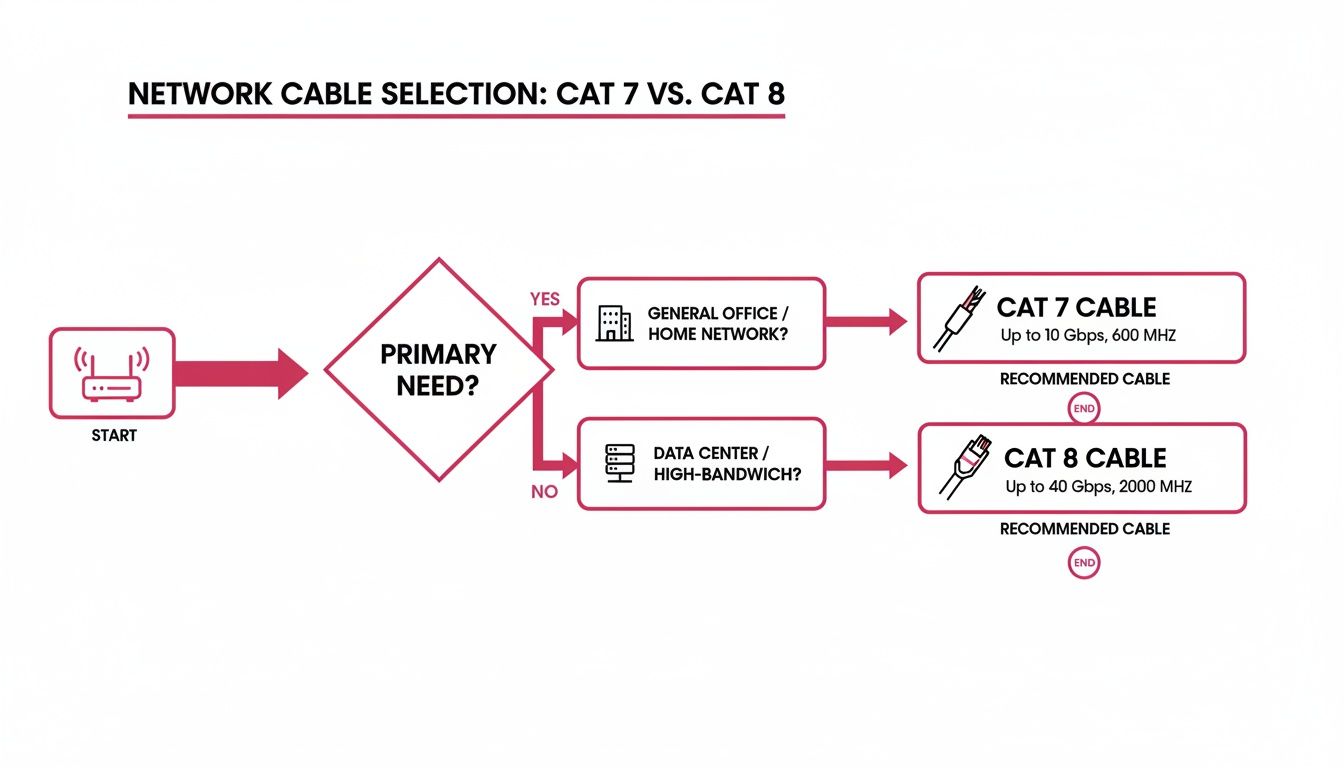
The main takeaway here is that your physical environment and performance needs are what should guide your decision. If you're wondering how these newer standards stack up against more common installations, our guide on Cat 6 vs Cat 8 offers some useful context.
A Detailed Technical Cabling Comparison
When you get down to the brass tacks of the Cat 7 vs Cat 8 debate, you have to look past the numbers on the box and into the technical specifications that actually drive performance. These aren't just abstract figures; they directly dictate how fast, reliable, and capable your network will be day-to-day. For any business in Hampshire or Wiltshire, making the right choice means matching these technical details to your real-world operational needs.
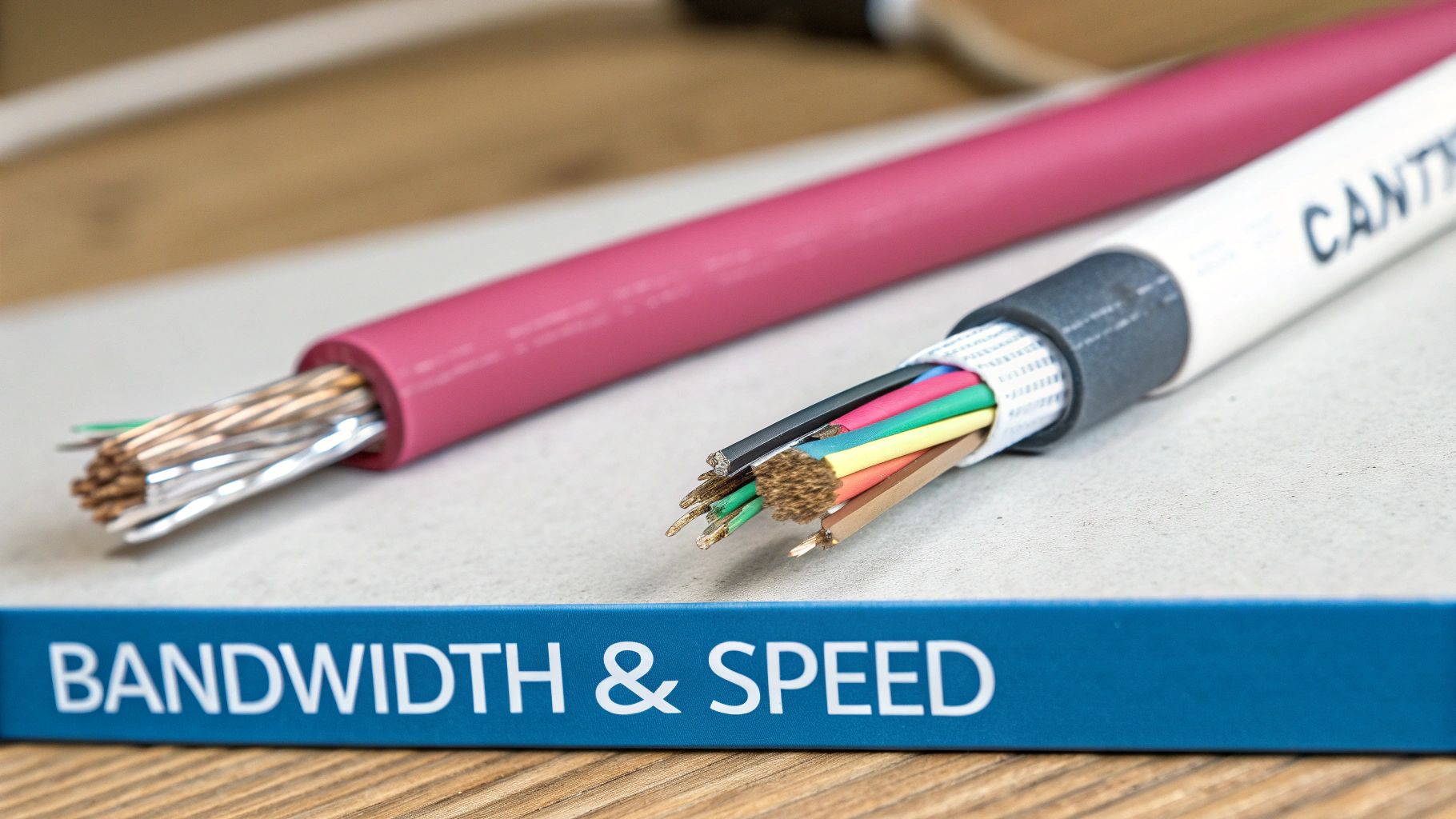
The biggest differences really come down to three key areas: bandwidth (also known as frequency), data transfer speed, and the maximum distance the cable can run. Each one plays a huge part in figuring out where each cable type really shines.
Bandwidth: The Data Motorway
I often tell clients to think of bandwidth, measured in megahertz (MHz), like the number of lanes on a motorway. More lanes mean more data can travel at once without creating a traffic jam, keeping everything running smoothly. It’s a vital concept, and you can get a deeper understanding by reading our guide on what network bandwidth means for your business.
- Cat 7 Bandwidth: This cable operates at a frequency up to 600 MHz. That’s a very wide "motorway," more than enough for what most modern offices need, including crystal-clear video calls, VoIP phone systems, and shifting large files around.
- Cat 8 Bandwidth: Here’s where things get serious. Cat 8 supports a massive 2000 MHz frequency. It’s a monumental leap, offering over three times the capacity of Cat 7. This level of bandwidth is engineered for places where huge amounts of data are in constant motion, like between servers and switches in a data centre.
For a typical accounting firm in Dorset, the 600 MHz from Cat 7 is plenty. But if you're a local data processing centre, you would see a very real performance boost from the 2000 MHz capacity of Cat 8.
Data Transfer Speed: How Fast Your Data Moves
If bandwidth is the number of lanes, data transfer speed (measured in gigabits per second, or Gbps) is the speed limit on that motorway. A higher speed limit means your data gets from A to B much faster, which is critical for time-sensitive operations.
For a business, the difference between 10 Gbps and 40 Gbps is profound. It's the difference between a standard file server and a high-performance computing cluster, where every millisecond of data transfer time impacts productivity and processing power.
Let's break down what that means in practice:
- Cat 7 Speed: Delivers data transfer speeds of up to 10 Gbps. For years, this has been the gold standard for high-performance business networks, easily handling demanding applications without creating bottlenecks.
- Cat 8 Speed: This cable is built for pure speed, capable of reaching 25 Gbps or even 40 Gbps. That four-fold increase is precisely why Cat 8 is the go-to choice for the core of a data centre network, connecting high-speed switches, servers, and storage arrays.
Cable Length: The Distance Limitation
The incredible speeds of Cat 8 cabling come with a significant trade-off: distance. It’s a simple law of physics—the faster the signal, the more it degrades over distance. This limitation is one of the biggest factors in deciding where each cable should be used.
- Cat 7 Maximum Length: It reliably supports its 10 Gbps speed over a full 100-metre channel. This generous length makes it perfect for wiring up entire office floors, connecting workstations, printers, and Wi-Fi access points back to a central communications cabinet.
- Cat 8 Maximum Length: Its 25/40 Gbps speeds are restricted to a much shorter channel length of just 30 metres. This is why you’ll almost exclusively find it used for short-run connections within a single room or even a single rack, like linking a server to a top-of-rack switch.
This fundamental difference in reach is at the heart of the Cat 7 vs Cat 8 comparison. Cat 7 is designed for the horizontal cabling that runs across a building, while Cat 8 is purpose-built for high-density, short-distance links inside your server room.
Analysing Real-World Business Use Cases
Knowing the technical specifications of Cat 7 and Cat 8 is one thing, but seeing where they fit into your actual business operations is what really matters. This isn't about which cable is "better" in a vacuum; it's about picking the right tool for the job. You need to be sure your investment is going to pay off.
For most businesses we work with across Dorset, Somerset, Wiltshire, and Hampshire, Cat 7 is a fantastic and practical solution. It’s a solid, reliable backbone for the vast majority of day-to-day work, hitting that sweet spot between high performance and sensible cost.
Cat 8, on the other hand, is a specialist. It’s built for extreme speed in very specific situations. Think of it as a non-negotiable for any business where data throughput isn't just a nicety but a fundamental part of the operation, usually inside a server room or data centre.
Cat 7 Use Cases: The High-Performance Office Standard
Category 7 cabling gives you more than enough headroom for the applications that keep a modern business running. Its ability to deliver a stable 10 Gbps over 100 metres makes it a brilliant choice for structured cabling throughout an office, linking workstations and departments back to the main comms cabinet.
Just think about the everyday professional scenarios where Cat 7 really shines:
- VoIP Telephony Systems: You cannot compromise on voice quality. Cat 7's excellent shielding and bandwidth mean your 3CX phone system will deliver crystal-clear calls without the jitter, lag, or drops that frustrate clients, even when your network is under heavy load. A financial services firm in Salisbury, for instance, would absolutely rely on this for uninterrupted client communication.
- Cloud Applications and DaaS: More and more businesses are running on cloud-based software (SaaS) and Desktop as a Service (DaaS). A practical example is an architectural practice using Cat 7 to ensure smooth, real-time rendering of large 3D models from a cloud server. Cat 7 provides the quick, responsive connection needed to make these services feel like they’re running on your local machine.
- General Workstation Connectivity: For the daily grind of shifting large files, jumping on video calls, and accessing shared drives, Cat 7 offers consistent, high-speed performance. It simply prevents those bottlenecks that kill productivity.
Of course, a great internal network needs a great internet connection to match. You can dive deeper into this topic in our article comparing lease line vs broadband solutions.
Cat 8 Use Cases: Powering Data-Intensive Environments
Category 8 cabling was designed with a very clear purpose in mind: moving huge amounts of data over short distances, fast. Its 40 Gbps capability is engineered for the "top-of-rack" or "end-of-row" setups you find in data centres and server rooms, where network switches and servers are packed in closely together.
The decision to invest in Cat 8 is justified when the cost of a network bottleneck is greater than the cost of the cable. For data centres, financial trading firms, or high-performance computing clusters, every millisecond of latency saved translates directly into improved performance and a stronger competitive edge.
Here are the specific environments where Cat 8 is really the only sensible option:
- High-Density Server Rooms: In a packed server rack, you have multiple servers all trying to talk to a top-of-rack switch at once. For a media production house rendering 4K video, Cat 8 delivers the 25 Gbps or 40 Gbps links needed to stop data traffic jams in their tracks and keep processing-heavy applications running smoothly.
- Data Centre Interconnects: This is the ideal cable for creating those ultra-fast links between rows of server racks or connecting your core network switches. It ensures data flows freely through the heart of your infrastructure, which is absolutely critical for things like virtualisation and storage area networks (SANs).
- High EMI Environments: The superior shielding on Cat 8 makes it incredibly resilient to electromagnetic interference (EMI). This is a vital feature for manufacturing plants in Hampshire or industrial sites in Wiltshire, where heavy machinery creates electrical 'noise' that could easily disrupt lesser cables and compromise data integrity.
Future-Proofing Your Network Infrastructure
When you invest in new network cabling, you're not just solving today's problems; you're laying the groundwork for the next decade. The choice between Cat 7 and Cat 8 isn't just about current speed requirements—it's about making sure your infrastructure can keep up with the pace of technology without needing a disruptive and expensive rip-and-replace job down the line.
Think of it this way: future-proofing means building a network that won't become a bottleneck as your business grows. While Cat 8 cabling has a higher upfront cost, its massive data-handling capacity is a long-term strategic advantage, preparing your business for whatever comes next.
Planning for What's Around the Corner
Technology waits for no one. New standards and applications constantly push the boundaries of what a network needs to handle, and your cabling has to be ready for these increasing demands. A smart choice today means looking at the trends that will define tomorrow.
Here are a few major shifts already on the horizon:
- Wi-Fi 7 (802.11be): The next generation of Wi-Fi is no slouch, promising speeds that could push past 40 Gbps. But wireless is only as good as the wires it connects to. To get that kind of performance from your access points, the wired backbone needs to be able to feed them multi-gigabit speeds—a perfect job for Cat 8.
- Multi-Gigabit Internet: As full-fibre internet becomes more common, the speeds available to your office are skyrocketing. There's little point in paying for a 10 Gbps internet connection if the cabling inside your building chokes that down to 1 Gbps.
- IoT and AI Applications: The Internet of Things (IoT) and Artificial Intelligence (AI) are no longer futuristic buzzwords. They're here, and they're hungry for data. These systems depend on collecting and processing huge amounts of information instantly, which demands the kind of low-latency, high-bandwidth network Cat 8 was designed for. A practical example would be a logistics depot using AI-driven cameras for package sorting, requiring a Cat 8 backbone for real-time video processing.
Choosing your network cabling is about more than just current speeds; it's about building a foundation that supports your five-to-ten-year technology roadmap. Aligning your infrastructure with strategic goals ensures your network remains an enabler of growth, not a barrier to it.
Matching the Cabling to Your Ambitions
To make the right call, you need to look past your immediate needs and consider where your business is heading. Are you planning to expand your premises? Will you be bringing in more data-heavy software or machinery? Your answers to these questions will tell you whether the investment in Cat 8 makes sense.
For many businesses, the case is already clear. In the advanced manufacturing hubs across Dorset and Hampshire, for instance, we've seen the adoption of high-category network cables like Cat 7 and Cat 8 jump by 28% between 2022 and 2025. Cat 8 is quickly becoming the standard for Industry 4.0 applications, driven by the need for rock-solid connections in smart factories. In fact, deploying Cat 8 has been shown to cut downtime by 35% thanks to its superior support for smart sensors and real-time data processing. You can discover more insights about the impact of Cat 8 in local industries and see how SES Computers helps businesses make the right choice.
Ultimately, the decision between Cat 7 and Cat 8 boils down to your appetite for growth and tolerance for risk. Cat 7 is a solid, reliable choice for most standard business operations today. Cat 8, however, offers genuine peace of mind, guaranteeing your infrastructure is ready for whatever technology throws at it next. For any business focused on scalability and resilience, the higher initial cost of Cat 8 is a small price to pay for a network that will support your ambitions for years to come.
Professional Installation and Cabling Guidance
Choosing between high-performance cables like Cat 7 or Cat 8 is one thing, but getting the performance you pay for is another entirely. The reality is that the quality of your network's installation is just as crucial as the cable itself. A shoddily installed premium cable can easily perform worse than an older, cheaper standard, completely undermining your investment.
These advanced cables are not like the patch leads you buy for your home router. They are thicker, less forgiving, and have incredibly strict handling requirements. Bending them too tightly or terminating them incorrectly can cripple signal quality. This is precisely why a DIY approach is a false economy for any serious business network.
When you're weighing up Cat 7 vs Cat 8, the installation details are every bit as important as the speed ratings on the box.
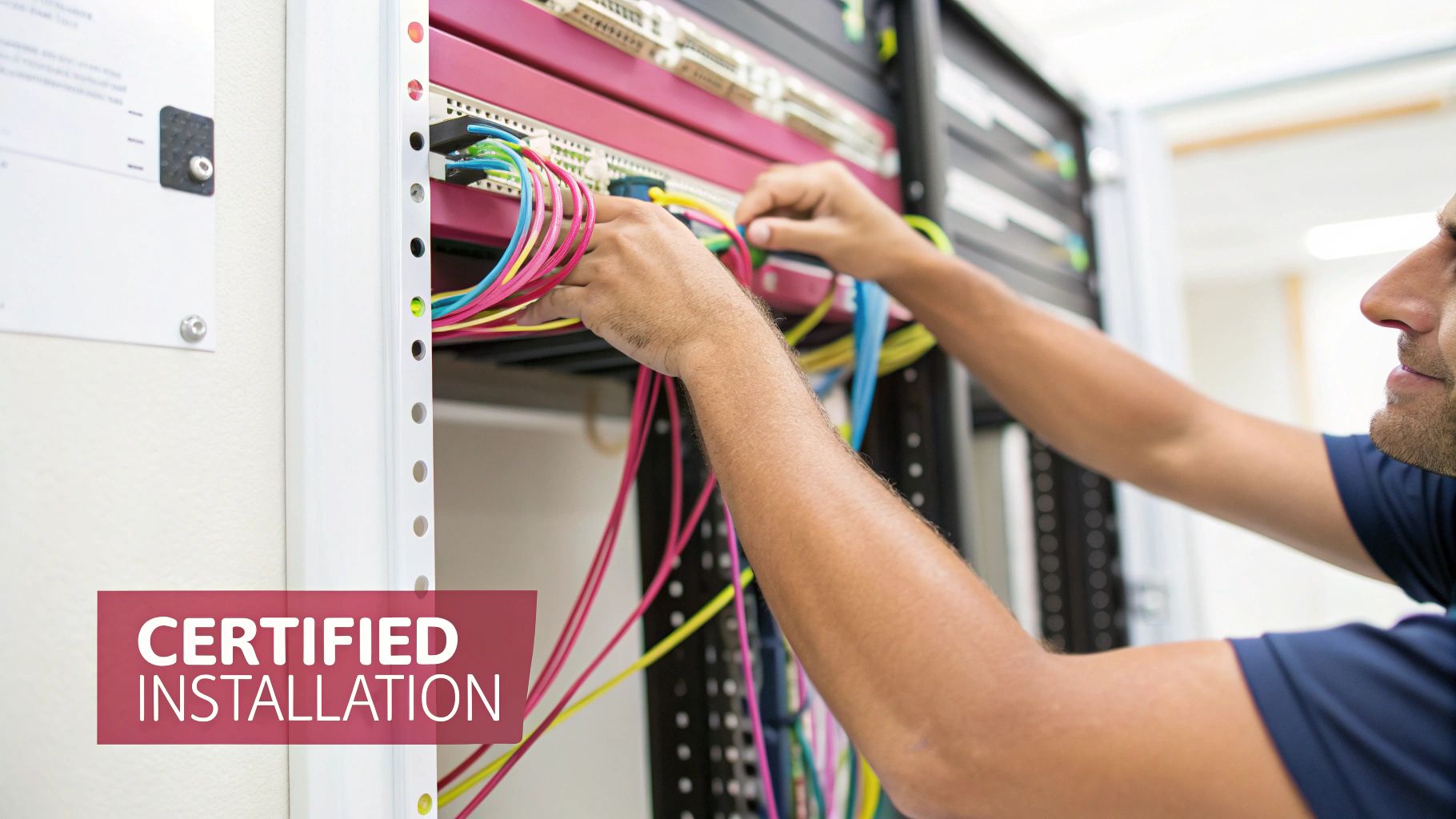
Why Professional Installation Is Non-Negotiable
Attempting a structured cabling job without the right training and tools almost always ends in trouble. You're left with performance gremlins that are a nightmare to track down and expensive to fix later. Professional installers work to precise industry standards, which is the only way to guarantee a cable performs to its specification.
Expertise is especially vital in these areas:
- Bend Radius: Both Cat 7 and Cat 8 cables have a minimum bend radius. If you bend a cable too sharply around a corner or through a tight conduit, you can physically damage the internal wiring and shielding. This introduces signal loss and crosstalk, but a professional knows exactly how to route cabling to avoid this.
- Termination Standards: Connecting the jacks and patch panels is a task of precision. Improperly terminated connectors are one of the most common failure points in a network, creating a bottleneck that strangles your data speeds right at the source.
- Shielding Integrity: The sophisticated shielding in Cat 7 and Cat 8 cables needs to be correctly earthed at both ends. An ungrounded shield is useless; worse, it can act like an antenna, pulling in interference and actively degrading your network's performance.
A certified installation isn't just about plugging things in. It's a guarantee that every single component of your network infrastructure meets the exact performance standards it was designed for. This gives you long-term reliability and ensures you see a true return on your investment.
The Critical Role of Certified Testing
So, how do you know for sure that your new cabling is actually delivering the speeds you were promised? The answer is certified testing. Once the installation is complete, a professional technician will use specialised equipment, like a Fluke Networks cable analyser, to validate every connection from end to end.
This is not an optional step; it's essential. The test measures a whole host of performance metrics to certify that the link meets the specific TIA/ISO standards for that cable category.
What Certified Testing Verifies:
- Attenuation: How much signal strength is lost along the length of the cable.
- Crosstalk (NEXT & FEXT): Checks for signal bleed between the different wire pairs.
- Return Loss: Confirms that poor connections aren't causing the signal to reflect back.
- Wiremap: Ensures all eight wires are connected to the correct pins at both ends.
Without this documented proof, you're flying blind. A "pass" certificate from a professional tester is your tangible assurance that the network backbone is solid and ready to support your business. For any mission-critical infrastructure, professional cabling guidance is the only way to guarantee performance and longevity.
Partnering with Experienced Technicians
For businesses across Dorset, Somerset, Wiltshire, and Hampshire, working with an experienced team like SES Computers takes all the guesswork out of the equation. A professional, certified installation provides far more than just a working network; it gives you peace of mind.
You get a system that is not only fast and dependable but is also backed by a warranty on the workmanship. This protects your investment and means that if an issue ever does crop up, you have expert support ready to put it right. Ultimately, the debate over Cat 7 vs Cat 8 only truly matters when you know the cable you choose will be installed to perfection.
Making the Right Cabling Choice for Your Business
When it comes to Cat 7 vs Cat 8, the decision isn't about which cable is "better" in a vacuum. It’s about which one makes the most strategic sense for your business, both for today's needs and tomorrow's ambitions. Let's cut through the technical jargon and get straight to the point.
Most small and medium-sized businesses just need their network to work, plain and simple. That means keeping the VoIP phone system crystal clear, ensuring cloud apps don't lag, and letting your team share files without a hitch.
The Verdict for Most Businesses
For the vast majority of commercial environments, Cat 7 is the clear winner. It reliably delivers a powerful 10 Gbps over the full 100-metre distance, which is the standard for structured office cabling. This provides more than enough bandwidth for what you need now, plus plenty of headroom for future growth. It's the perfect balance of performance and cost.
Stick with Cat 7 if you're:
- Wiring a new office or upgrading an existing one for everyday workstation use.
- Running a high-quality VoIP phone system or relying on frequent video conferencing.
- Needing fast, dependable access to cloud services and shared network drives.
The Specialist's Choice
Cat 8 is a different beast altogether. It was engineered for one thing: extreme speed in very specific, high-density environments. Its 40 Gbps capability is incredible, but it only works over a short 30-metre channel. This makes it completely impractical for wiring up an entire office floor.
Think of Cat 8 as a specialist tool for connecting the core of your network—the servers, switches, and storage that do the heavy lifting.
You only start looking at Cat 8 when the cost of a network bottleneck is far greater than the cost of the cable itself. It's an investment in raw performance, plain and simple.
Invest in Cat 8 when you're:
- Connecting servers to top-of-rack switches in a crowded server room.
- Creating ultra-fast links between core network hardware in a data centre.
- Working in environments with significant electromagnetic interference, like factory floors or medical facilities.
Your final choice should mirror how your business actually operates. Cat 7 is the workhorse for almost any modern, future-ready office network, giving you a powerful and reliable foundation. Cat 8, on the other hand, is the precision instrument for data centres and server rooms where maximum speed over a short distance is the only thing that matters. Making the right call ensures your network infrastructure is a genuine asset, not just a utility.
Frequently Asked Questions
When it comes to Cat 7 and Cat 8 cabling, we often hear the same questions from business owners and IT managers. Let's clear up a few of the most common queries we get from clients across Dorset and Hampshire.
Is Cat 8 Backwards Compatible With Cat 7?
Absolutely. A Cat 8 cable terminated with a standard RJ45 connector will work perfectly with Cat 7 ports and any older standard, like Cat 6a.
The key thing to remember, though, is that your network is only as fast as its slowest part. If you plug a high-spec Cat 8 cable into a switch that's only rated for Cat 7, you'll get Cat 7 speeds.
When Does Cat 7 Make Sense For a New Office?
For most new office fit-outs, Cat 7 is still the smart, cost-effective choice. It offers more than enough bandwidth for the tools modern businesses rely on—think VoIP phone systems, cloud-based software, and constant video calls.
It provides a great balance of high performance and sensible cost for standard cable runs up to 100 metres. It's a solid investment that will serve your business well for years, without paying for performance you simply do not need yet.
For a typical office environment, Cat 7 delivers all the power you need to support daily operations for the foreseeable future. The jump to Cat 8 is really only justified for specialised, high-density scenarios like server rooms, where its short-distance speed is essential.
Why Is Professional Installation So Important For Cat 8?
Cat 8 cabling is a different beast altogether and comes with incredibly strict installation rules. Its headline speed of 40 Gbps is only achievable over a much shorter distance—a maximum of 30 metres.
It also has a very tight bend radius, meaning it cannot be bent sharply without damaging its performance. To get the speed you're paying for, professional installation followed by certified testing is not just recommended; it’s essential.
Planning a network upgrade requires expert guidance to ensure your infrastructure can support your business goals. For professional cabling and IT support in Dorset, Somerset, Wiltshire, or Hampshire, contact SES Computers to discuss your requirements. Find out more at https://www.sescomputers.com.