Thinking about moving your business to the cloud can be daunting. It often feels like a mammoth project, packed with technical jargon and the very real risk of disrupting your day-to-day operations. This is precisely where Cloud Migration as a Service (CMaaS) comes in.
It’s a complete, managed solution where an expert team handles the entire process for you, from start to finish, massively reducing the risk and potential downtime.
What Is Cloud Migration as a Service?
Think of it like hiring a specialist removals firm for a critical office move. Instead of your own staff trying to figure out how to dismantle everything, pack it safely, and transport it without breaking anything, you bring in the professionals. A DIY cloud migration is much the same—it pulls your team away from their real jobs to tackle complex IT challenges they may not be equipped for.
A CMaaS provider manages the entire relocation. For example, a UK-based accountancy practice would entrust a CMaaS partner to migrate its client databases and practice management software to a secure cloud platform, ensuring a seamless transition with zero data loss. They take care of the planning, the heavy lifting, and the execution, freeing up your team to keep the business running smoothly. It turns a potentially chaotic IT project into a predictable and seamless transition for UK businesses.

A Managed Partnership for a Smooth Transition
The real value of CMaaS is in the partnership. Your provider doesn’t just hand you a set of tools and wish you luck; they take full responsibility for the project's success. It’s a world away from simply renting server space. If you want to understand the basics of the infrastructure itself, our guide on what is cloud hosting is a great place to start.
CMaaS is the service layer that manages the entire journey onto that infrastructure. This typically involves:
- Initial Assessment: A deep dive into your current IT setup, analysing your applications, data, and systems to spot any dependencies or potential hurdles.
- Strategic Planning: Crafting a bespoke migration roadmap that lines up with your business objectives, helping you choose the right cloud platform, and setting a realistic timeline.
- Secure Execution: The physical (and virtual) move. This means migrating your data, workloads, and software, followed by rigorous testing to ensure everything works perfectly with minimal interruption.
- Post-Migration Support: Once you’re in, the job isn’t over. This includes ongoing management, optimisation, and security monitoring to make sure you’re getting the most out of your new cloud environment.
The Removals Firm Analogy Explained
The removals firm analogy really hits home for UK professional services firms. Imagine a law firm in Dorset holding highly sensitive client files and running specific legal software. Trying to move all that to the cloud themselves could be a disaster, risking data breaches, significant downtime, and serious compliance issues.
A Cloud Migration as a Service provider acts as the project manager, the security detail, and the technical crew all rolled into one. Their entire focus is on moving your digital operations safely and efficiently, so you can unlock the door to your new cloud environment and get straight back to work.
To continue the analogy, the CMaaS team plans the layout of your new "office" (the cloud architecture), packs your most valuable assets securely (data encryption and transfer), and ensures every desk is set up and ready for your team to log in on day one. It’s this end-to-end responsibility that makes all the difference.
Why UK Businesses Are Embracing Managed Cloud Migration
For businesses across the UK, moving to the cloud isn't just a technical upgrade anymore; it's become a core part of a smart business strategy. It’s less about chasing the latest trend and more about securing real-world advantages that boost efficiency and protect the bottom line.
The numbers really tell the story. Cloud adoption in the United Kingdom has soared to 65% or higher, making it one of the most mature cloud markets in Europe. What's even more telling is that a record-low 3% of UK companies now say they have no plans to migrate at all. The reasons are clear: they're seeking better scalability (71%), serious cost reductions (64%), and the flexibility to support their remote teams (52%). For a deeper dive into these figures, you can read the full cloud adoption research from SQ Magazine.
Gaining True Business Agility and Scalability
One of the most compelling reasons to work with a cloud migration partner is the ability to scale your resources up or down at a moment's notice. Consider a London-based marketing agency approaching a major product launch for a client. In the past, they would need to buy expensive servers to handle the anticipated spike in website traffic, only for that hardware to sit underutilised for the rest of the year.
The cloud changes all that. They can instantly ramp up their computing power to handle the campaign launch and then, once the peak has passed, scale it right back down. They only ever pay for what they actually use. This avoids locking up cash in depreciating assets and gives them a level of agility that’s simply not possible with a traditional, on-premises setup.
Shifting from Capital Expense to Operational Expense
Every professional services firm, from an architectural practice to a management consultancy, values financial predictability. The old model of buying and maintaining your own servers is anything but predictable. It’s a cycle of hefty upfront capital expenditure (CapEx), expiring warranties, and the constant risk of an unexpected failure that requires a costly emergency fix.
Cloud migration flips this financial model on its head. It allows a business, like a Wiltshire-based engineering firm, to move away from unpredictable capital spending and towards a steady, predictable operational expense (OpEx). This subscription-style model simplifies budgeting and frees up capital to be reinvested where it matters most—in growing the business.
Bolstering Security and Nailing Compliance
With cyber threats becoming more sophisticated and regulations like GDPR getting stricter, security can’t be an afterthought. A professional cloud migration service builds a strong security and compliance foundation right from the start, taking the headache out of meeting demanding UK standards.
A managed provider doesn’t just move your data; they build your new cloud environment with security embedded at every level. This typically includes:
- Proactive Threat Monitoring: Keeping a constant watch to spot and stop threats before they can cause any harm.
- Robust Data Encryption: Safeguarding your sensitive information both in transit and while it’s stored in the cloud.
- Strict Access Controls: Making sure only the right people can access the right information and applications.
For any professional services firm handling sensitive client data, this expert-led approach provides invaluable peace of mind. It not only protects you but also demonstrates to your clients and regulators that you take your responsibilities seriously, especially in today’s world of remote and hybrid working.
Choosing the Right Cloud Migration Strategy
Picking the right way to move to the cloud is probably the biggest decision you'll make in the whole process. It’s a choice that will shape how quickly you can make the move, how much it costs, and the value you get out of it for years to come. Get it right, and the transition feels smooth and logical; get it wrong, and you could be in for a disruptive and expensive overhaul.
Think of it like moving house. You could just pack everything into boxes and shift it to the new place. Or you might decide to declutter and upgrade some old furniture along the way. In some cases, you might even realise it's better to sell everything and start fresh with brand-new stuff that fits the new home perfectly.
There are a few well-trodden paths for moving your IT to the cloud, and each comes with its own set of pros and cons. Let's break down the most common strategies we see UK businesses successfully use.
Rehosting (or ‘Lift and Shift’)
Often called ‘Lift and Shift’, this is the most straightforward approach. Imagine you’ve got a perfectly good server humming away in a cupboard, but you need to get it out of the office. Rehosting is the digital equivalent of picking up that server and moving it, exactly as it is, into a highly secure, modern cloud data centre.
You make almost no changes to how your applications are built or run. The main goal here is speed and simplicity.
- When to Use It: This is your go-to strategy when you're up against a tight deadline, like a data centre contract that's about to expire or some hardware that’s on its last legs. It’s a fast track to getting the basic benefits of cloud infrastructure without kicking off a massive development project.
- Practical Example: A law firm in Somerset gets notice that its hosting provider is shutting down in three months. It has to move its case management software, and it needs to do it without disrupting daily operations. A lift and shift lets them clone their existing setup in the cloud, hitting the deadline without having to rewrite a single line of their essential software.
Replatforming (or ‘Lift and Reshape’)
‘Lift and Reshape’, or replatforming, is a slightly more involved version of rehosting. You’re still moving the application largely as-is, but you make a few clever tweaks to take better advantage of the new cloud environment. It's like moving house but deciding to swap your old, inefficient boiler for a modern combi-boiler during the move.
You aren't rebuilding from the ground up, but you are making some smart improvements. A great example for a professional services firm is switching from a self-managed database on an old server to using a managed cloud database service like Amazon RDS or Azure SQL. This one change can slash administration time while boosting performance and reliability.
Replatforming hits that sweet spot between the raw speed of rehosting and the deeper benefits of a full redesign. It lets a business see real improvements without the cost and headache of refactoring.
Repurchasing (or ‘Drop and Shop’)
The ‘Drop and Shop’ strategy means ditching a legacy application entirely and switching to a modern Software-as-a-Service (SaaS) provider. Instead of trying to migrate your clunky, on-premises accounting software, you’d move your data over to a cloud platform like Xero or QuickBooks.
The classic example for almost every UK business is moving from an old, self-managed Exchange server to Microsoft 365. You simply stop worrying about the software and infrastructure and instead subscribe to a service that delivers everything you need, and often much more. This approach completely removes the burden of maintaining software, freeing up your team to focus on using the tools, not fixing them.
Refactoring (or ‘Rearchitecting’)
Refactoring is the most intensive strategy of them all. This involves fundamentally rebuilding an application so that it’s fully cloud-native. This isn't just moving house; this is knocking down the old property and building a modern, energy-efficient home from scratch, designed specifically to make the most of its location.
This approach is reserved for your most important, business-critical applications where you need serious scalability, top-tier performance, and the agility to adapt in the future. For example, a fintech company might refactor its core customer-facing application to handle massive transaction volumes and rapidly deploy new features. While refactoring demands the biggest upfront investment of time and money, it unlocks the true power of the cloud. It opens the door to features like auto-scaling and serverless computing, which can dramatically cut your long-term running costs and drive real innovation.
Comparing Cloud Migration Strategies
Choosing between these options can feel daunting, so here’s a table to help clarify which strategy might be the best fit for your specific situation.
| Strategy | Description | Best For | Example Scenario |
|---|---|---|---|
| Rehosting | Moving applications to the cloud with minimal or no changes. The "as-is" approach. | Speed and cost-effectiveness. Meeting tight deadlines like data centre closures. | A retail company needs to vacate its on-premises data centre within 60 days and moves its existing servers to a cloud provider without modification. |
| Replatforming | Moving applications with a few targeted cloud optimisations, like using a managed database service. | Gaining tangible cloud benefits (e.g., better performance, less management) without a full rewrite. | An e-commerce site migrates its web application but switches from a self-managed MySQL database to a managed cloud SQL service to improve reliability. |
| Repurchasing | Discarding an existing application and moving to a SaaS product that provides the same functionality. | When a commercial, off-the-shelf product can replace a legacy system, eliminating management overhead. | A business replaces its old, on-premises CRM software with a subscription to a cloud-based platform like Salesforce or HubSpot. |
| Refactoring | Rebuilding an application from the ground up to be cloud-native and take full advantage of cloud features. | Core business applications where scalability, future features, and performance are critical competitive advantages. | A financial services firm rearchitects its monolithic trading platform into a set of microservices to improve agility and scale on demand. |
Ultimately, the best strategy depends entirely on the application in question and your business goals. You might even find that you use a mix of these approaches for different parts of your IT estate—and that's perfectly normal. The key is to make a conscious, informed decision for each one.
The Four Phases of a Successful Migration Journey
Getting to the cloud isn't a single leap of faith; it's a carefully planned expedition. A professional cloud migration as a service provider treats it as a structured project, designed from the ground up to minimise risk and deliver a predictable, successful result. This phased approach means every detail is considered, from the initial deep-dive into your current systems to making sure everything runs perfectly long after the move is complete.
Phase 1: Assessment and Discovery
This first step is all about looking before you leap. Before a single file is moved, migration experts get under the bonnet of your current IT infrastructure. This is more than just a quick check; it's a forensic audit to map out every single application, server, database, and how they all talk to each other. The goal is to build a complete, unvarnished picture of your digital estate.
For instance, a specialist might find your old accounting software is quietly depending on an ancient, unsupported database—a potential bombshell in a cloud environment. Catching these kinds of dependencies early is what separates a smooth migration from a disastrous one. This groundwork forms the very foundation of a solid plan. For a closer look at this crucial stage, you can review our guide on the latest data migration best practices.
Phase 2: Planning and Design
With a crystal-clear understanding of what you have, the next phase is about designing what you need. This is where your business goals are translated into a technical blueprint. Your migration partner will design a cloud architecture that's secure, scalable, and cost-effective, carefully selecting the right services for your specific requirements.
This phase also delivers a detailed project plan. It clearly outlines the timeline, who is responsible for what, how risks will be managed, and how everyone will be kept in the loop. Think of it as the master schedule for the entire operation, ensuring no one is left guessing.
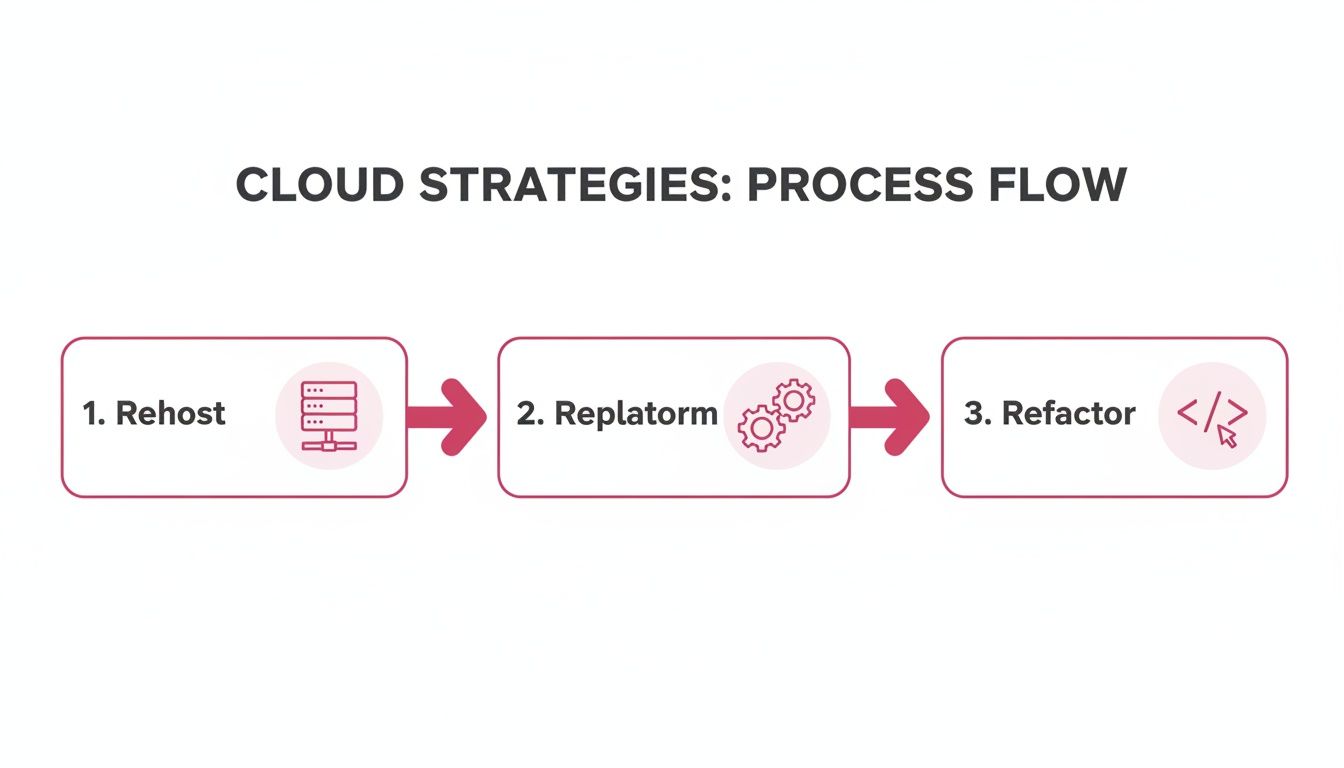
This flowchart shows how the migration strategy chosen during planning—from a simple "lift and shift" Rehost to a more involved Refactor—directly impacts the project's complexity and the long-term benefits you'll see. It really underscores why good planning is non-negotiable.
Phase 3: Migration and Execution
Now for the main event. Following the detailed plan, the technical team starts the process of moving your data, applications, and workloads into their new cloud home. This is handled with military precision to cause as little disruption as possible, often scheduled for evenings or weekends so your business can carry on as usual.
A huge part of this phase is relentless testing. As each piece is moved, it’s put through its paces to ensure it works just as it should. This validation is what guarantees there are no nasty surprises when your team logs on Monday morning.
Phase 4: Optimisation and Management
The journey isn’t over once you’ve landed in the cloud. In many ways, it’s just beginning. This final, ongoing phase is what ensures you get the full value from your investment. Your provider will now focus on fine-tuning the environment for peak performance and cost efficiency.
This continuous process typically includes:
- Performance Tuning: Keeping a close eye on your applications and infrastructure to make sure they're running as smoothly and quickly as possible.
- Cost Management: Actively analysing your cloud spend to spot and eliminate waste, making sure you only pay for what you actually use.
- Ongoing Security: Proactively managing your defences, applying security patches, and monitoring for threats to keep your data protected.
This last phase turns the migration from a one-time project into a cycle of continuous improvement, making sure your cloud setup keeps evolving and delivering for your business.
How to Navigate Cloud Security and Compliance
For any professional services firm, but especially those in tightly regulated sectors like finance or healthcare, security and compliance aren't just tick-box exercises. They're fundamental. So, when you're looking at cloud migration as a service, it's natural for these concerns to jump straight to the top of the list. A good migration partner tackles these issues head-on, building a secure and compliant environment from the word go.
The UK cloud migration market is absolutely booming, projected to grow from USD 566.77 million to a staggering USD 4,975.56 million by 2033. A huge driver for this growth is the demand for better security and flexible hybrid cloud setups. This rapid expansion just goes to show how critical it is to get security right from the start.

Understanding the Shared Responsibility Model
One of the first things that can cause confusion is figuring out who is responsible for what. This is where the Shared Responsibility Model comes in, and it's a really helpful concept. Think of it like renting a high-security storage unit.
- The Cloud Provider (e.g., Microsoft Azure): They are responsible for the security of the cloud. This is the physical security of the data centres, the core network, and the foundational services. In our analogy, they make sure the building is secure, the locks are strong, and the alarms are working.
- Your CMaaS Partner and You: You are responsible for security in the cloud. This covers everything you actually place inside your storage unit—your data, your applications, and who has access. Your partner's job is to configure and manage these elements to keep them completely safe.
Essentially, your managed service partner configures your cloud environment to protect what’s inside. They ensure the right people have the right keys and that everything is organised and shielded from threats.
Building for UK Compliance From Day One
Meeting UK-specific regulations is completely non-negotiable. A professional CMaaS provider doesn’t just lift and shift your systems. They architect your new cloud environment to comply with frameworks like GDPR and Cyber Essentials right from the ground up.
This proactive approach means compliance is baked into the design, not just bolted on as an afterthought. Security controls are built directly into the infrastructure, which is a far more robust way of doing things.
Let's take a real-world example. When migrating a local healthcare clinic, a provider would put specific measures in place:
- Strict Identity Management: Using multi-factor authentication to guarantee only authorised staff can access sensitive patient records.
- End-to-End Data Encryption: Protecting patient data both as it moves to the cloud and while it sits at rest.
- Proactive Threat Monitoring: Actively hunting for and responding to any suspicious activity to stop data breaches before they can even happen.
For an accountancy practice, the focus would shift slightly to securing financial records with tight access controls and detailed audit trails to satisfy financial regulations. If you'd like to get to grips with the basics, you can check out our guide on cloud computing security.
And while you’re strengthening your cloud security, don’t forget about the physical hardware you’re leaving behind. It's crucial to understand the importance of data security in IT asset disposition, as this is a critical, and often overlooked, part of staying compliant.
Selecting the Right Cloud Migration Partner
Choosing your migration partner is arguably the single most critical decision you'll make in this entire process. It’s a choice that will ripple through everything, from the initial budget and timeline to the long-term health and performance of your cloud setup. You aren't just looking for technical wizards; you need a team that takes the time to understand your business, communicates without jargon, and is genuinely invested in your success.
Finding the right expert isn’t about ticking boxes. It's a strategic hunt for a provider whose track record aligns with your company's unique challenges and industry-specific needs. This means you need to ask the right questions—ones that cut through the sales pitch and get to the heart of their project style, security practices, and what happens after the migration is done.
Key Questions to Ask Prospective Providers
To make a confident choice, you need a structured way to compare potential partners. The questions below are designed to help UK professional services firms figure out who is a genuine partner for their cloud migration as a service journey and who is just a vendor.
Kick things off by asking about their direct experience. A great starting point is: "Can you share case studies of businesses similar to ours in size and sector?" A provider who has helped an accountancy firm in Dorset move to the cloud will have a far deeper understanding of your software dependencies and compliance headaches than a generalist ever could.
Next, get into the nuts and bolts of the project. Ask: "What is your communication plan for managing the project and minimising downtime?" What you're listening for is a clear, proactive strategy. They should be able to name a single point of contact, promise regular updates, and have a solid plan for migrating outside your core business hours to keep disruption to an absolute minimum.
Verifying Technical and Security Expertise
Security and compliance are, of course, non-negotiable. It's vital to ask: "How do you ensure our data remains secure and compliant with UK regulations like GDPR throughout the process?" A confident answer will go into detail on their use of encryption, access controls, and their firm grasp of the Shared Responsibility Model.
Finally, think beyond the go-live date. One of the most revealing questions you can ask is: "What level of support do you provide after the migration is complete?" The best partners don’t just wave goodbye once you’re in the cloud. They offer ongoing optimisation, security monitoring, and cost management to make sure you get the full value from your investment. When evaluating potential partners for your cloud migration, understanding the role and benefits of an AWS managed service provider can provide valuable insight into what excellent post-migration support looks like.
A partnership should not end the moment your systems are live in the cloud. The true value comes from a long-term relationship focused on continuous improvement and ensuring your cloud environment evolves with your business.
The impact of getting this choice right is clear when you look at major UK success stories. Tesco Technology’s move to the cloud, for instance, led to £75 million in annual infrastructure savings and an 89% faster rollout of new features. Likewise, NHS Digital saved £150 million over five years and slashed its disaster recovery time from 48 hours to just two. These examples prove that the right partner delivers real, measurable returns. To learn more about these impressive outcomes, you can explore detailed insights on UK cloud migration successes.
Your Cloud Migration Questions, Answered
Moving to the cloud is a big step, and it's natural to have questions. To help you get a clearer picture, we've put together straightforward answers to some of the most common things UK businesses ask when considering a cloud migration as a service partner.
How Much Does a Cloud Migration Service Cost?
There's no single price tag for a cloud migration. The final cost really comes down to the scale and complexity of your current IT systems and what you want to achieve. For instance, a simple "lift and shift" for a couple of servers will be a very different investment compared to rebuilding a custom, mission-critical application from the ground up for the cloud.
Several key factors will shape your quote:
- The sheer volume of data you need to move.
- The total number of applications and servers involved.
- The migration strategy we agree on (e.g., Rehosting vs. Refactoring).
- The level of ongoing support you’ll need after the move.
Any good provider will conduct a thorough assessment first. This moves you away from guesswork and gives you a clear, predictable budget based on your specific needs.
How Long Will the Migration Take? And What About Downtime?
Just like cost, the timeline depends entirely on the project's complexity. A smaller, more straightforward migration might only take a few weeks. A larger, more intricate project involving many interconnected systems could span several months of careful planning and execution.
A core goal of any professional cloud migration is to make the transition invisible to your daily operations. The final switch is almost always planned for outside of business hours—think evenings or weekends—to ensure your team feels zero disruption.
We're big believers in testing, testing, and more testing. Rigorous checks before, during, and after the move guarantee that when your team logs in on Monday morning, everything just works.
What Happens After the Migration Is Complete?
Getting your systems live in the cloud isn't the finish line; it's the starting point. This is where the real value of a managed partnership shines through. Your provider shifts from managing a project to providing ongoing support focused on making your new cloud environment better and better.
This post-migration support is crucial and usually covers:
- Performance Optimisation: Continuously tweaking your new setup to ensure it’s running as efficiently and quickly as possible.
- Cost Management: Keeping a close eye on your cloud spend to find savings and make sure you’re only paying for what you actually use.
- Proactive Security: Ongoing monitoring, patching, and threat management to keep your data safe from new and emerging risks.
This ongoing relationship turns the migration from a one-off task into a long-term strategic advantage, ensuring your cloud investment keeps paying off as your business grows.
Ready to start your cloud journey with a partner you can trust? For over 30 years, SES Computers has delivered expert-led cloud migration and managed IT services to businesses across Dorset, Wiltshire, and Somerset. We handle all the technical complexity, leaving you free to focus on what you do best.