At its core, a cloud migration company is an expert IT partner that handles the entire process of moving your business from on-premises servers to a cloud environment. For businesses here in the UK, this isn't just about shifting data; it's a critical strategic decision. A good partner ensures the move is smooth, secure, cost-effective, and—most importantly—aligned with where your business is heading. It’s a genuine business transformation, not just a tech project.
Why a Cloud Partner Is a Strategic Move

Let’s be honest, moving to the cloud is rarely about the technology itself. It’s almost always a direct response to real-world business challenges and opportunities. For many small and medium-sized enterprises (SMEs) across the UK, the reasons are becoming impossible to ignore, turning cloud migration from a "someday" project into a "right now" necessity.
Going it alone is a risky path, littered with potential pitfalls like unexpected downtime, security breaches, and costs that quickly spiral out of control. This is exactly where a specialist cloud migration company proves its worth. They have navigated this complex journey countless times and can guide you towards tangible business results.
Common Drivers for Cloud Migration
The push to migrate usually starts with a specific operational headache. These challenges often throw the limitations of traditional, on-premises infrastructure into sharp relief, highlighting the need for something far more agile.
We see the same key triggers time and again with UK businesses:
- Ageing On-Premises Hardware: So many companies are running on servers well past their prime. They become expensive to maintain, are prone to failure, and cannot keep up with modern software, creating a very real risk of business disruption. For example, a law firm's server might be too old to support the latest security patches, putting client confidentiality at risk.
- Enabling Hybrid and Remote Working: The modern workplace demands secure, reliable access to company data from anywhere. Old-school on-premises setups often struggle to provide this without compromising security or performance.
- The Need for Greater Scalability: Think of a Wiltshire-based manufacturing firm with seasonal peaks. They need an infrastructure that can scale up to meet high demand and then scale back down to control costs. The cloud is built for this elasticity.
- Strengthening Cybersecurity Posture: With cyber threats growing more sophisticated by the day, securing an on-premises environment is a full-time battle. Cloud platforms, managed by experts, offer advanced security features that are simply out of reach for most SMEs.
A well-executed cloud migration is more than just a technical upgrade; it’s an investment in business resilience, security, and future growth. It allows you to refocus resources from maintaining hardware to driving innovation.
Real-World Scenarios and Tangible Outcomes
To see the value in action, consider a Dorset-based accountancy firm. Their team needs to access sensitive client data securely from the office, a client’s site, or home. Their old server relied on a clunky, unreliable VPN, which was both a productivity killer and a security risk.
By working with a cloud migration specialist, they could move their entire practice management software and client files to a secure, UK-hosted cloud environment. The result wasn't just a technology swap. It was a fundamental improvement in their operations. Staff could collaborate in real-time, compliance became simpler, and the firm could now offer genuine work flexibility, helping them attract and retain top talent. Digging into the wider cloud computing benefits for businesses shows just how profound this shift can be.
Ultimately, the right partner ensures your migration delivers strategic value that goes far beyond just moving data. They help you achieve measurable results, from reduced operational costs and a stronger cybersecurity framework to an agile infrastructure that can adapt to whatever comes next.
Getting Your Business Ready for the Cloud
Before you even think about picking a cloud migration company, you need to take a good, hard look in the mirror. Jumping into sales calls without this homework is a recipe for disaster. It's like asking a builder for a quote without knowing if you want a conservatory or a full extension. A solid self-assessment is the first real step, making sure you walk into those conversations prepared and in control.
This isn’t just about making a list of your servers. It’s about truly understanding how technology drives your business, pinpointing the risks, and deciding what a successful move to the cloud actually looks like for you. Get this bit right, and your talks with potential partners will be far more productive.
Take Stock of Your Current IT Infrastructure
First things first, you need a detailed inventory of your entire IT world. This isn't just a job for the techies; it's a vital business exercise that often shines a light on dependencies you never knew you had.
Start by mapping out the fundamentals of your current setup:
- Servers and Hardware: List every physical server, its specifications (CPU, RAM, storage), its age, and what operating system it’s running. Crucially, note what it does. Is it your file server, your main application host, or the domain controller that holds everything together?
- Business-Critical Applications: Identify every piece of software your business can't live without. Think CRM, accounting software, stock management systems, and especially any custom-built applications that are unique to you.
- Network Dependencies: Document how it all connects. How do your applications talk to each other? What’s your internet connection like? Understanding these links is absolutely critical to avoid chaos and downtime after the migration.
Imagine a logistics firm based in Dorset. Their initial audit reveals that their bespoke dispatch software is deeply intertwined with an old, on-premises accounting system. Moving one without the other would completely break their invoicing process. This is exactly the kind of landmine a thorough inventory helps you spot early on.
Get a Grip on Compliance and Data Sovereignty
For many UK businesses, particularly those in regulated industries, data isn't just an asset—it's a massive liability if you get it wrong. Nailing your legal and contractual obligations from the start isn’t optional.
Take a healthcare provider in Somerset. They handle incredibly sensitive patient data, which falls under strict GDPR and NHS Digital rules. A key part of their readiness check is confirming that any cloud solution keeps all that data physically hosted within the UK. This single requirement for data sovereignty immediately narrows down their options for both cloud platforms and migration partners.
Don’t leave compliance as an afterthought. It needs to be a core part of your readiness assessment, shaping your entire strategy from day one. It’s what protects your business from eye-watering fines and reputational damage.
Is Your Software Actually Cloud-Ready?
Not all software takes to the cloud equally well. You need to sort your applications into categories to figure out the best migration path for each one. This simple analysis will be worth its weight in gold when you start talking to a cloud migration company.
A quick checklist can help you work out where things stand:
- Cloud-Native/SaaS: Modern applications, like a cloud-based CRM, are already built for this. They're the low-hanging fruit.
- Cloud-Ready: Many off-the-shelf applications can be moved to the cloud with minimal fuss. This is what’s often called a "lift and shift".
- Needs Refactoring: Some applications, especially older or custom ones, will need some tweaks to their code to work properly and efficiently in a cloud environment.
- Requires Replacement: Be honest about your legacy systems. That ancient stock management tool built on obsolete technology might be too expensive or risky to move. Replacing it with a modern SaaS alternative is often the smarter long-term play.
This analysis is especially important for UK SMEs, where the drive for efficiency is relentless. The numbers speak for themselves. As of 2025, a staggering 96% of organisations are using the cloud in some capacity, and 64% of SMEs say it’s essential for enabling remote work. Companies that migrate key systems are reporting average cost savings of 30–40% and seeing 45% faster recovery times after a disaster. The cloud has become a core strategic tool for business continuity, and you can explore the latest cloud statistics for UK businesses to see just how deep these trends run.
Finding the Right Cloud Migration Partner
Choosing the right partner is, without a doubt, the single most important decision you'll make on your journey to the cloud. It’s the one thing that can mean the difference between a smooth, value-driven transition and a project plagued by cost overruns and disruption. For an SME in the UK, this isn't about picking the company with the flashiest website; it's about finding a team that genuinely gets what you need.
Not all cloud partners are the same, especially when you’re a business in Dorset or Hampshire with specific local challenges. You have to cut through the sales talk and ask the tough questions that reveal a provider’s real-world skills, experience, and commitment. This means looking closely at everything from their past projects to their security credentials.
Check Their Track Record and Sector Experience
A provider's past work is the best indicator of how they'll perform for you. You're not just buying a service; you're buying their experience. A company that claims to do everything for everyone often excels at nothing, so you need to dig into their history.
Look for a cloud migration company that can show you they have worked with businesses of your size, and ideally, in your sector. An IT partner who has successfully moved a ten-person accountancy firm in Wiltshire will have a far better grasp of your operational needs than one whose portfolio is full of massive national retailers.
Don't be afraid to ask for specific, anonymised case studies or even speak to a reference from a client who was in a similar boat to you.
- A good question to ask: "Could you tell me about a project you did for a professional services firm with about 30 staff? What were the biggest hurdles, and how did you overcome them?"
- A red flag: Vague answers or a portfolio that only features huge, irrelevant corporate clients.
- A green flag: Detailed stories about solving problems you recognise, like migrating specialist software or setting up secure remote access for your team.
Scrutinise Their Project Management and Methodology
A successful migration is a carefully planned project, not a chaotic scramble. How a provider manages the process tells you a lot about how they handle complexity, communicate progress, and deal with unexpected issues. You need to see a clear, transparent plan that keeps you in the loop and in control from day one.
Pay close attention to their discovery and planning phase. Any partner worth their salt will insist on a thorough assessment of your current setup before they even start talking about solutions. They should want to map out every application dependency and business process, not just fire over a quick quote. A detailed migration plan shouldn't be optional; it should be a core part of their proposal.
A partner who rushes the planning phase is setting you up for failure. The best cloud migration companies spend more time on discovery and strategy than on the migration event itself to ensure zero surprises.
Uphold Security and UK Compliance Frameworks
For any UK business, getting security and compliance right is non-negotiable. This is especially true if you handle sensitive data, like financial records or personal client information. Your potential partner must have a rock-solid understanding of UK-specific regulations like GDPR and data sovereignty rules.
Imagine a care provider in Somerset. They are legally required to keep all patient data within the UK. This isn't a 'nice-to-have'; it's a legal mandate. When evaluating a cloud migration company, they need to ask direct questions:
- "Which UK data centres do you use?"
- "How can you guarantee our data will never be stored or processed outside the UK?"
- "What security certifications, like Cyber Essentials Plus or ISO 27001, does your company hold?"
The provider’s ability to answer these confidently and back them up with evidence is a critical test. For local businesses, UK-hosted data and local support aren't just perks; they are fundamental for managing risk. Our guide on cloud migration consulting dives deeper into these considerations.
The focus on local expertise is only growing. The UK cloud migration services market is expected to grow at a CAGR of 26.8% from 2025 to 2030. This boom is driven by businesses needing specialist partners who can build robust hybrid systems and ensure critical data stays on UK soil. As trends noted in the top cloud computing stories for 2025 show, this is becoming a key requirement for businesses across the country.
Vendor Evaluation Checklist for Your Cloud Migration Partner
When you're meeting with potential partners, it's easy to get lost in the technical details. This simple checklist helps you stay focused on what really matters and provides a structured way to compare providers apples-to-apples. Use a simple scoring system (1 for poor, 5 for excellent) to see who truly aligns with your needs.
| Evaluation Criterion | Vendor A Score (1-5) | Vendor B Score (1-5) | Key Questions to Ask |
|---|---|---|---|
| UK SME & Sector Experience | "Can you provide case studies for businesses our size in our industry?" | ||
| Project Management Methodology | "Walk us through your migration process from discovery to post-migration support." | ||
| UK Data Sovereignty & Hosting | "Which UK data centres do you use and how is data residency guaranteed?" | ||
| Security & Compliance Certs | "What security accreditations (e.g., Cyber Essentials) does your firm hold?" | ||
| Local Support & Response Times | "What are your SLAs for critical incidents and where is your support team based?" | ||
| Technical Expertise & Platforms | "Which cloud platforms (Azure, AWS, VMware) do you specialise in?" | ||
| Long-Term Optimisation | "How do you help clients manage and optimise cloud costs after the migration?" |
By the end of your evaluations, this checklist should give you a much clearer picture of which provider not only has the technical chops but also understands the realities of running a UK-based SME.
What Does the Cloud Migration Process Actually Involve?
Embarking on a cloud migration can feel like a huge, intimidating leap. But in reality, a good cloud migration company turns it into a series of well-defined, manageable steps. It’s not about bamboozling you with technical jargon; it’s a structured project designed to get you from your current setup to a more flexible, efficient cloud environment with as little disruption as possible.
Understanding this journey from the outset helps you set realistic expectations. It also gives you a clear picture of what a professionally managed migration looks like, from that first conversation right through to long-term success. Think of it as a logical flow of activities, where each one builds on the last to ensure everything goes smoothly and securely.
It All Starts with Discovery and Planning
This is, without a doubt, the most critical part of the entire process. Before a single file is moved, your migration partner needs to get under the bonnet of your business. This goes way beyond simply making a list of your servers. It means mapping out every single application, figuring out all its dependencies, and understanding precisely how data flows between your different systems.
For instance, a partner might find that your accounting software is deeply intertwined with an old, on-premises stock control system. Just trying to move one without a solid plan for the other would cause instant chaos for your operations. This discovery phase is all about finding those potential landmines and defusing them with meticulous planning.
Designing a Cloud Architecture That Genuinely Fits
Once they have a complete picture of your current environment, the design work can begin. This is where your partner translates your business goals into a technical blueprint. They'll design a cloud architecture that's secure, scalable, and cost-effective, selecting the right blend of services from providers like Azure or AWS.
This is never a one-size-fits-all job. A Dorset-based legal firm, for example, would need a design that prioritises UK data sovereignty and beefed-up security to protect sensitive client information. By contrast, a Wiltshire-based retailer might need a design focused on pure scalability to handle the massive traffic spikes that come with seasonal sales.
Rigorous Testing and Validation Before You Go Live
No credible cloud migration company would dream of moving your live systems without putting them through their paces first. This phase involves creating a perfect replica of your new cloud environment and running extensive simulations to make sure everything works exactly as it should.
Imagine a Hampshire-based e-commerce business. Their partner would run performance tests by simulating thousands of users hitting the website at once. They’d also schedule user acceptance testing (UAT) during quiet periods, allowing the retailer’s own staff to process dummy orders and test every single function to guarantee a flawless customer experience after the switch.
A migration strategy without a thorough testing phase isn't a strategy at all—it's a gamble. Proper validation ensures that on the day you switch over, everything just works, protecting your revenue and your reputation.
As you start to get your head around the migration process, it's worth digging into what makes a formal strategy effective. Resources like this guide on mastering your enterprise cloud migration strategy offer a deeper dive into structured planning.
This diagram shows the key areas to look at when choosing a partner, zeroing in on their track record, methodologies, and security posture.
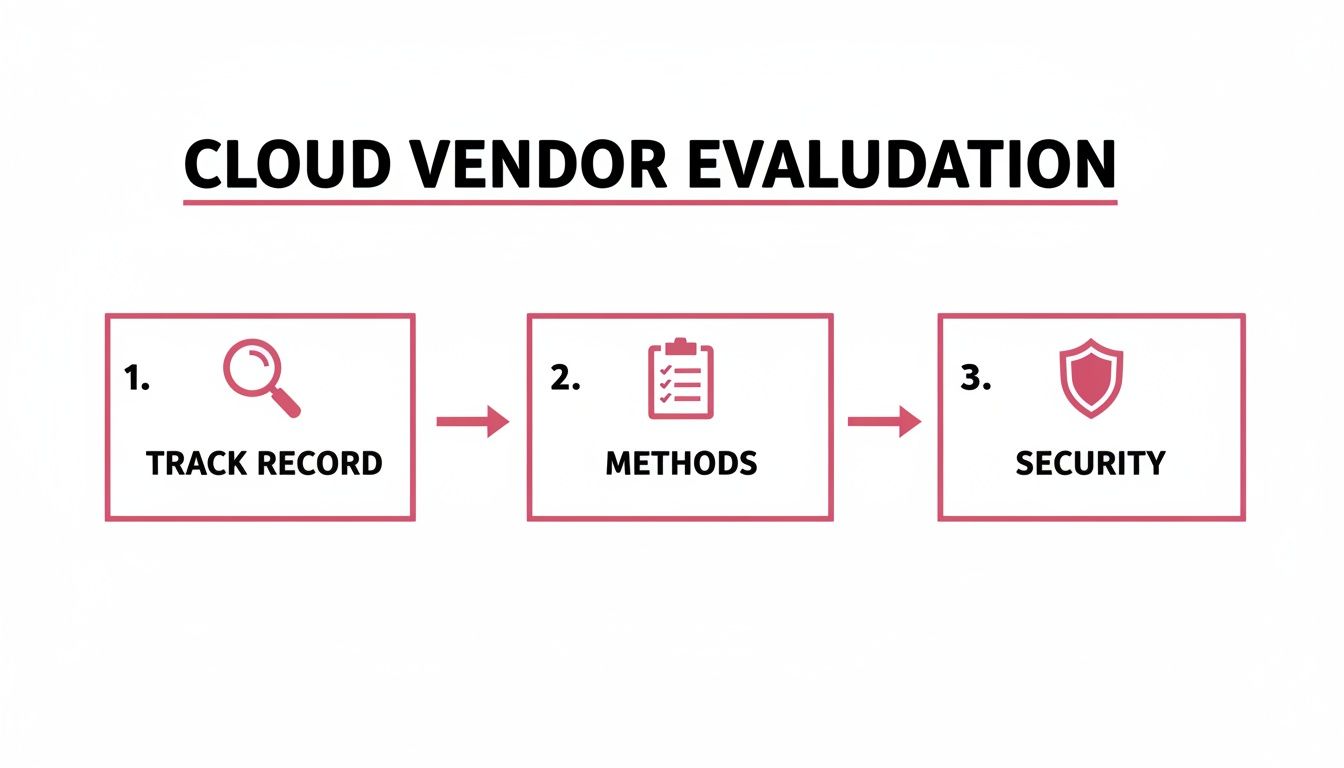
As you can see, a solid evaluation moves from checking past performance to scrutinising their current processes and security commitments.
The Big Day: The Migration Event and Go-Live
The migration itself is the culmination of all that careful planning and testing. This is the moment your data and applications are actually moved over to their new home in the cloud. To keep the impact on your business to an absolute minimum, this is almost always scheduled for well outside your core operating hours, like overnight or over a weekend.
Your partner will have a minute-by-minute runbook for the event, along with a bulletproof rollback plan. That means if any unexpected issues pop up, they have a pre-agreed procedure to instantly revert to the old system, making sure your business doesn't miss a beat.
Aftercare: Post-Migration Optimisation and Support
The job isn’t done once you’re in the cloud. The final, ongoing phase is all about optimisation. A great partner will continuously monitor your new environment, fine-tuning performance and managing costs to ensure you’re getting the maximum possible return on your investment. This typically includes:
- Performance Monitoring: Constantly checking system health and response times to catch issues before they affect users.
- Cost Management: Actively looking for and shutting down unused resources to stop your bills from creeping up.
- Security Audits: Regularly reviewing your setup and security protocols to protect against new and emerging threats.
This final stage is what turns the migration from a one-off project into a long-term strategic partnership, ensuring your cloud infrastructure grows and adapts right alongside your business.
Managing Costs, Security, and Ongoing Support

It’s a common mistake to think a cloud migration project is finished the moment your systems are live. The reality? That’s just the beginning. The real measure of success is found in long-term performance, cost efficiency, and solid security, all of which hinge on a strong partnership with your chosen cloud migration company.
Moving to the cloud fundamentally changes your IT budget. You’re swapping predictable, chunky capital investments in hardware for a more fluid, operational cost model. Without a watchful eye, those operational costs can spiral. This is precisely why post-migration management is every bit as important as the move itself.
Demystifying Total Cost of Ownership
To get a genuine financial picture, you have to look far beyond the initial migration fee. The Total Cost of Ownership (TCO) is a much broader concept, encompassing not just the monthly bill from your cloud provider but a whole host of other factors that a good partner will help you stay on top of.
These ongoing costs typically include:
- Cloud Consumption: This is the direct charge for the computing power, storage, and network resources you’re actually using. It's the most variable part of your bill and needs constant monitoring to trim waste.
- Support Contracts: Your agreement with your partner covers essential ongoing support, monitoring, and management—the very things that keep your new environment running smoothly.
- Software Licensing: The way you pay for software often changes in the cloud. A savvy partner will help you navigate new licensing models to keep you compliant without overpaying.
A great partner offers clear, transparent reporting that demystifies these costs. For instance, they might spot that a marketing app is chewing through expensive resources late at night and recommend an automated shutdown schedule to cut your monthly bill. Once you’re in the cloud, having clear strategies to control cloud costs is the key to making the investment worthwhile.
Navigating Security and Compliance Responsibilities
Cloud security isn't just one party’s job; it's a shared responsibility between you, your cloud provider (like Microsoft Azure), and your management partner. While the provider secures the core infrastructure, you're still on the hook for protecting your own data, applications, and user access. This is where a specialist cloud migration company proves its worth.
They step in to manage the critical security layers that protect your business, including:
- Continuous Monitoring: Using sophisticated tools to constantly scan for threats, unusual activity, and vulnerabilities before they become problems.
- Automated Backups: Ensuring your data is backed up regularly and automatically to a secure UK location, enabling rapid recovery if the worst happens.
- Access Control Management: Enforcing strict policies to make sure only authorised people can get near sensitive information.
Imagine a Somerset-based accountancy firm with troves of sensitive client financial data. Their IT partner could configure alerts that immediately flag any attempt to access client files from an unrecognised location. That’s the shared responsibility model in action. To get a better handle on this, you can explore our guide on what cloud computing security involves.
Security in the cloud isn't a one-time setup. It's a continuous process of monitoring, updating, and defending against an ever-changing threat landscape. Your partner acts as your dedicated guardian in this process.
The Value of Continuous Optimisation
The real magic of the cloud is its flexibility, but that advantage is only unlocked through continuous optimisation. A top-tier partner doesn’t just keep the lights on; they actively work to make your environment better over time, focusing on both cost management and performance enhancement.
For a Wiltshire-based manufacturing firm, performance optimisation might mean reconfiguring a database to speed up their stock management system, boosting shop floor efficiency. On the cost side, it means "right-sizing" resources to ensure you aren't paying for computing power you simply don't need. This proactive management turns your cloud infrastructure into a strategic asset that evolves right alongside your business.
The market reflects this growing need for specialist partners. Between 2024 and 2033, the UK cloud migration market is set to grow almost nine-fold, driven by a blistering 25.20% compound annual growth rate. This boom is closely tied to the rise of hybrid and multi-cloud models, which are expected to jump from 19% of UK organisations in 2024 to 26% within just three years. This shift highlights why experienced partners who can expertly blend on-premises systems with UK-hosted cloud workloads are no longer a luxury—they're a necessity.
Common Questions About Choosing a Cloud Partner
Even with a solid plan, picking the right partner will always bring up a few questions. For business owners across Dorset, Somerset, and Wiltshire, these are usually practical, bottom-line concerns. Here are the straight answers to the questions we hear most often when an SME is sizing up a cloud migration company.
How Long Does a Typical Cloud Migration Take?
Honestly, there’s no one-size-fits-all answer. The timeline hangs entirely on how complex your current setup is.
A simple project, like shifting company emails and files to the cloud, could be wrapped up in a matter of weeks. On the other hand, if we’re talking about moving bespoke business applications, multiple servers, and intricate databases, you’re looking at several months of very careful planning and execution.
Any decent cloud migration company will steer clear of vague estimates. They should start with a proper discovery phase to get under the bonnet of your infrastructure, and only then give you a detailed, realistic project plan.
The timeline really hinges on a few key things:
- The sheer amount of data you need to move.
- The number of applications you have and how they talk to each other.
- How much testing is needed beforehand to make sure the business doesn’t grind to a halt.
Think of it this way: moving a standard accounting package is worlds apart from migrating a custom-built manufacturing control system that needs exhaustive checks to prevent a production line from stopping.
What Are the Biggest Risks?
The main worries in any migration are always the same: disrupting the business, losing data, and opening up security holes. An inexperienced provider can quickly turn a migration into a costly mess, but a true expert partner has a game plan to deal with these risks from the get-go.
It all comes down to a structured approach:
- Meticulous Planning: This means a detailed migration runbook and, crucially, a solid rollback plan. If anything goes sideways, you can instantly revert to your old system.
- Minimising Disruption: The actual switchover should happen when it impacts you least, like overnight or over a weekend.
- Rigorous Testing: We’re talking about thorough checks both before and after the move to confirm every single application works exactly as it should.
And critically, they’ll build robust security controls in from day one. Security should never be an afterthought; it needs to be part of the foundation of your new cloud environment.
Will I Be Locked into a Single Cloud Provider?
That's a perfectly valid concern. Vendor lock-in is a real risk, and the last thing you want is to be so dependent on one technology provider that you have no room to negotiate on price or service down the line. A strategic cloud migration company will always design your cloud architecture with portability in mind.
A forward-thinking partner prioritises your long-term flexibility over tying you to one platform. Discussing an exit strategy and data portability should be a key part of your initial consultation.
They often achieve this by suggesting a hybrid or multi-cloud approach, which stops you from putting all your eggs in one basket. They might also use technologies like containerisation to make your applications easier to move, or just make sure your data is always stored in standard formats that aren't tied to one company.
Is a National Provider Better Than a Local One?
For SMEs in places like Dorset, Wiltshire, or Hampshire, a local IT company brings some real advantages to the table that a big national provider often can't. You get responsive, on-site support when you really need it, and they have a much better feel for the local business community.
A local partner gives you technical expertise with a personal touch. It means you have a direct line to the senior engineers who actually know your systems inside and out, instead of getting lost in an anonymous call centre queue. That kind of local accountability is priceless during a critical project like a cloud migration.
For over 30 years, SES Computers has been the trusted IT and cloud partner for businesses across Dorset, Somerset, Wiltshire, and Hampshire. We combine local expertise with deep technical knowledge to deliver secure, reliable, and cost-effective cloud migrations. Discover how our managed IT services can support your business goals.