So, what is cloud migration consulting? In simple terms, it's about bringing in a specialist team to guide your business through the complex, often daunting, process of moving your digital operations into the cloud. It’s less about simply moving data and more about fundamentally redesigning your infrastructure for better efficiency, security, and scalability.
The goal is to ensure the entire transition is smooth, with as little disruption to your daily business as possible.
What is Cloud Migration Consulting Really About?

Many small and medium-sized business (SMB) owners understandably see moving to the cloud as a purely technical job, a bit like upgrading the office computers. The reality is quite different. It’s a genuine business evolution that reshapes how your entire organisation operates, from where your data lives to how your team collaborates.
Without an expert on your side, this kind of shift can quickly become chaotic and risky. This is where professional cloud migration consulting proves its worth.
Think of a consultant not as a removal company hired to shift boxes from one building to another, but as an architect and project manager. For instance, for a legal practice, they don't just move case files; they meticulously design a new, secure digital home for them in the cloud, ensuring compliance and overseeing the entire transition process from start to finish.
It Goes Way Beyond a Technical Checklist
A good consultant’s role starts long before any data is moved. Their first job is to get under the skin of your business and understand what you’re trying to achieve.
For a manufacturing firm in Dorset, the main driver might be giving their remote sales team real-time access to stock levels. For a care provider in Hampshire, the absolute priority will be ensuring patient data remains confidential and fully compliant with strict UK regulations. An accountancy firm might need to integrate its practice management software with a cloud-based client portal.
This strategic groundwork ensures the migration is purpose-built to meet your specific objectives. It turns what could be a purely technical project into a powerful business advantage. A consultant’s expertise covers several critical areas:
- Strategic Planning: They'll create a detailed blueprint that maps out every single step, from the initial assessment of your current systems to the support you'll need after you’ve gone live. This careful planning minimises downtime and prevents costly missteps.
- Risk Mitigation: By identifying potential security vulnerabilities and compliance gaps before the move, they make sure your new cloud environment is secure from day one.
- Cost Optimisation: Consultants know the cloud landscape inside out. They help you pick the right services and pricing models, preventing the kind of budget blowouts that affect 69% of IT leaders during cloud projects.
A common misconception is that cloud migration is just about technology. It's actually about business transformation. A consultant provides the roadmap to ensure the technology serves your strategic goals, not the other way around.
The Problem with Going It Alone
Without a consultant, businesses often hit predictable but damaging roadblocks. Trying to manage a migration in-house can easily lead to data loss, security breaches, and painful periods of business disruption. Imagine an accountancy firm in Somerset accidentally moving sensitive client data to a server that isn't GDPR compliant – the fines and reputational damage could be devastating.
Ultimately, cloud migration consulting brings order, expertise, and a clear-sighted vision to a highly complex process. It ensures your business doesn’t just move to the cloud, but actually thrives there, supported by an infrastructure that’s more secure, more efficient, and ready for whatever the future holds.
The Real-World Benefits for UK Businesses
Working with a cloud migration consultant isn't just about a technology refresh; it's a fundamental business decision that delivers tangible, real-world results. For businesses across the UK, especially SMBs, the benefits move past the jargon and translate directly into better efficiency, stronger security, and a healthier bottom line. The whole point is to align your technology with your business goals, turning your IT infrastructure from a cost centre into an engine for growth.
This represents a major shift in thinking for many organisations. Instead of seeing IT as just a room full of servers and a stack of software licences, an expert consultant helps you see it as a dynamic tool for solving real business problems. The outcomes are practical and measurable, directly impacting your day-to-day operations and your ability to compete.
Driving Operational Efficiency and Innovation
One of the first things you'll notice after a well-planned cloud migration is a sharp improvement in how your business runs. When your tools and data are centralised in the cloud, your teams can collaborate far more effectively, no matter where they are. This kind of flexibility is a massive advantage for any business embracing hybrid or remote working.
Consider a Dorset-based architectural practice wrestling with huge design files stored on a local server. Collaborating with external engineers and clients becomes a slow process of emailing large attachments or using clunky file-sharing services. By moving to the cloud, they can grant secure, real-time access to project files, allowing multiple stakeholders to review and comment on the same document simultaneously. This single change can dramatically accelerate project timelines and reduce costly errors.
By partnering with a cloud migration specialist, you are investing in a more resilient and agile future for your business. The focus shifts from merely maintaining on-site hardware to strategically using powerful cloud capabilities to innovate and outperform the competition.
Optimising Costs Beyond Hardware
While getting rid of expensive, power-hungry servers is an obvious saving, the financial upside of a guided cloud migration goes much deeper. A consultant's job is to help you navigate the often-complex world of cloud pricing models. They ensure you only pay for the resources you actually use, cutting out the waste that comes with over-provisioning your own hardware "just in case."
The savings quickly add up in other areas, too:
- Reduced Energy Bills: The significant cost of powering and cooling an on-site server room simply disappears.
- Reallocated IT Staff Time: Your internal IT team is freed from the daily grind of server maintenance and troubleshooting. Their valuable time can be redirected towards projects that actually grow the business.
- Minimised Downtime: Professionally managed cloud environments are built for reliability, drastically reducing the financial and reputational damage caused by unexpected outages.
Exploring the many ways cloud adoption benefits businesses can provide deeper insights into these cost-saving opportunities.
A recent survey of UK IT decision-makers highlights the primary motivations behind these moves, showing a clear focus on security, cost, and modernisation.
Key Drivers for Cloud Migration in UK Businesses
| Migration Driver | Percentage of UK Decision-Makers Citing This Reason |
|---|---|
| Improving Security & Compliance | 58% |
| Reducing Operating Costs | 53% |
| Modernising Legacy Systems | 51% |
| Improving Business Agility | 49% |
| Enhancing Data Analytics Capabilities | 45% |
As the data shows, the decision to migrate is rarely about just one thing. It's a strategic move to build a more secure, cost-effective, and adaptable organisation.
Strengthening Security and Ensuring Compliance
For many UK businesses, especially those in regulated sectors like finance or healthcare, data security and compliance are non-negotiable. There's a common myth that the cloud is less secure than an on-premises server you can physically see and touch. With expert cloud migration consulting, the opposite is almost always true.
A specialist consultant will design a cloud environment that meets strict UK and international data laws, like GDPR, from the very beginning. Take a care provider in Hampshire, for example, that handles highly sensitive patient information. A consultant would implement a solution using UK-hosted data centres to guarantee data sovereignty, then layer on robust security protocols and automated backups. This builds immense trust with both clients and regulators.
This intense focus on security and compliance is fuelling huge market growth. The UK cloud migration services market was estimated at roughly USD 566.77 million and is forecast to reach about USD 4,975.56 million by 2033. This incredible growth highlights just how many UK businesses are looking to modernise their systems while meeting increasingly tough regulatory demands.
Your Cloud Migration Journey Step by Step
Thinking about moving to the cloud can feel a lot like planning a major business relocation, but without a map. A good consulting partner acts as your guide, providing a clear, structured roadmap to get you from A to B. This isn't just about ticking off technical tasks; it's a strategic journey, carefully managed at every stage to keep disruption to an absolute minimum while maximising the benefits for your business.
The whole process usually unfolds in four distinct phases. Each one builds on the last, turning what seems like a daunting technical project into a predictable, manageable evolution for your company. Let’s walk through what you can expect.
This visual guide shows how a structured process directly translates into better efficiency, lower costs, and stronger security.
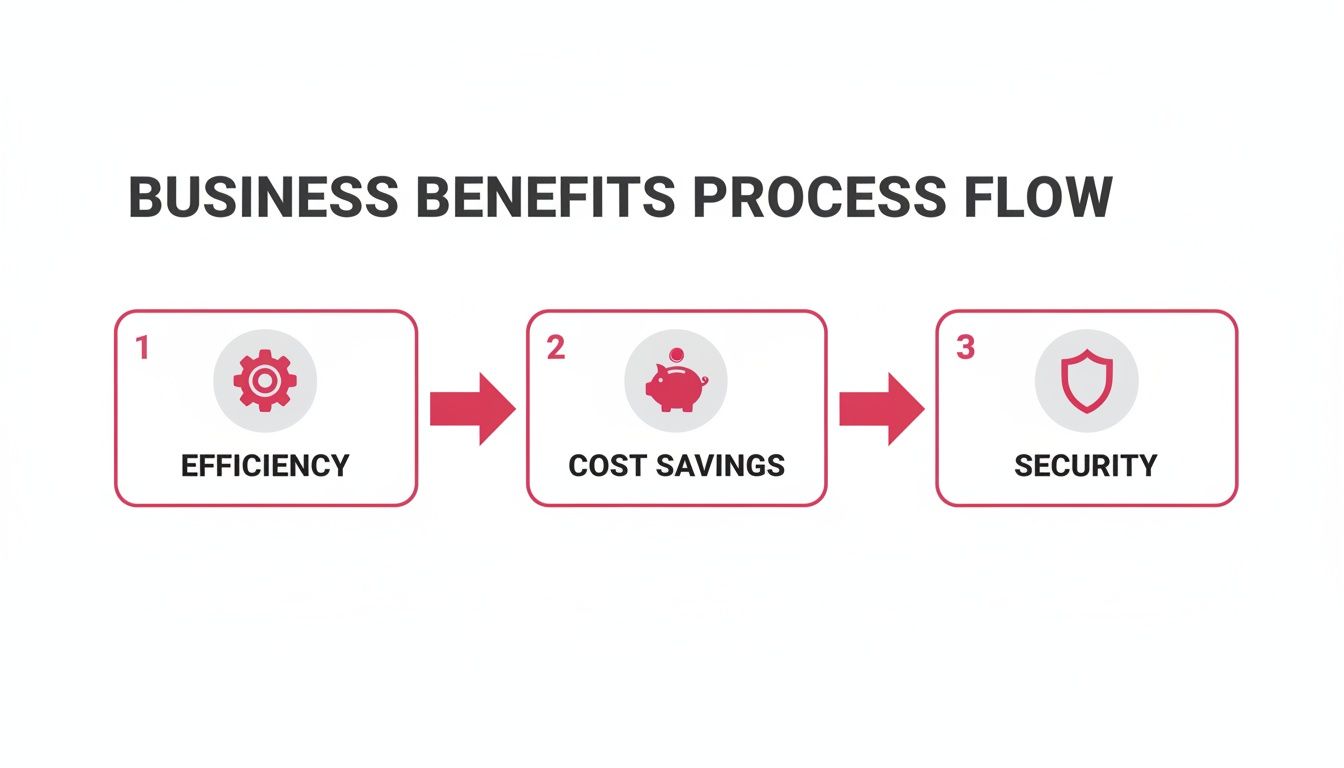
As you can see, the path is clear: improving how your business operates leads to real cost savings, all built on a more secure foundation.
Stage 1: Discovery and Assessment
The journey always starts with your business, not the technology. This first stage is a deep dive into your current IT setup, your applications, and your data. A consultant will sit down with you to get to grips with your current headaches and, more importantly, where you want the business to be in the future. Are you trying to support a growing remote team? Do you need better data insights?
This is so much more than a simple inventory. For instance, while working with a Somerset-based accountancy firm, this discovery phase might reveal that specific client financial records are subject to strict UK data residency laws. That one piece of information is critical; it will shape the entire migration strategy, from the choice of cloud provider to the physical location of the data centres.
Stage 2: Strategy and Planning
Once there’s a solid understanding of your current situation and future goals, it's time to draw up the blueprint. This is where your cloud migration consultant designs a plan that directly connects the technology to your business objectives. The key decisions happen here:
- Choosing the Right Cloud Model: Will a public cloud like AWS or Azure be the best fit? Or do your security and compliance needs point towards a private or hybrid model?
- Selecting the Migration Approach: Can some applications be moved with a straightforward 'lift-and-shift', or do others need to be re-engineered (refactored) to truly take advantage of what the cloud offers? It’s all about balancing speed, cost, and long-term value.
- Developing a Detailed Roadmap: This sets out clear timelines, who is needed for what, and a communication plan to ensure everyone in your organisation is kept in the loop.
A well-defined strategy is the single most important factor in a successful migration. It prevents scope creep, manages expectations, and ensures that every technical decision serves a clear business purpose, preventing the budget overruns that affect 69% of IT leaders.
Stage 3: Execution and Migration
Now it's time to roll up our sleeves. This is the hands-on phase where the plan is put into action, and your consultant manages the technical process of moving your data, applications, and workloads to their new cloud home. To minimise the impact on your day-to-day work, this is often done in carefully planned stages, with the most critical moves scheduled for after business hours.
Throughout this stage, everything is rigorously tested to make sure it works exactly as it should. A smooth execution phase is all down to meticulous planning. You can explore a variety of data migration best practices to get a sense of the complexities involved in moving information safely and efficiently.
Stage 4: Optimisation and Management
Getting to the cloud isn't the final destination; it's the beginning of a new, more agile way of working. After the migration, the focus shifts to making sure your new environment is running efficiently, securely, and without wasting money.
This ongoing management is where the long-term value of cloud migration consulting really shines. It typically includes:
- Performance Monitoring: Proactively keeping an eye on system performance to spot and fix issues before they ever affect your team.
- Cost Optimisation: Continuously reviewing your cloud spending to ensure you aren't paying for resources you don't need.
- Security Management: Providing 24/7 monitoring and managing vulnerabilities to protect your business from new and emerging threats.
This final stage makes sure your investment keeps paying off, leaving you free to focus on running your business, confident that your technology is in expert hands. For a smooth transition, it's always a good idea to review established 10 cloud migration best practices.
Mastering Cloud Security and Compliance

For many business owners, the biggest question marks around moving to the cloud are security and compliance. Handing over your company's most valuable asset—its data—can feel like a huge leap of faith. But here’s the thing: with expert cloud migration consulting, that move often results in a far more secure and compliant setup than your old on-premises servers could ever provide.
The key is understanding that cloud security is a partnership. It’s a concept known as the shared responsibility model, and it’s something your consultant will navigate for you from day one.
Understanding Your Role in Cloud Security
So, what is this shared responsibility model? In simple terms, it draws a clear line defining who is responsible for what. The cloud provider (like Amazon Web Services or Microsoft Azure) handles the security of the cloud—the physical data centres, the core network, and all the hardware their services run on.
You, on the other hand, are responsible for security in the cloud. This means looking after your data, managing who has access to it, and making sure your applications are configured correctly. A good consultant acts as your expert guide here, ensuring your side of the bargain is met with robust, industry-leading practices. They turn a complex task into a managed, secure process.
If you'd like to get into the nuts and bolts, we have a detailed guide on what is cloud computing security.
Adhering to UK Regulations and Data Sovereignty
For businesses in Dorset, Somerset, and across the UK, compliance isn't just a suggestion; it's a legal requirement. Regulations like GDPR have strict rules on how personal data is stored, processed, and protected. This is where a local consultant’s knowledge of UK data sovereignty becomes a massive advantage.
A crucial part of their strategy is often to insist on UK-hosted data centres. This simple step ensures your sensitive business and client information physically stays within the UK's borders, which makes GDPR compliance much more straightforward and gives you real peace of mind.
Think about a Hampshire-based care provider. They must store sensitive patient data in a way that meets strict NHS and Care Quality Commission (CQC) standards. An experienced consultant would design a cloud environment that meets these specific UK data protection rules from the very beginning, building compliance into the fabric of the system.
Practical Security Measures a Consultant Implements
A consultant doesn't just talk about security; they actively build it into your new cloud environment. Their work goes far beyond setting up a few strong passwords—they create layers of defence to properly protect your business.
This active security management often includes:
- 24/7 Cyber-Security Monitoring: Using advanced tools to constantly watch for suspicious activity, allowing for an immediate response to potential threats before they can cause real damage.
- Proactive Vulnerability Management: Regularly scanning your systems for known weaknesses and applying patches promptly, effectively closing the doors that hackers are always looking for.
- Automated Cloud Backups: Setting up reliable, automated backups ensures that if a disaster or cyber-attack ever happens, your data can be restored quickly with minimal disruption.
- Identity and Access Management (IAM): Implementing strict controls so that employees only have access to the specific data and systems they absolutely need to do their jobs.
Beyond these specific actions, it's also about understanding the wider security frameworks. For businesses wanting comprehensive protection, it's useful to compare ISO 27001 and ISO 27002 to see how these official standards create a rock-solid security posture. With this kind of expert guidance, the cloud becomes a fortress for your data, not a point of weakness.
Understanding the True Cost and ROI
Let's talk about the money. Moving to the cloud isn't just a technical switch; it’s a complete change in how you think about your IT spending. You’re moving away from buying expensive tin every few years (Capital Expenditure) to paying for what you use each month (Operational Expenditure). Getting your head around this is key to seeing the real return on your investment.
A good cloud consultant cuts through the complexity and gives you this financial clarity right from the start. They’ll help you map out the Total Cost of Ownership (TCO), which is just a fancy way of saying they compare what you’re really spending now with what you’ll spend in the cloud. And it's often much more than just the price of your servers.
On-Premises vs Cloud Costs: The Full Picture
When you dig into the true cost of running your own servers, you often find a lot of hidden expenses that drain your budget. A proper TCO analysis brings all these into the light.
- Hardware Costs: The obvious one – the servers, network switches, and storage you had to buy.
- Software Licencing: Those annual fees for Windows Server, databases, and other essential software.
- Maintenance Contracts: What you pay vendors to keep your hardware supported and replace it when it fails.
- Energy Consumption: The often-staggering cost of electricity to power and cool that server room, 24/7.
- Staff Time: The hours your team (or you!) spend patching, rebooting, and troubleshooting instead of working on the business.
A consultant will then show you the cloud model. Instead of all that, you have a predictable monthly bill for the exact resources you consume. The big, lumpy capital spend vanishes, replaced by a manageable operational cost.
A Practical Example: A Wiltshire Retailer
Imagine a retail business in Wiltshire with a high street shop and a booming website. Their old server in the back office groans under the strain every November and December. To cope with the Christmas rush, they’d traditionally have to buy a massively oversized server that sits half-asleep for the other ten months of the year – a huge waste of money.
This is where a smart cloud migration changes everything. A consultant helps them shift to a flexible cloud setup. For most of the year, they tick along on a modest, low-cost server configuration. But as the festive traffic ramps up, the system automatically scales up to handle thousands of extra shoppers. Once the rush is over, it scales back down. They only pay for the extra power when they actually need it.
This is the agility that drives the ROI. The business stops paying for hardware it doesn't use, slashes its energy bills, and, most importantly, avoids costly website crashes during its busiest, most profitable season. The initial migration cost is quickly paid back through these savings and protected revenue.
Introducing FinOps for Long-Term Value
The great thing about the cloud is its flexibility, but that same flexibility can lead to surprise bills if you’re not careful. This is where a discipline called FinOps (Cloud Financial Operations) comes in. Think of it as bringing financial discipline and common sense to the pay-as-you-go world of the cloud.
A crucial part of a consultant's job is to weave these FinOps principles into your setup from day one. They'll configure monitoring tools and spending alerts to give you a real-time view of your costs, so there are no nasty shocks at the end of the month.
This kind of proactive management ensures your cloud spend stays efficient long after the project is finished. For businesses here in the UK, this is non-negotiable. Recent data shows 71% of companies see scalability as a top reason to move to the cloud, with 64% pointing to cost savings. To deliver on that promise, any good cloud migration consultant in the UK must have a strong grip on FinOps. You can dig deeper into the latest cloud trends and statistics in the UK to see just how important this has become.
How to Choose the Right Local Consultant
Picking the right partner for your cloud migration is one of the most important business decisions you’ll make. Not all providers are the same, and for businesses across Dorset, Somerset, Wiltshire, and Hampshire, a local consultant brings something extra to the table. They offer more than just technical know-how; they bring a vital understanding of our regional business environment.
The goal is to find someone who feels like a genuine extension of your team. That means you need to look past the standard sales pitch and find real evidence of their expertise, a commitment to the local area, and a support model that has your back long after the project is finished. A great local consultant sees it as a partnership, not just a transaction.
Look for Deep Local Roots and Sector Experience
When you’re weighing up your options, their local presence should be high on your list. Have they got a proven track record of helping businesses like yours, in your sector, right here in the South West? A consultant who has already helped a Wiltshire-based accountancy firm or a Dorset manufacturing company move to the cloud will get to grips with your specific challenges from day one.
This local knowledge is priceless. They'll be familiar with regional broadband quirks, local supply chains, and the particular compliance pressures that businesses in our area face. Don't be shy about asking for case studies or references from companies of a similar size and industry.
Choosing a local expert means you're not just another client on a national firm's spreadsheet. They understand the local economy and are genuinely invested in the success of businesses in their own community. That shared context is the foundation of a much stronger, more effective partnership.
Verify Their Technical and Service Capabilities
Beyond having a local postcode, a top-tier consultant needs to offer a complete, end-to-end service. The migration itself is just one part of the journey. A first-rate partner provides a holistic solution that covers your ongoing needs, making sure your investment keeps paying off for years to come.
Key capabilities to look for include:
- UK-Hosted Infrastructure: This is a deal-breaker for data sovereignty. You must insist on a provider that guarantees your data will be stored in UK-based data centres. It massively simplifies GDPR compliance.
- Comprehensive Post-Migration Support: What happens the day after you go live? Look for clear service level agreements (SLAs) covering ongoing management, 24/7 security monitoring, and proactive system optimisation.
- Integrated Services: A partner who can manage your cloud environment, cyber-security, and even your VoIP phone systems under one roof just makes life easier. It creates a much more cohesive and efficient setup.
Spotting the Good from the Bad
To help you make a confident decision, it helps to know the difference between the hallmarks of a great consultant and the red flags that should make you think twice. This table is a quick checklist to use during your evaluation.
Evaluating a Local Cloud Migration Consultant
Before you sign on the dotted line, run potential partners through this simple checklist. It can help you separate the true local experts from those just paying lip service.
| Key Evaluation Criteria | What to Look For (Green Flags) | What to Avoid (Red Flags) |
|---|---|---|
| Consultation Approach | A customised strategy based on a deep dive into your specific business goals and challenges. | A generic, one-size-fits-all solution or a heavy focus on selling a specific product. |
| Local Presence & Proof | Demonstrable experience with local businesses in your sector and verifiable client testimonials. | Vague claims of experience with no local case studies or a purely national, remote-only service model. |
| Post-Migration Plan | A clear, detailed plan for ongoing support, security monitoring, and cost optimisation. | A lack of detail on post-migration services, or treating ongoing support as an afterthought. |
| Data Sovereignty | A firm guarantee that all your data will be hosted exclusively within UK data centres. | Ambiguity about data centre locations or using providers based outside the UK. |
Ultimately, choosing the right cloud migration consulting partner is about finding an expert who is not only technically brilliant but also deeply understands your local business context and is committed to your long-term success.
Frequently Asked Questions
It's only natural to have questions when you're thinking about a project as important as a cloud migration. We've pulled together some of the most common ones we hear from business owners to give you a clearer picture of what the process really involves.
How Long Does a Typical Cloud Migration Take?
This is one of those 'how long is a piece of string?' questions. The timeline really depends on what we’re moving. For a smaller business with a handful of straightforward applications, we could be looking at just a few weeks. It's a relatively simple lift-and-shift.
On the other hand, a larger company with deeply embedded legacy systems, complex databases, and mountains of data might be looking at a project spanning several months. A good consultant will give you a realistic schedule right at the start, after they've had a proper look under the bonnet of your current setup. We almost always break it down into manageable phases to keep things predictable.
Will My Business Experience Downtime During the Move?
Keeping your business running smoothly is our top priority. While you can never say never, the goal of any professional cloud migration consultant is to make any disruption practically invisible. We have well-practised methods to ensure downtime is kept to an absolute minimum.
Here's how we typically handle it:
- Phased Migrations: We don't try to move everything in one big bang. We move services and data in logical, planned stages.
- Out-of-Hours Scheduling: The heavy lifting happens when you're least busy – think evenings or weekends. This dramatically reduces the impact on your team and customers.
- Thorough Testing: Nothing gets switched off until we are 100% certain its new cloud counterpart is working perfectly.
What Happens to Our Old On-Premises Servers?
Once your new cloud systems are up, running, and proven to be stable, those old physical servers become redundant. A good consultant won't just leave you with a pile of old kit; we'll handle the entire decommissioning process for you.
This means securely wiping every bit of data from the hard drives so it's completely unrecoverable. After that, we arrange for the hardware to be disposed of or recycled responsibly, in line with all UK environmental laws.
The most critical step is ensuring complete and certified data erasure from old hardware. This protects your business from potential data breaches long after the equipment has been removed from your premises.
Can We Just Move Some Services to the Cloud?
Of course. In fact, it's a very common and sensible approach. This is what's known as a hybrid cloud model, and it gives you the best of both worlds. You can move certain parts of your business to the cloud while keeping other things running on-site.
A classic example is moving your email and shared files to the cloud for easy, secure access from anywhere, but keeping a specialised piece of accounting software on a local server in the office. A consultant's job is to help you figure out the right mix that supports how your business actually works.
Ready to explore how a carefully planned move to the cloud can secure and future-proof your business? The expert team at SES Computers has over 30 years of experience guiding businesses in Dorset, Hampshire, Somerset, and Wiltshire through successful cloud migrations. Get in touch today for a no-obligation consultation.