It is no longer a strategy just for the big players; outsourcing IT has become a fundamental part of how smart UK businesses operate and grow. The idea is simple: you hand over the reins of your technology management to a specialist firm. This frees up your team to focus on what they do best, leaving the complexities of your digital backbone to the experts.
Why Smart UK Companies Are Outsourcing IT
For many small and medium-sized businesses across Dorset and Hampshire, the choice to outsource IT is a powerful move toward efficiency and getting a leg up on the competition. It is really about liberating your people from the constant, often distracting, demands of technology.
Imagine a local legal practice. Their team of solicitors can concentrate entirely on client casework and billable hours, fully confident that their systems are secure, compliant, and running smoothly because a dedicated partner is managing everything behind the scenes.
This shift is gathering serious momentum. In 2025, a massive 57% of UK organisations are planning to increase their outsourcing, with an extra £3 billion expected to pour into the sector. This is not just a passing phase; it is a smart reaction to the mounting pressures of running a business today. For 65% of businesses, the main driver is the ability to focus on their core purpose, while 63% are drawn in by the promise of real cost savings.
The Specialist vs The Generalist Analogy
Think of it like this: your in-house IT person is often like a fantastic family GP. They are brilliant for day-to-day issues and know your setup well, but they are a generalist. When a really complex or specialised problem crops up, their expertise might be stretched thin.
An outsourced IT partner, on the other hand, is like having an entire hospital of specialists on call. You get immediate access to certified experts in cybersecurity, cloud systems, VoIP communications, and data recovery, all without the staggering cost of hiring each one individually.
This specialist firepower is what makes the difference. A manufacturing firm in Wiltshire, for example, does not just need its network to be online. It needs that network optimised for the production line and hardened against the specific cyber threats targeting its industry. This is where an outsourced team delivers incredible value, and it is a core part of understanding what is managed IT services.
Beyond Cost-Cutting: A Foundation for Growth
While saving money is an obvious and attractive perk, the real, long-term value is in building a more resilient and scalable business. The logic is similar to the reasons behind outsourcing marketing for small businesses—it is about bringing in expert knowledge to drive you forward.
When you partner with a great IT provider, you are not just fixing today's problems. You are investing in a stable technology foundation that can support your ambitions, keep you compliant, and ensure your operations run like clockwork, no matter what comes your way.
The Core IT Services Driving Business Growth
When a company decides to outsource its IT, it is not just offloading a to-do list. It is a strategic move to bring in specific, powerful services designed to deliver real, measurable results. Getting to grips with these core services is key to understanding how an IT partner can actively boost your efficiency, security, and ability to scale.
Each service tackles a different business challenge, turning your technology from a necessary expense into a genuine driver of growth. This infographic perfectly captures the high-level benefits businesses unlock when they make this shift.
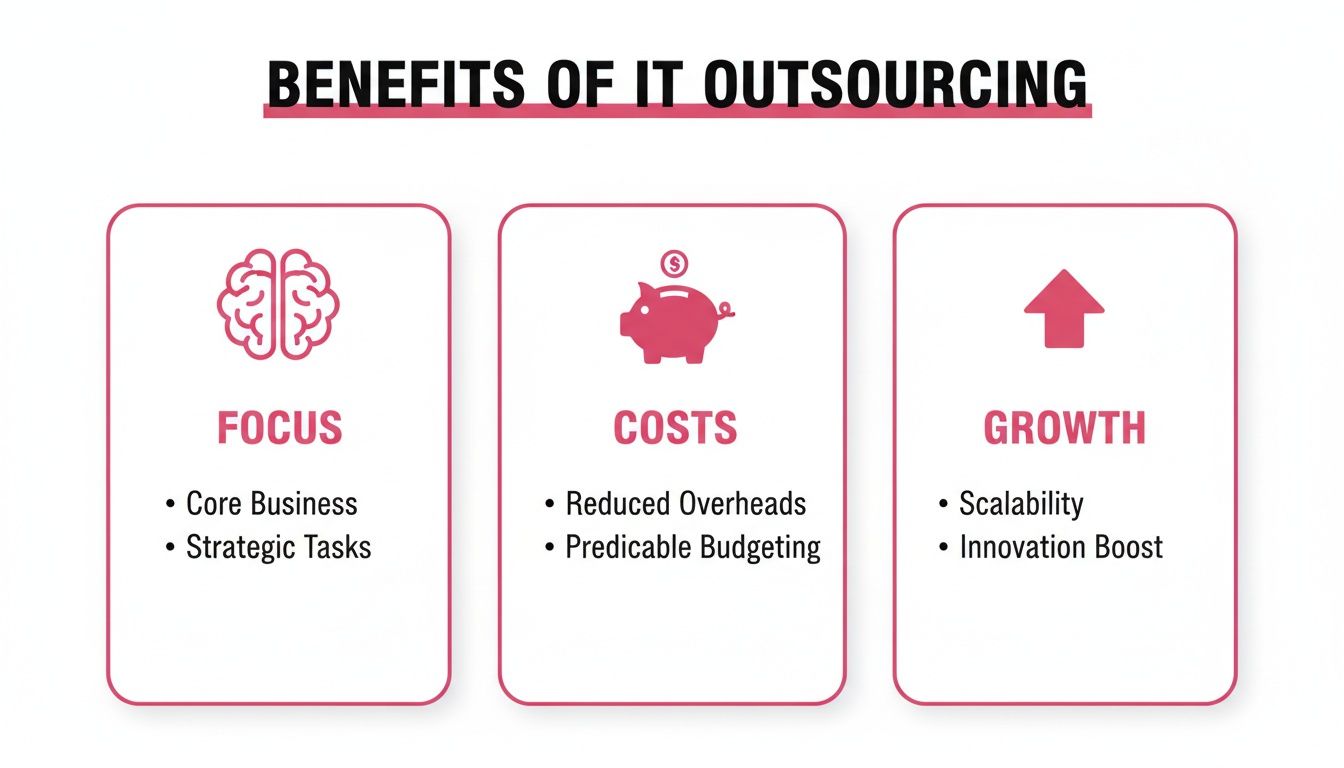
Ultimately, outsourcing lets you sharpen your focus on what you do best, get a firm grip on costs, and build the stable technological foundation you need for sustainable growth.
Managed IT Services
Imagine having a full, expert IT department at your disposal without the overheads of hiring an in-house team. That is what Managed IT Services deliver. This is not just about fixing things when they break; it is a proactive approach that includes constant monitoring, regular maintenance, and strategic management of your entire tech setup. The goal is simple: stop problems before they ever get a chance to disrupt your business.
A great practical example is a financial advisory firm in Dorset that used to battle system slowdowns every time they hit the critical end-of-quarter reporting season. After bringing in a managed service provider (MSP), they now have 24/7 network monitoring and ongoing performance tuning. The result? Zero downtime during their busiest times, meaning they can focus entirely on serving their clients.
Cloud Services and Remote Access
The cloud gives your business the freedom to operate securely from just about anywhere. It is about shifting your data, software, and infrastructure from servers tucked away in your office to highly secure, professional UK-based data centres. This move unlocks incredible flexibility and opens the door to powerful new ways of collaborating.
Consider a firm of architects in Wiltshire whose team needed to access huge, complex CAD files from the office, client sites, and home. By moving their core project data and software to a private cloud solution, their architects gained fast, secure remote access. This simple change dramatically improved project turnaround times and made a more flexible working culture possible.
Outsourcing is not about replacing people; it is about empowering them with better tools and unwavering support. By handing over the technical complexities, you allow your team to concentrate entirely on their core responsibilities and strategic goals.
VoIP Telephony
Voice over Internet Protocol (VoIP) is a modern phone system that runs over your internet connection rather than old-fashioned phone lines. This shift brings with it better call quality, a host of advanced features, and, quite often, significant cost savings.
A Hampshire-based recruitment agency is a perfect case in point. They swapped their clunky, inflexible phone system for a managed VoIP solution. Suddenly, their consultants had powerful tools like call routing to their mobiles, professional voicemail-to-email transcription, and detailed call analytics. Not only did they reduce their monthly phone bills by over 40%, but their client and candidate communication became slicker, and they never missed an important call again.
Cybersecurity and Compliance
With digital threats becoming more sophisticated by the day, solid cybersecurity is no longer optional. Outsourced cybersecurity provides layers of protection, from advanced threat detection and vulnerability management to essential security training for your staff. This is especially critical for any professional service business that handles sensitive information.
Consider a firm of accountants in Somerset holding confidential client financial data. To meet strict standards like GDPR, they partnered with an IT firm to build a managed security framework. This included everything from encrypted communications and multi-factor authentication to regular security audits, ensuring all sensitive data was protected and compliant. It was a move that safeguarded both their clients and their professional reputation.
Automated Backup and Disaster Recovery
What happens if the worst happens? A proper disaster recovery plan is your business's insurance policy against a critical event like a server failure, a cyberattack, or even a fire or flood. It relies on automated, secure backups of your essential data and systems, allowing for a rapid restoration.
For instance, a local law firm had a server fail, knocking their case management and billing systems offline. Because their IT partner had set up an automated backup and disaster recovery solution, their entire system was restored in less than an hour. That quick recovery prevented what could have been a catastrophic loss of billable time and operational chaos.
Weighing the Benefits and Navigating the Risks
Making the call to outsource your IT is a major strategic move. It can unlock some powerful advantages, but it is crucial to go into it with your eyes wide open, understanding both the massive upsides and the potential pitfalls. Getting this balance right is the key to building a partnership that works.
This is not just about hiring a contractor; it is about finding a genuine partner who can help steer your business towards long-term success.
The Clear Advantages of Outsourcing IT
One of the first things you will notice is the shift to predictable costs. When you run IT in-house, you are always one step away from a sudden, hefty bill. A critical server can die overnight, or an urgent software upgrade can land you with a five-figure invoice you never saw coming.
A managed IT service completely changes that dynamic. Those unpredictable capital costs are replaced by a single, fixed monthly fee. Your IT spending transforms from a reactive financial headache into a stable, operational expense, which makes budgeting a whole lot easier.
Then there is the instant access to specialised expertise. For what it would cost to hire a single, mid-level IT generalist, you get the brainpower of an entire team. This often includes certified experts in cybersecurity, cloud infrastructure, network engineering, and disaster recovery.
For a small or medium-sized business, this is a game-changer. It means you have enterprise-grade knowledge on tap, ready to tackle complex challenges and guide your strategic decisions without the immense overhead of building such a diverse team yourself.
Navigating the Potential Risks
Of course, it is just as important to acknowledge the very real concerns business owners have. One of the most common is a perceived loss of control. It can feel daunting to hand over the keys to your most critical systems, but this is a risk you can manage with clear agreements and solid communication.
Your most important tool here is a robust Service Level Agreement (SLA). This document is non-negotiable and should clearly spell out response times, system availability guarantees, and how you will communicate. A good partner will combine this with regular review meetings and transparent reporting, ensuring you always feel like you are in the driver's seat.
Data security concerns are another big one. You are entrusting your sensitive company and client data to a third party, so you need to be absolutely sure you can trust them. The trick is to do your homework and rigorously vet any potential partner’s security credentials.
Ask tough questions about their own internal security, where your data will be stored (you will want it in UK-based data centres), and what certifications they hold. Partnering with a specialist can actually strengthen your security posture; you can learn more by exploring different cyber security packages available to businesses.
Finally, always be on the lookout for hidden contract costs. Some providers might tempt you with a low initial price, only to sting you later with extra charges for things like call-outs, after-hours support, or certain software updates. A trustworthy provider will be upfront with transparent, all-inclusive pricing. Make sure you read the small print so you know exactly what is included and can avoid any nasty surprises.
Understanding the True Cost and ROI of Outsourced IT
When you get a quote from a potential IT partner, it is easy to focus on that single number. But to really grasp the financial sense of outsourcing, you have to look deeper. The true value emerges when you pit that fixed monthly fee against the sprawling, often-hidden costs of running your IT in-house. This is not just about cutting costs; it is about shifting to a smarter, more predictable way of managing your technology budget.

Before you can compare apples with apples, you first need to understand the different ways IT providers structure their pricing.
Demystifying Common Pricing Models
Managed Service Providers (MSPs) do not use a one-size-fits-all approach. Their pricing models are designed to match how different businesses operate. Getting to know them is the first step in finding the right fit for you.
- Per-User Model: Simple and effective. You pay a set fee for each employee who uses the IT services. This is a brilliant fit for professional services firms—think solicitors, accountants, or consultants—where your headcount is the main driver of IT support needs. It makes budgeting a breeze as you scale your team up or down.
- Per-Device Model: Here, the cost is tied to the number of devices under management—every server, desktop, laptop, and even mobile phone. This often works well for businesses in sectors like manufacturing or logistics, where several people might share one workshop PC or a point-of-sale terminal.
- Tiered Packages: Many providers bundle their services into packages, like Bronze, Silver, and Gold. A basic tier might cover essentials like remote monitoring, while a premium tier could add on-site support, strategic planning, and sophisticated cybersecurity defences. This lets you pick a service level that aligns perfectly with your budget and how much risk you are comfortable with.
Calculating the Total Cost of Ownership
To see if outsourcing really stacks up, you need to be honest about what your in-house IT is actually costing you. This is where the Total Cost of Ownership (TCO) comes in, and it is always more than just a salary.
TCO pulls back the curtain on your complete internal IT spend. It is not just about salaries; it is about all the other expenses that creep into your budget over the year. This gives you a proper, realistic baseline to compare against an MSP's quote.
When you are crunching the numbers for your in-house TCO, make sure you include everything:
- Salaries & Benefits: Do not forget National Insurance contributions, pension schemes, and sick pay.
- Recruitment & Training: What does it cost to find good people? And what about the ongoing spend on certifications and training to keep their skills sharp?
- Software & Licensing: The never-ending costs for operating systems, antivirus software, and all your essential business applications.
- Hardware Depreciation: Your servers, laptops, and networking gear are all losing value day by day.
- Management Overhead: Think about the time your senior managers spend overseeing the IT team or getting pulled into technical problems.
Once you have added all that up, you will often find that the real cost of a single in-house IT person is significantly higher than a fixed monthly fee for a comprehensive managed service.
Measuring the True Return on Investment
The real win with outsourcing goes way beyond direct cost savings. It is about the massive, non-monetary gains that protect your revenue, supercharge efficiency, and make your business tougher. The UK outsourcing market is thriving, with IT services at the forefront, proving that more and more businesses are recognising this value. You can explore more about these market trends on Grand View Research.
Just think about the financial fallout from these scenarios:
- Minimised Downtime: How much money would you lose if your entire operation ground to a halt for just one day? An MSP's proactive monitoring spots and fixes most issues before you even know they exist, directly protecting your income.
- Enhanced Employee Productivity: An outsourced helpdesk means your team gets fast, expert help whenever they need it. No more waiting around for a fix. Imagine you have 20 staff, and each one gets just 30 minutes of productive time back each week. That is over 40 hours of recovered productivity every single month.
- Fortified Data Security: A data breach can be catastrophic, leading to huge fines, a damaged reputation, and lost client trust. The investment in expert cybersecurity management is a tiny fraction of the cost of cleaning up that kind of mess. Stopping just one major security incident could deliver an ROI that dwarfs your entire annual MSP spend.
How to Select the Right Local IT Partner
Choosing the right IT partner is easily one of the most important decisions your business will face. This is not just about finding another supplier; it is about bringing a specialist into your corner who will be responsible for the very heartbeat of your operations—your stability and security. For any company outsourcing its IT, getting this selection process right is absolutely critical.

This goes way beyond comparing a few quotes. It involves a deep dive into their technical skills, how close they are to you, and whether they are a good cultural fit. You are looking for a provider who genuinely understands what you are trying to achieve.
Evaluating Local Presence and On-Site Support
For businesses in Dorset, Somerset, Wiltshire, and Hampshire, having a local partner is a real game-changer. Sure, most IT gremlins can be sorted out remotely, but some problems just need a hands-on fix. When a critical server gives up the ghost or your entire office network goes down, you need an engineer on-site, fast.
Having that local presence means quicker fixes and less painful, costly downtime. It also means you are dealing with people who get the local business scene. When you are weighing up your options, this is what separates a true regional specialist from a faceless national call centre.
Essential Questions to Ask Prospective Partners
To properly vet a provider, you need to go in armed with the right questions. Use this checklist to cut through the sales pitch and find out what their service is really like.
- Response Times and SLAs: "What are your guaranteed response times for critical, high, and low-priority issues? Can you show me exactly where these are defined in your Service Level Agreement (SLA)?"
- Local Testimonials: "Can you share case studies from other local professional services firms in our field? For example, a legal firm in Salisbury or an accountancy practice in Poole?"
- Team Expertise: "What certifications do your engineers hold? How do you ensure their skills stay sharp with all the new threats and tech popping up?"
- Security and Compliance: "How will you help us stay compliant with regulations like GDPR, and what are your own internal security credentials?"
- Strategic Guidance: "Beyond just fixing things, how will you act as a strategic partner? We need guidance on our technology decisions as we grow."
These questions are designed to shift the conversation from what they do to how they will help you succeed. Consider it essential due diligence. To get more insight into what sets providers apart, you can read our comparison of leading managed IT service companies.
Dissecting the Service Level Agreement
The Service Level Agreement, or SLA, is your contract. It is your guarantee. It should be a crystal-clear document that spells out every part of the service you are paying for. Do not just give it a quick glance; really get into the details and look for fuzzy language or hidden clauses.
Your SLA is the rulebook for your IT partnership. It must clearly outline responsibilities, guarantees, and consequences. If a provider is hesitant to commit to specific metrics in writing, consider it a significant red flag.
Look for concrete numbers on system uptime (you should be aiming for 99.9% or higher), how often data is backed up, and the exact process for escalating urgent problems. Be wary of contracts with long notice periods or vague terms about extra charges. A good, transparent partner will give you an SLA that protects everyone and sets clear expectations from day one.
Assessing the Onboarding Process and Cultural Fit
A smooth onboarding process is the hallmark of a well-run IT partner. Ask them to walk you through what happens when you sign on. You should hear about a structured plan that includes a full audit of your current setup, the deployment of their management tools, and clear communication to ensure your team is not disrupted.
Finally, never underestimate the importance of cultural fit. Your IT partner should feel like an extension of your own team. You need someone who speaks plain English, not impenetrable tech jargon, and who shows a real interest in your business goals. When checking out potential IT partners, it is worth understanding the platforms they use, as a comprehensive toolset like the one covered in this Atera review can point to efficient service delivery.
Ultimately, you want a partner whose values match yours—someone proactive, easy to talk to, and genuinely invested in your long-term success. That synergy is what turns a simple service into a powerful partnership.
Your Questions About Outsourcing IT, Answered
Deciding to hand over your IT to a third party is a big step, and it is only natural to have a few questions. In fact, we encourage them. Getting clear, honest answers is the only way to feel confident you are making the right call for your business. Here are some of the most common queries we hear from business owners.
Is Outsourcing Really a Good Idea for a Small Business?
It is not just a good idea; it is often a game-changer. I find that smaller businesses actually stand to gain the most. Think about it: outsourcing gives you immediate access to a level of tech, cybersecurity expertise, and 24/7 support that would cost a fortune to build and maintain yourself.
It puts smaller professional services firms in Dorset and Somerset on a more even footing with larger competitors, giving them sophisticated tools and a deep well of expertise without the hefty price tag of a full-time, in-house IT team.
Will I Still Be in Control of My Own Systems?
This is probably the biggest worry we hear, but it is a misconception. A good Managed Service Provider (MSP) works with you as a partner, not just for you as a contractor. You always own your data and set the overall IT strategy.
Your MSP handles the day-to-day grind—the monitoring, the updates, the troubleshooting—all within the clear boundaries of a Service Level Agreement (SLA) you both agree on. They should be providing you with regular, easy-to-understand reports, so you are always in the loop and firmly in the driver's seat for all the important decisions.
Partnering with a good MSP is not about losing control. It is about gaining better control over what matters. You offload the technical tasks so you can focus on strategy and growth, confident that your technology is in expert hands.
How Can I Be Sure My Company Data Is Safe?
Honestly, your data is often far safer with a dedicated IT provider than with an internal team juggling multiple roles. A professional MSP invests heavily in top-tier cybersecurity tools, constant threat monitoring, and specialist training—things that are simply out of reach for most SMEs.
The key is to ask the right questions. Dig into their security protocols, ask if they hold certifications like Cyber Essentials, and find out where your data will actually live. For any UK business, using an MSP with UK-based data centres is a must-have for GDPR compliance and peace of mind.
What Happens When I Need Someone to Physically Come to My Office?
That is the million-dollar question, and it is exactly why choosing a local provider makes all the difference. While most IT snags can be fixed remotely, there are always times when you need a real person on-site to sort things out.
Having an MSP with engineers based across Hampshire or Wiltshire means you can get someone through your door quickly when a server fails or a network point needs fixing. This rapid, on-the-ground support is something you just do not get from a faceless national provider and it is a critical factor to consider. Knowing that help is just a short drive away is incredibly reassuring.
Making sense of IT outsourcing can feel overwhelming, but you do not need to figure it out on your own. For over 30 years, SES Computers has been the local partner for businesses across Dorset, Hampshire, Wiltshire, and Somerset, helping them build technology that just works. If you are thinking about how a dedicated local team could help your business, let us have a chat.
Learn more about our managed IT services at https://www.sescomputers.com.