At its core, an IP phone service for your business is simply a modern way to handle calls. Instead of relying on old, expensive landline networks, it uses your existing internet connection. The result is a system with superior flexibility, advanced features, and significant cost savings that can turn your communications from a basic utility into a powerful business asset.
Why Your Business Needs to Evolve Its Communications
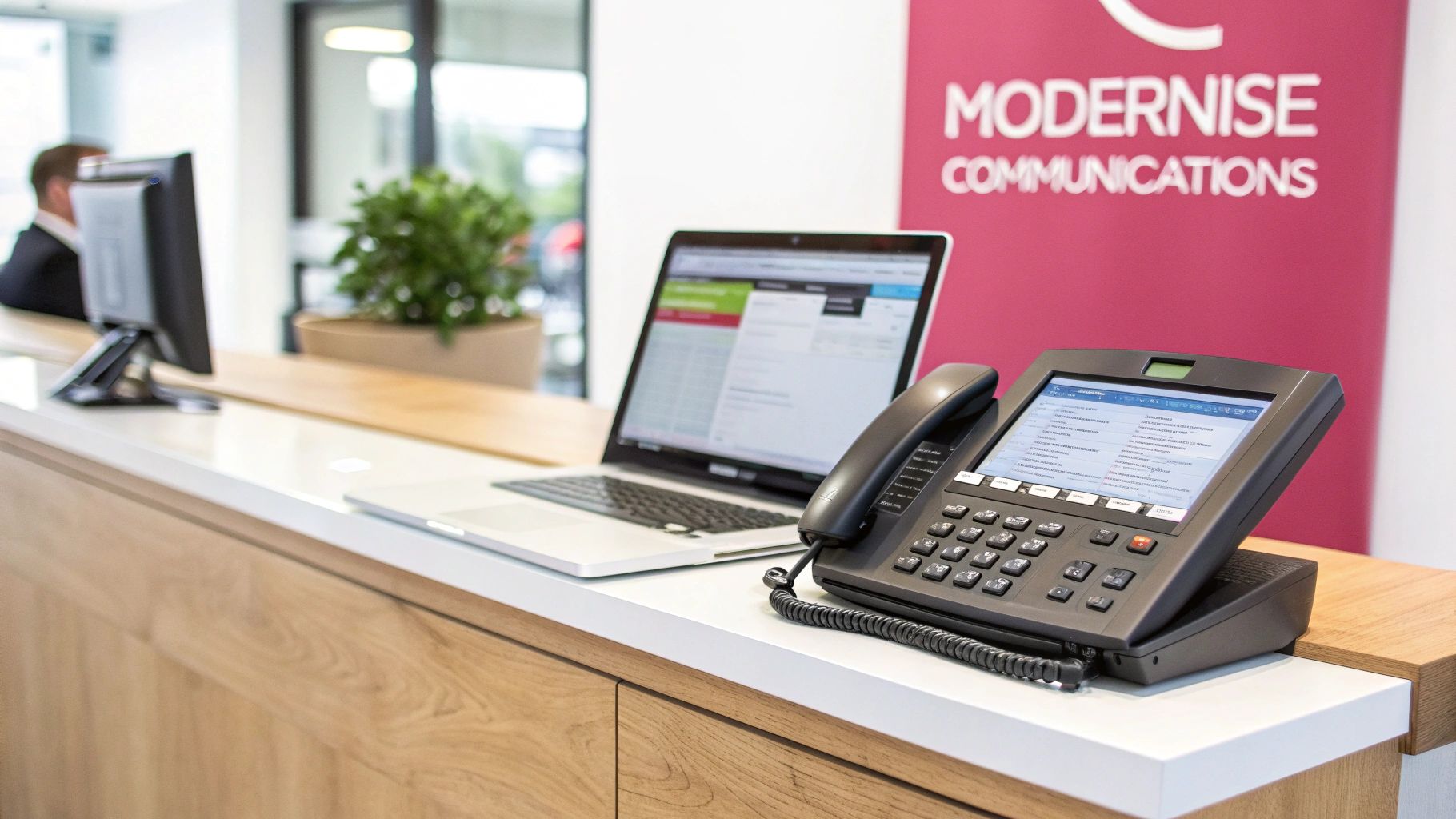
In today's world, sticking with an old-fashioned phone system is a bit like navigating with a paper map instead of a GPS. It might get the job done, but it's inefficient, creates bottlenecks, and simply cannot keep up with the demands of a modern, flexible workforce. For small and medium-sized businesses (SMEs), these limitations are a direct hit to both productivity and client service.
This guide is designed to tackle these challenges directly. We will show you how an IP phone service is the clear solution and demystify the technology behind it. Our goal is to provide a straightforward roadmap for professional service firms across Dorset, Somerset, Wiltshire, and Hampshire, helping you make a smooth transition and turn your phone system into a genuine competitive advantage.
The Shift Away from Traditional Lines
The move to internet-based phone systems is not just a fleeting trend; it is a fundamental shift in how businesses operate. The UK's IP Telephony market was valued at US$1.50 billion in 2017 and is on track to hit US$2.74 billion by 2025.
This rapid growth is no surprise. It is driven by the clear benefits of the technology and supported by government initiatives to improve broadband infrastructure, especially in more rural areas. As internet connectivity gets better, it is SMEs that are poised to see the biggest growth in adoption.
To appreciate why this evolution is so critical, it helps to understand the foundational aspects of telephony and data connectivity that all modern systems are built upon.
A modern IP phone service integrates voice, video, and messaging into a single, manageable platform. This unification is the key to unlocking new levels of productivity and client responsiveness, something traditional phone lines could never offer.
The advantages go far beyond just making and receiving calls. Adopting this technology means giving your team the tools they actually need to work effectively today. You can explore the future of business communication to see just how profoundly these systems are reshaping the professional world. From here, we will walk you through the practical steps—from grasping the core concepts to selecting the right local provider.
How an IP Phone Service Actually Works
To really get your head around how an IP phone service for business works, it helps to first picture the old way of doing things. A traditional phone system is a bit like having a single, private road built just for your calls. It is a dedicated line, sure, but it is also rigid, expensive to maintain, and a real hassle to change.
An IP phone service, on the other hand, uses the internet—think of it as a smart, multi-lane motorway. Instead of needing that one dedicated path, it cleverly breaks your voice down into tiny digital packets of data. These packets then zip along your internet connection with all your other traffic, like emails and web browsing, before being perfectly reassembled at the other end for the person you are speaking to.
This process is called Voice over Internet Protocol (VoIP). It is the magic that delivers crystal-clear conversations that are far more flexible and powerful than anything possible over old copper wires. It is the same basic idea behind services like Skype or WhatsApp calls, but fine-tuned for the demands of a professional business.
The Three Core Components
For this digital conversation to happen smoothly, you need three key elements working in perfect harmony. You can think of them as the vehicle, the road, and the traffic control centre.
-
The IP Phone (The Vehicle): This is simply what your team uses to talk. It could be a physical desk phone that looks and feels familiar but plugs into a network port instead of a classic phone socket. Or, it could be a 'softphone'—an application on a computer, tablet, or smartphone that turns the device into your business phone, usually used with a headset.
-
Your Internet Connection (The Road): This is the motorway carrying your voice data. A solid, business-grade broadband connection is non-negotiable here; it is what guarantees high-quality, dependable calls. Without a good road, even the best vehicle will struggle.
-
The Provider’s Server (Traffic Control): This is the brains of the whole operation. It is a powerful, cloud-based server run by your service provider (like us). This server is what routes your calls, manages your phone numbers, handles features like voicemail and call forwarding, and connects your calls to the traditional phone network when you are calling a landline or mobile.
Hosted vs Self-Managed Systems
Getting to grips with the difference between service models is key when choosing an IP phone service for business. The main distinction comes down to who looks after that "traffic control" server.
With a fully hosted solution, the provider handles everything. They own, manage, and maintain all the complex server hardware in their secure data centres. You just pay a straightforward monthly fee per user and get access to the whole system without any of the technical headaches.
This approach is perfect for most small and medium-sized professional service firms in Dorset, Somerset, Wiltshire, and Hampshire, as it requires no major on-site equipment and delivers fantastic reliability. On the other hand, a self-managed system, like one built using the 3CX platform, gives your business more direct control. While a partner like SES Computers can still host and manage it for you, it offers deeper customisation for businesses with very specific needs or their own in-house IT team.
The table below really highlights the shift from old to new phone technologies.
Traditional Phone Lines vs Modern IP Phone Services
| Feature | Traditional Phone System (Analogue/ISDN) | IP Phone Service (VoIP) |
|---|---|---|
| Technology | Relies on physical copper wires and on-site hardware (PBX). | Uses your existing internet connection to transmit voice as data. |
| Costs | High line rental fees, expensive call charges (especially international), and maintenance contracts. | Lower costs with a predictable per-user monthly fee and often includes free calls. |
| Features | Basic functions like caller ID and voicemail are often paid extras. | Advanced features like auto-attendant, call recording, and voicemail-to-email are standard. |
| Scalability | Adding new lines is slow and costly, requiring new physical installation. | New users can be added or removed instantly through a simple web portal. |
As you can see, the move to an IP phone service is not just a minor upgrade; it is a fundamental change in how a business communicates, bringing with it a huge boost in flexibility and features for a much lower cost.
Key Features and Real-World Business Benefits
It is one thing to understand the technology behind an IP phone service, but what really matters is seeing the impact it can have on your business day-to-day. This is not just about adding fancy bells and whistles; it is about getting real, measurable results that strengthen your operations, sharpen your professional image, and ultimately improve your bottom line.
The real power lies in a suite of smart tools that change how your team communicates. These are not clunky add-ons but core functions built to solve common business headaches. From making sure every single client call is handled perfectly to empowering a modern, flexible workforce, an ip phone service for business gives you a genuine competitive advantage.
Enhancing Your Professional Image
First impressions count, and how your business answers the phone says a lot about you. Modern IP phone systems give you the tools to ensure every caller has a slick, professional experience, whether you are a team of five or fifty.
One of the most useful features for this is the Auto-Attendant. You can think of it as a digital receptionist that never takes a break.
Practical Example: Imagine a law firm in Dorset. They can set up their auto-attendant with a custom greeting: "Thank you for calling ABC Solicitors. For conveyancing, press 1. For family law, press 2." The call is instantly sent to the right specialist, which not only speeds things up for the client but also frees up admin staff to work on more valuable tasks.
A simple feature like this means callers are not left waiting on a ringing phone. They feel they are being handled efficiently, which immediately elevates their perception of your firm's professionalism.
Boosting Team Productivity and Flexibility
Beyond how you look to the outside world, an IP phone service brings massive efficiencies inside your business. It gives your team the tools they need to work smarter and stay connected, whether they are at their desk, working from home, or out on a client site.
Here are a few features that make a direct impact:
- Voicemail-to-Email: This function is a real time-saver. It converts voice messages into audio files and drops them straight into a user's email inbox. A team member can listen on their laptop or phone without ever needing to dial into a clunky voicemail system.
- Find Me / Follow Me: This clever call routing makes sure key people never miss an important call. You can create rules so a call rings the office phone first, then a mobile after a few seconds, and maybe a home office line as a last resort.
- CRM Integration: This is a complete game-changer. By connecting your phone system to your Customer Relationship Management (CRM) software, a client's entire history can pop up on the screen when they call, giving your team immediate context for a much better conversation.
Practical Example: Think of a team of surveyors spread across Hampshire. They rely heavily on Voicemail-to-Email. When a client leaves an urgent message about a site issue, the audio file lands in the surveyor's inbox right away. They can listen and respond directly from their mobile, solving problems faster and keeping clients happy without a trip back to the office.
Driving Cost Savings and Scalability
For many businesses, one of the most compelling arguments for switching to an IP phone service is the financial one. This shift is not just a choice anymore; with the old ISDN network being shut down for good in 2025, all UK businesses will have to move to internet-based communications.
But this is not just a forced upgrade; it is a strategic one. VoIP systems provide far better call quality, using a wider audio frequency range than old phone lines for crystal-clear conversations. That clarity, paired with powerful features, is why a staggering 90% of call centres report operational improvements after switching. To get the full picture, you can read more about these telecommunication usage trends in the UK.
The biggest financial win comes from getting rid of expensive, physical phone lines for every user. You simply use the internet connection you are already paying for, consolidating costs into one predictable, per-user monthly fee.
This model is also incredibly scalable. If your business in Wiltshire needs to bring on three new people for a project, you can get their phone extensions up and running in minutes from a simple web portal. There is no more waiting weeks for an engineer to come out and install new lines, giving you the agility to adapt to business demands instantly.
Security and Compliance: More Than Just Talk
If you are running a professional service, whether it is a solicitor’s office in Wiltshire or a financial advisory in Hampshire, the security of your conversations is non-negotiable. It is a common worry that shifting your calls onto the internet might open up new risks. In reality, a modern IP phone service for business is built to be significantly more secure than the old analogue lines it is designed to replace.
When you are discussing sensitive client details or commercially sensitive information, you need to know that conversation is private. With traditional phone lines, intercepting calls through ‘wiretapping’ was always a lingering risk. Internet-based phone systems tackle this threat head-on, using robust security protocols designed for the digital age.
The core of this protection is end-to-end encryption. The simplest way to think about it is like sending a letter in a locked box where only the person you have sent it to has the key. Encryption effectively jumbles up the voice data as it travels online, making it complete gibberish to anyone trying to eavesdrop.
Building a Digital Fortress Around Your Calls
Beyond just encryption, a good provider will wrap your IP phone service in multiple layers of defence. It is not about adding a single security feature; it is about weaving security into the very fabric of the system.
This multi-layered approach usually involves:
- Secure Real-time Transport Protocol (SRTP): This is the technical name for the standard that encrypts your voice and video calls, ensuring they remain confidential from start to finish.
- Constant Network Monitoring and Firewalls: Your provider’s network acts as a vigilant gatekeeper, using powerful firewalls to filter out malicious traffic. Behind the scenes, their team monitors the network 24/7, ready to spot and shut down any suspicious activity before it becomes a problem.
- Regular Security Audits: The best providers do not just set up their defences and forget about them. They constantly test their own systems, looking for weaknesses to ensure they are always a step ahead of emerging cyber threats.
When you opt for a professionally managed IP phone service, you are essentially handing over your communication security to a team of specialists. This gives you access to enterprise-level security that would be incredibly complex and costly for most small or medium-sized businesses to manage on their own.
Making Compliance Second Nature
For any business handling personal data, meeting regulatory standards like the General Data Protection Regulation (GDPR) is a major responsibility. The good news is that a quality IP phone service comes with features designed to make compliance far less of a headache.
A standout feature is secure call recording. Many professions are required to record calls for compliance, training, or simply to have a record in case of a dispute. An IP system lets you manage this securely and transparently.
Practical Example: Imagine a financial services firm in Somerset that needs to record all calls where investment advice is discussed. Their 3CX phone system can be set to automatically play a message informing the client that the call is being recorded, taking care of consent. The recording itself is encrypted and stored safely in the cloud, with access tightly controlled. This creates a perfect, compliant audit trail.
This kind of built-in functionality takes the guesswork out of staying compliant. You are no longer relying on clunky manual processes or separate, potentially insecure devices. The system handles everything—recording, consent, and storage—within one secure platform. Choosing the right local partner means you are not just getting a better phone system; you are adopting a fundamentally more secure and compliant way of working, protecting your business and your clients.
Analysing Costs and Calculating Your Return on Investment
Let us get down to brass tacks: does moving to an IP phone system actually make financial sense for your business? All the advanced features in the world do not mean much if the numbers do not add up. The good news is that the financial model for modern telephony is a world away from the old, unpredictable systems we are used to. It is about swapping surprise bills for clear, manageable costs.
Think about your current phone bill. It is likely a jumble of line rental charges, fluctuating call rates, and maybe a pricey maintenance contract on top. An IP phone service scraps all that. Instead, you typically pay a straightforward per-user, per-month fee. This simple subscription model bundles your costs, making budgeting a whole lot easier.
Breaking Down the Financials
The real value of an IP phone system shines through when you look at the total cost of ownership over time. Yes, there might be an initial, one-off cost for new handsets or professional setup, but the ongoing monthly savings usually start paying that back almost immediately. The trick is to look past that first invoice and focus on the long-term gains.
Here is where you will see the difference:
- Predictable Monthly Subscriptions: Your bill is the same each month. That single fee covers the service, all its features, and often includes very generous or even unlimited call packages. No more anxiety about how much this month's calls will cost.
- Elimination of Line Rental: You are already paying for an internet connection, right? An IP system uses that, meaning you can finally stop paying for expensive old ISDN or analogue phone lines you no longer need.
- Reduced Maintenance Costs: With a hosted solution, there is no physical phone system (a PBX box) sitting in your office that needs maintaining, repairing, or upgrading. That means no more surprise bills for engineer call-outs.
The security benefits that come built-in also help protect your bottom line by reducing business risk.
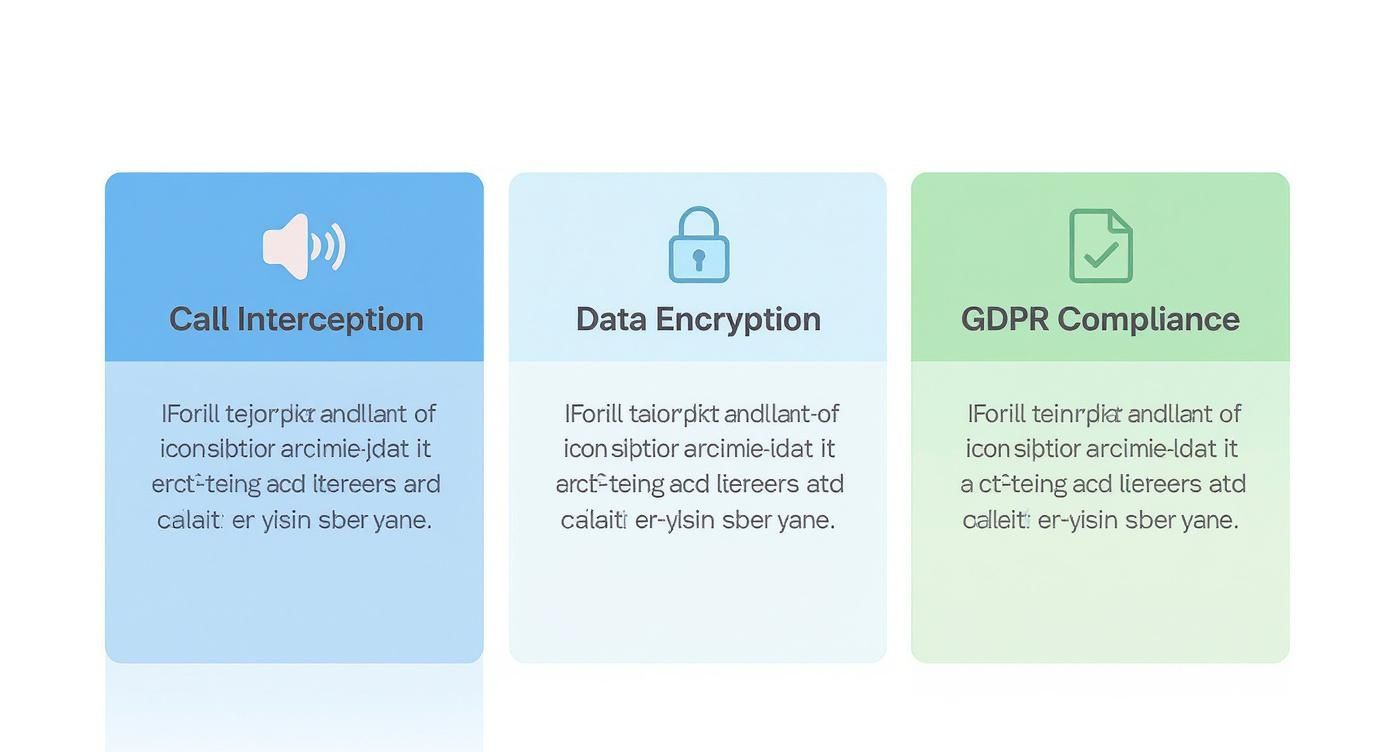
As you can see, these systems are designed from the ground up with security and compliance in mind, helping you avoid the potentially huge costs that come with data breaches or regulatory fines.
Calculating a Practical Return on Investment
Let us make this real. Imagine a 15-person engineering consultancy in Somerset still using an old-fashioned phone system. Moving to a modern IP service is not just about getting new features; it is a solid business decision.
A Quick ROI Example:
- Calculate Monthly Savings: They cancel their ISDN line rental, saving £250 per month. Better call rates save them another £150 on average. That is a total monthly saving of £400.
- Factor in One-Time Costs: Let us say the new handsets and professional installation came to a one-off cost of £3,000.
- Determine the Payback Period: If you divide the initial cost (£3,000) by the monthly savings (£400), you find the new system completely pays for itself in just 7.5 months.
In this scenario, the firm would see a net saving of £6,600 over two years. And that is before you even start to factor in the value of the productivity gains from all the new, modern features.
When you run the numbers like this, the decision shifts from being a perceived expense to a clear-cut, strategic investment.
For a more detailed look at how different systems compare financially, our business phone system comparison offers some great insights. Calculating your own potential ROI is the best way to get the clarity and confidence you need to make the switch.
How to Choose the Right UK Provider for Your Business
Picking the right technology is only half the battle; choosing the right provider to partner with is just as critical. A great IP phone service for business can genuinely transform how you operate, but only if it is backed by a team that actually understands your needs. This is not just about comparing prices—it is about finding a provider who delivers solid reliability, expert support, and a real feel for your local business environment.
The UK market is modernising fast. It is expected that by 2025, a staggering 31% of UK businesses will have made the switch to VoIP. This is not just a trend; it is a major shift driven by big cost savings and the demand for smarter features. It also highlights just how important it is to find a partner who can make that transition a smooth one for you.
Vetting Potential Partners: A Practical Checklist
When you are sizing up potential providers, you need a plan. It is easy to get lost in the sales pitch, so you have to ask the right questions to get to the heart of what they really offer. A good partner will be upfront and will not stumble when you press them for details.
Use this checklist to guide your conversations:
- Technical Support: Is your support team actually based in the UK? What are your guaranteed response times when things go wrong? You need to know that if there is a problem, you will be speaking to an expert who can fix it quickly, not someone in a call centre halfway across the world reading from a script.
- Onboarding and Migration: How will you handle moving our existing business numbers over? Can you guarantee there will not be any significant downtime during the switch? A seamless changeover is absolutely essential to avoid disrupting your clients.
- Pricing Transparency: Is your pricing a simple, all-in monthly fee per user, or are there hidden extras? What about features like call recording or voicemail-to-email—are they included? Make sure the quote you get is the price you will actually be paying, with no nasty surprises.
For small and medium-sized businesses, the decision to choose the right VoIP solution for your SMB is a big one, and it pays to be thorough when looking at features, scalability, and support.
The Value of Local Expertise
There is a massive advantage to working with a provider who gets the local business scene in areas like Dorset, Hampshire, Wiltshire, and Somerset. They will be familiar with everything from rural broadband quirks to the specific infrastructure in local business parks. That kind of on-the-ground knowledge is priceless, both during setup and for any support you need later on.
A local provider is not just selling you a service; they are invested in your success. They understand the pressures and opportunities facing businesses in your area, allowing them to offer more relevant advice and proactive support.
This regional focus means the solution they recommend is genuinely right for you, not just a generic package they sell to everyone. For a closer look at the options out there, our guide to the best VoIP providers in the UK is a great place to start.
Hosted Service vs. a 3CX System
A key part of the decision-making process is understanding the type of system a provider offers. This choice really determines how much control you have and how much management is needed from your side.
Fully Hosted Service:
This is, by far, the most popular route for SMEs. With a hosted service, the provider manages all the complicated tech on their own secure servers. You just plug in your IP phones and get to work. It is a completely hands-off approach that gives you top-tier features and reliability without needing your own IT team to run it.
3CX Phone System:
This option puts more control and customisation in your hands. While a partner like SES Computers can still host and manage it for you, a 3CX system gives businesses with an in-house IT department or very specific technical requirements the flexibility to fine-tune everything. It is a seriously powerful platform that can be tailored to fit precise workflows.
At the end of the day, the right partner will take the time to understand your company's goals, resources, and budget. They will not just sell you a phone system; they will guide you to the service model that makes the most sense for your business in the long run.
Frequently Asked Questions About IP Phone Services
It is completely normal to have a few questions when you are thinking about changing your phone system. Making the right choice is important, so we have put together some straight-talking answers to the questions we hear most often from businesses looking into IP phone services.
Will Call Quality Be as Good as My Landline?
It is actually better—often, noticeably so. Traditional landlines are limited by old copper wire technology. Modern IP phone systems, on the other hand, use high-definition (HD) voice, which captures a far broader range of audio frequencies. The result is conversations that sound clearer, richer, and much more natural.
The key to unlocking this quality is a solid, business-grade internet connection. Any good provider will check your current broadband to make sure it can handle your call traffic without a problem, long before you sign anything.
What Happens to Our Phones if the Internet Goes Down?
This is where a modern IP phone service really shines. A well-designed system is built for resilience, with smart failover options that mean you never have to miss a critical call. It is all about ensuring business continuity.
If your office internet drops, calls can be set to automatically and instantly forward to your mobile, a colleague's phone, or even another office. Plus, with applications on your team's smartphones, they can carry on making and taking calls on your main business number from anywhere they have a 4G, 5G, or Wi-Fi signal.
This built-in backup plan keeps your communication channels open, so a local internet issue does not have to bring your business to a halt.
Can We Keep Our Existing Business Phone Number?
Yes, absolutely. Your phone number is a core part of your business identity, and you do not have to give it up. The number your customers have known and trusted for years can come with you.
The official process for this is called 'porting'. Your new provider handles all the technical legwork to move the number over. It is a regulated process here in the UK, designed to be smooth and seamless with minimal to no interruption, so your clients will not notice a thing.
Ready to modernise your communications with a reliable, secure, and cost-effective IP phone service? The team at SES Computers has over 30 years of experience helping businesses across Dorset, Somerset, Wiltshire, and Hampshire make the switch. Contact us today for a no-obligation consultation to discover the right solution for you at https://www.sescomputers.com.