Think of IT strategy consultancy as the process of ensuring your technology is not just working, but is actively helping your business achieve its long-term goals. It's about shifting your mindset from seeing IT as a necessary cost to treating it as a powerful asset that fuels growth, sharpens efficiency, and strengthens your defences.
What an IT Strategy Consultancy Actually Does
Imagine an architect meticulously crafting a blueprint before a single brick is laid for a new building. That’s exactly what an IT strategy consultant does for your company's technology. It’s all about deliberate, forward-thinking planning, not just scrambling to react when something inevitably breaks.
This approach is a world away from the familiar break-fix cycle of traditional IT support. Instead of just solving today's problems, a strategic consultant builds a technology roadmap that directly supports your core business ambitions. This foresight helps prevent expensive future headaches and creates a solid foundation for sustainable growth.
The Strategic Blueprint for Your Business
Whether you're a growing accountancy firm in Dorset or a busy law practice in Hampshire, the goal is the same: to ensure your technology is a genuine contributor to your success. An IT strategy consultancy makes certain your digital tools are doing more than just running—they should be actively boosting productivity, tightening security, and opening doors to new opportunities.
A strategic partner gets under the skin of your business. They start by analysing your current infrastructure and getting to grips with your commercial objectives before designing a practical plan.
For a professional services firm, this roadmap might involve:
- Pinpointing outdated practice management software that's slowing your team down and causing data silos.
- Assessing hidden cyber security weaknesses, such as inadequate email filtering, that could lead to a damaging data breach of client information.
- Planning for future expansion by selecting flexible, scalable cloud solutions that support hybrid working for fee-earners.
- Ensuring you're fully compliant with UK-specific regulations like GDPR and any professional body requirements.
The guiding principle is refreshingly simple: every technology decision must have a clear business purpose. It's about turning IT from an operational expense into a real competitive advantage.
Moving Beyond Reactive Fixes
The distinction between everyday IT support and strategic consultancy is stark. One keeps the lights on; the other maps out where the building is headed next. Too many professional services firms are stuck in a reactive loop, only reaching out for help when a server crashes or a laptop dies. This approach is not just inefficient; it’s risky.
You can learn more about the day-to-day operational side in our detailed guide on what managed IT services are, which often goes hand-in-hand with a robust strategic plan.
To really get to grips with this, let’s look at the two side-by-side.
IT Support vs IT Strategy at a Glance
| Aspect | Reactive IT Support | Proactive IT Strategy Consultancy |
|---|---|---|
| Focus | Solving immediate technical problems (break-fix). | Aligning technology with long-term business goals. |
| Timing | Responds after an issue occurs. | Acts before issues arise to prevent them. |
| Goal | Restore normal operations as quickly as possible. | Drive growth, improve efficiency, and manage risk. |
| Value | Minimises downtime. | Maximises competitive advantage and ROI. |
| Example | Fixing a broken printer or a slow computer. | Planning a cloud migration to support business expansion and enable secure remote work for staff. |
This table highlights the fundamental shift in thinking. A strategic consultancy flips the model on its head by anticipating needs and building a resilient, secure, and efficient technology environment designed for the future.
This proactive stance is becoming essential for survival and success. The UK strategy consulting market is projected to grow from £3,386.4 million in 2025 to £5,875.0 million by 2035. This sharp increase shows that nearly 60% of British business leaders now recognise that urgent digital upgrades are vital to staying competitive.
The Core Services an IT Consultancy Actually Delivers
An IT strategy is not just a document that gathers dust. A great consultancy turns that strategy into tangible, practical services that make a real difference to your day-to-day operations. These are the building blocks for a more resilient, secure, and efficient business. The end goal is always a specific business outcome, whether that's boosting productivity, securing sensitive data, or enabling flexible working.
Let's look at the core services you should expect from a reputable IT partner, with some real-world examples from professional services firms in mind.
Cloud Migration and Management
Think of moving to the cloud as relocating your company's digital headquarters. Instead of being tied to a physical server in your office, you're moving to a secure, flexible, and accessible online space. It is not just about storage; it is about fundamentally changing how your team collaborates.
A consultancy will manage this entire transition, from the initial planning and execution right through to ongoing support, ensuring any disruption is kept to an absolute minimum. For instance, a solicitors' practice in Somerset could migrate its entire case management system to a secure cloud platform like Microsoft 365. This would allow fee-earners to securely access and update client files from court, from home, or while on the move, dramatically improving their responsiveness and efficiency.
The result is a more agile business with predictable monthly costs, free from the surprise expense of maintaining and eventually replacing an old, on-site server.
Fortifying Your Cyber Security
In the current climate, strong cyber security is not just a nice-to-have—it is essential for survival. This is especially true for any firm that handles sensitive client information. An IT strategy consultancy delivers a multi-layered defence system to protect your most valuable asset: your data.
It all starts with a thorough security audit to find the weak spots in your network, software, and even your team's day-to-day habits. From there, the consultancy puts a comprehensive security plan into action. For an accountancy firm, this might include:
- Advanced Threat Protection: Deploying sophisticated software to block malware, phishing attacks, and ransomware before they can compromise sensitive financial data.
- Employee Training: Running workshops to help your team spot and avoid common security threats, like fraudulent emails requesting fund transfers.
- Access Control: Ensuring staff can only access the client data they absolutely need to do their jobs, which massively reduces the risk of internal breaches.
- 24/7 Monitoring: Proactively watching for any suspicious activity, such as unusual login attempts from overseas, and enabling an immediate response.
You cannot overstate how important this is. Cybersecurity consulting is one of the fastest-growing areas in the UK’s IT market. The growth rate for this specialism is forecast to almost double from 4.7% in 2024 to 9% in 2025, making it a top priority for businesses. You can learn more about how these cyber security services are tailored for small businesses in our detailed article. This rapid growth just underscores the urgent need for expert guidance in protecting business operations.
Device as a Service (DaaS)
Device as a Service (or DaaS) is a smarter way to equip your team. Instead of buying laptops and desktops outright, you subscribe to a service that provides all the hardware, software, management, and support for a simple, fixed monthly fee.
Picture a marketing agency in Hampshire with a hybrid team. With DaaS, every team member gets a pre-configured, secure laptop that is ready to use straight out of the box. The consultancy handles all the updates, security patches, and support. When the device gets old, it’s simply swapped out for a new one. It’s a model that gives you predictable costs and frees up your team from time-consuming IT admin.
DaaS turns a hefty capital expenditure into a manageable operational expense, ensuring your team always has reliable, secure technology without the big upfront investment.
Modern VoIP and Backup Solutions
Finally, a first-class consultancy will bring your communications and data resilience up to modern standards. A modern Voice over IP (VoIP) phone system offers so much more than a traditional landline, often integrating directly with your CRM and other business software for a truly unified communications experience. For example, a financial advisor could have their VoIP system automatically bring up a client's record on screen when they call.
At the same time, they will design and implement a robust Backup and Disaster Recovery (BDR) plan. This is your business’s insurance policy against data loss. If you ever suffer a ransomware attack, hardware failure, or even a fire or flood, a solid BDR plan ensures you can restore your data and systems quickly, guaranteeing business continuity. For instance, top-tier IT consultancies often provide expertise in areas like Automated Data Processing to ensure these backup systems run smoothly and efficiently without needing constant manual oversight.
How to Choose the Right IT Partner
Picking an IT consultancy is one of the most important decisions a business leader can make. This is not just about buying technology; it is about finding a genuine strategic partner who will take the time to get under the bonnet of your business, understand your vision, and help you get there. The choice demands more than a quick look at their website – it requires a proper look at their expertise, their process, and whether they’re the right fit for your company culture.
A real partnership is built on trust and a shared sense of purpose. The right IT strategy consultant will want to know everything about your operations, your headaches, and your goals before they even think about suggesting a solution. Their success should be completely intertwined with yours.
Most reputable consultants follow a clear, logical process. It is not about guesswork; it is about methodical planning.
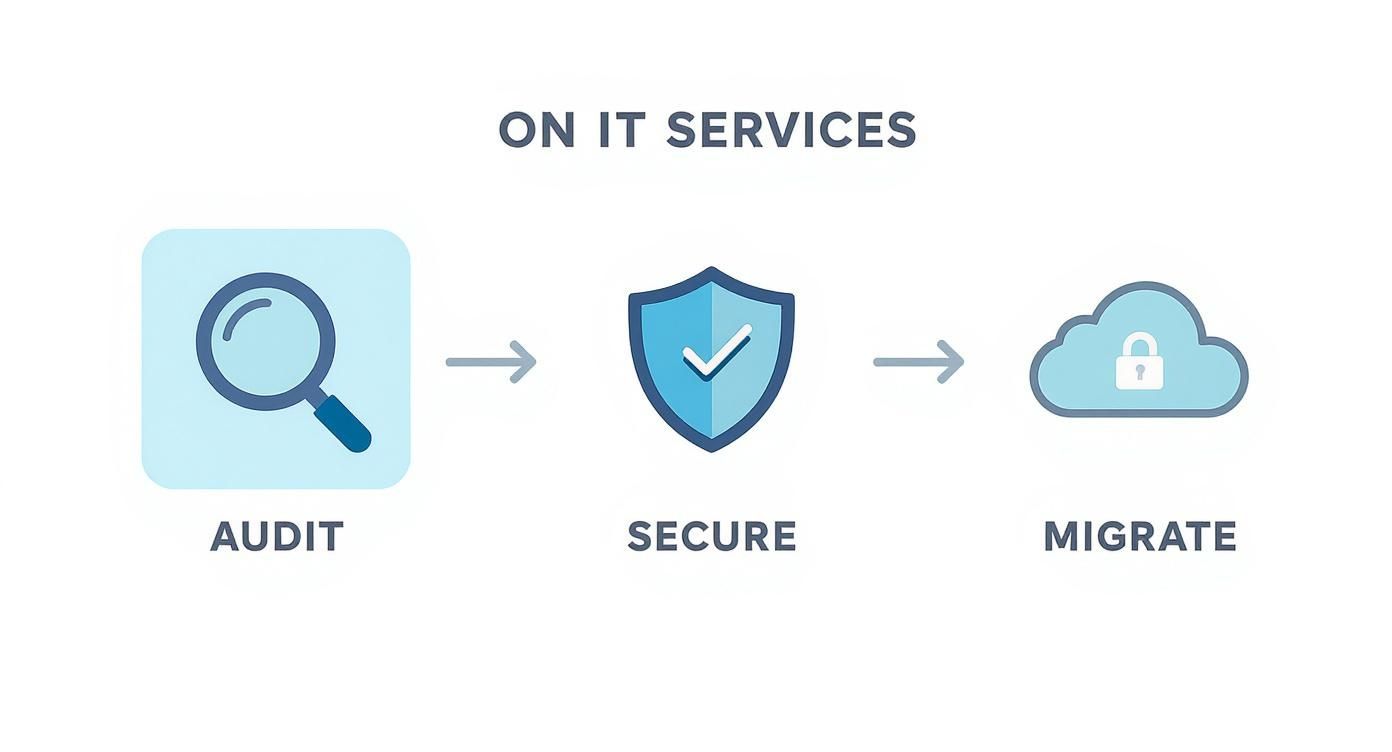
This simple flow – Audit, Secure, Migrate – gets to the heart of a structured approach. It ensures every action is based on a solid understanding of where you are now and where you want to be.
Vetting Technical Expertise and Industry Experience
First things first, you need to be sure they have the technical chops and, just as importantly, direct experience in your industry. A consultancy that’s brilliant with manufacturing clients might not have a clue about the strict compliance and client confidentiality rules a law firm has to follow. You need someone who speaks your language from day one.
When you're vetting potential partners, you need to ask direct, specific questions. Wishy-washy answers are a massive red flag.
To help you dig deeper, we have put together a table of essential questions. This is not just a checklist; it is a framework for a meaningful conversation that will quickly reveal whether a potential partner truly understands your world.
Essential Questions to Ask a Potential IT Consultancy
| Category | Key Question | Why It Matters |
|---|---|---|
| Industry Experience | Can you share case studies or references from professional services firms similar to ours? | This proves they understand your sector's specific challenges, such as client confidentiality and regulatory demands, and can deliver measurable results. |
| Local & Regulatory Knowledge | How do you ensure your recommendations comply with UK-specific regulations like GDPR? | This confirms their grasp of the local regulatory environment, which is critical for professional services firms in Hampshire, Dorset, and Wiltshire. |
| Technical & Project Skills | What is your process for managing a large-scale project like a cloud migration and how will you keep us informed? | This gives you insight into their operational style and whether it aligns with how your team works. Clear communication is key to minimising disruption. |
| Security & Compliance | How do you stay current with the latest cyber security threats, particularly those targeting SMEs in the legal or financial sectors? | Their answer reveals if they are proactive about security or just reactive. A good partner is always thinking ahead to protect your firm's reputation. |
Asking the right questions sets the stage for a successful partnership. It forces a potential supplier to prove their value and demonstrate a track record of success with businesses like yours.
Choosing an IT partner is like hiring a senior member of your team. Technical skill is just the ticket to the game; the real value comes from their strategic insight, industry knowledge, and genuine commitment to your business's future.
For a more detailed look at what separates the good from the great, our guide to the key attributes of leading managed IT service companies offers some extra pointers.
Assessing Cultural Fit and Communication Style
Technical brilliance means very little if you cannot work together. The importance of cultural fit is huge. You’re starting a long-term relationship, and clear, honest communication is the bedrock it’s built on. A partner who only talks in impenetrable tech-speak is not a partner at all; they're a vendor putting a wall between you and your own technology.
Look for a team that makes clarity a priority. They should be able to explain complex ideas in plain English, always linking their recommendations back to a tangible business benefit. In those first meetings, are they listening more than they’re talking? Do they seem genuinely curious about your business problems, or are they just pushing their favourite product?
Think about it this way: imagine your accountancy firm in Dorset has a critical security problem. You need a partner who can calmly explain what’s happening, outline the fix, and clarify the business impact without sending everyone into a panic with a stream of jargon. This ability to translate technology into business sense is the true mark of an IT strategy consultancy. It ensures you stay in control and fully informed, making technology work for you, not the other way around.
From Strategy to Success: A Client Story

Sometimes the best way to see the real-world value of an IT strategy consultancy is to walk through a genuine story. Let’s look at ‘ABC Solicitors’, a fictional but very typical law firm based in Wiltshire that was wrestling with some familiar technology headaches. Their ambitions were high, but their IT was holding them back.
The firm had reached a tipping point. Their on-site server was old, slow, and simply not built for the kind of flexible, remote work needed to attract the best legal minds. Worse still, the partners were losing sleep over the security of their sensitive client data on such dated hardware. They knew a change was needed, but they did not know what that change should be.
The Initial Technology Audit
The first thing the consultancy did was not to propose a solution, but simply to listen. They carried out a deep dive into every corner of ABC Solicitors' IT setup, from hardware and software to how the team actually worked day-to-day.
This thorough audit quickly flagged several critical problems:
- Their main server was on its last legs, creating a serious risk of catastrophic failure and data loss.
- Cyber security measures were worryingly basic, leaving them wide open to ransomware and phishing scams targeting legal practices.
- The old-school phone system was rigid and could not support a team working from different locations.
- Remote access was a frustratingly slow and clunky experience, which was directly eating into billable hours.
Crafting a Strategic Roadmap
With a crystal-clear understanding of the challenges, the consultants put together a practical, phased roadmap. The central recommendation was a move to Microsoft 365, shifting the firm’s entire operation from that high-risk server to a secure and accessible cloud platform.
But this was about more than just swapping out old tech for new. The plan integrated advanced cyber security, like multi-factor authentication and continuous threat monitoring, to properly protect client confidentiality. The final piece of the puzzle was a modern VoIP phone system that could be used anywhere and would work seamlessly with their existing legal software.
The entire strategy was built around delivering tangible business results. The goal was not just to install new equipment, but to boost productivity, slash operational risk, and establish a predictable monthly IT cost that made sense for the firm's finances.
The Transformation
The migration itself was handled meticulously over a couple of weekends to ensure zero disruption to the firm’s working week. The consultancy took care of everything, from the technical heavy lifting to training the staff, ensuring everyone felt confident with the new tools from day one.
The impact was immediate. Solicitors could now work just as effectively from a courtroom, their home office, or a client’s site. The new VoIP system meant important calls were never missed, with staff able to answer on their laptops or mobiles. Most importantly, the partners finally had peace of mind. They knew their data was secure, their team was productive, and their firm was now a much more appealing place to work for talented professionals looking for a modern, flexible employer.
Measuring the ROI of Your IT Strategy
Trying to justify the spend on a strategic IT partner can feel like a tough sell. But the real return on your investment (ROI) is about much more than just the figure on the invoice. Thinking of an IT strategy consultancy as a simple cost is a common mistake; in reality, it is a direct driver of your profitability, impacting everything from day-to-day efficiency to long-term risk.
The financial upside is often hiding in plain sight. To see it, you need to look beyond the monthly retainer and start adding up the value of what you gain—and, crucially, what you avoid losing. It’s a shift in perspective that reveals the true picture.
Calculating the Value of Increased Productivity
One of the most immediate returns you will see is a boost in employee productivity. When your systems are fast, reliable, and properly joined up, your team spends less time fighting with technology and more time on valuable, billable work. That’s a direct, measurable financial win.
Let's put it into practical terms. Imagine:
- A law firm with 10 solicitors gets a new, optimised IT infrastructure. It saves each of them just 30 minutes per day that was previously lost to slow logins, clunky software, or finding files.
- If their average billable rate is £150 per hour, that’s £75 of recoverable time per solicitor, every single day.
- Across the whole team, that adds up to a staggering £750 per day in regained productivity. Annually, that’s over £180,000 in billable time that was previously evaporating.
This simple calculation is not just theory. It shows how a well-planned IT strategy directly creates significant revenue. It’s not an abstract benefit; it’s real time you can either bill to clients or reinvest into growing the business.
The Financial Impact of Avoiding Downtime and Breaches
Often, the most significant ROI comes from the disasters that do not happen. For a small or medium-sized business, just one hour of downtime can cost thousands in lost revenue, not to mention the damage to your reputation. A data breach under GDPR is even worse, carrying the risk of crippling fines and a catastrophic loss of client trust.
A good strategic consultancy works proactively to stop these things from ever happening. That proactive defence is a huge part of the value they bring to the table.
This focus on future-proofing is why the sector is booming. Technology consulting is now the fastest-growing part of the UK's entire strategy consulting market, expanding at a 6.32% compound annual growth rate. This surge is fuelled by the need for digital evolution, with 66% of UK consultants pointing to AI as the biggest area for growth. You can see more detailed figures on the UK management consulting services and their market growth.
When you build a business case around these clear metrics—more productive time, avoided downtime, and breach prevention—it becomes obvious. Investing in a high-quality IT strategy is not just another business expense; it is one of the smartest financial moves you can make.
Your Questions, Answered
When you're thinking about bringing in an IT strategy consultant, a few questions naturally pop up. Let's tackle some of the most common ones we hear from business owners.
Is This Really Something for a Small Business?
Absolutely. In fact, you could argue that smaller and medium-sized businesses have the most to gain from strategic IT advice.
Big corporations often have entire teams dedicated to IT strategy. A consultancy gives you access to that same calibre of expertise, but without the eye-watering cost of hiring a full-time Chief Technology Officer (CTO). It is all about levelling the playing field, helping you boost efficiency, tighten security, and plan for growth just like the big players do. For example, a small accountancy firm can use a consultant to devise a secure cloud strategy that allows them to compete with much larger practices.
What's the Difference Between an IT Consultancy and a Managed Service Provider (MSP)?
It is a great question, as there is often some overlap. Think of it like this: your MSP is the team on the ground, handling the day-to-day running of your systems. They're the ones keeping the lights on, fixing issues, and making sure everything works as it should.
An IT strategy consultant, on the other hand, is looking at the bigger picture—the blueprint. Their job is to ensure your technology is not just working, but that it is actively helping you achieve your long-term business goals. A good partner will often do both, creating a smart, forward-thinking plan and then managing the systems to make it a reality.
How Much Is This Going to Cost?
The cost really depends on what you need. Most consultancies are flexible and will have a couple of common ways of working.
- Project-Based Fees: This is perfect if you have a specific goal in mind, like planning a cloud migration or carrying out a deep-dive security audit. You agree on a fixed price for a defined piece of work.
- Ongoing Retainer: This model works well if you need continuous, high-level advice. It’s like having a strategic expert on call to help guide your decisions month after month.
The key is to stop thinking of it as a cost and start seeing it as an investment. A solid IT strategy should pay for itself through better efficiency, lower risk, and real, measurable growth.
Ultimately, the goal is to turn your technology from a necessary expense into a powerful asset that actively drives your business forward.
Ready to build a technology roadmap that drives your business forward? The team at SES Computers has over 30 years of experience providing strategic IT support to businesses across Dorset, Hampshire, Wiltshire, and Somerset. Contact us today for a no-obligation consultation.