Picture your business internet connection as a motorway. If standard business broadband is the M25 at 5 PM on a Friday—jammed, unpredictable, and painfully slow—then a leased line is your own private, three-lane motorway. It is a direct, clear route to the internet with no traffic, guaranteed speeds, and rock-solid reliability.
Your Private Internet Motorway Explained

So, what exactly is a leased line? It’s a dedicated, private fibre optic cable that connects your business premises directly to the provider's network. Unlike standard broadband, where you share the local connection with dozens of other businesses and homes, this line is exclusively yours. That one, simple difference is what gives it all its advantages.
With a shared broadband connection, your internet speed can drop dramatically during peak hours as everyone in the area competes for the same bandwidth. A leased line for your business completely sidesteps this issue. The bandwidth you pay for is the bandwidth you get, 24/7, no matter what your neighbours are doing online.
This guide is not just about faster internet; it’s about making a strategic investment in your company's performance and stability. We will explore how a dedicated line solves common business frustrations and gives your operations a real competitive edge.
The Defining Features of a Leased Line
To really grasp its value, you need to understand what sets a leased line apart. It is not just about speed; it is about guaranteed performance. Here are the core principles:
- Uncontended Connection: Your line is yours alone. No sharing means no slowdowns. Your speeds stay consistently fast all day, every day. For example, a financial advisory firm in Winchester can be confident that their connection will not falter during critical market hours, regardless of local network traffic.
- Symmetrical Speeds: You get the same lightning-fast speed for both uploads and downloads. This is absolutely critical for sending large files, running cloud applications, and holding crystal-clear video calls.
- Guaranteed Uptime (SLA): Leased lines are backed by a Service Level Agreement (SLA). This contract guarantees a specific level of uptime (typically 99.9% or higher) and promises fast fixes if anything ever goes wrong.
A leased line changes your internet from an unpredictable frustration into a dependable utility, just like your electricity or water supply. It provides the solid foundation that modern businesses need to rely on cloud services, VoIP phone systems, and seamless remote working.
For businesses across Dorset, Somerset, Wiltshire, and Hampshire, figuring out if this is the right move is a crucial step in future-proofing your operations. To learn more about how internet needs evolve as a business grows, take a look at Your Guide to Small Business Internet and Phone Systems. It is a great resource for mapping out the journey from a basic connection to the kind of robust solution that helps a growing company thrive.
Core Benefits of a Dedicated Leased Line
So, we've talked about a leased line being like your own private motorway. But what does that actually mean for your business day-to-day? The advantages are not just technical jargon; they translate into real-world gains in productivity, security, and the simple peace of mind that comes from having a connection you can count on. It is about turning your internet from a potential bottleneck into a powerful business asset.
The real value of a leased line comes from its exclusivity. This is your own private, uncontended circuit. The performance you pay for is the performance you get, all day, every day. This simple fact eliminates the guesswork and frustration that so often comes with shared broadband.
Unlocking Symmetrical Speed and Uncontended Bandwidth
One of the first things you will notice is the symmetrical speed. Your typical business broadband is asymmetrical – it is designed for fast downloads but offers much slower uploads. A leased line, on the other hand, gives you identical speeds in both directions.
For a modern professional services business, this is a genuine game-changer. Imagine an architectural practice in Salisbury sending enormous 3D model files to clients. On a standard connection, a multi-gigabyte upload could take hours, grinding their workflow to a halt. With a 1Gbps symmetrical leased line, that same transfer is done in minutes, keeping projects moving forward.
This same benefit ripples through everything you do online:
- Cloud Applications: Running tools like Microsoft 365 or your specialist cloud-based accounting software feels seamless, with no frustrating lag.
- VoIP Phone Systems: You get crystal-clear, jitter-free calls, which is essential for maintaining a professional image with your clients.
- Off-site Backups: Large data backups to a secure off-site data centre complete quickly and reliably overnight, without impacting your team's work during the day.
- Video Conferencing: You can host high-definition meetings with clients and remote staff where every single person has a stable, clear connection.
The Iron-Clad Guarantee of a Service Level Agreement
In business, reliability is everything. While broadband providers do their best to keep you online, a leased line contractually guarantees it with a Service Level Agreement (SLA). This is a formal, binding contract that defines the minimum level of service you are guaranteed to receive.
A typical SLA will include:
- An Uptime Guarantee: This is often 99.9% or higher, committing the provider to near-unbreakable connectivity.
- A Target Fix Time: If an issue ever does occur, the SLA specifies a maximum fix time – often within 4 to 6 hours.
Picture a manufacturing firm in Poole whose entire production line is managed through a cloud system. An internet outage on a standard broadband line could mean waiting a day or more for an engineer, costing thousands in lost production. A leased line SLA ensures that any fault is treated with the highest priority, turning a huge business risk into a managed utility.
An SLA is your peace of mind. It’s the assurance that your connection is monitored 24/7 and that expert engineers are on standby to respond immediately, keeping your business online and productive.
Enhanced Security for Your Business Data
In an age of constant cyber threats, security has to be a priority. By its very nature, a leased line is a more secure connection than a shared broadband network. Because the line is exclusively yours and is not shared with any other organisation, it presents a much smaller target for would-be attackers.
For any business handling sensitive information, this is a crucial advantage. A legal practice in Wiltshire or a healthcare provider in Somerset simply cannot afford any compromise on client confidentiality. A dedicated leased line business connection becomes a foundational part of their security strategy, protecting data as it moves between their offices, cloud services, and data centres. It helps them meet strict compliance requirements and gives clients confidence that their data is properly protected.
This shift to dedicated, reliable connections is becoming the norm. Once seen as a tool for massive corporations, leased lines are now the backbone for UK small and medium-sized businesses that rely heavily on cloud services and remote working. The UK's Internet Service Providers industry has grown to an estimated £9.8 billion in revenue, driven largely by this growing business demand for fibre and dedicated connectivity. You can dig deeper into this market trend in recent industry reports.
Leased Lines vs. Business Broadband: What’s the Real Difference?
Choosing the right internet for your business goes way beyond just looking at the advertised download speeds. You need to get under the bonnet and compare a dedicated leased line against standard business broadband options like Fibre to the Premises (FTTP) or Fibre to the Cabinet (FTTC). While they both get you online, how they do it is worlds apart, and that has huge implications for your daily operations.
The biggest distinction boils down to a single, critical concept: the contention ratio.
Why "Sharing" Is a Problem for Business Internet
Think of business broadband as a public motorway. The connection running to your local street cabinet or even your building is shared with dozens, sometimes hundreds, of other businesses and homes in your area. You are all trying to use the same motorway at the same time.
During quiet periods, traffic flows freely. But at 9 am on a Monday, when everyone is logging on, or during a school holiday when everyone is streaming, you hit a traffic jam. The network gets congested, and your speeds plummet. Your advertised "up to 1Gbps" speed is a best-case scenario, not a daily reality. This sharing is why you experience frustrating slowdowns right when you need the connection most.
A leased line gets you off the motorway and onto your own private, clear road. It is a dedicated fibre optic cable that runs directly from your office to the provider's network. No one else uses it. Ever.
This means your contention ratio is 1:1. The speed you pay for is the speed you get, 24/7, no matter what your neighbours are up to.
The question for any serious business is not 'which connection is fastest on paper?'. It is 'which service guarantees the performance my business cannot afford to lose?'. That is the peace of mind a leased line delivers.
A Practical Comparison: Broadband vs. Leased Line
Let us put this into a real-world context. Picture a busy design agency in Salisbury that relies on an FTTC connection. They are constantly battling to upload large video files and high-resolution creative assets for clients. The painfully slow, asymmetrical upload speeds create a major bottleneck, pushing back deadlines and frustrating the team.
By switching to a leased line, that problem vanishes overnight. They get symmetrical speeds, meaning uploads are just as fast as downloads. Sending a massive file becomes as quick and effortless as receiving one.
To make the choice even clearer, let us break down the key differences side-by-side.
UK Business Connectivity Options Compared
Here’s a direct comparison of the most common options available to businesses in the UK, highlighting where each one shines and where it falls short.
| Feature | Leased Line | FTTP Business Broadband | FTTC Business Broadband |
|---|---|---|---|
| Connection Type | Private, dedicated fibre | Shared fibre to premises | Shared fibre to cabinet |
| Speed Guarantee | Guaranteed, symmetrical | Asymmetrical, "up to" speeds | Asymmetrical, "up to" speeds |
| Contention Ratio | 1:1 (Uncontended) | Shared (e.g., 20:1 or higher) | Shared (e.g., 50:1 or higher) |
| Reliability (SLA) | 99.9%+ uptime guarantee | Best efforts, longer fix times | Best efforts, basic support |
| Security | Inherently more secure | Shared network infrastructure | Shared network infrastructure |
| Typical Use Case | Mission-critical operations | General office use, small teams | Small offices, low-demand use |
This table clearly shows why so many businesses are moving away from older, contended services. Industry reports confirm a steady decline in revenue from ADSL and basic FTTC as they're gradually phased out. Businesses are voting with their feet, migrating towards more reliable connections that offer guaranteed performance. You can see more on this in these UK business broadband statistics.
Ultimately, while standard business broadband is a perfectly good, cost-effective solution for many, it simply cannot provide the assurances that a leased line business connection does. For any company where connectivity is fundamental—for running VoIP phone systems, accessing cloud software, or processing transactions—the private, guaranteed nature of a leased line is less of a cost and more of an essential investment.
To explore this further, take a look at our detailed guide on the differences between a leased line and broadband.
How to Budget for a Leased Line Connection
Figuring out the cost of a leased line is a lot more straightforward than you might imagine. Unlike the shifting sands of business broadband pricing, a dedicated line turns a potential financial headache into a predictable, fixed operational cost. It all boils down to three core factors that shape your monthly fee.
Once you get a feel for these, you can forecast your expenses with real accuracy and see exactly where a leased line fits into your budget. That kind of clarity is invaluable, letting you plan for a service that underpins your company's entire operation.
The Three Pillars of Leased Line Pricing
When you get a quote for a leased line, the monthly price will almost always be built from three simple components. Get your head around these, and you will have a very good idea of what to expect.
- Bandwidth (Speed): This is the biggest driver of cost. How fast do you need to go? A 100Mbps connection is naturally going to be less of an investment than a full 1Gbps (1,000Mbps) circuit. It is a simple case of paying for the performance you need.
- Contract Length: Providers reward commitment. You will find that a typical three-year (36-month) contract offers a much better monthly rate than a one-year agreement. Locking in for longer almost always saves you money in the long run.
- Physical Location: This one is just common sense. The quote will be influenced by how far your office is from the provider's nearest network exchange. A business in a well-connected town centre in Wiltshire, for example, will likely see a slightly lower price than a more remote site in the countryside.
These three elements combine to give you a single, fixed monthly price. For many UK SMEs, that predictability is a breath of fresh air compared to other fluctuating business costs.
Setting a Realistic Budget
So, what are we actually talking about in pounds and pence? While every quote is tailored to the specific building, there are some very clear benchmarks in the market today.
A leased line is no longer some abstract, enterprise-level luxury. It is an accessible and affordable utility for any serious SME that simply cannot afford internet downtime or sluggish performance. The investment pays for itself in operational stability.
Most UK SMEs can expect a 100Mbps leased line to start from around £200 per month. If you need to step up to a 1Gbps connection, prices often begin at roughly £300 per month. For businesses we work with across Dorset, Somerset, and Hampshire, these national figures are a solid starting point for any budget discussion. Of course, the final quote will depend on your location and contract term, but this price range is the typical entry point for getting proper, guaranteed connectivity. You can find more details on UK leased line costs and what influences them.
With these figures, it becomes much easier to calculate the annual cost and weigh it against the very real losses that come from unreliable internet.
Understanding One-Off Installation Costs
While the monthly fee is fixed, you do need to be aware of a potential one-off installation charge. This only happens if significant physical work is needed to get the fibre optic cable to your building, and it is known as an Excess Construction Charge (ECC).
An ECC might come into play if:
- Your premises are a good distance from the nearest fibre network point.
- New ducting needs to be laid, perhaps under a road or across private land.
- Specialist engineering work is required to physically bring the cable into your office.
The crucial thing to remember is that these charges are never a surprise. A reputable provider like SES Computers will always carry out a detailed site survey before you sign on the dotted line. That survey confirms exactly what work is needed and gives you a final, fixed quotation that includes any ECCs. This complete transparency means you know every cost involved from day one, allowing you to approve the project with total financial confidence.
The Leased Line Installation Journey Explained
Getting a leased line is not quite as simple as ordering home broadband, but it is a very structured and transparent process. Think of it as commissioning a bespoke piece of engineering for your business—it requires careful planning and execution to deliver a perfect result. Understanding the roadmap from the outset helps you plan and ensures there are no surprises along the way.
From your initial enquiry to the moment your connection goes live, the process follows a clear path. Let us walk through it step-by-step so you know exactly what to expect.
Stage 1: Needs Analysis and Consultation
The whole journey begins not with technical jargon, but with a straightforward conversation about your business. A good provider will want to get under the skin of your operations, understand your current pain points, and hear about your plans for the future. Are you wrestling with slow cloud uploads? Is your VoIP system dropping calls? Are you planning on taking on more staff in the next year?
This initial chat is vital. It’s what helps us determine the right bandwidth and service level for your specific needs, ensuring you invest in a solution that fixes today's problems while being ready for tomorrow's growth.
Stage 2: Desktop Survey and Formal Quotation
Once we have a clear picture of your requirements, the provider carries out a desktop survey. Using network planning tools, they’ll check the availability of fibre infrastructure in your area and map out the nearest network points of presence (PoPs). This initial check gives a solid indication of feasibility and likely costs.
Based on that data, you will receive a formal quotation. This document will clearly detail the proposed bandwidth, contract length, the fixed monthly cost, and an estimate for any one-off installation charges. It’s a transparent breakdown of the investment, with no hidden fees, before you need to commit.
This flowchart outlines the key factors that influence the final cost of a leased line business connection.
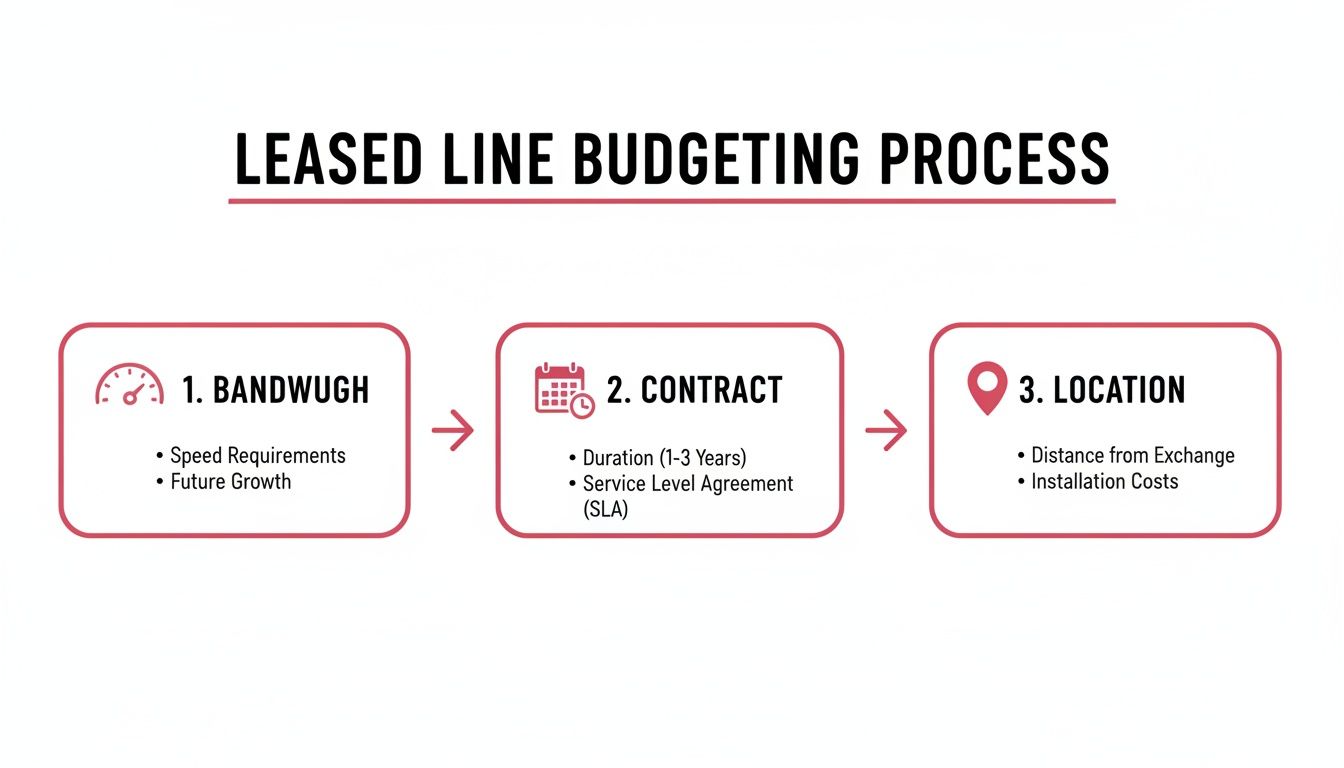
As you can see, bandwidth, contract term, and your physical location are the three main levers that determine the price. It’s all about finding the right balance between performance and budget.
Stage 3: Detailed On-Site Engineering Survey
After you have accepted the quote, the next critical step is the on-site survey. An engineer will visit your premises to meticulously plan the physical installation. Their job is to map the precise route the fibre cable will take from the street into your building and pinpoint the best spot for the internal network hardware.
This survey is where the plan becomes concrete. It confirms the exact work needed and finalises any potential Excess Construction Charges (ECCs), ensuring the final installation is as efficient and non-disruptive as possible.
Stage 4: Wayleave and Planning Permissions
More often than not, the new fibre cable will need to cross land that is not owned by you. This could be anything from a neighbour's field to a private car park or a council-owned pavement. To get the legal right to install the infrastructure on this land, a wayleave agreement is required.
Obtaining wayleave is frequently the most time-consuming part of a leased line installation. It involves legal agreements between the network provider and landowners, and the timeline is often outside your provider's direct control.
Your provider will manage this entire process for you, but it is a stage that requires patience. Being on good terms with your neighbours can sometimes help to speed things up!
Stage 5: Physical Installation and Civil Works
With all the permissions signed off, the physical work can finally begin. This is the exciting part where you see tangible progress as engineers lay the new fibre optic cable. The work might involve running cables through existing underground ducts or along overhead poles, or it could require minor civil engineering, like digging a small trench.
This stage is all about bringing that dedicated circuit right to your doorstep. Sometimes, this involves laying what's known as 'dark fibre'—unlit fibre optic cable that creates a direct physical path. If you are interested in the technology, you can learn about dark fibre and its role in modern networks.
Stage 6: Equipment Setup and Activation
The finish line is in sight. With the fibre now in place, an engineer will install the necessary termination equipment inside your building. They’ll set up the router, connect it to your internal network, and run a series of rigorous tests to make sure the circuit is performing exactly as it should.
Once everything gets the green light, your new leased line is officially activated. You are now connected to your own private, high-performance internet connection, ready to support every aspect of your business with guaranteed speed and unwavering reliability.
Choosing Your Local Leased Line Partner
Picking the right technology is only half the battle. To turn a great connection into a genuine business asset, you need to choose the right partner to manage it. The installation process for a leased line is complex and having rock-solid reliability is non-negotiable, which makes your choice of provider a critical decision.
A big national provider might flash a tempting price, but they often lack the hands-on, local accountability that businesses in Dorset and Hampshire really need. You want a partner who truly understands the regional terrain and is personally invested in your success.
Why a Local, Managed Service Matters
At SES Computers, we have spent over 30 years on the ground supporting businesses across Dorset, Somerset, Wiltshire, and Hampshire. We do not just sell you a connection and walk away; we deliver a fully managed service designed for complete peace of mind.
What does that look like in practice? It means we handle everything:
- Full Procurement Management: We take care of the entire quoting and ordering maze with the network carriers on your behalf.
- End-to-End Installation Oversight: Our team project-manages every single step, from the initial site survey right through to the final switch-on.
- Ongoing Local Support: If a problem ever arises, you call us directly. You get a local team you know and trust, not a faceless call centre.
Choosing a provider is not just about the physical cable. It is about having a single, accountable partner who takes full ownership of your connectivity, ensuring it works flawlessly so you can get on with running your business.
We see a powerful leased line business connection as the very foundation of a great IT strategy. It’s the bedrock for our other solutions, whether that’s crystal-clear 3CX VoIP phone systems, secure cloud services, or proactive IT support.
By bringing your connectivity and core IT under one roof, we get rid of that frustrating old problem of different suppliers blaming each other when something goes wrong. With SES, the buck stops here.
For more tips on what to look for, take a look at our guide on how to choose an internet provider. We’re here to provide the robust infrastructure your business needs to grow.
Frequently Asked Questions About Leased Lines
Thinking about getting a dedicated connection for your business? It’s a big step, and it’s only natural to have a few practical questions. To help you feel confident in your decision, we've tackled some of the most common things business owners ask us.
How Long Does Installation Actually Take?
This is probably the number one question we get, and it is important to be realistic. A leased line is not something you can just switch on overnight. From the moment you place your order to your connection going live, you should typically plan for between 60 and 90 working days.
Why so long? Well, that timeframe covers everything from a detailed on-site survey and network planning right through to potential civil works. The biggest unknown, however, is often securing wayleave agreements – that’s the legal paperwork needed to run a cable across land that does not belong to you. Your provider handles the heavy lifting, but this part of the process can sometimes add delays.
Can I Upgrade My Leased Line Speed in the Future?
Absolutely. In fact, this is one of the best long-term advantages of a leased line. When the physical fibre optic cable is installed, it is put in on a high-capacity "bearer" line, often capable of handling 1Gbps or even 10Gbps.
Your day-one speed is then configured on that line, but the physical potential is already there.
Think of it like this: you might start with a 200Mbps service on a 1Gbps bearer. If your team grows and you suddenly need 500Mbps, your provider can usually make that change remotely with a simple configuration update. It’s a quick, seamless upgrade with no need for an engineer to visit.
This built-in flexibility means your connection grows as you do, making it a genuinely future-proof investment. You only pay for what you need now, knowing you can easily ramp it up later.
What Happens If the Service Goes Down?
Uptime is the whole point of a leased line, but in the rare case that something does go wrong, the response is incredibly fast. This is where the Service Level Agreement (SLA) really proves its worth. Unlike the "we will get to it when we can" approach of standard broadband, an SLA is a contractual promise.
Your connection is monitored around the clock, 24/7/365. Often, if a fault is detected, engineers are already fixing it before you have even picked up the phone. If the line does go down completely, your SLA guarantees a fix time, typically within just four to six hours. This ensures any disruption to your business is kept to an absolute minimum.
A solid, guaranteed internet connection is the backbone of almost every successful modern business. At SES Computers, we specialise in designing and managing leased line solutions that give businesses across Dorset and Hampshire the performance and reliability they need to thrive. To talk through your requirements and get a clear, no-obligation quote, get in touch with our local connectivity experts today.