Let’s be honest, standard business broadband can feel like a roll of the dice. One minute, everything’s running smoothly; the next, you’re apologising for a frozen screen during a crucial client video call. A leased line for business cuts through that uncertainty, giving you a private, dedicated internet connection that’s exclusively yours.
Why Your Business Needs a Dedicated Internet Connection
The daily frustrations of a shared internet connection are all too familiar for most UK businesses. You’ve got those crippling slowdowns at peak times, unreliable performance when you’re trying to use cloud tools like Microsoft 365, and that constant, nagging worry about downtime. These aren't just minor irritations; they’re real operational risks that chip away at your productivity and profits. If your team is constantly battling issues with unstable internet connections, it's time to look for a better way.
The fundamental issue with standard broadband is that you're sharing the line with everyone else in your area.
Think of it like a public motorway during rush hour. Your speed and journey time are completely at the mercy of how much traffic is on the road. When everyone in your local area jumps online, your connection can slow to a crawl, no matter what speed you’re paying for.
The Private Motorway Analogy
A leased line for business changes the game entirely. Instead of battling the traffic on the public motorway, you get your own private, clear road—reserved exclusively for your company's data. For a professional services firm, such as a law practice handling sensitive client documents or an accountancy firm accessing cloud-based financial software, this uncontended connection means data has a smooth, fast, and predictable journey every single time. It's a world away from the chaos of shared internet, especially for businesses that have moved beyond basic web browsing and rely on their connection for mission-critical operations. Of course, there are various business broadband solutions out there, but a leased line is in a class of its own.
Downtime is a silent killer, but a leased line is your best defence. It can help you avoid the median 18-35 hours of annual downtime often seen with shared broadband. According to Ofcom's 2025 figures, with the average cost of downtime at £4,200 per hour, that could save a business anywhere from £75,600 to £147,000 a year. For SMEs right here in Dorset, Somerset, Wiltshire, and Hampshire—where solid connectivity is the backbone for everything from 3CX VoIP systems to automated cloud backups—it's easy to see why leased lines are becoming the go-to choice. You can dig deeper into these leased line cost calculations on amvia.co.uk.
So, What Exactly Is a Leased Line?
Ever wondered what truly sets a leased line for business apart from the internet connection you have at home? Think of it this way: standard broadband is like sharing the M3 during rush hour. You’re competing with everyone else, and your speed depends entirely on how much traffic there is.
A leased line, on the other hand, is your own private, dedicated motorway. It’s a fibre optic cable that runs directly from the local exchange straight to your office. It's yours and yours alone.
Because this private road is entirely ‘uncontended’, the performance is guaranteed. Your bandwidth is 100% yours, 100% of the time. No traffic jams, no unexpected slowdowns because the business next door is streaming videos. You get a rock-solid, consistent connection that you can rely on for your most critical work.
This is why it's the solution for so many common internet frustrations.
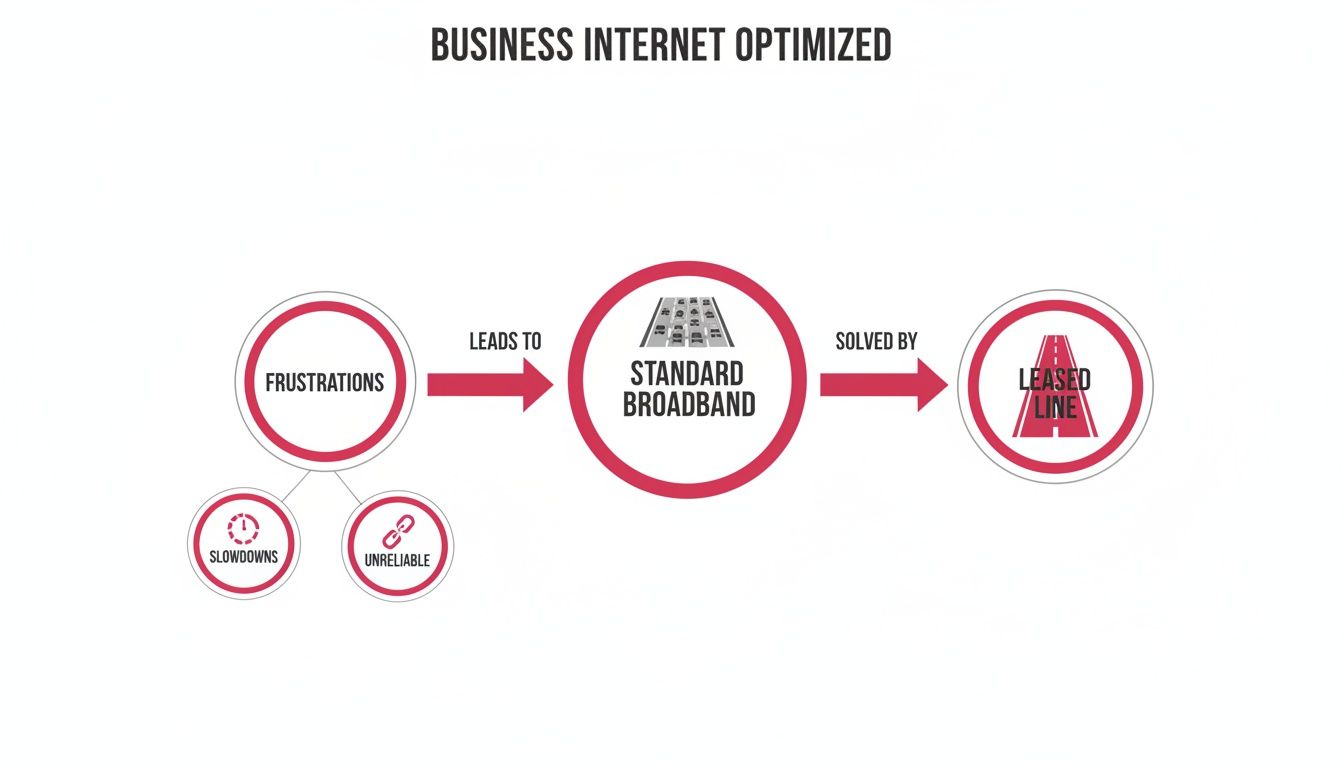
As you can see, while standard broadband often leads to bottlenecks, a leased line simply bypasses the congestion, giving you a clear path for your data.
The Three Pillars of a Leased Line Service
When you invest in a leased line, you're not just buying faster internet. You're getting a professional-grade service built on three core components that are a world away from typical broadband packages.
-
Symmetrical Speeds: This is a real game-changer. It means your upload speed is just as fast as your download speed. For any modern professional services firm, this is massive. Imagine a marketing agency in Hampshire trying to send a huge video file to a client, or an accountancy firm in Dorset that relies on real-time cloud accounting software. Symmetrical speeds mean those upload-heavy jobs fly, killing off those frustrating bottlenecks for good.
-
Service Level Agreement (SLA): This isn't just a promise; it's a legally binding contract from your provider. An SLA guarantees specific levels of performance, uptime, and, crucially, fix times. A typical leased line SLA will guarantee 99.9% uptime and have a target fix time of just a few hours. For a solicitors' practice, this means court deadlines won't be missed due to an internet outage. That’s a level of assurance that the ‘best effort’ support of a standard broadband connection simply can’t touch.
-
Unmatched Reliability: When the line is dedicated solely to your business, it’s naturally far more stable. The connection is proactively monitored 24/7 by the provider's network operations centre. This means they often spot and fix potential issues before you even know there’s a problem.
To really hammer home the difference, let's put the two types of connection side-by-side.
Leased Line vs Standard Business Broadband
This table breaks down the fundamental differences between a dedicated leased line and a shared business broadband connection, highlighting what truly matters for a growing UK business.
| Feature | Leased Line for Business | Standard Business Broadband |
|---|---|---|
| Connection Type | Uncontended and Private A direct, exclusive fibre line just for your business. | Contended and Shared Bandwidth is shared with numerous other users in your local area. |
| Bandwidth Speeds | Symmetrical Upload and download speeds are identical (e.g., 100Mbps up / 100Mbps down). | Asymmetrical Download speeds are significantly faster than upload speeds (e.g., 80Mbps down / 20Mbps up). |
| Performance Guarantee | Legally Backed SLA Guarantees uptime (e.g., 99.9%) and rapid fix times (e.g., 4-6 hours). | "Best Endeavours" Support No formal guarantees on performance, and fix times can take days. |
| Typical Use Case | Mission-Critical Operations Ideal for VoIP, cloud applications, large file transfers, and video conferencing. | General Office Use Suited for basic web browsing, email, and occasional downloads. |
The choice really comes down to how critical a stable, high-performance internet connection is to your daily operations. For many professional service firms, once they experience the reliability of a leased line, there's no going back.
The Real-World Business Benefits of a Dedicated Leased Line
Deciding on a leased line for business isn't just about getting faster internet; it's a fundamental strategic move that pays dividends across your entire operation. The advantages stretch far beyond quicker downloads, touching everything from day-to-day productivity and security to your capacity for future growth. By upgrading to a dedicated connection, you’re essentially laying a more robust and efficient foundation for your company's future.
This shift directly translates into tangible productivity gains. In fact, research shows that 87% of companies see efficiency improvements averaging between 12-18% after making the switch. This boost comes from eliminating frustrating outages, speeding up file transfers, and ensuring critical applications run smoothly. The return on investment is hard to ignore: avoiding just 30 hours of downtime a year can save a business around £126,000. When compared to a typical £6,300 annual leased line cost, that delivers an ROI of over 1,900%.
Unlock True Productivity with Symmetrical Speeds
One of the first things you'll notice is the incredible power of symmetrical speeds. Unlike standard broadband where your upload speed is just a fraction of your download speed, a leased line gives you the exact same high-speed performance in both directions.
This is a complete game-changer for modern businesses. Picture a creative agency in Wiltshire trying to send huge, high-resolution video files to a client. On a leased line, that task takes minutes instead of hours, freeing up designers to start the next project. Or think of a finance team in Somerset using cloud accounting software; they'll experience zero lag, even while the rest of the company is on video calls.
Gain Peace of Mind with Guaranteed Uptime
Downtime isn't just an inconvenience; it's a direct threat to your revenue and reputation. A leased line tackles this head-on with a solid Service Level Agreement (SLA) that legally guarantees your connection will stay online.
A typical SLA will promise 99.9% uptime. What does that actually mean? It means your connection might be down for a maximum of just over eight hours across an entire year. In many cases, the guarantee is even stronger, cutting potential downtime to mere minutes—a world away from the roll-of-the-dice reliability of shared broadband.
This kind of rock-solid stability is essential for modern communication. For any business relying on a VoIP phone system like 3CX, a dependable connection is non-negotiable. For a recruitment agency, for example, it means no more dropped calls or poor audio, ensuring every client and candidate conversation sounds professional and clear. Your ability to deliver a high standard of service is directly linked to your connection's stability, a concept often referred to as Quality of Service in networking.
Strengthen Your Defences and Security
In an age of ever-present cyber threats, security has to be a priority. A leased line provides a naturally more secure connection simply because it's a private circuit, used only by your organisation.
Your data isn't jostling for space alongside traffic from other businesses or home users. This isolation significantly reduces your exposure to certain online threats. For any professional service handling sensitive information—like law firms, accountants, or financial advisers—this private line adds a vital layer of security and helps you meet your data protection obligations. It’s a secure, isolated channel for your confidential client data.
Future-Proof Your Business for Growth
Finally, a leased line is an investment that grows with you. As your business expands, your need for reliable connectivity will only increase. You’ll hire more staff, adopt more cloud applications, and rely more heavily on data-intensive tools.
A standard broadband connection can quickly become a bottleneck that chokes your growth. A leased line, however, is built for scalability. Increasing your bandwidth is a straightforward process, allowing your connection to expand alongside your team and technology without requiring a disruptive and expensive overhaul. It's a foundation that supports your future, not one that holds you back.
Untangling Leased Line Costs and Contracts
So, what does a leased line for business actually cost? It's the natural first question, but the answer isn't as straightforward as a standard broadband package. With a leased line, you're not just buying a connection; you're investing in a dedicated, private circuit for your business.
Thinking of it as just another monthly expense is missing the bigger picture. It's really about protecting your business from the crippling costs of downtime and sluggish performance.
What Shapes the Price Tag?
The quote you receive for a leased line isn't just a number pulled out of thin air. It’s a bespoke price tailored specifically to your business, based on a few key factors.
-
Bandwidth Requirements: This is the biggest driver of cost. A small solicitors' office that just needs a solid 100Mbps for cloud-based case management software and VoIP calls will pay far less than a video production company that needs a lightning-fast 1Gbps line to shift huge files around. You're paying for the capacity you need.
-
Your Physical Location: Where you are in the world matters. A business in a bustling commercial park in Hampshire will likely get a better price because the fibre infrastructure is already there. On the other hand, a company in a more rural part of Somerset might face higher costs to cover the engineering work needed to get a line to their premises.
-
Contract Length: This is where you can find some real savings. Providers are always happier to offer a better deal for a longer commitment. Signing up for a 36-month term will almost always bring your monthly cost down significantly compared to a 12-month contract, and it often means the provider will waive the installation fees altogether.
It’s helpful to shift your mindset from "cost" to "value." When you weigh the monthly fee against the thousands of pounds you could lose from just one afternoon of internet failure, a guaranteed, reliable connection suddenly looks like a very smart investment in your company's future.
The UK Market Right Now
The great news for businesses is that the leased line market has become much more competitive over the last few years. Prices have dropped quite a bit, with some deals for smaller businesses now starting from as low as £200 per month.
Of course, location is still a major factor. Businesses in cities often get lower rates, while those in more remote areas can expect to pay a premium of 20-65%. Committing to a 36-month contract usually shaves 12-18% off the monthly cost compared to shorter terms and, as mentioned, often gets rid of those upfront installation charges. You can read more about these UK leased line cost trends at babble.cloud.
Getting your head around these factors is the first step to making a smart decision. It’s all about balancing what your business needs with your budget to find a leased line that gives you a genuine return on investment. If you're still weighing things up, our guide on how to choose the right internet provider has some more helpful tips.
What to Expect from the Installation Process
Getting a leased line for business isn't like ordering standard broadband. It’s a proper infrastructure project, and it's important to understand that from the outset. We're not just flicking a switch in a cabinet down the road; we're establishing a brand new, physical connection that runs directly to your premises.
This is why the lead times are longer. You can forget about a next-day setup. A typical leased line installation takes anywhere from 30 to over 90 working days. This isn't a sign of poor service; it's the time needed for meticulous planning, surveys, and often physical engineering work to guarantee the rock-solid connection you're investing in.
Think of it as building a private road directly to your office, rather than just using the public motorway. It takes time, but the end result is a clear, uncongested route for your data.
The Step-by-Step Installation Journey
The entire process is carefully managed to minimise any disruption to your business. Here’s a breakdown of what the journey usually looks like:
-
Initial Site Survey: After you've placed your order, an engineer will visit your site. Their job is to map everything out – checking existing ducting, finding the best path for the new fibre cable, and identifying precisely what work will be needed to get the connection into your building.
-
Planning and Wayleave: This is where the admin happens. The provider plans the route in detail and, crucially, secures any legal permissions needed to run cables across land they don't own. This is called 'wayleave', and getting sign-off from landlords or local councils can often be the longest part of the entire process.
-
Civil Works (If Required): If the survey finds there's no existing duct to use, then some digging will be needed. These 'civil works' involve creating a new path for the fibre. It’s a major reason why lead times can stretch, but it's a fundamental step in creating your dedicated line.
-
Fibre Installation and Termination: Once the route is clear, engineers will pull the fibre cable through to your building. They'll then install a termination point inside your comms room or office. This is the physical point where your private line officially arrives.
-
Commissioning and Testing: Finally, your line is connected to the core network. The provider then runs a battery of tests to make sure it delivers the exact speeds and performance promised in your contract. The service is only handed over to you once everything checks out perfectly.
Preparing Your Premises for a Smooth Install
You can help keep things moving smoothly. Simple things like making sure engineers have clear and easy access to comms rooms, riser cupboards, and the spot where the cable will enter the building can make a real difference. It’s also a good idea to have your own internal network equipment ready for the new connection.
For a lot of businesses, managing this kind of project is a headache they can do without. That’s where we come in. At SES Computers, we handle the entire process for you, liaising with the network providers and engineers to make the installation as seamless and hassle-free as possible.
Building in Resilience from Day One
A leased line is incredibly reliable, but for true peace of mind, you need to plan for the unexpected. The best time to think about a backup plan is during the installation itself.
A common and effective strategy is to install a secondary failover circuit. This could be a standard business broadband line or even a modern, high-speed 5G mobile connection. If an issue ever did affect your primary leased line, your internet traffic is automatically re-routed through the backup. This simple step can guarantee 100% connectivity, keeping your business online no matter what happens.
Is a Leased Line Really What Your Business Needs?
So, how do you know when you’ve hit the ceiling with standard broadband? At what point does it make sense to invest in a dedicated connection for your business? The tipping point for getting a leased line isn’t about company size; it’s about how much you truly depend on your internet connection to operate.
It all boils down to one simple question: what’s the real-world cost to your business if the internet goes down? A bit of honest self-reflection here can tell you whether a leased line is a vital investment now or something to plan for down the road.
A Quick Reality Check for Your Business
Picture this: it’s 2 PM on a Tuesday, and your internet connection drops out for the next three hours. What’s the damage? I’m not just talking about lost sales, but the knock-on effect on your team's productivity and your company's reputation.
To help you think it through, ask yourself these questions:
- How much do you lean on the cloud? Is your day-to-day work impossible without cloud-based tools like your CRM, accounting software, or project management platforms?
- Is seamless communication essential? Does your team live on VoIP phone systems and video calls to talk to clients and each other?
- Are you constantly shifting large files? Think about how often you upload or download hefty data files. Does waiting for them to transfer slow down your entire workflow?
- What’s your genuine tolerance for downtime? Could you really afford to be offline for half a day, or even a full day, waiting for a standard broadband fault to be fixed?
If you found yourself nodding 'yes' to most of these, it’s a pretty strong sign that your business is ready for a leased line. It stops being an expense and becomes an insurance policy for the very systems that keep your business running.
What This Looks Like in Dorset, Somerset, and Wiltshire
Let’s bring this to life with a few local examples of professional services firms.
Think of an architectural practice in Dorset. They're constantly sending huge CAD files and 3D models to clients and contractors. For them, symmetrical speeds aren't a luxury; they're essential for hitting project deadlines. And the enhanced security is non-negotiable for protecting their valuable intellectual property.
Now, imagine a financial advisory practice in Somerset. They need rock-solid, constant access to live market data and secure client portals. Even a minor blip in connectivity could have serious financial repercussions, which is why a 99.9% uptime guarantee is so crucial.
Or consider a multi-site law firm with its head office in Wiltshire. Their entire case management and billing system is centralised in the cloud. If that connection fails, it's not just one office that grinds to a halt—it's the entire business.
These examples show that the decision is driven by your operational risks and growth plans. The good news is that the nationwide push towards full-fibre is making these dedicated connections more accessible than ever. With over 90% of UK businesses expected to have access by the end of 2026, this is the biggest digital upgrade we’ve seen in a generation. It means a leased line is no longer just for big city corporations; it's a realistic and powerful tool for SMEs across Dorset and Hampshire who rely on the cloud to get work done. You can read more about what's coming in the future of UK leased lines on leasedlineandmpls.co.uk.
Your Leased Line Questions Answered
We get it. Moving to a dedicated internet connection is a big step, and it's natural to have questions. To help you get a clear picture, we've answered some of the most common queries we hear from business owners who are thinking about making the switch.
How Is a Leased Line Different from Business Fibre Broadband?
This is the number one question, and the distinction is crucial. While both often use fibre optic cables, that's where the similarity ends. Think of business fibre broadband as sharing a motorway with thousands of other users – at peak times, you get traffic jams and slowdowns.
A leased line for business, on the other hand, is your own private, dedicated lane. You're not sharing it with anyone. This means you get a private, uncontended connection with symmetrical speeds, so your upload speed is just as fast as your download.
The other major difference is the guarantee. Your leased line comes with a formal Service Level Agreement (SLA) that guarantees performance and uptime, with rapid-fix times if something does go wrong. Standard broadband simply doesn't offer that level of protection.
Is My Business Too Small for a Leased Line?
Not at all. There’s a common misconception that leased lines are only for huge corporations. A few years ago, that might have been true, but today they are far more accessible and affordable.
The real question isn't about the size of your team; it's about how much your business depends on a stable internet connection.
If your internet going down for a few hours would grind your operations to a halt, lose you sales, or frustrate your customers, then a leased line is a sensible investment, no matter how small your business is. A five-person accountancy firm that can't access cloud software is just as impacted as a 50-person firm.
What Happens If My Leased Line Has a Fault?
Leased lines are built for reliability, which is why they come with SLAs that guarantee uptime of 99.9% or more. But in the rare event that an issue does occur, you don't join a queue. You get priority support.
Instead of waiting days for a fix like you might with standard broadband, a leased line fault is typically resolved within 4-6 hours. For businesses that can't afford a single second of downtime, we often install a resilient backup connection – like a secondary fibre line or a 5G mobile link – that kicks in automatically if the primary line ever fails.
Ready to secure a reliable, high-performance internet connection for your business? The team at SES Computers has over 30 years of experience delivering managed leased lines across Dorset, Somerset, Wiltshire, and Hampshire. Contact us today to discuss your connectivity needs.