For many businesses in the UK, a standard broadband connection feels a lot like sharing a public motorway during rush hour. It is often congested, unpredictable, and a real source of frustration. Leased lines for business, on the other hand, are the complete opposite. Think of it as your own private, dedicated express lane on the information superhighway—a connection where speed and performance are guaranteed 24/7, ensuring your operations never stall.
Is Your Internet Connection Limiting Your Business Growth?
Does your team constantly complain about sluggish file uploads or grainy, frozen video calls? These are not just minor irritations; they are clear signs that your internet connection is actively holding your company back.
For professional services firms, like an accountancy practice in Wiltshire or a legal firm in Hampshire, these moments of poor connectivity translate directly into lost productivity and can even damage client trust. Every dropped client call or delayed document transfer chips away at confidence and operational efficiency.
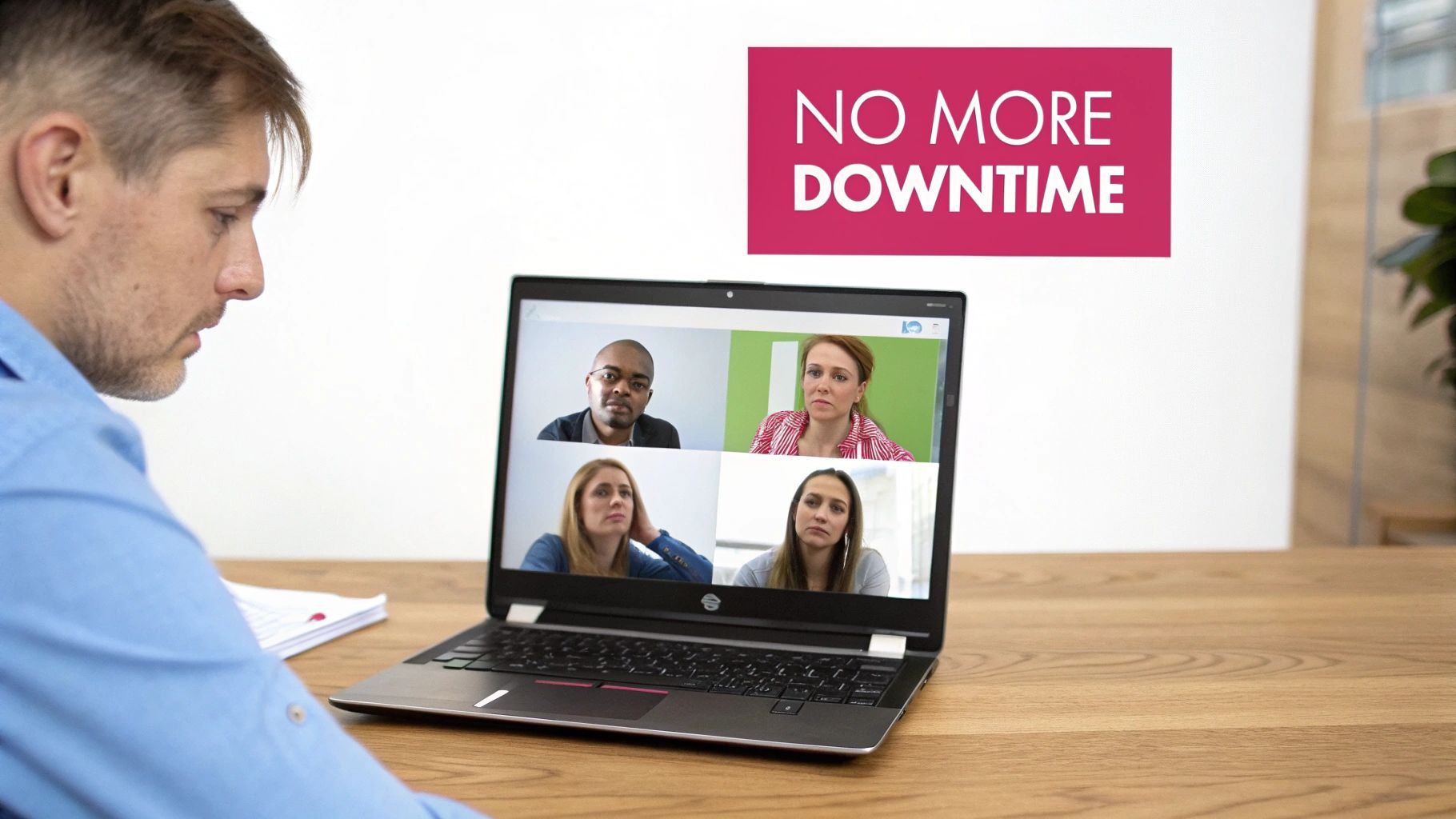
This daily struggle is almost always down to the shared nature of standard broadband. Your connection is constantly competing for bandwidth with every other business and home in your area. When local usage spikes—like during school holidays or major events—your performance inevitably drops. A dedicated leased line completely solves this problem.
The Real Cost of Unreliable Connectivity
The knock-on effects of a poor internet connection ripple through every department, causing tangible financial and reputational damage. Consider these all-too-common scenarios for professional services:
- Lost Revenue: A Dorset-based e-commerce site slows to a crawl during a crucial sales event, leading to abandoned shopping baskets and unhappy customers.
- Reduced Productivity: An architectural firm in Somerset wastes valuable hours just trying to upload large design files to the cloud, delaying project milestones and straining client relationships.
- Compromised Communication: A financial adviser’s important video consultation with a high-value client is ruined by poor quality, undermining their professional image.
In today's market, internet downtime is not just an IT issue; it is a critical business risk. A leased line transforms your connection from a potential point of failure into a strategic asset that underpins growth and resilience.
Investing in Operational Certainty
Ultimately, choosing a leased line is not just an IT upgrade; it’s a strategic investment in operational certainty. It provides the solid, stable foundation you need for modern tools like VoIP, cloud computing, and hosted desktops to work as they should. Of course, even with a great connection, understanding what is network bandwidth is key to getting the most out of your setup.
Building a resilient infrastructure also goes beyond the connection itself. To truly unlock your business's potential, it pays to explore effective network management strategies that keep your entire system running smoothly. By taking connectivity issues off the table, you empower your team to perform at its best, confident that their most important tool will always be there for them.
What Exactly Is a Leased Line?
So, what is a leased line, really? Let's cut through the jargon. Imagine you have a private motorway, built just for you, that runs directly from your office to the internet. No traffic jams, no rush hour, no sharing with anyone else. That’s a leased line.
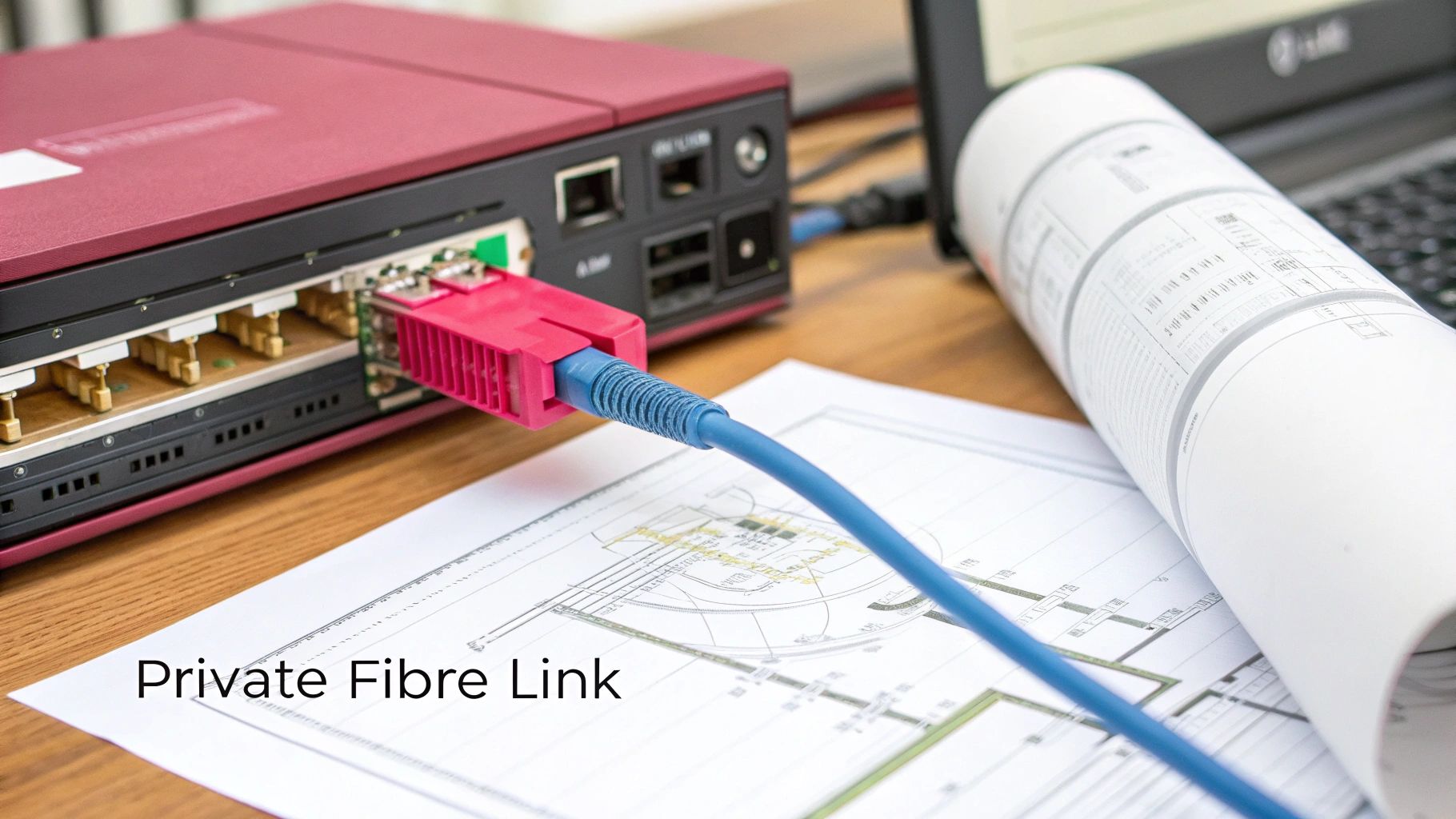
Unlike standard business broadband, where you share the local connection with every other business (and home) in the area, a leased line is yours and yours alone. This private, dedicated fibre-optic connection is the key to unlocking consistent, predictable performance. You are no longer at the mercy of your neighbours’ heavy usage or what time the local schools finish.
Why Uncontended Bandwidth Is a Game-Changer
You will often hear the term uncontended used with leased lines. It’s a simple but powerful concept: the bandwidth you pay for is exclusively yours. If you sign up for a 100Mbps leased line, you get the full 100Mbps, 24/7. It is never diluted or shared.
This has a massive impact on day-to-day operations. It gives you the rock-solid stability needed to run modern business tools without glitches or dropouts. For professional services firms across the South West, this kind of reliability is not just a nice-to-have; it is fundamental.
Internet failures can be crippling. Businesses in our local counties like Dorset and Hampshire are increasingly moving to leased lines for business to get ahead of this risk. Shocking recent research found that UK firms lost over 50 million hours to internet outages in 2023, costing them an incredible £3.7 billion in lost productivity. You can read more about how leased lines protect against this in this excellent Verstech.co.uk analysis.
A leased line is not just about faster internet; it is a guarantee of consistent performance. By eliminating contention, you remove one of the biggest variables affecting your daily productivity and operational resilience.
The Power of Symmetrical Speeds
Another huge advantage of a leased line is its symmetrical speeds. This simply means your upload speed is just as fast as your download speed. In contrast, a typical 100Mbps fibre broadband package might cripple you with a slow 20Mbps upload speed, creating a serious bottleneck for common business tasks.
This symmetry is vital for the way we work today, where sending data is just as important as receiving it.
- Cloud Applications: A legal firm using a cloud-based practice management system can save and synchronise large case files to platforms like Microsoft 365 or SharePoint instantly, without frustrating delays.
- VoIP and Video Conferencing: A recruitment agency’s outgoing video and audio stream for a candidate interview is as strong as the one they receive, ensuring crystal-clear, professional meetings.
- Remote Access & Backups: Staff working remotely can access company servers without lag, and crucial cloud backups can run in the background without grinding the entire office network to a halt.
Think of an architectural practice in Salisbury that needs to send enormous 3D design files to a client. With a standard broadband connection, that upload could take ages, slowing everyone else down in the process. With a 100Mbps symmetrical leased line, those same files are sent in minutes, while the rest of the team continues with video calls and other work, completely unaffected. That’s the practical, real-world power of a dedicated connection.
The Real-World Business Impact of a Leased Line
Let's move beyond the technical jargon for a moment. The true value of a leased line is not just about megabits and uptime percentages; it’s about the tangible, day-to-day advantages it brings to your business. Think of it as an investment that directly empowers your team, fortifies your operations, and gears you up for whatever comes next.
That guarantee of performance is the bedrock of modern business. It’s what allows your critical cloud applications to run without a hitch. For an accountancy firm in Dorset running on Microsoft 365, or a design agency in Somerset using Hosted Desktops (DaaS), a leased line means these essential tools are always on and instantly responsive. This translates directly into better staff productivity and far less time spent staring at loading screens.
Unwavering Reliability and Superior Uptime
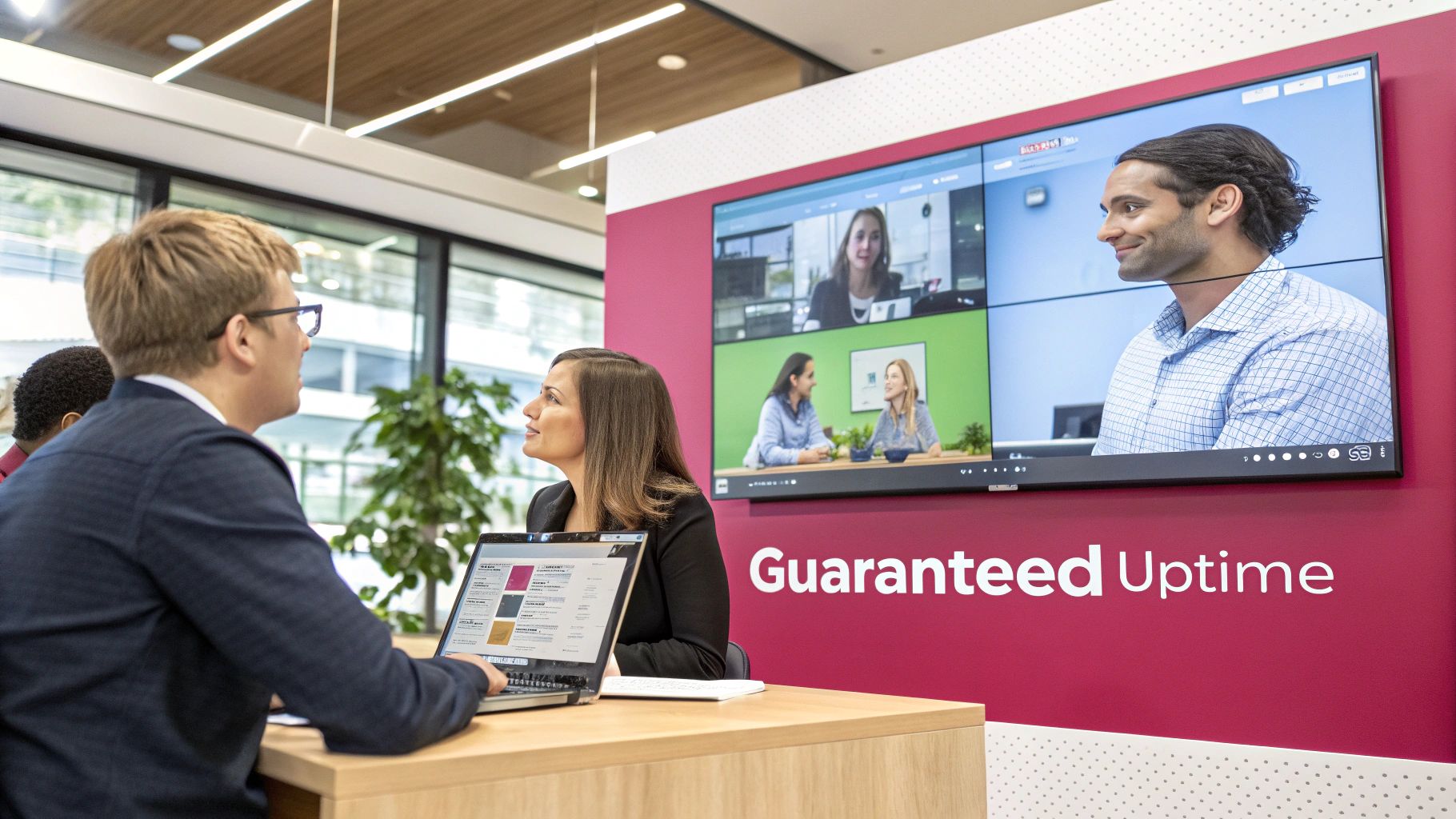
If there is one standout benefit, it is the rock-solid reliability, and this is not just a vague promise. It is backed by a strict Service Level Agreement (SLA). These agreements typically promise 99.9% uptime or even higher, a different world entirely from the 'best effort' service you get with standard broadband.
And if an issue ever does crop up? The SLA kicks in, mandating rapid fix times, often within just four hours. For any professional services firm where the internet connection is mission-critical, that assurance is worth its weight in gold. It means costly downtime stops being an unpredictable disaster and becomes a managed, quantifiable risk.
A leased line fundamentally changes your relationship with the internet. It ceases to be an unpredictable utility and becomes a dependable business asset, as reliable as your electricity or water supply.
Enhanced Security for Sensitive Operations
Because a leased line is a private, dedicated circuit used only by your business, it’s inherently more secure than a shared broadband connection. The data travelling between your offices and the internet is not mixing with everyone else's traffic, which significantly reduces your exposure to certain online threats.
This is a crucial point for any organisation handling confidential data.
- Care Providers in Hampshire: A dedicated connection is vital for protecting sensitive patient data and staying compliant with data protection regulations.
- Financial Advisers in Wiltshire: A secure line is essential when you are managing client portfolios and confidential financial records, reinforcing the trust your clients place in you.
- Legal Firms in Somerset: Protecting privileged client communications and case files is non-negotiable. A private line adds a much-needed layer of security.
This stability is also a game-changer for real-time communications. A dedicated line ensures crystal-clear calls and flawless performance for applications like enterprise-grade VoIP solutions, making your investment in quality voice systems truly pay off.
Scalability to Match Your Ambition
Finally, a leased line is designed to grow with you. The underlying fibre optic cable has massive capacity, which makes it remarkably straightforward to increase your bandwidth as your needs change. You might start with a 100Mbps connection today, but you can easily scale that up to 1Gbps, 10Gbps, or more in the future—often without needing disruptive and costly physical installation work.
This kind of future-proofing is more important than ever. We are seeing a clear shift across the South West as businesses move away from older, less reliable technology. The numbers tell the story: while total business and residential connections in the UK hit 29.1 million in Q4 2024 (a 2.43% year-on-year increase), old ADSL lines have plummeted. They now make up just 6.29% of the total, a steep drop from 12% in Q1 2022. That’s a clear signal that businesses are decisively moving towards more robust solutions like leased lines.
Leased Lines vs. Fibre Broadband and Ethernet
When it comes to business connectivity, the options can feel a bit overwhelming. You have got leased lines, various types of fibre broadband, and terms like 'Ethernet' thrown around. Let's cut through the noise and get straight to what separates them.
At its core, the biggest difference comes down to one thing: sharing.
Even the fastest Fibre-to-the-Premises (FTTP) broadband is a shared service. I often tell clients to think of it like a motorway. It is wide and fast, but during rush hour, your speed is dictated by everyone else on the road. Your business is sharing that digital motorway with hundreds, sometimes thousands, of other local users—from homes streaming Netflix to other businesses uploading large files.
This is the fundamental trade-off with broadband. For a deeper look at how this plays out in practice, we have broken down the key differences in our leased line vs broadband comparison.
The Problem with Sharing
Let's imagine a real-world scenario. A busy marketing agency in central Bournemouth has just upgraded to a top-of-the-range business fibre package. Everything runs smoothly in the morning—cloud files synchronise instantly, and video calls are crystal clear.
But like clockwork, every afternoon around 3 p.m., things grind to a halt. Large design files take an age to upload for client review, and team calls become a pixelated, stuttering mess. Why? It’s not a fault with their line. It’s the network effect. The local schools have finished, people are getting home from work, and the entire neighbourhood starts streaming, gaming, and downloading. The agency's shared connection is feeling the pressure.
A leased line is your own private, dedicated road. It completely bypasses the public network traffic. Because the line is exclusively yours, your speed is guaranteed and consistent, 24 hours a day, 7 days a week. What your neighbours are doing has absolutely no impact on your business.
Where Does Ethernet Fit In?
You will often hear the term 'Ethernet' used in the same breath as leased lines. Think of Ethernet as the technology used to deliver these high-grade, dedicated services. While a pure full-fibre leased line is the best you can get, there are other Ethernet-based options available.
One common one is Ethernet over FTTC (EoFTTC). This is a sort of hybrid solution that uses a mix of fibre and older copper lines. It provides a more reliable and often symmetrical connection than standard broadband, but it does not quite match the performance or resilience of a dedicated full-fibre line.
While EoFTTC can be a solid step up, a full-fibre leased line is the only real choice for businesses that simply cannot afford downtime or inconsistent speeds. If your phone system is VoIP, your team works on hosted desktops, or you rely on constant cloud access, that guaranteed performance is what underpins your entire operation.
The market for leased lines for business is growing fast, especially for SMEs across the UK. Major providers like BT have built out huge networks, which is fantastic for multi-site businesses in more rural counties like Hampshire or Wiltshire. At the same time, other providers focus on delivering competitive pricing for smaller firms, offering speeds anywhere from 100 Mbps to 10 Gbps with solid SLAs. This competition is great news, especially as 63% of UK small businesses can now get full-fibre—a huge jump showing just how critical this kind of connectivity has become. For more on this, you can check out insights on the business leased lines market on Wiseguyreports.com.
Understanding Leased Line Costs and Service Agreements
When businesses start exploring leased lines, one of the first questions is always about the price. It is a fair question, as it is a step up from a typical broadband bill. But thinking of it purely as a monthly cost misses the point. It is better to see it as an insurance policy for your business—a fixed monthly payment that protects you from the huge, unpredictable costs of internet downtime.
Several things influence the final price tag. The most obvious is bandwidth; a 100Mbps line is naturally going to cost less than a full 1Gbps connection. The length of your contract also plays a big role. Providers offer better monthly rates for longer commitments, usually over three or five years.
And finally, your physical location is a crucial piece of the puzzle. A business in a well-connected town centre in Dorset might see lower installation fees than a factory on the edge of rural Wiltshire. The difference comes down to the amount of engineering work needed to bring that dedicated fibre right to your door.
Realistic Pricing and Value
So, what should you actually expect to pay? Prices always vary depending on those factors we just mentioned, but you can get a good idea. A dedicated 100Mbps leased line in areas like Dorset or Wiltshire typically starts from around £200-£400 per month. If you need more power, a 1Gbps connection often lands in the £450-£700 per month range.
Yes, that’s more than a standard broadband package. But the real value is what you get for that money: guaranteed performance and total peace of mind. The return on investment becomes crystal clear when you stop and think about what just one afternoon of internet failure would cost your business in lost sales, wasted staff wages, and damaged client trust. For a 20-person legal practice, that one afternoon of downtime could easily cost thousands in lost billable hours alone.
Decoding Your Service Level Agreement
The value of a leased line is all spelt out in its Service Level Agreement (SLA). This is not just a document full of technical jargon; it is a legally binding contract that holds your provider to their promises on performance and reliability. Getting to grips with its key components is essential.
Your SLA is the rulebook that holds your provider accountable. It transforms vague promises of "good service" into concrete, measurable, and financially backed commitments that protect your business operations.
Let’s break down what those commitments really mean for you day-to-day:
- Guaranteed Uptime (e.g., 99.95%): This is a promise that your connection will be working for at least 99.95% of the time. While that sounds impressive, it still allows for roughly four hours of potential downtime across an entire year. The best providers will push for even higher figures.
- Target Fix Time (e.g., 4 Hours): This is probably the most critical part of the SLA for keeping your business running. It’s a guarantee that if a fault does happen, an engineer will have it fixed within a specific window—often just 4 hours—24/7, 365 days a year. This is a world away from the "we will get to it when we can" support you get with broadband.
- Service Credits: This is the financial penalty for failure. If your provider does not meet their guaranteed uptime or fix time, you are entitled to compensation. This usually comes as a credit on your next bill, ensuring there is a real consequence for them if the service falters.
An SLA also covers other important metrics like latency and packet loss, which are vital for a smooth experience with real-time tools like VoIP calls or video conferencing. To get a better handle on this, you can learn more about what is Quality of Service and how it affects everything you do online. At the end of the day, the SLA is what turns a leased line from a simple internet connection into a truly dependable business utility.
What to Expect from the Leased Line Installation Process
Getting a leased line is not like ordering home broadband, where an engineer shows up a few days later. It is a proper construction project, managed from start to finish, and involves several different teams working in concert. Knowing what to expect from the outset helps manage timelines and really shows the value of having an IT partner like us coordinating everything for you.
You should plan for the entire process to take anywhere from 30 to 90 working days. In some complex cases, particularly in more rural parts of Dorset or Wiltshire, it can take a bit longer. This timeframe is not arbitrary; it covers everything from detailed surveys and legal permissions to the physical engineering work needed to bring a dedicated fibre cable right into your building.
The whole journey breaks down into three clear stages: surveying the site, sorting the legal agreements, and finally, getting the hardware installed and switched on.
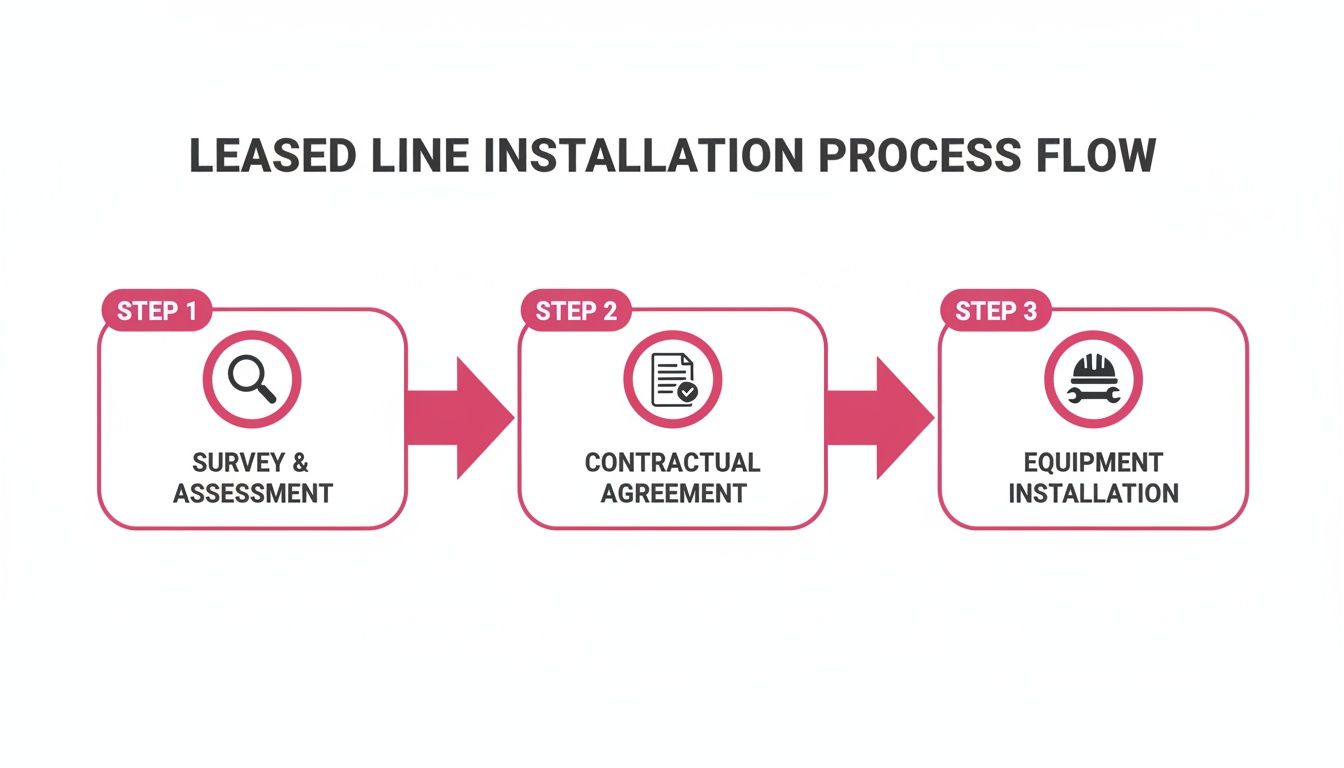
As you can see, it is a methodical process that moves from initial checks right through to the final commissioning of your new line.
Stage 1: The Initial Site Survey
Once we have agreed on a quote, the first real-world step is a detailed site survey. A network engineer will visit your premises to meticulously map out the physical route for the new fibre cable. They will look at the existing ducts and infrastructure, figure out the best place for the cable to enter your building, and scope out precisely what work is needed.
This survey is absolutely crucial for spotting potential roadblocks early. For instance, if the plan involves crossing a public road or running the cable across land you do not own, this is where it gets flagged. The survey's findings create the final blueprint and confirm if any extra "civil engineering" work is needed.
Stage 2: Securing Wayleave Agreements
Now, if the survey finds that the fibre cable needs to cross privately owned land – maybe a neighbouring farmer’s field or the car park of a shared business park – then a wayleave agreement becomes necessary. Think of it as a formal permission slip; it’s a legally binding document that lets the network provider install and later maintain their equipment on that third-party land.
Sorting out a wayleave can be one of the longest poles in the tent, as it often involves a bit of back-and-forth with landlords or property owners.
A wayleave is essentially a right of way for the physical cable. Delays in getting this legal permission signed off are probably the single most common reason for an installation timeline to stretch out, which really highlights why proactive project management is so important.
An experienced partner like SES Computers is invaluable here. We can chase the relevant parties and make sure the paperwork is handled efficiently to keep your project moving forward.
Stage 3: Civil Works and Final Installation
With the surveys done and all the legal permissions in place, the digging can begin. This is what the industry calls "civils" or civil engineering works. Sometimes it’s straightforward, like pulling a new fibre through an existing underground duct. Other times, it means digging a brand new trench to lay the cable.
Once the fibre physically reaches your building, the final on-site steps kick in:
- On-Site Engineering: An engineer will install the termination point inside your office, connecting the new fibre line to a router.
- Commissioning and Testing: The line is then lit up, and the provider runs a battery of tests to make sure you are getting the exact symmetrical speeds and performance you are paying for.
- Go-Live and Handover: Once everything checks out, the connection is officially handed over. This is where we step in to configure your network, firewalls, and systems to use the new line, ensuring a completely seamless switch.
This carefully managed process ensures your new connection is rock-solid and ready to support your business from the moment it goes live.
Frequently Asked Questions About Leased Lines
Even after weighing up the benefits, it is completely normal to have a few more questions before committing to a leased line. Here are the answers to some of the most common queries we hear from businesses across Dorset, Somerset, Wiltshire, and Hampshire.
How Do I Know If My Business Really Needs a Leased Line?
The acid test is simple: if your internet connection failed for an entire afternoon, would it cost the business money? If you just answered "yes," you should be seriously thinking about a leased line.
It is also a clear signal if your team relies heavily on cloud services like Microsoft 365, uses a VoIP phone system, or regularly sends large files back and forth. For any professional service firm where connectivity is crucial to getting work done, the guaranteed uptime of leased lines for business offers a level of resilience that standard broadband just can’t touch.
What Happens If My Leased Line Service Fails?
This is where your Service Level Agreement (SLA) truly shines. Forget the vague 'best effort' support you get with broadband; a leased line is backed by a contract that promises a swift, guaranteed response.
As your managed IT provider, we monitor the connection 24/7. If an issue does crop up, the SLA kicks in with a target fix time, which is usually around 4-6 hours. Should that strict timeframe ever be missed, you’re entitled to service credits. It’s a powerful incentive that holds the provider accountable.
A leased line SLA turns a potential crisis into a managed event. It swaps an unpredictable problem for a structured, rapid-response plan that protects your revenue and minimises disruption.
Is It Possible to Get a Leased Line in a Rural Location?
Yes, absolutely. A major advantage of a leased line is that a dedicated fibre connection can be built to almost any business premises in the UK. That includes rural parts of Dorset or Somerset where decent broadband options might be thin on the ground.
The installation might be more involved and require extra engineering work, which can influence the final cost and lead time, but it’s almost always achievable. The journey always starts with a professional site survey to map out exactly what is needed for your specific location and give you a firm quote.
What Is the Real Difference Between a 100Mbps Leased Line and 100Mbps Fibre Broadband?
This is a great question, and the answer gets to the heart of what you are paying for. While the "100Mbps" speed might look the same on paper, the service you actually receive is worlds apart.
- Performance: A 100Mbps broadband connection is a theoretical maximum you share with everyone else in your area. Your real-world speed will go up and down all day. A 100Mbps leased line is uncontended—that full 100Mbps is reserved exclusively for you, 24/7.
- Symmetry: Business broadband is asymmetrical. You might get 100Mbps for downloads, but your upload speed could be as low as 20Mbps. A leased line is symmetrical, giving you the full 100Mbps in both directions. That’s vital for smooth video calls, quick cloud backups, and responsive hosted desktops.
- Guarantees: Your leased line is backed by that crucial SLA for uptime and fast repairs. Standard business broadband offers no such promise.
Ready to secure the reliable, high-performance connectivity your business deserves? The team at SES Computers has over 30 years of experience delivering managed internet solutions, including expertly planned and installed leased lines for businesses across the South West. Contact us today to discuss your requirements and discover how a dedicated connection can protect your productivity and fuel your growth.
Find out more about our managed IT services at https://www.sescomputers.com.