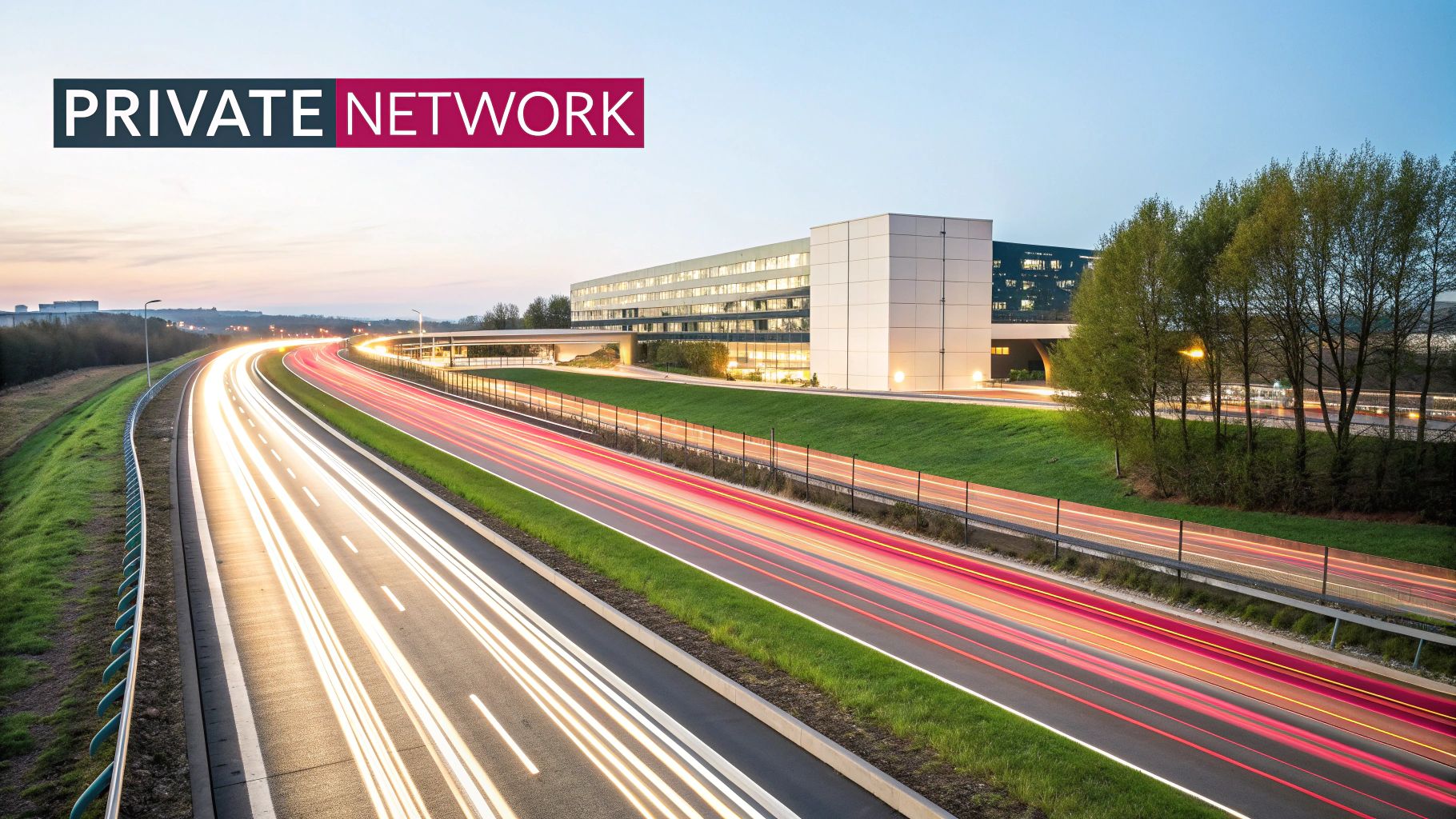
Think of your business's internet connection like a motorway. With standard broadband, you are sharing the road with every other home and business in your area. When rush hour hits, everything grinds to a halt. A leased line, on the other hand, is your own private, exclusive lane. There is no traffic, no congestion, just a clear, fast route for your data to travel.
This is the fundamental difference. A leased line is a dedicated, private internet connection that is rented directly from a provider and is reserved solely for your business. It guarantees performance and speed because you are not competing with anyone else for bandwidth.
What Is A Leased Line And Why Does Your Business Need One
That private motorway analogy is not just a gimmick; it gets to the heart of why a leased line is so crucial. It is an exclusive fibre optic circuit that connects your premises directly to the provider's network, completely bypassing the public internet's traffic jams. This immediately gets rid of the slowdowns and unpredictable performance that plague shared broadband, especially during peak business hours.
For most professional service firms and other small and medium-sized businesses today, reliable internet is not just a "nice-to-have"—it is the absolute foundation of your entire operation. We have all felt the pain of a dropped video call with a key client, a massive file transfer that crawls along, or a cloud application that just will not respond. These are not just minor annoyances; they directly hit your productivity and, ultimately, your bottom line.
Building Operational Resilience
This is where a leased line stops being an IT cost and starts becoming a powerful strategic asset. It is built from the ground up to support the business-critical functions that simply cannot afford to fail. By giving you that dedicated connection, it delivers the kind of reliability and performance essential for:
- VoIP and Video Conferencing: Say goodbye to stuttering calls and frozen screens. A law firm, for example, can conduct confidential client consultations via video, confident that the connection will remain stable and clear.
- Cloud Applications: Get constant, lightning-fast access to your CRM, practice management software, and cloud storage without any lag. An accountancy practice can run its entire suite of cloud-based tax and audit software seamlessly, even during the busiest reporting periods.
- Data Transfers: Uploading and downloading huge files becomes quick and painless, a game-changer for creative agencies, architects, or engineering consultants sharing complex design files.
- Secure Transactions: Process payments and handle sensitive client information over a more stable and secure connection, vital for any business handling financial data.
A leased line is fundamentally about managing risk. It is an investment in keeping your business running smoothly, guaranteeing your digital operations stay online, efficient, and secure, no matter what is happening on the public network.
Any thorough business continuity risk assessment will quickly identify internet failure as a major weak point for most companies. Whether you are a law firm in Dorset needing 24/7 access to legal databases or a manufacturing plant in Somerset relying on cloud-based systems to manage your inventory, a leased line provides the solid foundation you need to operate with confidence.
While the technology is built on fibre optic cables, it is a very different service from standard fibre broadband. For those curious about the underlying physical infrastructure, our guide on what is dark fibre goes into more detail.
The Strategic Advantages Of A Dedicated Connection
While standard broadband can often feel like a roll of the dice, a business leased line is built on a foundation of contractual guarantees. This simple shift turns your internet from a utility that might work into a strategic asset you can rely on, day in and day out. Three core advantages really drive this difference home: symmetrical speeds, an ironclad Service Level Agreement, and uncontended bandwidth.
These are not just bits of technical jargon; they are solid promises that directly impact your daily operations, your team's productivity, and ultimately, your bottom line. Let's break down what they actually mean for your business.
Symmetrical Speeds For Modern Workflows
Ever been on a critical video call when your screen freezes or your voice turns into a garbled mess? That is almost always down to poor upload speed, a classic weakness in standard broadband packages that are designed for downloading content, not sending it. A leased line provides symmetrical speeds, which means your upload and download capabilities are equally fast and powerful.
This is a complete game-changer for the way professional services firms operate now:
- Seamless Cloud Access: Shifting large project files or backing up critical client data to the cloud becomes a quick and reliable job, not something you have to leave running overnight.
- Crystal-Clear VoIP Calls: Your phone system just works. No stuttering, no dropped calls that leave a bad impression on clients.
- Flawless Video Conferencing: Your teams can collaborate properly without battling technical glitches, making for professional and productive meetings.
For an architectural practice in Wiltshire, this means they can share complex 3D models with clients in real-time. For a financial services firm, it ensures their cloud-based software runs without a single stutter, guaranteeing operational continuity.
Uncontended Bandwidth Guarantees Performance
A leased line gives you uncontended bandwidth. In plain English, the connection is 100% yours. You never have to share it with other businesses or residential users in the area. Remember that private motorway analogy? Your lane is always clear, even at 3 PM when the local schools finish and everyone jumps online.
Because it is dedicated to you, your connection speed stays constant and predictable right through the working day. For example, a marketing agency can confidently upload high-resolution video content for a client campaign at peak times, knowing the speed will not drop. Your team's productivity is no longer at the mercy of network congestion happening down the road.
The real value of a leased line is consistency. It removes the element of chance from your digital operations, providing a stable platform you can build your business on with confidence.
The Service Level Agreement: A Contractual Promise
Perhaps the most significant advantage is the Service Level Agreement (SLA). This is a legally binding contract that guarantees specific levels of performance, including uptime and how quickly any faults will be fixed. Most leased line SLAs promise 99.9% uptime or even higher, which translates to virtually no unplanned downtime across the entire year.
If an issue ever does occur, the SLA kicks in, guaranteeing a prioritised engineering response. Often, a fix is guaranteed within just a few hours—a world away from the vague "best effort" support you get with standard broadband. Internet downtime is incredibly expensive; UK businesses suffered over 50 million hours of downtime in 2023, leading to an estimated £3.7 billion in losses. Preventing just one major outage can easily justify the investment in a leased line, making it a critical asset for any business that simply cannot afford to be offline. A robust SLA is also a key part of your resilience planning, which you can read more about in our guide on what is network redundancy.
Comparing Leased Lines And Business Broadband
When it comes to your business's internet, the choice often boils down to two main contenders: a dedicated leased line or a standard business broadband package, even the fast fibre ones. On the surface, they both get you online, but that is where the similarities end. They are built for entirely different purposes. Think of it like booking a private taxi versus taking the bus; both will get you to your destination, but one offers a direct, guaranteed journey, while the other is a shared service subject to delays and other passengers.
The infographic below really gets to the heart of what makes a leased line a premium business tool.

These three pillars—guaranteed symmetrical speeds, rock-solid uptime, and an exclusive connection—are what create a truly resilient digital foundation for a growing business.
To help clarify the differences, this table breaks down the key characteristics of each service side-by-side.
Leased Line vs Business Broadband At A Glance
| Feature | Leased Line | Business Broadband (inc. Fibre) |
|---|---|---|
| Connection Type | Uncontended (Private & Dedicated) | Contended (Shared with others) |
| Bandwidth | Symmetrical (Same upload & download speed) | Asymmetrical (Faster download, slower upload) |
| Speed Guarantee | Guaranteed speed via an SLA | "Up to" a maximum speed, can fluctuate |
| Uptime Guarantee | Yes, typically 99.9% or higher | No formal guarantee, "best effort" |
| Repair Time | Guaranteed fix times (e.g., 5 hours) | No guaranteed fix, often next business day or longer |
| Cost | Higher monthly investment | Lower monthly cost |
| Best For | Mission-critical operations, VoIP, Cloud apps | General office use, small teams, non-critical tasks |
As you can see, the differences are not just minor technicalities—they have a real-world impact on performance, reliability, and ultimately, your bottom line.
Key Differences That Matter
So, what do these technical terms actually mean for your day-to-day work?
The biggest difference is whether your connection is contended or uncontended. Business broadband is a shared line. You are sharing bandwidth with dozens of other businesses and homes in your area, which is why your connection grinds to a halt at 3 PM when the local schools finish. A leased line is your own private lane on the information superhighway—no one else can use it, so your speed never dips.
Then there is the matter of symmetry. Standard broadband is always asymmetrical, meaning your download speed is much faster than your upload speed. That is fine for browsing, but a disaster for modern business. Leased lines for businesses are symmetrical, giving you the same powerful speeds for both uploading and downloading. This is non-negotiable for reliable video calls, backing up data to the cloud, or using VoIP phone systems.
With business broadband, you get an estimated speed "up to" a certain level. With a leased line, your speed is contractually guaranteed by a Service Level Agreement (SLA), giving you absolute certainty over your connection's performance.
Practical Scenarios: Which Is Right For You?
Once you understand these fundamental differences, choosing the right service becomes much clearer. It is not just about raw speed; it is about weighing the operational risk of a poor connection against the cost.
Let's look at a couple of real-world examples:
- A small café in Dorset: Their main internet needs are for the till and offering free Wi-Fi to customers. A slight dip in speed is not going to grind the business to a halt. In this case, a high-quality business broadband connection is the smart, cost-effective choice.
- A multi-site recruitment agency in Hampshire: This company lives in the cloud. They rely on their CRM, conduct video interviews all day, and depend on VoIP to speak with clients. Any internet outage or slowdown means they stop making money. For them, the guaranteed performance of a leased line is not a luxury; it is essential.
The decision really hinges on one question: how much does an unreliable internet connection cost your business? For a deeper dive, check out our full comparison of broadband vs leased line connections.
Calculating the Real Cost and ROI of a Leased Line
Let's get straight to the point: the first question on any business owner's mind is, "Can we afford this?" With leased lines, it is tempting to compare the monthly fee to your current broadband bill and stop there. But that is the wrong way to look at it. The real conversation is not about cost, it is about the return on investment (ROI).
Yes, the initial outlay is higher than for a standard connection, but understanding what goes into that price is the first step to seeing its actual value.
The good news is that dedicated business-grade connections are not just for big corporations anymore. In 2025, a UK business can get a 100Mbps leased line starting from around £200 per month, making it a realistic option for SMEs across Dorset, Somerset, Wiltshire, and Hampshire. Of course, the price scales with speed. A 1Gbps line will likely start around the £300 mark, while a hefty 10Gbps connection will push past £1,000. For a deeper dive, you can find more insights on 2025 leased line pricing over at babble.cloud.
Key Factors That Influence Your Price
So, what determines that final monthly figure? It is not just plucked from thin air. A few key variables come into play, and knowing them helps you find the sweet spot between your operational needs and your budget.
Three main factors shape your quote:
- Your Required Bandwidth: This is the most straightforward cost driver. A 100Mbps line will always be cheaper than a 1Gbps one. The trick is to get an honest assessment of what you need now and what you will need in a year or two as you rely more on cloud apps, VoIP, and heavy data transfers.
- Your Geographic Location: Your postcode really does matter. A business in a well-connected urban centre in Hampshire will likely pay less than one in a rural part of Somerset. If more engineering work is needed to physically connect you, that cost is reflected in the price—sometimes adding a premium of 20-65%.
- Your Contract Length: Providers like commitment. Signing up for a longer-term contract, say 36 months instead of 12, can drop your monthly payments significantly. We often see reductions of 12-18%, and many providers will waive the installation fees (saving you around £1,800) for customers willing to commit.
Moving Beyond Cost to Calculate True ROI
Thinking of a leased line as just another monthly expense is a massive mistake. The real calculation is measuring the cost of not having one. The financial hit from internet downtime can be genuinely staggering, which reframes the leased line as a critical investment in business continuity.
When your business lives or dies by its connectivity, the most expensive internet is the one that does not work. A leased line is not a cost centre; it is an insurance policy against lost revenue and productivity.
To get a feel for your potential ROI, you need to add up the hidden costs of your current, unreliable connection:
- Cost of Downtime: The numbers here are sobering. Studies often peg the average cost of an internet outage for an SME at around £4,200 per hour. If your leased line prevents just one major outage a year, it has likely paid for itself. For a professional services firm, this could equate to several billable hours lost for every employee, every hour you are offline.
- Lost Productivity: Take a moment to think about your team's salaries. Every minute they sit there, staring at a loading screen or waiting for a file to sync, is money down the drain. A stable, fast connection means your staff are working, not waiting.
- Reputational Damage: What is the price of a dropped call with a major client because your VoIP system gave out? Or the damage to a relationship when you miss a deadline because you could not access a critical file? A reliable connection is fundamental to your professional reputation.
Finding the Right Leased Line Provider
Choosing a leased line is much more than just picking a technology; it is about starting a long-term relationship with the company that manages it. Getting the right partner is every bit as critical as the connection itself. While cost is always part of the conversation, looking past the monthly fee to really dig into a provider's capabilities, support quality, and local knowledge is the key to a good outcome.
Your first move should be to size up a provider’s network reach and find out which major carriers they work with. In the UK, big names like BT have built out a massive national infrastructure, which means they can offer solid connections even in the more rural corners of Dorset or Wiltshire. But it is not a one-size-fits-all market; different providers have strengths in different areas.
What to Look For in an SLA and Support
The Service Level Agreement, or SLA, is the single most important document you will sign. It is the provider's written promise to you, and you need to go through it with a fine-tooth comb. Do not just get dazzled by a 99.9% uptime guarantee. The real value is in the small print—the details that kick in when something inevitably goes wrong.
Make sure you ask any potential provider these questions:
- What is your guaranteed fault repair time? For a business-critical connection, a four-hour target is the gold standard.
- What happens if you miss that target? You need to know exactly how you will be compensated for any downtime that breaches the SLA.
- Is your support team UK-based and available 24/7? When your business is offline, you need to be talking to a skilled engineer who can fix the problem, not a call centre agent following a script.
A strong SLA is your business’s insurance policy. It is a guarantee that if an issue arises, getting you back online becomes the provider's absolute top priority, with financial penalties attached if they do not deliver.
Understanding the Installation Process and Timescales
It is also crucial to have realistic expectations about the installation. A leased line is not like standard broadband that can be switched on in a few days. The process is far more involved. You should plan for a typical timeline of 30 to 90 days, and sometimes even longer for more complicated sites. This window covers a detailed site survey, potential civil engineering works (like digging trenches for new ducts), and the final configuration of all the equipment. A good provider will keep you in the loop with regular updates every step of the way.
While the UK’s business broadband market brought in £824 million in 2024, leased lines offer a level of stability that a shared consumer network simply cannot promise. With a 47.94% market share, BT is a reliable choice for nationwide coverage, while others like TalkTalk often compete on price. You can learn about the latest UK business broadband statistics to see the broader market picture. A partner with local insight, however, can stitch these services together into a secure, fully managed system that just works.
This is where working with a local managed service provider like SES Computers really pays off. We know the business landscape across Dorset, Wiltshire, and Somerset inside out. We handle everything for you—from finding the best carrier and project-managing the installation to providing proactive monitoring and integrating the line into your security defences. It is an approach that gives you a powerful, hassle-free connection built specifically for your business.
Securing Your Business With A Leased Line
Picking the right internet connection is one of those crucial decisions that underpins everything else your business does. If you are running cloud-based software, using VoIP phones, or handling sensitive client data here in Dorset or Somerset, a leased line offers a level of reliability and performance that standard broadband simply cannot match.
Because the connection is private and exclusively yours, it is a much more secure foundation for your entire digital operation. Think of it as your own private road to the internet, keeping your data traffic away from the public highway's potential jams and security risks.
This dedicated circuit becomes a core part of building a resilient, competitive business. While it provides an inherently secure connection, it is just one piece of the puzzle. For total peace of mind, it is vital to follow a comprehensive guide to network and information security and integrate your leased line into a broader security strategy.
Secure Your Complimentary Connectivity Health Check
Ready to see how a dedicated connection could strengthen your business? We are offering a complimentary 'Connectivity Health Check' to business leaders across Dorset, Somerset, Wiltshire, and Hampshire.
This no-obligation audit is the first step in turning your internet from a frustrating bottleneck into a genuine business asset. We will benchmark your current setup, calculate the potential return on investment, and give you a clear, tailored quote.
With over 30 years of local expertise, the team at SES Computers knows how to find the perfect fit for your specific needs, ensuring you have the stable, powerful connection you need to grow.
Frequently Asked Questions About Leased Lines
When you are thinking about a leased line for your business, it is natural to have a few practical questions. It is a significant step up from standard broadband, so getting clear, straightforward answers is the first step to making a confident decision.
How Long Does It Take to Install a Leased Line?
This is one of the first things business owners ask. Unlike a standard broadband connection that can often be switched on remotely, a dedicated line is a different beast entirely. You should realistically budget for an installation lead time of anywhere between 30 and 90 days.
Why so long? This is not just a simple activation. The process involves a detailed site survey to map out the physical route, securing any necessary permissions (sometimes called 'wayleaves'), and occasionally, actual groundwork to lay new fibre optic cable right to your building.
Can I Get a Leased Line in a Rural Area?
Yes, absolutely. It is almost always possible to get a leased line into more rural parts of Dorset or Wiltshire. While major carriers have extensive networks, it is true that costs and installation times can be higher if there is less existing infrastructure nearby.
This is exactly where having a local partner makes all the difference. We know the local landscape and can manage the specific challenges of your location, ensuring the whole process is as smooth as it can be, no matter your postcode.
The core benefit of a leased line is its private, uncontended nature. This inherent privacy creates a stronger, more secure foundation for your entire cybersecurity strategy, isolating your critical data traffic from the public internet.
Is a Leased Line Genuinely More Secure?
In a word, yes. A leased line is fundamentally more secure than a shared broadband connection. Think of it as your own private road to the internet. Because the circuit is exclusively for your business, your data is not travelling alongside traffic from countless other companies and home users.
This private connection dramatically reduces your exposure to certain types of online threats right from the start.
What Happens If My Leased Line Goes Down?
This is where the Service Level Agreement (SLA) really proves its worth. If your connection ever fails, your provider is contractually bound to jump on it immediately. Forget the "we will get to it when we can" approach of consumer broadband; you get a priority response from expert engineers.
Most leased line SLAs come with a guaranteed fix time, often aiming to get you back online within just four to five hours. This rapid, guaranteed repair service is designed to minimise business disruption and is one of the biggest reasons companies make the investment.
Ready to move past unreliable internet? SES Computers has over 30 years of experience providing robust, high-performance leased lines to businesses across Dorset, Somerset, and Hampshire. Contact us today for a complimentary 'Connectivity Health Check' and a tailored quote.