Think of a Managed IT service company as your business's dedicated technology partner. For a predictable monthly fee, they take complete responsibility for your entire IT infrastructure, shifting your support from a reactive, break-fix model to a far more strategic, preventative approach. The goal is simple: keep your systems optimised, secure, and running smoothly at all times.
What Are Managed IT Service Companies?

Let's use an analogy. For years, most businesses treated their IT like an old car—you’d only call a mechanic when the engine sputtered to a halt or a tyre burst on the motorway. This is the classic 'break-fix' model, a reactive approach that guarantees frustrating downtime and completely unpredictable repair bills.
Managed IT service companies, often called Managed Service Providers (MSPs), work on a different philosophy entirely. They are your dedicated pit crew, constantly fine-tuning the engine, checking the diagnostics, and making sure every part of your system is running at peak performance. Their entire focus is on preventing breakdowns before they ever have a chance to happen.
This proactive partnership is fundamentally changing how UK businesses operate. Instead of seeing IT as a cost centre full of nasty surprises, companies can finally treat it as a reliable, strategic asset that actively drives efficiency and growth.
The Shift from Reactive to Proactive IT
The real difference comes down to incentives. In a traditional break-fix world, an IT support company makes money when you have problems. The more things that go wrong, the more they can bill you. A managed service model completely flips that on its head.
With a fixed monthly fee, an MSP is motivated to keep your systems running smoothly and securely. Their success is directly tied to your operational stability, creating a true partnership aligned with your business goals.
For instance, a Dorset-based architectural practice cannot afford for its CAD software or servers to fail during a critical project deadline. A reactive approach means frantic calls, lost working hours, and a potentially unhappy client. A managed service provider, on the other hand, would have already spotted the server's warning signs and addressed them overnight, ensuring the firm’s team can get on with their work without a single interruption.
A Growing Sector in the UK
The move towards managed services is not just a fleeting trend; it’s a major economic shift. As of early 2024, the UK was home to nearly 13,000 active MSPs, employing over 340,000 people and generating an estimated £51 billion in revenue.
These figures, highlighted in recent government reports, show just how much trust UK businesses are placing in managed IT service companies. You can explore further UK government research on the MSP sector to see the full picture.
The Core Services That Drive Your Business
So, we have talked about the big-picture idea of proactive support, but what does that actually look like day-to-day? The real value comes from a specific set of services that keep your business secure, efficient, and ready for anything. These are not just tech fixes; they are essential functions that directly support what you do best.
If you’re a solicitor in Hampshire, you need constant, reliable access to your case files. For a financial adviser in Dorset, protecting client data is not just good practice—it's a regulatory necessity. The right managed IT services provide the foundation for that security and stability.
Let's unpack the key services you should expect from any managed IT partnership and see how they translate from technical jargon into real-world benefits for your business.
Proactive Monitoring and Maintenance
This is the absolute heart of the managed services model. Rather than sitting back and waiting for something to break, your provider uses specialised tools to keep a close eye on your network, servers, and computers 24/7. This constant watchfulness means they can spot and fix potential problems long before your team even notices.
For example, a managed IT service company might detect that a law firm's server is running low on disk space. Instead of letting it crash during business hours, they would perform maintenance overnight to archive old data and clear space, preventing any interruption to the firm's operations.
Cybersecurity and Compliance
With digital threats lurking around every corner, strong security is non-negotiable. A managed IT service company builds a multi-layered defence to shield your organisation from malware, phishing scams, and costly data breaches.
This involves everything from managing firewalls and deploying sophisticated antivirus software to making sure every system is updated with the latest security patches. Just as importantly, they help you navigate the tricky waters of compliance standards like GDPR, ensuring your client data is always handled securely and legally.
A big part of modern business is simply managing risk, and the right tools make all the difference. To get a better idea of the solutions an IT partner might use, you can explore this buyer's guide on the top risk management software.
Data Backup and Disaster Recovery
Ask yourself this: what would happen if your essential business data disappeared tomorrow? It could be a hardware failure, a cyber-attack, or even an accidental deletion. For most businesses, the answer is chaos. A critical part of any MSP's job is to create and manage a solid backup and recovery plan. This typically includes:
- Automated Backups: Your data is backed up regularly and automatically to a secure, off-site location, so it's always protected.
- Regular Testing: They periodically test those backups to make absolutely sure they can be restored when you need them most.
- Rapid Recovery: There’s a clear, rehearsed plan in place to get your systems and data back online fast, keeping expensive downtime to a minimum.
This service acts as a vital safety net for your business continuity. To see what a professionally managed backup service entails, you can read our in-depth guide.
Cloud and Communication Management
Today’s businesses run on cloud platforms like Microsoft 365 and Voice over IP (VoIP) phone systems. A good IT partner does not just set these up; they manage them to ensure they’re configured correctly, kept secure, and running smoothly. This kind of hands-on support means your team can work effectively from anywhere, knowing their tools are reliable and their communications are always professional.
Strategic Advantages for UK Businesses
Partnering with a managed IT service company is about more than just fixing problems when they crop up; it is a strategic move that can give you a real competitive edge. It’s about turning your IT from a reactive, unpredictable expense into a powerful asset that actively helps your business grow and stay resilient. For many UK businesses, this change is no longer a luxury—it’s essential.
The financial argument is often the most compelling place to start. Think about the cost of hiring just one qualified IT professional in-house. You have got the salary, benefits, recruitment fees, and the constant need for training to keep their skills sharp. A managed service provider, on the other hand, gives you access to an entire team of certified specialists—experts in everything from cybersecurity to cloud computing—all for a predictable monthly fee that often comes in at less than the cost of that single employee.
Gaining an Enterprise-Level Edge
One of the biggest game-changers for small and medium-sized businesses is getting access to technology and expertise that, not too long ago, only large corporations could afford. Suddenly, a small architectural practice in Dorset can protect itself with the same calibre of cybersecurity tools used by a multinational firm. This provides a level of defence against sophisticated cyber threats that would be completely out of reach otherwise.
This levelling of the playing field allows smaller businesses to compete more effectively, secure sensitive client data, and protect their hard-earned reputation with truly robust defences. And as we'll see, the advantages of managed IT services go well beyond just security.
Mitigating Risk and Ensuring Compliance
Keeping up with data protection laws like GDPR is a huge headache for any business owner. One slip-up can lead to massive fines and, perhaps worse, a total loss of your clients' trust. A good MSP partner, especially one familiar with the local Hampshire business scene, can lift this weight from your shoulders, ensuring your systems and processes tick all the right regulatory boxes.
For example, a financial services firm must adhere to strict data residency and encryption rules. Their managed IT service provider would ensure all client data is stored on UK-based servers and that all communications are encrypted end-to-end, providing a clear audit trail to demonstrate compliance to regulators like the FCA.
By outsourcing complex IT management, you are not just fixing problems; you are buying back time and focus. This allows you to concentrate on your primary business objectives, confident that your technology foundation is secure, compliant, and optimised for success.
It is no surprise that the UK managed services market is on a steep growth trajectory, driven by these very benefits. In 2024, the UK's IT services market was valued at approximately £85.2 billion and is projected to hit £146.6 billion by 2032. Managed security services are a massive part of that growth. You can find more insights on the UK IT services market.
Navigating Managed IT Pricing Models

Getting your head around how managed IT service companies charge is the first step toward making a smart investment. One of the biggest wins of moving to a managed service is swapping unpredictable IT bills for a fixed, predictable cost. It’s all about forecasting your expenses and avoiding those horrible, unexpected invoices that can throw your whole budget off course.
The most common approach you’ll find is a simple, subscription-based model. This flat-fee structure does something brilliant: it aligns your provider’s goals directly with your own. Put simply, they make money when your systems are running smoothly, not when everything falls apart.
This is a world away from the old ‘break-fix’ way of doing things, where every support call means a fresh bill. The old model rewards downtime; the new one rewards uptime.
Common Subscription Models
While every provider has its own spin, most managed IT services use one of two main subscription structures. The whole point is to keep things simple, scalable, and easy for you to budget for.
- Per-User Pricing: This is exactly what it sounds like. You pay a set monthly fee for each employee being supported. It’s a great fit for businesses where people use multiple devices (a laptop, a desktop, a phone) because the support follows the person, not the hardware. For example, an accounting firm with 20 staff would pay a fixed fee for each of those 20 users, simple as that.
- Per-Device Pricing: In this model, your monthly fee is based on the number of devices on your network—servers, desktops, laptops, and so on. This can be more cost-effective if you have more bits of kit than people, like in a manufacturing plant or a school with computer labs.
The Break-Fix Alternative
The traditional break-fix model is essentially an emergency call-out service. You only pay when a problem crops up. While that might sound tempting at first glance, the hidden costs can be staggering. A major server crash could land you with a huge bill for emergency labour, and that’s before you even calculate the cost of being out of action for hours or days.
A managed service subscription turns IT into a predictable operational expense (OpEx) rather than a volatile capital expense (CapEx). This shift provides financial stability and allows for accurate long-term financial planning, which is a key advantage for any growing business.
To make the differences crystal clear, it helps to see the two main approaches side-by-side.
Comparing IT Support Pricing Models
The table below offers a direct comparison of the most common IT support models, helping you understand the different cost structures, incentives, and the overall value you get from each.
| Feature | Managed Services (Per-User/Device) | Break-Fix Model |
|---|---|---|
| Cost Structure | Predictable monthly fee | Unpredictable, hourly billing |
| Incentive | Proactive maintenance to prevent issues | Reactive response after issues occur |
| Budgeting | Easy to forecast and manage | Volatile and difficult to predict |
| Downtime | Minimised through constant monitoring | Inevitable and often prolonged |
| Focus | Long-term strategic partnership | Short-term transactional fixes |
As you can see, the choice is not just about cost—it is about fundamentally changing your relationship with technology from a reactive headache to a proactive business asset.
How to Choose the Right IT Partner
Picking a managed IT service company is one of the most important decisions you will make for your business. This is not just about hiring another supplier; you are choosing a long-term strategic partner. They will be responsible for the security, stability, and efficiency of your entire technology backbone, so getting it right is crucial for your peace of mind and your company's growth.
Making an informed decision means taking a structured approach. You have to look past the sales pitch and get into the details that really matter, from their technical qualifications to their track record with businesses just like yours.
Create Your Evaluation Checklist
Before you even start ringing potential providers, it is vital to sit down and define exactly what you are looking for. A solid checklist will help you compare different managed IT service companies fairly and make sure you do not miss anything critical.
Your checklist should cover these fundamental areas:
- Technical Certifications: Check that their team holds current certifications from major players like Microsoft, Cisco, or CompTIA. This is more than just a piece of paper; it proves they’re committed to professional standards and keeping their skills sharp.
- Sector-Specific Experience: Have they actually worked with businesses in your industry before? A provider who understands the specific compliance and confidentiality needs of a law firm is very different from one who knows the IT challenges of a manufacturing floor.
- Cybersecurity Expertise: This is a big one. Dig into their security offerings. Do they provide advanced threat detection, 24/7 monitoring, and a clear, well-rehearsed plan for when things go wrong? In today's climate, this is absolutely non-negotiable.
- Service Level Agreements (SLAs): Your SLA is your service guarantee. It needs to clearly state response times for critical issues, promised system uptime percentages, and what happens if the provider fails to hit those targets.
Ask the Right Questions
Once you’ve got a shortlist, it is time to start asking some probing questions. The answers—and how they give them—will tell you a lot about a provider’s capabilities, their company culture, and whether they are truly ready to support your business.
Do not be afraid to press for details. A confident and capable IT partner will welcome in-depth questions and give you clear, transparent answers. How they respond to your queries is often a direct reflection of the support you can expect to receive day-to-day.
Try asking questions like these during your interviews:
- "Can you provide case studies or references from clients of a similar size and in our industry?" This is the single best way to verify their claims and get a real-world picture of their performance.
- "How do you handle an emergency cyber incident, such as a ransomware attack?" You’re looking for a clear, step-by-step process that covers containment, eradication, recovery, and a post-incident review.
- "What is your client onboarding process like?" A professional MSP will have a structured plan to make the transition as smooth as possible, with minimal disruption to your team. If you're new to this, our ultimate guide to outsourced IT support can help you understand what to expect.
- "How will you help us align our technology with our long-term business goals?" This simple question separates a basic break-fix shop from a true strategic partner who wants to help you grow.
The demand for high-quality managed IT service companies is growing fast. Recent data shows 45% of UK companies planned to increase their IT budgets by up to 20%, driven by the need for scalable and secure technology. You can discover more insights about managed service provider statistics to see how the market is trending.
Taking the Next Step in Your IT Strategy
We have walked through how partnering with a managed IT service company can be a game-changer for your business's security, day-to-day efficiency, and long-term growth. The theory is sound, but now it’s time to move from understanding to action.
Choosing the right partner is not a decision to be taken lightly. It is about finding a team you can trust, which means taking a close look at their credentials, their service guarantees, and their track record.
The image below gives you a clear, simple framework for vetting a potential IT partner.
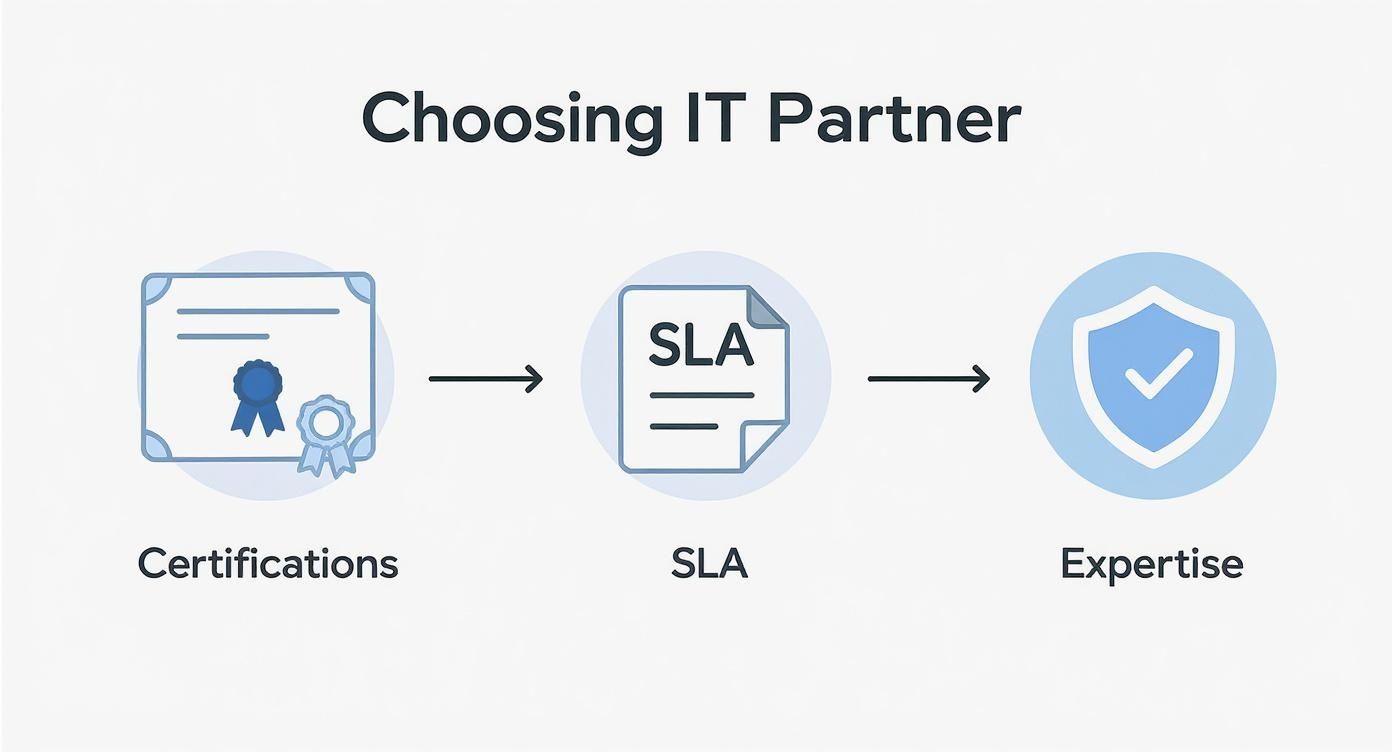
It boils down to three core steps: verifying their technical certifications, scrutinising the details of their Service Level Agreements (SLAs), and confirming they have genuine, proven expertise in your industry. Get these right, and you are well on your way.
For businesses across Dorset, Hampshire, and the surrounding areas, this is where SES Computers comes in. We combine industry-leading technical skill with essential local knowledge, and we are deeply committed to seeing our clients succeed. We have refined our onboarding process to be as smooth and transparent as possible, ensuring minimal disruption to your operations.
Think of it this way: a proactive IT partnership is not just another business expense. It is one of your greatest competitive advantages, giving you the freedom to focus on what you do best while we handle the technology.
Ready to see how this could work for your business?
We invite you to have a straightforward, no-obligation chat with our team. We will listen to your specific challenges and explore how our services can help you move forward with confidence. Contact us today to start the conversation.
Your Questions About Managed IT Services, Answered
It is completely normal to have a few questions before handing over the reins of your business's technology. Making the right decision is crucial, so we have put together some straightforward answers to the questions we hear most often from business owners just like you.
What's the Real Difference Between Managed Services and Traditional IT Support?
The biggest difference is in the mindset: reactive versus proactive. Traditional IT support, often called 'break-fix', is all about reacting to problems. Your server goes down, you call for help, and you get a bill for the emergency fix. This model means downtime for you and unpredictable costs, and frankly, the IT company only makes money when your tech fails.
Managed IT services flip that model on its head. For a predictable monthly fee, we work tirelessly in the background to prevent problems from ever happening. Our goal is to keep your systems running smoothly, securely, and efficiently. Our success is directly tied to your stability—if you are not having problems, we are doing our job right.
Are Managed IT Services Genuinely Affordable for a Small Business?
Absolutely. When you do the maths, it is almost always more cost-effective than hiring an in-house IT person. With a managed service provider (MSP), you are not just getting one person's expertise; you get an entire team of specialists.
Consider a small business with 15 employees. Hiring a single IT manager might cost £45,000 per year plus benefits. A managed service plan could provide comprehensive support, cybersecurity, and backup services for every user for a fraction of that cost, offering a much broader range of expertise for a predictable monthly fee.
How Painful Is It to Switch IT Providers?
We know the thought of switching can be daunting, but a professional MSP has this down to a fine art. The entire process, which we call onboarding, is meticulously planned to ensure your business operations continue without a hitch.
A smooth transition usually follows these steps:
- We start with a thorough audit of your current IT setup to understand exactly what we are working with.
- Next, we map out a detailed migration plan that works around your schedule and business needs.
- The actual switchover is then carried out, often outside of your core business hours to avoid any disruption.
For most small businesses, a well-organised onboarding is completed within a few weeks, with your team barely noticing a thing—except for better-running tech.
Ready to turn your IT from a source of frustration into a real business advantage? The team at SES Computers is here to help. Contact us today for a no-obligation consultation and let's explore how our managed IT services can protect and grow your business.