Think of a managed IT service provider as your outsourced, all-in-one IT department. For a simple, predictable monthly fee, they offer proactive support and forward-thinking advice, completely changing how you manage your technology.
Unlike the old way of doing things—waiting for something to break and then calling for help—a managed service provider (or MSP) focuses on preventing problems before they ever have a chance to disrupt your work. The entire goal is to keep your technology running smoothly, securely, and efficiently in the background.
So, What Is a Managed IT Service Provider, Really?
Let’s use an analogy. For years, businesses treated their IT like an old car, relying on the 'break-fix' model. You’d just keep driving it until the engine warning light came on or, worse, you broke down on the side of the road. It was always a stressful, disruptive, and often expensive surprise.
A managed IT service provider flips that script entirely. They are not the mechanic you call in a panic; they are your dedicated pit crew, constantly monitoring, tuning, and optimising everything to make sure you never break down in the first place.
This is more than just a different service; it's a fundamental shift in strategy. You stop seeing IT as an unpredictable cost centre and start treating it as a powerful, reliable asset that actively helps you achieve your business goals.
The Shift from Reactive Repairs to Proactive Partnership
The real magic is in the business model. A traditional break-fix technician only makes money when your technology fails. It's a model that, frankly, profits from your misfortune.
An MSP, on the other hand, succeeds when you succeed. Their profitability is directly linked to how stable and reliable your systems are. Their incentive is to keep problems to an absolute minimum because fewer support tickets and emergencies mean they operate more efficiently. It is a true partnership where everyone is pulling in the same direction.
This model is a game-changer for small and medium-sized enterprises (SMEs). Hiring an in-house team with specialists in cybersecurity, cloud computing, and network engineering is a massive expense. An MSP gives you access to that entire pool of expertise for a fraction of what it would cost to build it yourself.
For instance, a busy solicitor's office in Somerset must be focused on its clients and casework, not worrying about server updates or the latest phishing scams. By partnering with an MSP, they can be confident that their sensitive data is secure and their systems are always online, letting them focus on what they do best.
An MSP becomes your virtual Chief Information Officer (CIO). They do not just fix what is broken; they offer strategic guidance on how technology can refine your processes, bolster your security, and drive real business growth. It's about making sure your IT investment delivers a tangible return.
This proactive approach typically covers a few key pillars:
- Continuous Monitoring: Your network, servers, and computers are monitored 24/7 to catch and resolve small hiccups before they can escalate into major downtime.
- Security Management: They build and manage a multi-layered security defence to shield your business from ever-present threats like ransomware and data breaches.
- Strategic Planning: A good MSP helps you look ahead, advising on the right technology upgrades and projects to align with your long-term business ambitions.
Ultimately, working with a managed IT service provider gives you a stable, secure, and efficient technology foundation. It frees you up to stop worrying about IT and get back to what truly matters—running and growing your business.
What Does a Managed IT Service Provider Actually Do?
Think of a good managed IT service provider (MSP) as less of a contractor and more of a dedicated technology department for your business. They offer a whole suite of services designed to keep your tech running smoothly, securely, and in a way that actually helps you achieve your goals. It’s a far cry from just calling someone when a computer breaks.
The importance of this sector is hard to overstate. As of March 2025, the UK is home to an estimated 12,867 MSPs, collectively generating around £51 billion in revenue. That’s a testament to how vital they’ve become for businesses of all sizes.
But what are you actually paying for? Let's break down the core services that form the foundation of any strong MSP partnership.
Proactive Monitoring and Maintenance
This is the biggest mindset shift from old-school IT support. Instead of waiting for a problem to bring your business to a halt, an MSP is constantly watching over your entire network—your servers, computers, and other devices—looking for early signs of trouble.
Imagine a busy Dorset accountancy firm in the thick of tax season. Their server, home to all their critical software, starts showing the first subtle signs of a failing hard drive. An MSP's monitoring tools would pick up on these signals, like slow response times or unusual error logs, long before a catastrophic failure. A technician could then pop in after hours to replace the drive, preventing a complete meltdown during their most profitable time of year.
This infographic perfectly captures the difference between the chaotic, expensive break-fix model and the predictable, proactive approach of managed services.
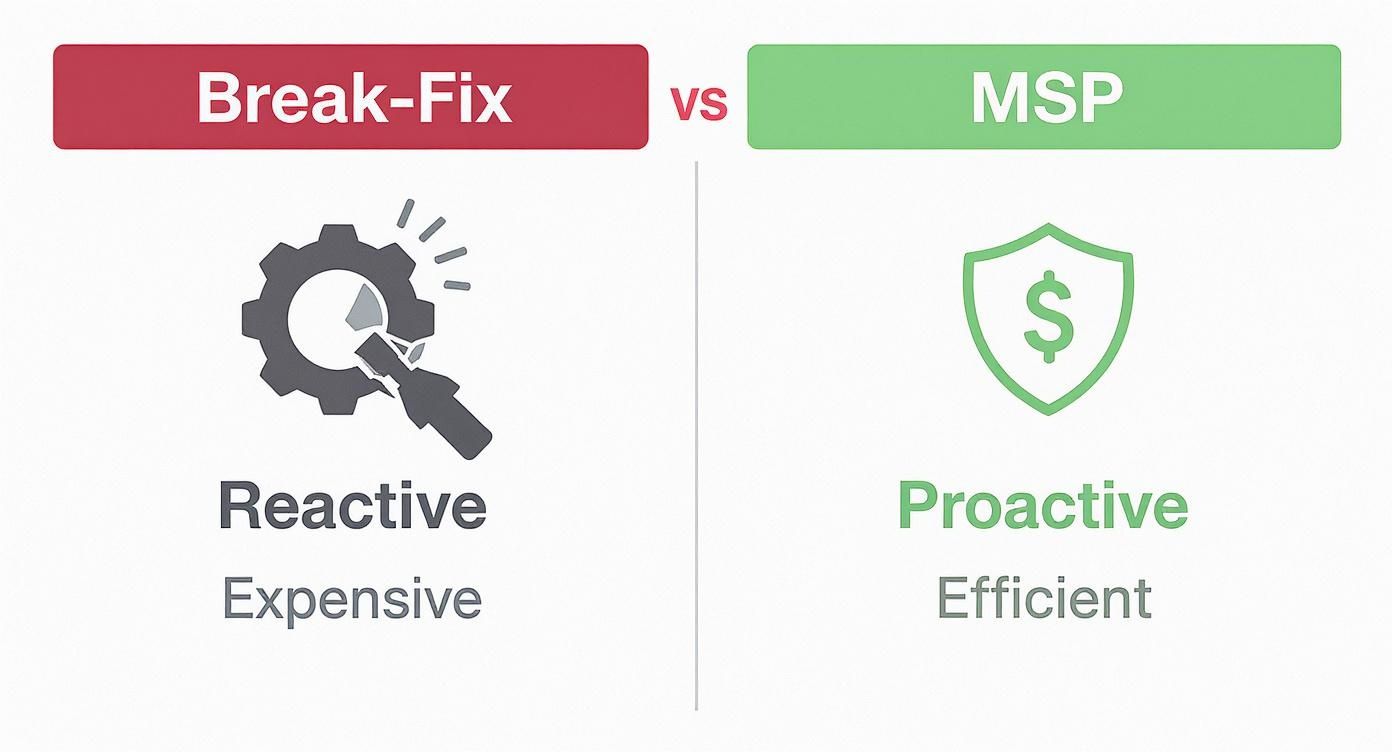
It’s all about moving from firefighting to future-proofing, swapping unpredictable emergencies for stable, planned efficiency.
Backup and Disaster Recovery
Ask yourself this: what would happen if all your business data simply disappeared overnight? A solid backup and disaster recovery plan is not a 'nice-to-have'; it is an absolute essential, and it is a cornerstone of what any good MSP delivers. We are not just talking about copying files to an external drive. This is about a tested, proven strategy to get your entire operation back on its feet, fast.
Picture a solicitor’s office in Wiltshire getting hit by a ransomware attack that encrypts every single client file. With a proper managed backup solution, the MSP can immediately isolate the threat, wipe the compromised systems, and restore everything from a clean, recent backup. Instead of facing days of crippling downtime or even considering paying a ransom, the firm is back up and running within hours. Their reputation is protected, and client confidentiality is maintained. For a more detailed look, you can read our guide on how to choose a managed backup service.
Comprehensive Cybersecurity Protection
In today's world, cybersecurity is not an IT issue; it is a fundamental business responsibility. An MSP acts as your dedicated security team, building a multi-layered defence to shield you from an ever-growing list of digital threats.
This goes way beyond basic antivirus software. A proper security posture includes:
- Advanced Firewall Management: Acting as a digital gatekeeper, controlling all traffic in and out of your network to block malicious attempts before they even get close.
- Endpoint Detection and Response (EDR): Actively monitoring laptops and desktops for suspicious behaviour that could signal an attack in progress.
- Email Security: Filtering out the phishing scams, spam, and dangerous attachments that constantly target your team.
- Staff Security Awareness Training: The human element is often the weakest link. Good training turns your staff into a powerful first line of defence by teaching them how to spot and avoid threats.
Beyond the day-to-day, a proactive MSP also helps you manage your technology assets over their entire lifecycle, incorporating IT Asset Management best practices.
Cloud Services and Strategic Guidance
Whether you’re thinking of moving your servers to the cloud or just want to get more out of platforms like Microsoft 365, an MSP has the expertise to make it happen without the headaches. They can manage the entire migration process, configure your systems for peak performance, and make sure your cloud setup is both secure and cost-effective.
Take a Hampshire-based professional services firm with a growing number of remote workers. Moving to a hosted desktop solution allows their team to securely access their work from anywhere, on any device. The MSP handles the migration, provides ongoing support, and ensures the system scales up or down as needed, so the firm never pays for more than it uses.
A great managed IT service provider does not just maintain your current setup. They act as a strategic partner, helping you understand how new technologies can improve your business processes, enhance collaboration, and create a real competitive advantage.
The Real-World Benefits for Your Business
Thinking about a managed IT service provider (MSP) as just an outsourced helpdesk is missing the bigger picture. It is a strategic shift that moves your technology from a frustrating, reactive cost centre to a proactive asset that genuinely drives your business forward. For small and medium-sized businesses, the impact on your bottom line, day-to-day productivity, and ability to grow can be immense.

This move towards proactive management is not just a niche trend; it’s a massive shift in how businesses operate. The UK's managed IT services market was valued at around £15.35 billion in 2023 and is on track to hit over £42 billion by 2030. Why the boom? Because businesses are catching on to the incredible value of predictable costs, tighter security, and smoother operations. You can get a deeper look at what's driving this growth in this detailed analysis of managed IT services.
Predictable Costs and Significant Savings
One of the first things you will notice is the end of financial guesswork. The old "break-fix" model is a complete rollercoaster—you never know when you will be hit with a massive bill for an emergency call-out, a failed server, or an urgent project. An MSP smooths all that out into one, simple monthly fee.
This predictable cost makes budgeting a breeze, but the real savings go much deeper. Let's break down the true cost of hiring an in-house IT expert:
- Salary and Benefits: You're looking at a competitive salary, plus National Insurance and pension contributions.
- Training and Certification: Technology changes fast. You have to keep investing in their skills just to keep them current.
- Tools and Software: They need professional diagnostic and management software, which comes with its own licensing fees.
- Absence Cover: What happens when they’re on holiday or call in sick? The business grinds to a halt.
Working with a managed IT provider gives you access to an entire team of specialists for a fraction of the cost of hiring just one senior IT professional.
Immediate Access to Specialist Expertise
Let's be realistic: no single IT person can be a master of everything. Today’s tech landscape demands deep knowledge in everything from network design and cloud migrations to, most importantly, cybersecurity.
When you partner with an MSP, you get a whole team of experts on your side from day one. This means having cybersecurity analysts who live and breathe the latest threats, cloud architects who can build efficient systems, and network engineers who keep everything running smoothly. For a professional services firm, this is like having top-tier advice on data protection without the six-figure salary.
An MSP essentially makes enterprise-grade IT expertise affordable and accessible for SMEs. You are no longer held back by the limitations of a small internal team, giving you a serious competitive advantage.
Enhanced Productivity and Focus
Think about how much time is lost when your team is wrestling with tech problems. Slow computers, network dropouts, and software glitches are silent productivity killers. Over a year, that lost time adds up to a significant amount of lost revenue.
A good MSP works in the background to stop these problems from ever happening. With 24/7 system monitoring and out-of-hours maintenance, they make sure your technology is a tool that helps you, not a constant source of frustration. For example, by proactively managing software updates and security patching overnight, an MSP ensures that a firm of financial advisors can start their day with fully operational, secure systems, rather than wasting the first hour waiting for updates to install. This frees up your staff—whether they're accountants, solicitors, or consultants—to focus 100% on looking after your clients and growing the business.
Strategic Scalability and Agility
Your business is not going to stand still, so your IT support shouldn't either. An MSP offers the flexibility to scale your technology up or down as your needs change. Taking on new people? An MSP can get their accounts, hardware, and software set up in no time. Need to streamline? You're not stuck with fixed staffing costs.
This agility is vital. It means you can react to market changes and jump on growth opportunities without being held back by a rigid IT setup.
Making Sense of Managed IT Service Pricing
One of the first things you will want to get your head around is how managed IT providers charge for their services. This is crucial because it’s not just about cost—it’s about finding a partner whose pricing structure makes sense for how your business actually works. Moving to a predictable monthly fee is a huge win, but understanding how that fee is calculated will help you compare apples with apples when looking at quotes.
The whole point is to find a model that gives you predictable costs without forcing you to pay for support you do not use. Let's break down the three most common pricing models you will come across.
Per-User Pricing
This is probably the most common and straightforward model out there. With per-user (or per-seat) pricing, your monthly cost is simply based on the number of people on your team. That single price per person usually covers everything they need to do their job: their main computer, their laptop, their work mobile, plus all the helpdesk support they require.
This approach works brilliantly for businesses where the number of staff directly drives the IT workload—think accountancy firms, solicitors, or consultants. As you hire a new person, you add a new "seat" to your plan. It makes budgeting a doddle because your IT costs scale perfectly with your headcount.
Per-Device Pricing
The per-device model flips things around. Instead of counting people, it counts the equipment being managed on your network. Everything from servers and desktops to firewalls and printers gets tallied up. Different types of devices often have different price points attached, reflecting how much work is involved in keeping them running smoothly.
Imagine a logistics company in Dorset with a large warehouse full of scanners, printers, and networked machinery. They might only have a small office team, but their real IT complexity lies in the dozens of devices on the warehouse floor. For them, a per-device model is a much better fit. It aligns the cost directly with where they need the most support—keeping the supply chain moving.
The key is to match the pricing model to your business's operational reality. Ask yourself: does our IT complexity grow with our headcount or with the amount of equipment we operate? The answer will point you to the most cost-effective model.
Tiered Pricing
Many providers bundle their services into different packages, often with names like Bronze, Silver, and Gold. This lets you pick a level of service that aligns with both your budget and how critical IT is to your daily operations. A starter tier might cover the basics like monitoring and remote help, while the higher tiers could add things like guaranteed faster response times, regular on-site visits, and proactive strategic planning.
To give you a clearer idea, we have put together a simple table comparing the three main models.
Comparing Common MSP Pricing Models
This table compares the three most common pricing models to help you identify the best fit for your business.
| Pricing Model | How It Works | Best Suited For |
|---|---|---|
| Per-User | A flat fee is charged for each employee, typically covering all their devices and support needs. | Professional services firms (e.g., accountants, solicitors) where IT complexity is tied to staff numbers. |
| Per-Device | A set fee is charged for each managed device (server, PC, firewall, etc.) on the network. | Businesses with more equipment than people, such as manufacturing, hospitality, or logistics. |
| Tiered | Services are bundled into packages (e.g., Bronze, Silver, Gold) with increasing levels of support and features. | Companies that want to choose a specific service level and have a clear path to scale up support as they grow. |
Ultimately, the tiered model gives you clarity and control. You can start with what you need right now, knowing you can easily move up to a more comprehensive package as your business grows or your reliance on technology increases.
Meeting Your Cybersecurity and Compliance Duties
Let's be clear: cybersecurity is not just an IT problem anymore. It is a core business responsibility, and getting it wrong can have serious legal and financial repercussions. A good managed IT service provider is your first line of defence, shifting your entire security posture from reactive panic to proactive strength. They become a vital partner in helping your business tick all the right legal boxes.
For any professional services business in the UK, navigating regulations like the General Data Protection Regulation (GDPR) is simply not optional. An MSP does not just talk about compliance; they put the practical measures in place. For a law firm, this means implementing robust data encryption to shield sensitive client information and setting up strict access controls so only authorised personnel can see or edit case files.

Building a Layered Security Strategy
A single security tool just will not cut it these days. A skilled MSP constructs a multi-layered defence—think of it like the concentric walls of a castle—specifically for your business and its risks. This approach creates several barriers an attacker would need to breach, ensuring that if one layer fails, others are ready to stop the threat dead in its tracks.
Imagine a financial advisory firm in Wiltshire, responsible for highly sensitive client investment portfolios. Their MSP would build a security framework that includes:
- Advanced Firewall and Network Security: This acts as a strong perimeter, inspecting all traffic coming in and out to block any unauthorised access attempts before they can even get started.
- Endpoint Protection: Deploying next-generation antivirus and anti-malware software on every laptop and desktop to neutralise threats right at the point of entry.
- Phishing Awareness Training: Regularly coaching staff on how to spot and report suspicious emails. This simple step can turn your employees from a potential weak link into a formidable human firewall.
This layered approach dramatically reduces the odds of a successful cyberattack. You can dive deeper into this topic in our article on essential cybersecurity services for small businesses.
A crucial part of any solid security plan is preparation. That’s why MSPs often develop and implement a modern data breach response plan to minimise damage and get you back on your feet quickly. It's not just about defence; it's about being ready to act decisively if the worst should happen.
Securing Your Supply Chain
Your business's security is only as strong as its weakest link, and increasingly, that weak link can be found in your network of suppliers and partners. A supply chain attack is when a cybercriminal infiltrates your systems through an outside provider who has access to your network or data.
This is exactly why your MSP's own security is so important. A reputable provider will have incredibly stringent internal security controls, hold industry-recognised certifications (like Cyber Essentials), and be completely transparent about their own practices. They know they are a key part of your business ecosystem and take that responsibility very seriously.
This intense focus on security is a huge driver in the IT services market. The introduction of new frameworks and regulations is pushing managed security services toward a forecasted growth of 9.6% CAGR through 2030, as businesses scramble for compliant solutions. By making sure your MSP is secure, you’re not just protecting your own data—you're safeguarding your entire operational network from the outside in.
How to Choose the Right MSP Partner
Picking a managed IT service provider is not just another item on your to-do list; it’s a major business decision. You are not simply buying a service. You are bringing a new partner into the fold, one who will have their hands on the very systems that keep your business running day in, day out.
Getting this choice right from the start is absolutely critical. It’s about finding a team you can genuinely trust with your most sensitive data and essential operations. This is not about just glancing at quotes; it requires a bit of homework to find a provider that truly understands your business and its goals.
Your Essential Vetting Checklist
Before you even think about signing a contract, you need to dig deep into how a potential provider works. Their answers to your questions will tell you everything you need to know about their professionalism, their reliability, and whether they see you as a partner or just another number. Do not hesitate to be direct.
Here are the non-negotiable areas to investigate:
- Service Level Agreements (SLAs): Ask to see their SLA document in full. This is the backbone of your relationship, defining their promises in black and white. Look for concrete, guaranteed response times for different problems – a critical server failure needs a much faster response than a minor software glitch. What happens if they do not meet these promises?
- Client Testimonials and Case Studies: A great provider will be proud of their track record and happy to provide references. Ask if you can speak to a few of their current clients, especially businesses in your sector or of a similar size. Nothing beats hearing about their real-world performance from a fellow business owner.
- Industry Certifications: Keep an eye out for recognised accreditations. Certifications like Microsoft Solutions Partner or Cyber Essentials are not just fancy badges for their website; they are proof that the provider has been independently verified and meets high industry standards for technical skill and security.
- The Onboarding Process: A messy handover can cause chaos. Ask them to talk you through their onboarding process, step by step. A well-prepared provider will have a clear, structured plan for migrating your systems, getting your team up to speed, and making the entire transition as smooth as possible.
The Advantage of a Local Partner
For professional services businesses across Dorset, Somerset, Wiltshire, and Hampshire, choosing a local managed IT service provider offers real, tangible benefits that a remote, national firm just can't replicate. When a critical piece of hardware fails and a remote fix is not cutting it, the value of having an engineer who can be on-site in a hurry cannot be overstated.
A local MSP already gets the regional business landscape. They are part of your community, which usually means you get a more personal, accountable, and responsive service.
This local connection often makes all the difference. For example, a Dorset-based estate agent recently cut their IT overheads by 20% by switching to a local team who immediately understood their unique software and compliance needs. In another case, a care provider in Hampshire bolstered their data security thanks to an MSP who could deliver crucial cybersecurity training to their staff in person.
These are not just abstract benefits; they are real results driven by proximity and local know-how. Picking the right partner is all about careful evaluation, and for more advice, you might find it helpful to read our deeper analysis of what sets different managed IT service companies apart.
Your Questions Answered: A Closer Look at Managed IT
It is natural to have questions when you are thinking about handing over the reins of your business technology. Let's tackle some of the most common ones we hear from business owners just like you.
What’s the Real Difference Between Managed Services and Traditional IT Support?
Think of it this way: traditional IT support is like a firefighter. You only call them when there is already a blaze—your server has crashed, your network is down, or a critical application has stopped working. It is a reactive model, built around fixing problems after they have already caused disruption and downtime.
A managed IT service provider, on the other hand, is like having a fire marshal on-site 24/7. We’re proactive. Our job is to constantly monitor your systems, perform regular maintenance, and spot potential issues long before they can flare up into a full-blown crisis. It’s about preventing problems, not just heroically solving them. This approach gives you stability and a predictable monthly cost, instead of a surprise bill every time something breaks.
Is My Business Too Small for This?
Definitely not. In fact, we find that small and medium-sized businesses often get the most out of managed IT services. For a small business, hiring a single, dedicated IT professional can be a huge expense, and it’s impossible for one person to be an expert in everything from cloud infrastructure to advanced cybersecurity.
Working with an MSP gives you access to an entire team of specialists for a fraction of that cost. Suddenly, you have a network engineer, a security analyst, and a helpdesk technician all on your side. It is a way for smaller businesses to gain the kind of robust, enterprise-level IT support that was once only available to large corporations.
The bottom line is this: an MSP transforms your IT from a source of stress and unexpected costs into a reliable asset that supports your growth. You get to focus on running your business, knowing your technology is in safe hands.
Why Do You Keep Talking About a Service Level Agreement?
The Service Level Agreement, or SLA, is the single most important document in our partnership. It is not just a formality; it is our written promise to you, setting out exactly what you can expect from us.
A proper SLA is all about accountability. It should clearly define:
- Guaranteed Response Times: Exactly how quickly we will jump on an issue you report.
- Resolution Targets: The timeframe we aim for to get different types of problems fixed.
- System Uptime: A specific promise for how much of the time your key systems will be online (for example, 99.9%).
- Consequences: What happens on our end if we fail to meet these commitments.
Without a solid SLA, you're just working on a handshake and a vague promise. This document ensures you get the consistent, high-quality service your business depends on to operate effectively.
Ready to stop worrying about IT and start focusing on your business? For over 30 years, SES Computers has been the trusted local partner for SMEs across Dorset, Somerset, Wiltshire, and Hampshire. We provide proactive managed IT support that prevents problems before they start. Discover how our local expertise can benefit your business.