When you hear the term “managed IT services,” think of it as hiring a dedicated team of specialists to look after your entire technology setup. Instead of just calling for assistance when a computer breaks, you partner with a professional services firm that constantly monitors and maintains your systems to prevent problems from ever happening in the first place.
This simple shift turns IT from a reactive headache with surprise costs into a predictable, fixed monthly investment, allowing your business to focus on its core objectives.
From Reactive Firefighting to Proactive Strategy
Most businesses are familiar with the traditional ‘break-fix’ model of IT support. Your network grinds to a halt, or a critical server fails, and only then do you call for help. This is pure firefighting. You’re left dealing with frustrating downtime and a hefty, unexpected bill, all while your team sits idle. It’s a model that only profits your IT support when your business is suffering.
Managed services completely flips that on its head.
Think about it like this: a reputable law firm wouldn't wait for a critical legal deadline to be missed before organising its case files. It would have robust systems in place to manage them proactively. A Managed Service Provider (MSP) does precisely that for your digital infrastructure—your servers, network, and security.
The Core Philosophy of an MSP
At its heart, an MSP’s job is to keep your technology running smoothly, securely, and without interruption. They take full ownership of specific IT functions, from cybersecurity to daily operations. The entire relationship is built on proactive care, not just scrambling to fix things when they break.
A great provider acts as a strategic partner, not just a helpdesk. They’re invested in optimising your technology to help your professional services firm operate more effectively. You can dive deeper into their role by reading our guide on what is a managed service provider.
This strategic value is why so many companies are making the switch. In fact, the UK managed services market hit an impressive £15,349.99 million in 2023 and is expected to climb to £28,291.12 million by 2032. Businesses are clearly voting with their feet, choosing foresight over firefighting.
By entrusting your IT to a specialist, you are not just outsourcing tasks; you are adopting a strategy that prioritises stability, security, and efficiency. It’s about transforming your technology from a potential liability into a reliable asset that actively supports your business objectives.
Ultimately, this proactive approach delivers tangible benefits:
- Cost Predictability: Say goodbye to volatile repair bills. You get a single, fixed monthly fee that makes budgeting simple and straightforward.
- Reduced Downtime: Constant monitoring means potential problems are spotted and sorted long before they can bring your operations to a standstill.
- Enhanced Security: Your business gains a dedicated guardian, with experts constantly monitoring for and protecting against the latest cyber threats.
- Strategic Focus: Freeing your team from IT troubleshooting lets them concentrate on what they do best—driving your business forward.
What’s Actually Included in Managed IT Services?
When you sign up for managed IT services, what are you really getting? It’s not just about having someone to call when your printer breaks. Think of it as having a dedicated technology team whose main job is to keep your professional services firm running smoothly, securely, and efficiently.
Let's pull back the curtain and look at the core components that make up a typical managed services package. Each element plays a specific role, but they all work together to build a more resilient and productive business.
We can break down the most common services into a few key areas. The table below gives a quick overview, and then we'll dive into what each one means for a real-world business like yours.
A Breakdown of Common Managed IT Services
| Service Component | Description | Practical Business Example |
|---|---|---|
| Proactive Monitoring | 24/7 surveillance of your IT systems (servers, network, devices) to detect and fix issues before they cause downtime. | An accountancy firm's server hard drive shows early signs of failure. The monitoring system alerts an engineer who replaces it overnight, avoiding a crash during tax season. |
| Managed Cybersecurity | Multi-layered defence including firewalls, email filtering, threat hunting, and software patching to protect against cyber-attacks. | A law firm's managed security service stops a sophisticated phishing email, preventing a data breach and protecting sensitive client information. |
| Cloud Management | Expert management of cloud platforms like Microsoft 365, focusing on cost optimisation, security, user access, and performance. | A growing consultancy gets help structuring its SharePoint data and automating new employee setups, enabling secure and efficient team collaboration. |
| Backup & Disaster Recovery | A comprehensive plan to back up all critical data and systems, ensuring a rapid recovery after a disaster like a fire, flood, or major cyber-attack. | A financial advisory's on-site server is destroyed by a power surge. The BDR plan kicks in, and the team is working from a cloud replica in under 30 minutes. |
Now, let's explore these in a bit more detail.
Proactive System Monitoring
This is the bedrock of any good managed IT service. Imagine a security guard who never sleeps, constantly checking the health and performance of your servers, network, and computers. That’s what proactive monitoring does for your digital infrastructure.
This constant vigilance means your provider can spot tell-tale signs of trouble—like a server running out of memory or unusual network activity—long before it snowballs into a full-blown crisis that stops your business in its tracks.
Practical example: An accountancy firm in Dorset depends on its central server to access crucial tax records. The monitoring system flags a hard drive showing early signs of failure. An engineer is dispatched to replace the drive out of hours, preventing a catastrophic server crash during the busiest time of the year. The business experiences zero downtime.
Managed Cybersecurity
In a world where digital threats are a constant reality, having strong cybersecurity isn't optional. Managed cybersecurity services give you multiple layers of protection, acting as your dedicated shield against ransomware, phishing, and data breaches. This is a world away from simply installing antivirus software.
It’s a comprehensive defence that includes managing firewalls, patching software vulnerabilities as soon as they’re discovered, filtering out malicious emails, and actively hunting for threats. For any professional service firm in Hampshire or Wiltshire handling sensitive data, this protection is absolutely vital for maintaining your reputation and meeting compliance regulations.
Practical example: A law firm in Somerset stores highly confidential client case files. Their MSP’s advanced threat detection system spots and quarantines a clever phishing email designed to steal login details. The attack is shut down before any data is compromised, saving the firm from a potentially ruinous breach and hefty regulatory fines.
Cloud Management
The cloud offers fantastic flexibility, but without expert oversight, it can quickly become complex and costly. Managed cloud services are all about helping you get the absolute most from platforms like Microsoft 365 or your own private cloud hosting.
This involves fine-tuning costs so you're not overspending, managing who can access what, making sure your cloud data is properly backed up, and adjusting your resources as your business grows. It also means building in resilience through smart strategies like multi-provider failover reliability.
Managed cloud services transform powerful tools like Microsoft 365 from a simple subscription into a finely tuned engine for productivity and collaboration, ensuring you only pay for what you need while maximising its capabilities.
Practical example: A growing consultancy in Wiltshire relies heavily on Microsoft 365. Their MSP steps in to help them organise their SharePoint data structure, automate the onboarding process for new staff, and roll out security policies to stop accidental data leaks. The result? The team can collaborate effectively and securely as the company scales.
Backup and Disaster Recovery
It's the question no business owner wants to ask: what would happen if a fire, flood, or major cyber-attack wiped out your systems tomorrow? A solid Backup and Disaster Recovery (BDR) plan is your answer. It's so much more than just backing up files; it's a tested, proven strategy to get your entire business back on its feet in minutes or hours, not days.
This service automates regular backups of your most important systems and data, stores them safely off-site, and gives you the ability to bring everything back online at a moment's notice.
Practical example: A Hampshire-based financial advisory firm gets hit by a power surge that fries their main server. Thanks to their BDR plan, the MSP immediately activates a virtual copy of the server from the latest backup. In under 30 minutes, the entire team is logged in and working from the cloud-based replica. Their clients never even knew there was a problem.
The Real Cost of Break-Fix vs. Managed IT Support
To really get to grips with the value of managed IT services, it’s useful to put it side-by-side with the old-school alternative: the break-fix model. Let's paint a picture of two local professional services firms, each running into a common tech headache. Their very different experiences tell a story about the hidden costs that never show up on an invoice.
First, we have ‘Firm A’. They stick with a break-fix IT company, meaning they only pick up the phone when something breaks. On a busy Tuesday morning, their main server gives up the ghost. Suddenly, chaos erupts. Client files are locked away, emails are dead in the water, and the entire team is forced to down tools.
They make an emergency call-out, which comes with a hefty high-priority fee. It takes the technician four hours just to figure out what’s failed. The business loses a full day's work, deadlines are blown, and a few key clients start to get twitchy. The final bill is painful enough, but the real damage is the lost revenue and dented reputation from being knocked offline.
Shifting from Reaction to Prevention
Now let’s look at ‘Firm B’, which has a partnership with a Managed Service Provider (MSP). Their MSP has proactive monitoring tools that are always keeping an eye on the health of their systems. Two weeks ago, those tools flagged that a hard drive in their server was starting to show early signs of trouble.
Instead of a full-blown crisis, Firm B simply got a calm heads-up from their provider. The MSP scheduled an engineer to pop in over the weekend and swap out the failing drive during a planned maintenance window. The job was done and dusted out of hours, with zero disruption to the business.
For Firm B, the server crash never happened. This is the fundamental difference: managed IT support is designed to prevent problems, while the break-fix model only profits from them. It moves your business from a state of recurring crisis to one of controlled stability.
This scenario really brings home how the unpredictable nature of break-fix support is loaded with hidden costs. You might feel like you're saving money by avoiding a monthly fee, but a single major outage can easily cost more than a year's worth of managed services. This comparison is key to understanding the real value offered by different types of outsourced IT support.
The core services baked into a managed package—like proactive monitoring, cybersecurity, and data backup—are all there to build resilience.
The chart below shows the key areas that form the foundation of a proactive IT strategy.
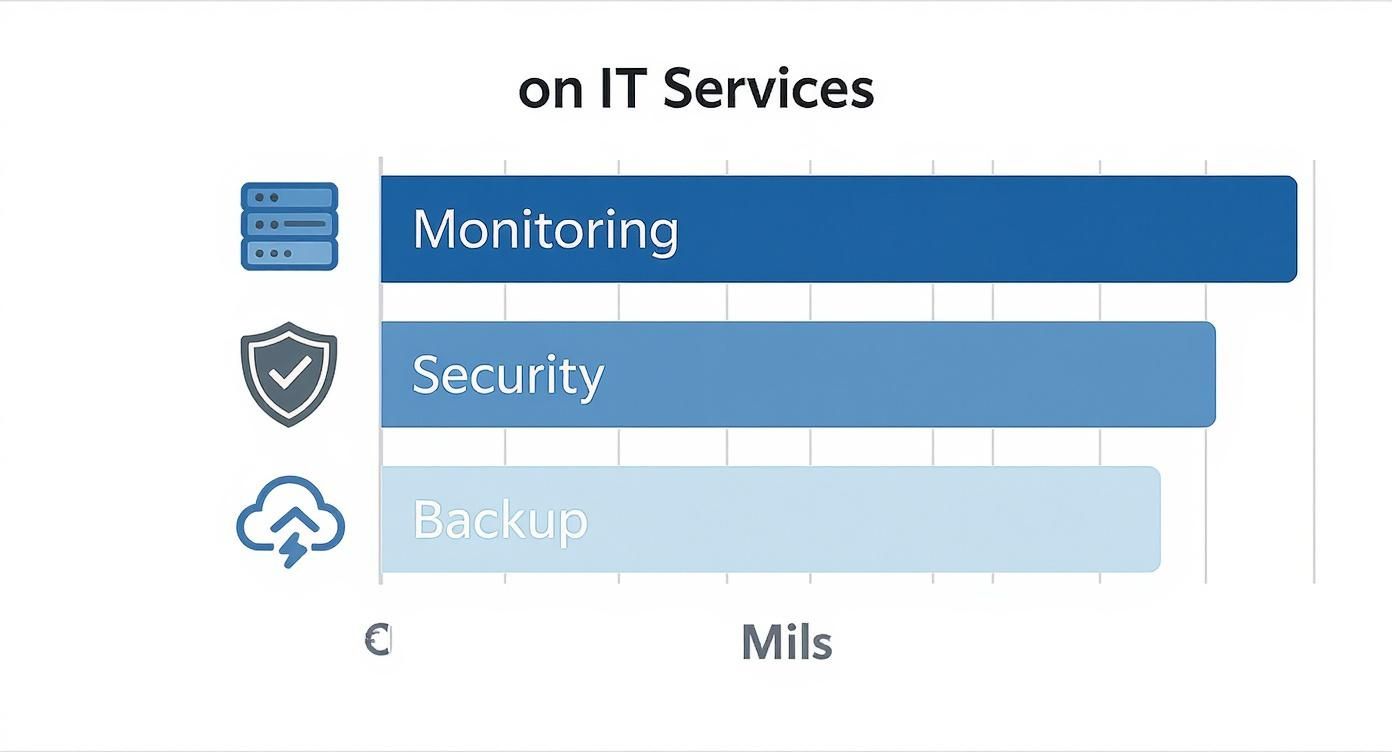
This illustrates that a comprehensive managed service is built on layers of protection, from constant system monitoring to robust security and reliable backups.
The True Financial Picture
When you step back and look at the total cost of ownership, the financial argument becomes crystal clear. The break-fix model might look cheaper on a month-to-month basis, but it's a high-stakes gamble.
- Unpredictable Costs: Emergency call-out fees, the sudden cost of new hardware, and project fees for disaster recovery are always unplanned and often inflated because they’re urgent.
- Productivity Loss: Every hour of downtime is an hour your team isn't working, serving clients, or bringing in revenue. This is often the biggest, unbudgeted cost of all.
- Reputational Damage: Telling a client you can't deliver because your IT has failed can do lasting harm to your business relationships.
In contrast, managed IT services offer a fixed, predictable monthly cost. This makes budgeting a breeze and turns IT from a volatile capital expenditure into a stable operating expense. The proactive maintenance and monitoring included in this fee actively reduce the risk of that costly downtime, delivering a far better return on investment over the long haul.
How Managed Services Drive Business Growth

Good IT isn't just about keeping the lights on anymore. It's a powerful engine for business growth. When your technology is managed properly, it stops being a drain on your budget and becomes a genuine asset that helps you win. This is where managed services truly shine, delivering real-world results that push your business forward.
When you partner with a Managed Service Provider (MSP), you're doing more than just handing off a few tasks. You're bringing in a framework designed to give you financial stability, tougher security, deeper expertise, and a laser focus on what you do best. Let’s break down the four key ways this approach turns IT management into a growth strategy.
Achieve Predictable Costs and Financial Stability
For any SME, one of the biggest headaches is unpredictable spending. A server suddenly dying can land you with an unexpected bill for thousands, completely wrecking your budget and cash flow. Managed services flip this on its head, turning volatile capital expenditure (CapEx) into a steady, predictable operating expense (OpEx).
You simply pay a fixed monthly fee for all your IT support, maintenance, and monitoring. Budgeting becomes incredibly simple, and you can say goodbye to those nasty financial shocks from emergency repairs. This stability means you can confidently put your money towards growth—like marketing or hiring new people—instead of keeping it locked away for the next IT disaster.
Strengthen Security and Ensure Compliance
In this day and age, solid cybersecurity and data compliance are non-negotiable. For many professional services firms, a data breach isn't just an inconvenience; it can be catastrophic, leading to hefty fines, lost clients, and a reputation that's hard to rebuild. An MSP brings the specialist security knowledge needed to build a defence that actually works.
Practical example: Imagine a financial advisory firm based in Hampshire. They're handling highly sensitive client data and have to follow strict regulations. An MSP would implement and manage a full-stack security strategy, including:
- Advanced Firewalls: The first line of defence, keeping external threats out.
- Proactive Threat Hunting: Constantly looking for any sign of trouble on your systems.
- Regular Security Audits: Making sure everything you do meets tough compliance standards.
This constant oversight gives you peace of mind and proves to regulators and clients alike that you're taking their security seriously. What was once a major risk becomes a source of client trust.
Gain Instant Access to a Deep Bench of Expertise
Hiring, training, and retaining a senior in-house IT expert is a huge investment in both time and money. And even then, you're relying on one person to be an expert in everything from cloud architecture and cybersecurity to network infrastructure, which is simply impossible. This is where managed services offer a massive advantage.
Working with an MSP gives your business immediate access to an entire team of certified specialists, often for less than the cost of a single senior hire. You get a whole spectrum of skills on tap. Whether you need help with a tricky cloud migration or advice on a new phone system, the expertise is right there when you need it, without the overhead of a large internal department.
This model effectively levels the playing field, giving an ambitious SME in Dorset or Wiltshire the same calibre of IT expertise that was once only available to large corporations. It’s a powerful way to punch above your weight.
This demand for specialised skills is fuelling huge growth in the sector. The UK IT services market, which includes managed services in it, is on track to hit USD 112.5 billion in 2025. And while big companies still lead the way, SMEs are catching on fast, with their segment expected to grow at an annual rate of 9.2% through to 2030. This rapid adoption is partly driven by government support, showing a clear shift towards strategic IT partnerships. You can dig deeper into these trends and read the full research on the UK IT services market growth.
Focus Your Leadership on Core Business Strategy
Every hour your leadership team spends wrestling with an IT problem is an hour they aren't spending on serving clients, innovating, or planning the future of the business. Technology should make things easier, not get in the way. Handing over the day-to-day management of your IT frees up your most valuable asset: your team’s time and energy.
When your technology just works—reliably and securely—your people are free to do their best work. This renewed focus is often the most powerful benefit of all. It lets you concentrate on what you're truly good at, knowing the technology behind you is solid, safe, and built to support your ambitions.
How to Choose the Right IT Partner
Picking a managed IT service provider is a huge decision for any business. Get it right, and you gain a genuine partner who helps you grow, tightens up your security, and makes your operations smoother. Get it wrong, and you're in for a world of operational pain and frustration. For small and medium-sized businesses across Dorset, Hampshire, and the surrounding counties, seeing past a polished sales pitch is absolutely critical.
The market is certainly crowded. As of March 2025, the UK is home to 12,867 active managed service providers. It’s a massive industry, pulling in around £51 billion a year and employing over 343,000 people. With so much choice, you need a smart way to filter out the noise and find a partner that’s a genuine fit. You can dig deeper into the numbers with the UK's thriving managed service provider market from official government research.
Why Local Presence and Fast Response Still Matter
Even in a world of remote support, having a local partner is a massive plus, especially for businesses in places like Wiltshire and Somerset. Most day-to-day issues can be sorted out remotely, but what happens when a critical server dies or your network hardware gives up? That’s when you need a real person, on-site, fast.
A provider with a local base of engineers means they can physically get to your office when disaster strikes. Before you even think about signing a contract, ask them point-blank about their on-site response times and where their engineers are actually located. It’s a detail that can make all the difference.
Look for Real Technical Expertise, Not Just Buzzwords
Technical certifications aren't just for show; they're proof that a provider is serious about maintaining high standards. Accreditations like Cyber Essentials or ISO 27001 are especially important because they show that a provider's security processes have been independently checked and verified. This is non-negotiable when it comes to protecting your business and your clients' data.
Ask a potential provider to show you their team's certifications and, more importantly, explain what they mean for your business. It’s a great way to gauge their technical depth and commitment to doing things properly.
A provider's certifications are a direct reflection of their technical discipline. Vetting these credentials ensures you are partnering with a team that takes security and best practices as seriously as you do.
Experience in your specific industry is another game-changer. An IT partner who already understands the compliance headaches of an accountancy firm or the operational flow of a manufacturing business will get up to speed much faster. They’ll already know the software you use and the challenges you face, which means quicker solutions and more relevant advice.
Ask the Right Questions to Find the Right Fit
A solid evaluation comes down to asking direct, insightful questions that get you past the marketing fluff. Having a list ready helps you compare potential partners on a level playing field and truly understand how they operate.
To help you get started, we've put together a practical checklist. Think of this as your guide to evaluating potential MSPs and making sure they're the right cultural and technical fit for your business here in the South.
Vendor Selection Checklist for a Local MSP
| Evaluation Criteria | Key Questions to Ask | Why It Matters |
|---|---|---|
| Onboarding Process | "Can you walk me through your exact process for onboarding a new client like us? What is the timeline and what will you need from my team?" | A clear, structured onboarding process shows they're organised and minimises disruption to your business. |
| Team Structure & Access | "Who would be my primary point of contact? Will I have a dedicated account manager, or speak to a different engineer each time I call?" | A dedicated contact builds a stronger relationship and ensures the person you're talking to understands your specific setup. |
| Proactive Strategy | "How do you move beyond just fixing problems? Can you give me an example of how you proactively improved another client's IT systems?" | You want a partner who prevents problems, not just a reactive helpdesk. Look for evidence of strategic thinking. |
| Client References | "Could you connect me with one or two current clients in a similar industry to ours? I'd like to hear about their experience." | Speaking to real clients is the best way to get an honest, unfiltered view of their service quality and reliability. |
| Service Level Agreement | "What are your guaranteed response and resolution times for different priority issues? How do you report on your performance against these SLAs?" | The SLA is your guarantee. It needs to be clear, measurable, and aligned with your business's needs for uptime and support. |
By taking the time to ask these questions, you’ll build a much clearer picture of what working with each provider would actually be like day-to-day. It’s about finding a partner with the right technical skills who also fits your company culture. For a deeper dive, our guide on evaluating managed IT service companies offers more detailed criteria to help you make the best choice.
Finding Your Strategic Partner for Growth
We’ve covered a lot of ground in this guide, but it all comes down to one core idea: proper managed IT services are about much more than just outsourced support. It's a complete change in mindset, moving your business away from lurching from one IT fire to the next and towards a stable, predictable technology foundation that actually helps you grow. This isn't just about fixing things faster; it's about stopping them from breaking in the first place.
When you bring a managed services partner on board, you change the role IT plays in your company. It stops being a source of frustration and becomes a genuine asset. The unpredictable, often eye-watering, cost of emergency call-outs is replaced by a simple, fixed monthly fee. That financial clarity gives ambitious SMEs the confidence to budget properly and invest in what really matters, instead of keeping cash aside for the next inevitable server crash.
Unlocking Your Competitive Edge
The real power of this partnership is what it unlocks for your business. When your team can rely on their tools, your systems are secure, and your data is safe, technology stops being a roadblock and starts becoming a competitive advantage. You’re no longer held back by what your IT can't do; you’re propelled forward by what it can.
This strategic approach brings real, tangible benefits that drive your business forward:
- Boosted Operational Efficiency: With technology humming away reliably in the background, your team can get on with their actual jobs, which means productivity goes up.
- A Robust Security Stance: You get the peace of mind that comes from knowing experts are constantly watching over and protecting your digital front door.
- Sharper Strategic Focus: Your leadership team is freed from fire-fighting tech problems, letting them concentrate on innovation, looking after clients, and planning for the future.
Ultimately, the right managed services partner doesn’t just keep the lights on. They actively work to make sure your technology is perfectly aligned with where you want to take your business. They help you build a company that is more resilient, more efficient, and more secure—ready for whatever comes next.
The checklists and advice we've shared are here to help you make a smart decision. Use them to take a hard look at where your IT is now and to properly assess any potential partners who claim they can help you hit your goals. It’s time to stop seeing technology as a problem to be solved and start treating it as the engine for your future growth.
Frequently Asked Questions
Even when the benefits are clear, it’s only natural to have a few practical questions before committing to managed IT services. Let’s tackle some of the most common queries we hear from business owners.
What Is the Typical Cost of Managed IT Services?
There’s no single price tag for managed IT, as the service is built to fit your business, not the other way around. The good news is that the pricing is almost always predictable, typically based on one of these straightforward models:
- Per-User Pricing: You pay a set monthly fee for each person on your team. This works brilliantly for professional services firms where most staff use a similar set of tools and devices.
- Per-Device Pricing: Here, the cost is tied to each piece of hardware being looked after (like a server, laptop, or desktop). It’s a great fit for companies where multiple people share a single machine, such as in manufacturing or shift-based work.
- Tiered Pricing: Many providers offer packages—think Bronze, Silver, Gold—with different service levels. This allows you to pick a plan that lines up with both your budget and your technical needs.
Ultimately, the final figure will depend on factors like the size of your team, the complexity of your current setup, and whether you need specialised services like advanced cybersecurity or 24/7 support.
Can an MSP Work with My Existing IT Staff?
Absolutely. In fact, some of the most successful arrangements we see are when an MSP partners with a company's in-house IT expert. This setup is often called co-managed IT, and it’s not about replacing your team—it’s about making them even better.
Think of a co-managed model as a force multiplier. The MSP handles the endless, time-consuming tasks like daily monitoring and patching, which frees up your internal team to focus on bigger, business-specific projects that actually move the needle.
Practical example: An MSP could take care of the 24/7 network security and server health checks for a large solicitor's office, while their internal IT manager dedicates their time to rolling out new case management software. It's a collaborative approach that gives you the best of both worlds: broad, round-the-clock support and deep, focused company knowledge.
How Complex Is the Switch to a New Provider?
A reputable MSP will have a tried-and-tested onboarding process designed to make the transition feel seamless. While every business is unique, the journey usually follows a clear, well-communicated path:
- Discovery and Audit: First, the provider gets under the bonnet of your current IT infrastructure. This deep dive helps them understand your systems, pinpoint any weak spots, and map out the migration.
- Onboarding Plan: Next, they’ll create a detailed plan with a clear timeline. Every step is outlined, from installing monitoring software to moving your data across.
- System Integration: The MSP then carefully integrates their management and security tools into your network. This is usually done outside of your normal working hours to avoid any disruption.
- Go-Live and Handover: Once everything is tested and ready, the service officially kicks off. Your team gets a proper introduction to the new support process, and the MSP formally takes the reins.
The whole thing is project-managed by the provider, ensuring a smooth handover that requires very little heavy lifting from you.
Is My Business Too Small for Managed Services?
That’s one of the biggest myths out there. Managed services are incredibly scalable and can deliver huge value to businesses of every size, from a one-person consultancy to a growing company. In our experience, it's often the smaller businesses that feel the benefits most profoundly.
Without an in-house IT department, a small business suddenly gains access to a level of expertise and security that would be completely unaffordable otherwise. Practical example: A local five-person accountancy firm getting enterprise-grade cybersecurity and data backup for a simple, predictable monthly fee. It gives them a resilience that protects their clients' sensitive data and safeguards their reputation. Good providers tailor their packages so you only ever pay for what you actually need.
Ready to transform your IT from a cost centre into a strategic asset? The expert team at SES Computers has over 30 years of experience providing proactive, reliable managed IT services to businesses across Dorset, Hampshire, Wiltshire, and Somerset. Contact us today for a no-obligation consultation.