In the UK, reliable internet isn't just a utility anymore; it's the very backbone of modern business. For a growing number of companies, mobile broadband is stepping up, offering the kind of flexibility and resilience needed to stay ahead. It's quickly moving from a simple backup plan to a primary tool for getting things done.
Why Mobile Broadband Is Your New Competitive Edge
Picture a construction firm breaking ground on a new site. They can't wait weeks for a fixed line to be installed. They need instant access to blueprints, project management tools, and client emails from the get-go. Or think of a professional services firm running a pop-up advisory clinic at a trade show, needing to access client records and process new contracts on the spot.
In both these real-world scenarios, traditional internet is a non-starter. This is exactly where business-grade mobile broadband comes in, delivering a solid, secure internet connection wherever there's a mobile signal.
This kind of immediate connectivity is becoming mission-critical. As we've all seen with the rise of hybrid working and the need for solid disaster recovery plans, relying on a single, fixed internet line can be a real weakness.
The Driving Forces Behind Mobile Broadband Adoption
So, what's pushing UK businesses to weave mobile broadband into their IT strategies? It's really boiled down to a few key pressures that make it less of a 'nice-to-have' and more of a fundamental need.
- Enabling a Flexible Workforce: To properly support remote and hybrid teams, you need to provide secure, fast connections that don't rely on the whims of an employee's home Wi-Fi. For example, a law firm needs its solicitors to access confidential case files securely from court or a client's office.
- Ensuring Business Continuity: A fixed-line outage can grind your entire operation to a halt. A mobile broadband failover ensures that everything from your cloud accounting software to your VoIP phone systems stays online, no matter what.
- Powering Innovation Anywhere: Think of temporary event sites, service vans kitted out with diagnostics, or IoT sensors tracking valuable assets. Businesses need dependable data in places a physical cable could never go.
It's telling that in the UK, 54.7% of all internet traffic now comes from mobile devices. This isn't just a trend; it's a fundamental shift in how we all connect, highlighting why a business connectivity plan can no longer be tethered to a single office.
Ultimately, a mobile broadband business strategy is about building a more adaptable and resilient company. It gives you the freedom to work securely and effectively, regardless of location or what surprises the day might bring. This guide will walk you through what you need to know to build an internet infrastructure that not only supports your growth but also protects your future.
What Is Business Mobile Broadband, Really?
It’s a common mistake to think that the mobile data plan on your company smartphone is the same thing as a dedicated mobile broadband business solution. It’s an easy assumption to make, but it’s a bit like comparing a standard passenger car to a purpose-built delivery van.
Sure, you can cram a few boxes in the back of the car, but the van is engineered from the ground up for reliability, security, and heavy-duty use. The same principle applies here. Business-grade mobile broadband is specifically designed for commercial environments, focusing on stability and features that consumer plans just don't offer.
This distinction is more important than ever. Wireless connections are the fastest-growing part of the UK broadband market, which generated a massive USD 26,288.7 million in 2024. Projections show it rocketing to USD 44,218.3 million by 2030, a clear sign that businesses are increasingly relying on robust mobile connectivity. You can explore more about the UK's broadband market and its projected USD 44 billion future.
It’s Not Just About Speed
When people talk about mobile internet, the conversation usually gravitates towards 4G and 5G speeds. But for a business, the truly critical features are often less glamorous. They’re the nuts and bolts that keep your operations running smoothly, securely, and without costly interruptions.
Here’s what really sets a professional service apart:
- Static IP Addresses: Absolutely essential if you need to host your own services, like a company server, a VoIP phone system, or CCTV cameras. A static IP gives you a fixed, reliable address for remote access, whereas consumer plans use dynamic IPs that can change at any moment. For a marketing agency, this means reliably hosting a client's website files for remote collaboration.
- Enhanced Security: Business solutions come with far more robust security options. We’re talking about private networks and advanced encryption that are built to protect sensitive company data from prying eyes.
- Ruggedised Hardware: You're not just tethering to a phone. Professional setups often involve durable, business-grade routers and the option for externally mounted antennas, which can dramatically improve signal strength and reliability, especially in rural areas or buildings with thick walls.
- Service Level Agreements (SLAs): An SLA isn't just a promise; it's a contractual guarantee from your provider on uptime and performance. For any professional services firm where downtime means lost billable hours, this is non-negotiable.
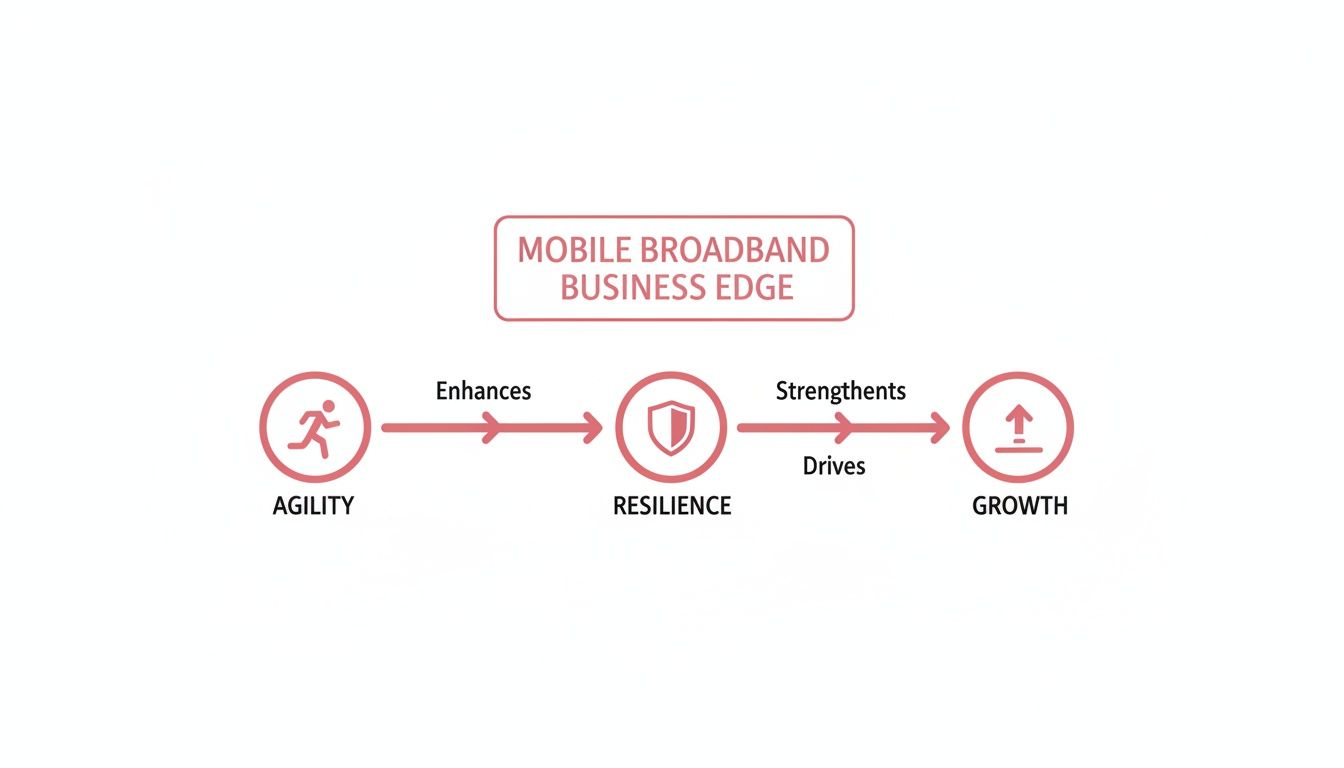
These professional-grade features are what give a business the foundation for genuine agility, resilience, and growth.
Business Mobile Broadband vs Consumer Mobile Data
To really hammer home the difference, it helps to see a direct comparison. The table below lays out the practical distinctions that IT managers and business owners should consider when deciding on their connectivity strategy.
| Feature | Consumer Mobile Data | Business Mobile Broadband |
|---|---|---|
| IP Address | Dynamic (changes frequently) | Static (fixed and reliable for hosting) |
| Hardware | Basic Mi-Fi dongles or smartphone tethering | Durable routers, options for external antennas |
| Support | Standard consumer call centres with limited hours | Dedicated business support with faster response times |
| Service Guarantee | None; "best effort" service | Formal Service Level Agreement (SLA) guaranteeing uptime |
| Security | Basic, designed for personal use | Advanced options like VPN integration and private APNs |
| Network Management | Subject to network congestion and traffic shaping | Prioritised traffic and superior network management |
Ultimately, the choice comes down to purpose. Consumer mobile data is built for convenience, while business mobile broadband is engineered for continuity. One is a handy tool for casual access; the other is a critical piece of infrastructure designed to protect your revenue and reputation.
Viewing a professional service not as an expense but as an investment in operational resilience is the first step toward building a connectivity setup that can truly support your business goals.
Real-World Scenarios Driving Business Success
Let's move beyond the technical jargon and see what mobile broadband looks like in the real world. Its true value isn't just in the specs, but in how it solves everyday problems, gets you out of a tight spot, and opens up new opportunities for growth. Here are four tangible scenarios where UK businesses are using it to do more than just get by—they're getting ahead.

Unbreakable Business Continuity
Imagine an accountancy firm in Dorset during the frantic final weeks of tax season. Their whole operation—cloud software, client emails, digital submissions—is completely dependent on their internet connection. Then, the worst happens: their fixed-line broadband goes down due to a fault at the local exchange.
In a typical setup, this would be a disaster. Hours of downtime, missed deadlines, and a major blow to their professional reputation. But with a managed mobile broadband failover system, the switch is so seamless, nobody even notices. The office router instantly detects the outage and reroutes all traffic through its built-in 4G/5G connection.
For the accountancy firm, this means zero interruption. Staff carry on working, deadlines are met, and clients remain blissfully unaware of the near-disaster. This isn't just a backup; it's a fundamental pillar of modern business resilience.
This seamless transition highlights just how much we've come to rely on mobile networks for mission-critical work. The numbers back it up, too. In 2025, UK mobile data consumption shot up by 18% over the previous year. It's businesses in sectors like professional services and retail driving this growth as they increasingly turn to mobile for both continuity and primary connectivity. For a deeper dive, you can explore the full Ofcom report on the UK's mobile data consumption trends.
Empowering Remote and Hybrid Teams
Now think of a forward-thinking consulting firm in Hampshire. They have specialists working from home offices all over the country. Relying on each employee's personal home Wi-Fi is a recipe for trouble—it introduces major security risks and performance headaches, which is a non-starter when you're handling sensitive client data.
The solution? The firm provides every consultant with a dedicated business-grade 4G/5G router. This simple device creates a secure, managed link straight to the company network, completely isolated from the employee’s home internet.
This strategy pays off in several key ways:
- Enhanced Security: All business traffic is channelled through a secure VPN, shielding confidential information from the weak points of a shared home network.
- Guaranteed Performance: The business connection isn't fighting for bandwidth with Netflix or online gaming, ensuring video calls and large file transfers are always smooth.
- Simplified IT Management: The IT team can manage and monitor every device from a central point, pushing out security updates and fixing issues without ever having to touch an employee's personal network.
This approach turns remote working from a potential liability into a secure, productive asset, giving the consultancy a real advantage in attracting and keeping top talent.
Instant Connectivity, Anywhere
A boutique retail brand decides to open a pop-up shop at a summer festival in Somerset. They need a rock-solid way to process card payments, track stock in real time, and maybe even offer guest Wi-Fi. The catch? They're in a field with no existing infrastructure, and waiting weeks for a traditional line installation just isn't an option.
By deploying a mobile broadband router, they're up and running the moment they set up their stall. The router provides reliable, business-grade connectivity for their Point of Sale (POS) systems and stock management tablets.
The result is a professional and smooth experience for every customer. Payments go through instantly, stock levels are always accurate, and the business can capitalise on sales opportunities that would otherwise have been missed.
Powering the Internet of Things
Finally, let’s look at a logistics company with a fleet of delivery vehicles crisscrossing Wiltshire and beyond. To optimise routes, monitor vehicle health, and keep drivers safe, they need a constant stream of real-time data from every single truck.
Each vehicle is fitted with a rugged mobile broadband router that's connected to a whole suite of IoT sensors. These sensors constantly send data back to head office, which allows them to:
- Track Vehicles in Real-Time: For smarter dispatching and giving customers accurate delivery times.
- Get Predictive Maintenance Alerts: Engine diagnostics can flag a potential fault before it leads to a costly breakdown on the motorway.
- Monitor Driver Behaviour: To promote safer driving habits, which in turn helps reduce fuel consumption.
This use of mobile broadband for business turns their fleet into a smart, data-driven machine, cutting running costs and drastically improving their service. It’s a perfect illustration of how mobile data is becoming the engine for the next wave of business efficiency.
How to Choose the Right Provider and Plan
Choosing the right mobile broadband for your business can feel like navigating a minefield, but it doesn't have to be. It all boils down to getting four things right: network performance, data allowances, hardware, and the support agreement. Nail these, and you’ll have a solution that truly works for you, not just an off-the-shelf product that causes headaches later.
The first, and most important, step is to check performance where it actually counts. Don't just punch your head office postcode into a coverage map and call it a day. You need to know the signal strength for every single critical location—from your remote workers' homes to that new pop-up shop or temporary building site.
Assess Network Performance and Coverage
Here in the UK, you’re looking at the big four: EE, O2, Vodafone, and Three. Each has its own particular strengths and blind spots. A provider might deliver blistering 5G speeds in central Manchester but offer a patchy 4G signal in rural Yorkshire. That’s why you have to do your own homework.
Before you even think about signing a contract, use the providers' online coverage checkers for every relevant address. For really critical locations, it’s worth asking for a trial SIM card or even a professional site survey to test real-world speeds and reliability. In the UK market, providers are constantly fighting to keep customers, so weighing up their network quality against their business service offerings is key to finding the best fit.
The UK market is quite concentrated, with O2 holding the largest customer share at 27.4%. EE is hot on their heels at 24.9%, followed by Vodafone at 20% and Three at 12.1%. Knowing this helps you understand which providers are investing most heavily in the business sector.
Decode Data Allowances and Fair Use Policies
Next, you need to get real about how much data you actually use. You’ll see the word "unlimited" thrown around a lot, but it almost always comes with a Fair Use Policy (FUP). This is the small print that allows a provider to throttle (deliberately slow down) your connection if you use "too much" data. Imagine that happening in the middle of a critical business operation—it could be disastrous.
To avoid falling into this trap, start by auditing your current data usage. If you’re setting up a simple failover connection, your needs will likely be low. But if it's for a team of remote staff constantly on video calls and using cloud apps, you’ll need a plan with a hefty, clearly defined allowance.
Always ask for the specific details of a provider's Fair Use Policy. A reputable business provider will be completely transparent about data caps or traffic management policies. This allows you to choose a plan that matches your real-world needs without risking unexpected slowdowns.
Match Hardware to Your Specific Needs
The router or device you use is just as important as the plan itself. The right choice depends entirely on what you're using it for.
- Portable Mi-Fi Devices: These are small, battery-powered hotspots perfect for individuals or small teams on the move. They’re incredibly flexible but often lack the signal strength and features of a dedicated router.
- Desktop 4G/5G Routers: These are the workhorses. They’re ideal for office failover, remote offices, and temporary sites. They’re much more powerful than Mi-Fi devices, provide Ethernet ports for wired devices, and come with more robust security features.
- Externally Mounted Antennas: For any location with a weak indoor signal, an external antenna can be a complete game-changer. These are fitted professionally to the outside of a building and wired to the router inside, giving your signal strength and stability a massive boost.
Prioritise SLAs and Business Support
Finally, if this connection is for anything mission-critical, a Service Level Agreement (SLA) is absolutely non-negotiable. An SLA is your contract with the provider, a formal guarantee that outlines their commitment to uptime, performance, and support. This is something you simply won't get with a consumer-grade service.
When you’re looking at an SLA, check for these specifics:
- Guaranteed Uptime: What percentage do they promise? You should be looking for figures like 99.9%.
- Support Response Times: If something goes wrong, how quickly will they respond and fix it?
- Hardware Replacement: What’s the process if your router fails?
Choosing a provider is a big decision, and many of the same principles apply as when you're selecting a fixed-line service. For more insight, take a look at our guide on how to choose an internet provider. A solid SLA and responsive business support are what elevate a simple mobile connection into a truly reliable piece of your business infrastructure.
Implementing a Secure and Resilient Network

When you're rolling out a mobile broadband business solution, security and resilience can't be afterthoughts. They need to be baked into the design from the very beginning. A professional setup ensures your wireless connection is every bit as robust and secure as a fixed line, protecting your data and keeping your business running, no matter what.
This takes a bit of strategy. It’s about moving beyond simply "getting online" and creating a network that's both tough and intelligent. Let's look at the key pieces you need to get this right.
Protecting Data in Transit
As soon as data leaves your device and travels over a mobile network, it's out in the open. For any business—especially those with remote staff handling sensitive client details—keeping that data safe while it's on the move is an absolute priority.
This is where a Virtual Private Network (VPN) comes in. Think of it as creating a secure, encrypted "tunnel" through the public internet. It scrambles the data, making it completely unreadable to anyone who might try to snoop. For your remote team, this means they can securely access company servers and files just as if they were sitting at their desk in the office.
A business-grade mobile broadband solution should always be configured with a robust VPN. This isn't just a technical feature; it's a critical security measure that safeguards your company's intellectual property and maintains client confidentiality.
Advanced Network Control and Management
The router you get from a high street shop offers basic controls, but business-grade hardware gives you the professional tools you need to properly manage your network. These devices provide granular control over how your connection is used, which is vital for both security and performance.
Key features to look for include:
- Content Filtering: This lets you block access to non-work-related or malicious websites, which helps reduce the risk of malware and keeps your team on task.
- Traffic Shaping: You can prioritise bandwidth for your most important applications. For instance, you can guarantee your VoIP calls and video conferences get the speed they need, even if someone else is downloading a massive file.
These tools transform your router from a simple internet gateway into a smart controller for your network. For a deeper dive into protecting your connections, you might find our guide on securing your wireless network useful.
The Importance of a Static IP Address
One of the biggest distinctions between consumer and business mobile broadband is the option for a static IP address. A consumer plan typically gives you a dynamic IP that changes all the time, but a static IP provides a fixed, permanent address for your business online.
This is a non-negotiable for any company that needs to:
- Host its own servers for email, websites, or specialised business software.
- Provide secure remote access for staff to connect to office systems.
- Remotely manage on-site equipment like CCTV cameras or building control systems.
A static IP ensures these critical services are always available at the same address, providing the reliability you need for professional operations.
Seamless Integration with Your Existing IT
For many businesses, mobile broadband acts as an insurance policy—a failover solution ready to kick in if the primary fixed line goes down. The trick is to make this integration completely seamless and automatic, with no need for someone to flick a switch.
This is usually handled by a dual-WAN router or more advanced SD-WAN (Software-Defined Wide Area Network) technology. These smart devices can manage both your primary fibre line and your 4G/5G mobile connection at the same time. The moment the router senses a problem with the main line, it automatically reroutes all internet traffic through the mobile backup. The switch is so fast your team won't even notice, ensuring true business continuity.
Let SES Computers Manage Your Mobile Broadband
Choosing the right technology is one thing, but getting it installed and working perfectly is a whole different ball game. It’s easy to think about using mobile broadband for your business, but turning that idea into a stable, secure, and lightning-fast connection takes real expertise. That’s precisely where we come in.
Going it alone might look like it'll save you a few quid upfront, but it often ends in headaches. You can quickly run into everything from weak signals to glaring security holes. A managed service from SES Computers, on the other hand, gives you a complete, professionally managed solution built around your exact needs. Think of it as an investment in guaranteed uptime and total peace of mind.
Our Proven Four-Step Process
We’ve spent years honing a straightforward, effective process for deploying managed mobile broadband solutions. We take care of every last technical detail so you can focus on what you do best: running your business.
Our structured approach means no stone is left unturned:
-
Discovery and Site Survey: It all starts with a conversation. We get to grips with your business and what you need the connection for. Then, our engineers conduct a professional on-site survey to find the strongest network signal and the perfect spot for the equipment. This step is crucial for guaranteeing the best possible performance.
-
Tailored Hardware and Configuration: Armed with data from the survey, we select and pre-configure the right combination of routers, SIMs, and high-gain antennas for your location. This completely removes the guesswork and ensures all the kit works together seamlessly.
-
Professional On-Site Installation: Our engineers handle the entire installation from start to finish. We’ll fit external antennas, run cabling discreetly, and connect the new system into your existing network. The goal is a smooth, clean deployment with zero disruption to your team.
-
Proactive Monitoring and UK-Based Support: This is where you see the real value of a managed service. We don't just 'fit and forget'. We actively monitor your connection’s health and data usage, apply essential security patches, and provide fast, expert support from our UK-based team whenever you need us.
By managing the entire process—from that first survey to ongoing support—we deliver a level of reliability and performance that’s incredibly difficult to achieve on your own. It’s this proactive management that turns a simple internet connection into a rock-solid business tool.
Ultimately, choosing a managed solution is about reducing risk and getting the most value from your investment. The expertise offered by established managed services providers in the UK ensures your connectivity is always robust, secure, and fully supported. You get a partner dedicated to keeping you online, freeing you and your team to focus on what truly matters.
Frequently Asked Questions
When you're exploring mobile broadband for your business, a few practical questions always seem to pop up. Let's tackle some of the most common ones to help you see how this technology fits into the real world and make a better decision for your company.
Is 5G a Viable Replacement for Office Fibre?
For many businesses, the answer is a definite "maybe," leaning more and more towards "yes." Modern 5G mobile broadband can deliver some seriously impressive speeds, often matching or even beating what you'd get from a traditional fibre line. This makes it a fantastic option for your main office connection, especially if you're in an area where getting fibre installed is a slow, painful process.
But it’s not a simple swap. Your specific needs really dictate the answer here. While 5G brings incredible speed and responsiveness to the table, you have to consider things like how consistent the signal is in your exact location and whether the network gets bogged down at peak times. For example, a creative agency that needs to upload large video files would need to verify that the local 5G network offers consistently high upload speeds throughout the working day.
How Much Data Does a Business Use on Failover?
This is a big worry for many, but the truth is, a properly set-up failover link uses very little data. Think of it as your business's emergency service – it sits quietly in the background, only kicking in when your main internet connection goes down. When it does, it's just handling the essentials: emails, phone calls, and access to your crucial cloud apps.
A typical small business might only burn through a few gigabytes of data a month on its failover connection, simply because outages (hopefully!) aren't a daily event.
For example, an accountancy firm that suffers a two-hour fibre outage would likely use less than 10GB to keep its core cloud systems and communications running. The trick is to have a plan that can handle a worst-case scenario without you getting hit with eye-watering extra charges.
What Is the Real Difference in Routers?
The gap between a consumer router you'd pick up from a high-street shop and a business-grade one is massive. It all comes down to reliability, security, and control.
- Durability and Signal: Business routers are built like tanks with better components. They also typically support external antennas to pull in the strongest possible signal, giving you a much more stable connection.
- Security Features: This is a big one. They come with advanced security tools like built-in VPN support, powerful firewalls, and content filtering that you just don't get with consumer models.
- Advanced Control: Business hardware gives you granular control over your network. You can prioritise traffic for critical applications, ensuring your video calls or payment systems always get the bandwidth they need.
At the end of the day, a business router is a professional tool engineered for maximum uptime and security. A consumer device is just built for convenience at home.
Ready to get a reliable, high-performance mobile broadband solution for your business? SES Computers offers managed services that take all the complexity off your plate, from professional site surveys to ongoing support. Contact us today and let's make sure your business stays online, no matter what.