For many UK businesses, outsourcing the IT department has moved far beyond a simple cost-cutting exercise. It is now a fundamental strategic play for building resilience and fuelling growth. The basic idea is simple: you hand over your technology management to a specialist provider. This frees you up to concentrate on what you do best, without getting bogged down by the complexities of IT.
The Strategic Shift to Outsourcing IT
Deciding to bring in an external IT partner is a big step for any small or medium-sized enterprise (SME). A good way to think about it is like hiring a master electrician for a complex wiring job. You could try to figure it out yourself, but a specialist will get it done faster, safer, and to a much higher standard. Your company's technology is no different.
When you partner with a specialist, you can get back to focusing on your day-to-day business, whether you’re running an accountancy firm in Hampshire or a care home in Dorset. Your team’s energy should be spent on looking after clients and winning new business, not troubleshooting server problems or worrying about software patches. This is not just about offloading a task; it is about gaining a genuine strategic partner.
Why More UK Businesses Are Making the Change
The move towards outsourcing is picking up serious steam. Recent studies show that in 2025, a huge 57% of UK organisations are planning to increase their outsourcing. What is really telling is that 80% of small firms (those with 10-49 employees) are set to do the same.
The reasons are pretty clear-cut. 65% say it helps them focus on their core business, while 63% point directly to cost savings. This is not just a trend; it is a significant shift in how businesses are thinking about their operations. They are realising that tapping into external expertise is a smart way to become more agile and competitive.
By outsourcing IT, a business gets far more than just tech support. It gains a dedicated team of specialists whose entire job is to make sure the technology lines up perfectly with the company's commercial goals, from locking down cybersecurity to enabling seamless growth.
The Core Drivers of IT Outsourcing
So, what is really pushing businesses towards this model? It goes deeper than just cost and focus. Outsourcing solves some of the most common headaches that SMEs face every day.
- Access to Specialised Skills: You instantly get access to certified experts in areas like cybersecurity, cloud computing, and modern VoIP phone systems, all without the eye-watering cost of hiring and training them yourself. For example, a law firm needing to ensure client data confidentiality gains immediate access to cybersecurity professionals who are experts in data encryption and threat detection.
- Enhanced Scalability: Need to grow or shrink your operations? An outsourced partner makes it easy. You can scale your IT support up or down as needed. For instance, an architecture practice can quickly add ten new users and workstations for a major project, then scale back down once the project is complete, without long-term overheads.
- Improved Security and Compliance: A dedicated partner means your systems are monitored around the clock, keeping you safe from threats and ensuring you stay compliant with regulations like GDPR. For more information, read our article: https://www.sescomputers.com/news/managed-service-it/
If you want to explore how to leverage external IT partners effectively, this strategic guide to IT outsourcing development is a great resource. It correctly frames the decision not as a reluctant expense, but as a proactive investment in your company’s future.
Comparing IT Outsourcing Models for Your Business
Choosing the right way to outsource your IT is not a one-size-fits-all decision. The best model for you hinges on your current set-up, the skills you already have in-house, and where you want your business to be in the long run. Let's break down the three main ways businesses partner with an IT provider, each with its own structure and purpose.
Getting your head around these options is the first step toward building a partnership that genuinely works. Each one offers a different balance of integration, control, and responsibility, so it is vital to pick the one that truly aligns with what your business needs.
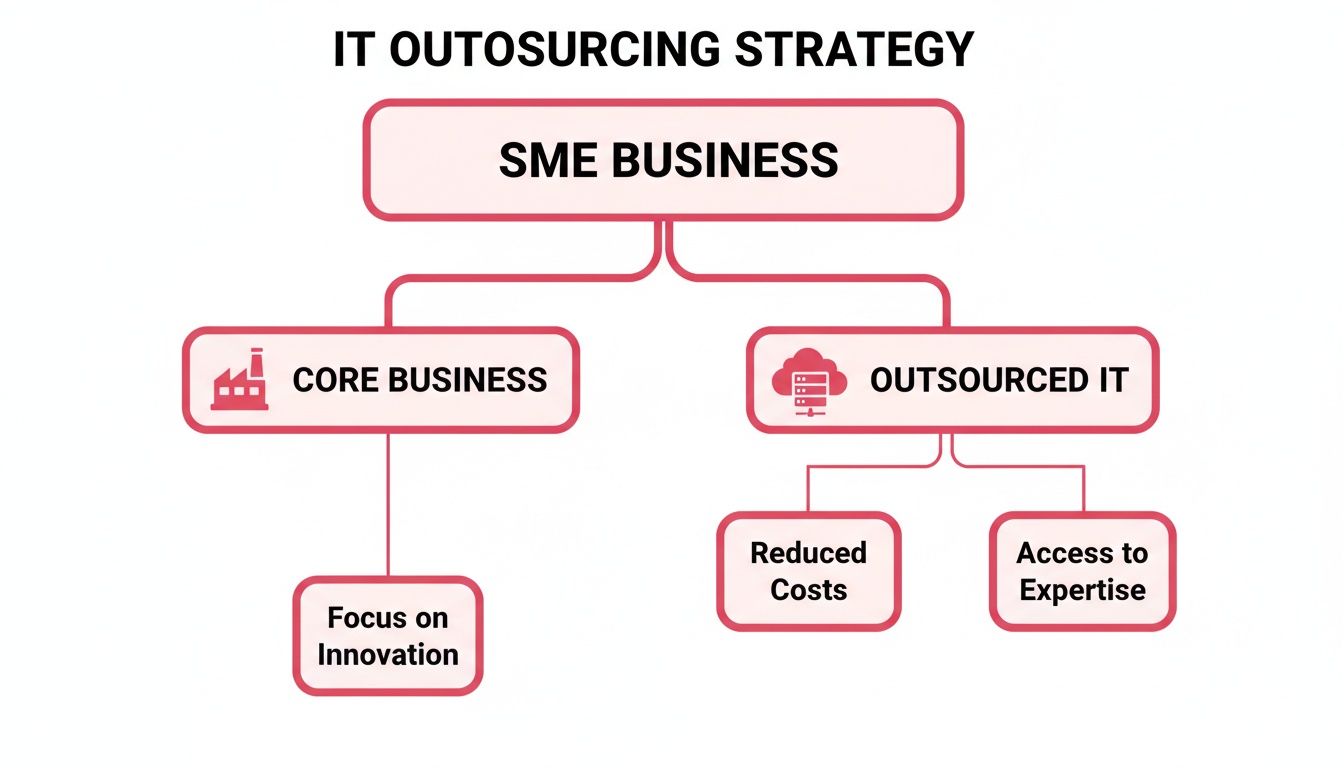
This diagram shows how outsourcing fits into an SME's structure. The idea is to let you focus on your core business while a specialist team handles the technology that supports it.
Fully Outsourced IT
The most all-encompassing option is the fully outsourced IT model. Think of it like hiring a dedicated facilities management company to look after your entire building. You would not hire a separate plumber, electrician, and cleaner—you would engage one firm to handle everything from maintenance to security, leaving you free to get on with business.
In this model, your IT partner takes complete ownership of your technology. They manage your servers, support your team, secure your network, and provide the strategic guidance you need to grow. It’s the perfect solution for businesses with no internal IT staff or those that want to completely hand over the reins of technology management.
A Salisbury-based law firm, for instance, is an ideal candidate. Their expertise is in legal services, not network administration. Outsourcing gives them round-the-clock support and robust cybersecurity without the cost and distraction of building an in-house team.
Co-Managed IT
The co-managed IT model is a completely different beast. It is not about replacing your IT team; it is about empowering them. This is like bringing in a specialist structural engineer to work alongside your trusted construction crew on a tricky part of a project. Your team handles the day-to-day, while the specialist brings high-level expertise and advanced tools to the table.
This partnership works wonders for businesses that already have an IT manager or a small team that is stretched thin. Your internal staff can focus on immediate user support and on-site tasks, while the external partner handles complex areas like cybersecurity monitoring, server management, and long-term planning. It is a powerful blend of your team's on-the-ground knowledge and the deep resources of a dedicated IT provider.
Co-managed IT creates a powerful synergy. Your internal team provides essential business context, while the outsourced partner delivers specialised skills and advanced security tools that would be too expensive to acquire independently.
Staff Augmentation
Finally, we have staff augmentation. This is the most targeted approach and is typically used for a fixed period. It is like hiring a freelance architect for a single project, such as designing a new office extension. They come in, apply their specific skills to achieve a defined goal, and the engagement ends when the project is finished.
This model is all about filling a temporary skills gap or getting extra hands on deck for a specific, time-bound project. A business might use staff augmentation to bring in a certified expert for a complex cloud migration or a major software roll-out. It gives you the exact expertise you need, precisely when you need it, without the long-term commitment of a permanent hire.
IT Outsourcing Models at a Glance
To help you see the differences more clearly, this table breaks down the three models, comparing their ideal use cases, cost structures, and the level of control you can expect.
| Model | Best For | Level of Control | Cost Structure | Example Scenario |
|---|---|---|---|---|
| Fully Outsourced | Businesses with no internal IT staff or those wanting to offload all tech responsibilities. | Strategic control; day-to-day management is delegated to the partner. | Fixed monthly fee for a comprehensive service package. | A care home provider outsources all IT to ensure 24/7 system uptime and data compliance. |
| Co-Managed | Companies with an existing IT team that needs additional support, expertise, or resources. | High; your team works collaboratively with the external partner. | Fixed monthly fee for specific services (e.g., security, server monitoring). | A manufacturing firm's IT manager uses a partner for cybersecurity and cloud backup. |
| Staff Augmentation | Organisations needing specialised skills for a specific, short-term project. | Direct project control; you manage the augmented staff member. | Billed hourly or on a per-project basis for a specific scope of work. | An accountancy practice hires a specialist for a three-month data migration project. |
Each model serves a distinct purpose. The key is to assess your internal capabilities and strategic goals honestly to find the partnership that will deliver the most value.
The Real Business Benefits of an IT Partner
Let's move past the theory and look at what an outsourced IT partnership actually does for your business. While lower costs are often the first thing people think of, the real financial upside is much bigger than just saving on a salary. You are also cutting out the hidden costs – the relentless cycle of recruitment fees, continuous training, software licences, and hardware upgrades.
This is a strategic shift. You’re freeing up capital that would otherwise be tied up in depreciating IT gear and staff development. Instead of a hefty upfront investment, your IT becomes a predictable operational expense. This makes budgeting and financial forecasting far more straightforward.
Immediate Access to a Deep Pool of Expertise
One of the biggest wins is getting a whole team of specialists on your side from day one. Trying to build an in-house team that is truly expert in everything from cybersecurity and cloud architecture to modern telephony is a slow, costly, and often frustrating exercise. Outsourcing lets you sidestep that entire challenge.
Think about it. Say you need a certified 3CX telephony expert to overhaul your communication systems. Instead of spending months searching for the right person, an IT partner brings that expertise to the table immediately. Your business can adopt new tools and solve tricky problems much faster, without the drag of a drawn-out hiring process.
Here’s a real-world example: a financial advisory firm in Wiltshire needed to upgrade its client relationship management (CRM) system while ensuring compliance with Financial Conduct Authority (FCA) regulations. Rather than trying to upskill their staff, they engaged a partner with proven experience in both the specific software and the regulatory landscape, ensuring a smooth and compliant transition.
Effortless Scalability and Business Agility
Your business is not static, so why should your IT be? A good IT partner gives you the flexibility to adapt on the fly. Your technology support can scale up or down right alongside your business activity, meaning you only ever pay for what you are actually using.
This kind of agility gives you a real competitive edge.
- Seasonal Demand: A retail business in Dorset can instantly boost its e-commerce server power and support team for the Christmas rush, then scale everything back in January without being stuck with unnecessary overheads.
- Business Growth: As you take on new staff, your IT partner can get them set up with new accounts, hardware, and software access in no time, making onboarding a breeze. For a professional services firm, this means a new consultant can be client-ready and billable from their first day.
- Project Work: If a big, data-heavy project lands on your desk, you can temporarily increase your storage and processing capacity without getting locked into a long-term contract.
The ability to scale on demand transforms IT from a fixed, cumbersome overhead into a flexible resource that directly supports your business’s rhythm and growth trajectory. This is a level of agility that is almost impossible to achieve with a fixed in-house team.
Sharpening Your Focus on Core Operations
Perhaps the most valuable benefit of all is the focus it gives back to your business. Every minute your team spends trying to fix a server issue, wrestling with a software glitch, or worrying about data compliance is a minute they are not spending on winning new clients or driving the business forward.
Take a legal practice in Somerset. Their job is to provide expert legal advice, not to manage IT infrastructure. By handing over their tech management, they can dedicate more billable hours to their clients, safe in the knowledge that their systems are being proactively managed and secured by specialists. That translates directly into more revenue and happier clients.
To explore how external partnerships can drive efficiency, it is worth reading up on the benefits of offshore outsourcing. The core idea is the same: when you delegate functions that are not central to your mission, you free up your team to do what they do best.
Strengthening Your Cybersecurity and Compliance
For many small and medium-sized businesses, keeping up with cybersecurity can feel like an endless game of cat and mouse. The threats are constantly evolving, the technology is bewilderingly complex, and the fall-out from a breach can be catastrophic. When you outsource your IT, however, that persistent worry can be transformed into one of your greatest strengths.
Think of your IT partner as the dedicated security team for your entire digital operation. They are the ones building the defensive walls and staffing the watchtowers 24/7, giving you a level of protection that is simply not feasible for most in-house teams. It is about far more than just installing antivirus software; it is about having specialists who are actively hunting for threats, managing vulnerabilities, and monitoring your systems around the clock.
Navigating Complex Regulations Like GDPR
Compliance is another headache that just will not go away, especially with stringent regulations like the General Data Protection Regulation (GDPR). Staying on the right side of the law is not just a box-ticking exercise—it is fundamental to keeping your clients’ trust and avoiding eye-watering fines. A good IT partner takes the guesswork out of the equation.
They already know the technical ins and outs of protecting personal data, from implementing robust access controls and data encryption to maintaining the detailed logs required to prove compliance. Better yet, by partnering with a provider that uses UK-hosted infrastructure, you can rest assured that your data is stored securely and in line with data sovereignty laws. This is particularly crucial for businesses in sensitive sectors like professional services or care.
If you want to understand more about what this involves, take a look at our overview of cybersecurity services for small businesses.
Proactive Defence and Disaster Recovery
One of the most significant shifts you will experience when outsourcing your IT is moving from a reactive "break-fix" approach to a proactive, strategic one. Instead of just waiting for something to go wrong, your partner is constantly working to prevent problems from ever occurring in the first place. This is clearest when it comes to backups and disaster recovery.
Automated, secure cloud backups are the foundation of this strategy. Your critical data is regularly copied to a secure, off-site location, ensuring a complete and recent version is always ready to go. But having a backup is one thing; knowing you can actually use it when disaster strikes is another.
An outsourced IT partner does not just set up backups; they create and regularly test a full disaster recovery plan. This plan is a detailed playbook that ensures if the worst happens—be it a cyberattack, hardware failure, or natural disaster—your business can be back online with minimal disruption and data loss.
Let's look at a real-world scenario. A Wiltshire-based accountancy firm was hit by a ransomware attack that encrypted all of their on-site servers, including critical client financial data. This could have easily been a business-ending event. But because their outsourced IT partner had implemented a robust cloud backup and disaster recovery plan, the incident was contained. The team restored the systems from a clean backup taken just hours before the attack, turning weeks of potential downtime into a single afternoon of disruption.
This is the real value of outsourcing IT. It is not just about day-to-day support; it is about building a resilient business that can withstand modern threats and keep moving forward. This security-first approach protects your data, your reputation, and ultimately, your bottom line.
How to Choose the Right IT Outsourcing Partner
Picking a partner to handle your IT is not just another procurement decision; it is one of the most critical moves you’ll make for your business. You are not just hiring a supplier. You are bringing in a strategic ally who will be responsible for the technology that keeps your entire operation running. The right choice can propel you forward, while a poor fit will lead to endless frustration and costly disruptions.
To get this right, you need to go beyond the glossy brochures and sales pitches. It is about digging into the details of how they actually work and asking the tough questions that reveal their real capabilities, their grasp of your business, and their commitment to service.
Technical Expertise and Industry Knowledge
First things first: do they have the right technical chops? A potential IT partner must have proven, hands-on experience with the specific software, hardware, and platforms your business depends on every single day. A generic, one-size-fits-all skill set just will not cut it. You need specialists who genuinely understand your world.
Think about it this way: an accountancy firm in Somerset has completely different IT needs from a manufacturing plant in Wiltshire. The accountants rely on specialised financial software and need iron-clad data security to protect sensitive client information. The manufacturer, meanwhile, needs support for complex factory floor systems and a rock-solid network to keep production lines moving.
Here’s what you should be asking:
- Software and Systems: Can you show us concrete proof of your experience supporting our core applications, like our CRM or accounting software?
- Certifications: Are your engineers currently certified for key technologies we use, such as Microsoft 365, VMware, or 3CX telephony?
- Industry Experience: Have you worked with other businesses in our sector before? Give us some examples of how you’ve tackled problems specific to our industry.
Local Presence and Service Levels
Remote support is great for handling day-to-day tickets, but you cannot underestimate the value of having someone local. When a critical server dies or your entire network goes down, you need a partner who can be there, on-site, to get you back in business fast.
A provider's proximity is a huge indicator of how quickly they can respond in a real emergency. Choosing a partner with engineers based in your region—like Dorset or Hampshire—guarantees a faster response when every minute counts.
Before you even think about signing a contract, you need absolute clarity on their service level agreement (SLA). This is not just a piece of paper; it is their promise to you. It should spell out their commitments in plain English, including guaranteed response times for different issues and the penalties if they fail to meet them. A vague SLA is a massive red flag.
Communication and Cultural Fit
Finally, you need to figure out if you can actually work with these people. The most brilliant technical minds are useless if they speak in impenetrable jargon and their reports leave you more confused than when you started. A good partner should feel like a natural extension of your own team.
Look for a provider that values transparency. They should give you regular, jargon-free reports that clearly show what they’ve been working on and how your systems are performing. Pay close attention to how they act in your initial meetings. Are they listening to your concerns, or just pushing a pre-packaged solution? Trustworthy client testimonials and case studies are also goldmines for understanding their reputation and the real quality of their service.
Ensuring a Smooth Transition to Outsourced IT

The idea of handing over the keys to your IT kingdom can feel a bit nerve-wracking. But a successful move to an outsourced IT partner is not a disruptive upheaval; it is a carefully managed project. A structured transition means you start seeing value from day one and your daily operations barely notice a change.
The whole process is best handled in four distinct phases. Each stage builds on the last, creating a clear, logical path from where you are now to a fully supported and optimised IT environment. Think of it as a joint effort, where clear communication between your team and your new partner is the most important ingredient.
Phase 1: Discovery and Assessment
The journey always starts with a deep dive into your existing technology. Your new partner will conduct a thorough audit to get their head around every piece of your set-up—from hardware and software to network maps and security protocols. This is not just about looking for problems; it is about understanding what is working well and spotting opportunities to make things better.
To speed this along, it really helps to have some key information ready.
- Documentation: Pull together any network diagrams, software licence details, and lists of your main IT assets.
- Key Personnel: Pinpoint the go-to people in your business who know the ins and outs of specific systems.
- Pain Points: Be prepared to talk openly about the biggest IT headaches and frustrations your team faces.
Phase 2: Strategic Planning
Once there is a complete picture of your current set-up, the next step is to build the roadmap. This strategic plan maps out the "how" and "when" of the transition. It is a document you build together, aligning the partner’s technical advice with your business goals to make sure everyone is pulling in the same direction.
The plan should clearly lay out the project timeline, key milestones, and who is responsible for what. It will also nail down the specifics of the service level agreement (SLA), confirming exactly what to expect in terms of response times and support. This is your blueprint for a seamless handover. For a deeper look at this, our guide on effective IT change management processes offers some great insights.
Phase 3: Migration and Onboarding
This is where the plan springs to life. The migration phase involves the practical transfer of responsibility. For a busy professional services firm, for instance, we would typically schedule this out of hours or over a weekend to guarantee zero operational downtime.
A well-managed migration is almost invisible to your team. The goal is for them to leave work one day and return the next to find their systems running faster and more reliably, with a new, friendly support team ready to help.
During onboarding, we introduce your staff to the new way of working. This means showing them how to raise a support ticket, who to call for different issues, and what they can expect from us. Communication here is everything; we want everyone to feel confident from the very start.
Phase 4: Ongoing Management and Optimisation
The transition is not over just because the switch has been flipped. The final, ongoing phase is all about continuous improvement. Your partner will proactively monitor your systems 24/7, applying patches, managing threats, and making sure everything is running as it should.
Regular strategic reviews are a core part of this. These meetings are a chance to look at system performance, go over security reports, and plan for what is next. This constant dialogue ensures your IT strategy keeps pace with your business, delivering real value long after the initial project is complete.
Common Questions About Outsourcing Your IT
Deciding to bring in an IT partner is a big step, so it is only natural to have a few questions. It is a major business decision, and you need to feel confident before you commit. We have put together answers to some of the most common queries we hear from businesses just like yours.
Getting this right is crucial. The answers below are straightforward and designed to cut through the jargon, tackling the key concerns many business owners have.
Is Outsourcing IT Really Cheaper Than Hiring In-House?
For most small and medium-sized enterprises, the answer is a clear yes. You might see a single monthly fee for an outsourced service, but that one figure replaces a whole host of separate, often unpredictable, in-house costs. You completely sidestep the expenses tied to recruitment, salaries, National Insurance, pensions, and continuous training.
But it goes deeper than that. You also save on the hefty capital investment needed for server hardware, sophisticated monitoring software, and specialist diagnostic tools. When you partner with a provider, you get a whole team of certified experts for a fixed price—often just a fraction of what it would cost to hire even one or two full-time specialists with the same breadth of knowledge.
Will I Lose Control Over My IT Operations?
This is a common worry, but the reality is quite the opposite. You are not losing control; you are swapping the day-to-day technical firefighting for high-level strategic oversight. A good IT partner does not just take over and lock you out. Think of them as a natural extension of your business, managing the time-consuming technical work that pulls you away from what you do best.
You still set the direction and sign off on the strategy. Your partner gives you clear, easy-to-understand reports on system performance, security, and project progress, so you always know what is going on. This frees you up to focus on the bigger picture: how to use technology to drive efficiency, serve your clients better, and hit your business goals.
Outsourcing is not about surrendering control; it is about redirecting it. You move from managing technical problems to steering your technology strategy, with an expert team handling the implementation.
How Secure Is My Data With An Outsourced Provider?
A specialist IT provider can almost always deliver a higher level of security than an SME can manage on its own. They have dedicated cybersecurity teams focused entirely on spotting and stopping threats, using advanced tools that are simply too expensive for most individual businesses to buy.
These partners live and breathe regulatory requirements like GDPR and make sure your data is protected 24/7 in secure, UK-based data centres. Their entire business reputation is built on their ability to protect client data, so they invest heavily in multi-layered security, proactive monitoring, and solid disaster recovery plans to keep your information safe.
What Does The Onboarding Process Look Like?
A professional onboarding process should feel smooth and cause minimal disruption. It all starts with a deep dive into your current set-up. The provider will audit your systems to get a handle on your infrastructure, how your team works, and where the current pain points are.
From there, you will work together to create a strategic plan with a clear timeline for the switch. The actual transition is managed carefully, often scheduled outside of normal business hours, to make sure your team experiences no downtime. Throughout the process, they will keep you in the loop, so everyone knows what is happening and feels supported right from the start.
Ready to gain the strategic advantages of an expert IT partner? For over 30 years, SES Computers has provided businesses across Dorset, Hampshire, and Wiltshire with reliable, proactive managed IT support. We transform your technology from a daily headache into a powerful asset for growth. Learn more about our managed IT services and get a no-obligation consultation today.