Are you looking ahead to the 2027 PSTN switch-off and wondering what it all means? At the centre of this change is the Voice over IP (VoIP) handset. It’s your essential upgrade, designed to turn your voice into digital data and route calls over the internet, leaving those outdated copper wires behind. This shift is about more than just compliance; it’s about unlocking crystal-clear calls, powerful features, and a new level of flexibility for your professional services firm.
What is a Voice over IP Handset?
At first glance, a VoIP handset might look just like the traditional telephone that’s been on your desk for years. Under the bonnet, however, it’s a completely different beast. Think of it as the hub for your business's modern, digital conversations. Instead of plugging into an old-fashioned phone socket tied to a physical copper line, a VoIP handset simply connects to your office's internet network.
This seemingly small change completely transforms how calls are handled. A traditional phone sends your voice as an analogue signal down a dedicated wire—a bit like posting a physical letter. A VoIP handset, on the other hand, converts your speech into neat packets of digital data and sends them instantly across the internet, just like an email. For a busy law firm, this means every client call is handled with digital precision and clarity. The whole process is faster, more efficient, and paves the way for a whole host of advanced communication features.
The Driving Force Behind the Switch
The move to VoIP isn’t just a trend; it's becoming a necessity. With the Public Switched Telephone Network (PSTN) set for a complete shutdown in January 2027, every business in the UK must migrate its landlines to a digital alternative. This deadline has understandably spurred a huge wave of adoption. In fact, an incredible 31% of UK businesses switched to VoIP systems in 2025 alone, making it the fastest-growing business communication technology out there. You can learn more about the UK business transition to VoIP to see why so many are getting ahead of the curve.
But this isn't just about meeting a deadline. For professional service firms across Dorset and Wiltshire, it’s a golden opportunity to build a communications setup that’s more resilient, scalable, and far more cost-effective.
The real magic of a Voice over IP handset is that it frees your business communications from a physical location. Your phone number is no longer tied to a specific line in the wall; it’s linked to your user account. This means you can make and receive calls from your desk phone, your computer, or even your mobile—anywhere you have an internet connection.
This technology is the foundation for a much smarter, more agile way of working, bringing key benefits that old phone systems simply cannot offer:
- Enhanced Call Quality: VoIP systems often provide high-definition (HD) audio, which makes conversations sound noticeably clearer and more professional.
- Greater Flexibility: Staff can use their business number across multiple devices, which is perfect for supporting hybrid and remote working models.
- Advanced Features: You get access to powerful tools like intelligent call routing, voicemail-to-email, and video conferencing as standard, not as expensive extras.
- Scalability: Need to add a new team member? Just plug in a new handset. There's no need to wait for an engineer to come and install another physical phone line.
Choosing the Right Handset for Your Business Needs
Picking the right voice over IP handset is not a simple case of "one size fits all". The best choice really comes down to how your team works day-to-day. Think of these handsets less as simple telephones and more as specialised tools, each designed for a specific job. For a professional services firm, getting this hardware match right is the key to unlocking better productivity and smoother client communication.
This quick decision tree can help you map out whether a VoIP system upgrade is the right move for your business right now.
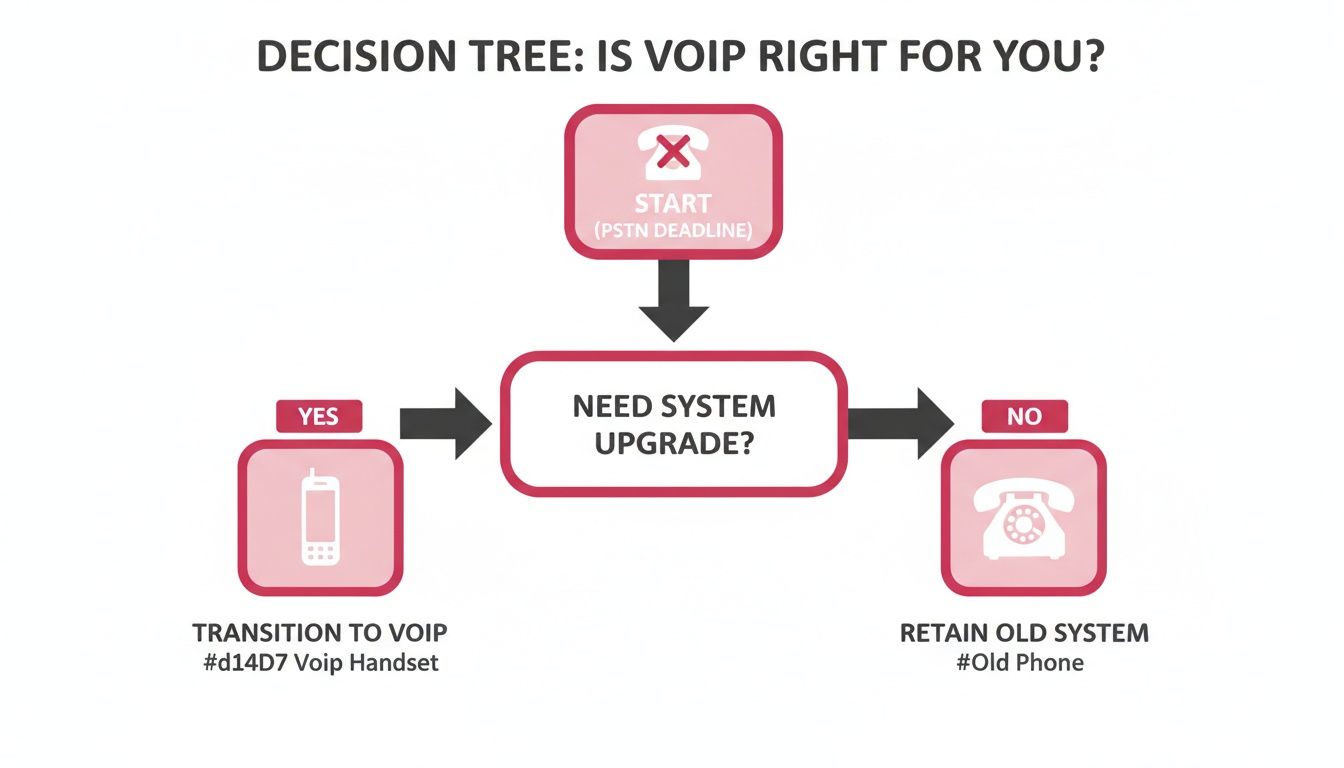
As you can see, with the old PSTN network being switched off, a system upgrade is becoming less of a choice and more of a necessity, pointing businesses directly toward modern VoIP solutions.
To help you navigate the options, we've put together a simple comparison of the main handset types.
Comparison of VoIP Handset Types for Professional Services
| Handset Type | Best For | Key Advantage | Consideration |
|---|---|---|---|
| SIP Desk Phones | Office-based professionals, e.g., solicitors, accountants, receptionists. | Unmatched reliability and audio quality via a wired Ethernet connection. | Limited mobility; requires physical network ports at each desk. |
| DECT Phones | Staff who move around a site, e.g., warehouse managers, retail floor staff. | Excellent range and call quality without relying on Wi-Fi. | Requires a dedicated base station connected to the network. |
| Wi‑Fi Handsets | Mobile teams in locations with strong, seamless Wi-Fi coverage, like modern offices. | Uses existing wireless infrastructure, offering flexibility without new base stations. | Performance is entirely dependent on the quality and stability of your Wi-Fi network. |
| Softphones | Remote workers, hybrid teams, and business development managers on the road. | Ultimate location independence; turns any laptop or mobile into a business phone. | Relies on the user's device and internet connection; may not feel as traditional as a physical handset. |
This table gives you a bird's-eye view, but let's dive into the specifics of where each type really shines.
SIP Desk Phones: The Office Workhorse
For any professional based at a desk, the SIP Desk Phone is still the undisputed champion. These are the powerful, feature-rich phones you see in environments like accountancy practices or legal firms. They plug directly into your network with an Ethernet cable, giving them rock-solid reliability and fantastic, crystal-clear audio.
These phones are built for people who live on the phone. With programmable buttons for speed dials, one-touch call transfers, and instant access to the company directory, they become a real hub of efficiency for a partner at a law firm or a busy sales executive.
DECT Cordless Phones: Mobility Within Your Premises
But what about staff who are never in one place for long? That's where DECT (Digital Enhanced Cordless Telecommunications) Phones come in. These cordless handsets connect to a base station that's plugged into your network, giving staff the freedom to roam around your building without ever worrying about losing a call or a drop in quality.
Just think of the practical uses:
- A warehouse manager in Hampshire checking stock in the aisles while coordinating with the office.
- An estate agent in Salisbury taking a client call while moving between meeting rooms.
- A retail assistant checking with the stockroom without ever leaving a customer's side.
In these kinds of active environments, a tough DECT phone is the perfect tool for the job.
Wi-Fi Handsets and Softphones: Ultimate Flexibility
For a truly modern and flexible setup, you have Wi-Fi Handsets and Softphones. A Wi-Fi handset works a lot like a DECT phone, but instead of connecting to a base station, it connects directly to your wireless network. This is a brilliant option if you have excellent Wi-Fi coverage across your entire site. If your signal has a few dead spots, our guide on how to improve Wi-Fi coverage can help you get it sorted.
Softphones, meanwhile, are a complete game-changer. They are simply software applications you install on a computer, laptop, or smartphone. In an instant, they turn that device into a fully-featured business phone, giving your team complete location independence. A business consultant visiting a client can make and receive calls on their business number from their mobile app, ensuring they always look professional, no matter where they are.
Decoding Key Technical Handset Features
To really get the most out of a modern VoIP handset, it helps to peek under the bonnet and understand the technology that makes it all work. While the jargon might sound a bit daunting at first, a few key features have a direct impact on your call quality, how efficiently your system runs, and even how simple your office setup can be.
Getting your head around these concepts means you’re not just buying a phone; you're making a smart investment. It's precisely this kind of advanced, reliable technology that’s fuelling the UK VoIP market’s impressive growth, which is forecast to expand by USD 5.3 billion between 2024 and 2029. High-quality voice is a massive draw for businesses making the switch. You can discover more insights about the UK VoIP market growth and its drivers to get the full picture.
Voice Codecs: The Engine for Audio Quality
Think of a voice codec (short for coder-decoder) like the file format for a digital photograph. When you save a photo, you might choose a huge, uncompressed file for gallery-level quality or a smaller, compressed JPEG that’s easy to email. Codecs do exactly the same thing for your voice, converting it into digital data packets for its journey across the internet.
- High-Quality Codec (e.g., G.711): This is your uncompressed, high-resolution photo. It uses a bit more internet bandwidth but delivers pristine, high-definition audio. For businesses where clarity is everything, like a financial advisory firm in Wiltshire discussing sensitive details, this is the gold standard.
- Efficient Codec (e.g., G.729): This is your compressed JPEG. It uses far less bandwidth, making it a great choice if your internet connection is under strain, though the audio quality might be a touch less rich.
The good news is that your VoIP system is smart enough to negotiate the best codec for each call automatically, finding the perfect balance between quality and network performance.
Power over Ethernet: A Simpler, Cleaner Setup
One of the most practical innovations in modern office hardware is Power over Ethernet (PoE). In the old days, every desk phone needed two cables: one for the network and a separate power adaptor plugged into a socket. PoE gets rid of that clutter in one elegant move.
When you have a PoE-compatible network switch, a single Ethernet cable delivers both data and power straight to your VoIP handset. This makes installation a breeze, banishes the rat's nest of cables under desks, and makes moving phones around the office incredibly simple. For a growing accountancy firm in Dorset, that means less time and money spent on electricians every time a new person joins the team.
SIP Provisioning: The Plug-and-Play Magic
Imagine the headache of manually setting up dozens of new phones. SIP Provisioning is the technology that makes that nightmare a thing of the past. It automates the entire process, making deployment quick, easy, and completely free of human error.
SIP Provisioning is the 'plug-and-play' magic that lets a new handset automatically configure itself. When you connect a new phone to the network, it securely contacts the central phone system (like 3CX), downloads its specific configuration—extension number, user details, company directory—and is ready to use in minutes.
This feature is a huge time-saver for IT teams and guarantees every device is set up perfectly.
Quality of Service: Your VIP Lane for Voice Calls
Finally, there’s Quality of Service (QoS). This is a crucial network setting that makes sure your calls stay crystal-clear, even when your internet connection is busy. Think of it as a VIP lane on the motorway for your voice data.
QoS prioritises your voice packets, letting them speed past less urgent traffic like big file downloads or emails. For any professional service firm, where every word counts, QoS is non-negotiable. It prevents that jittery, robotic-sounding audio that makes conversations frustrating, ensuring you sound professional on every single call.
Connecting Your Handsets to a 3CX Phone System
A shiny new VoIP handset is fantastic, but it's really only as good as the phone system it’s connected to. This is where getting the integration right is absolutely crucial. Thankfully, modern platforms like 3CX are built from the ground up to make this process as painless as possible, ensuring all your tech works in harmony.
The magic ingredient making all this possible is a standard called Session Initiation Protocol (SIP). The simplest way to think of SIP is as a universal translator for VoIP. It allows different devices and systems, regardless of the manufacturer, to speak the same language. If a handset is ‘SIP-compliant’, it should, in theory, play nicely with any SIP-compliant phone system. This gives you incredible freedom and stops you from being locked into one hardware brand for life.
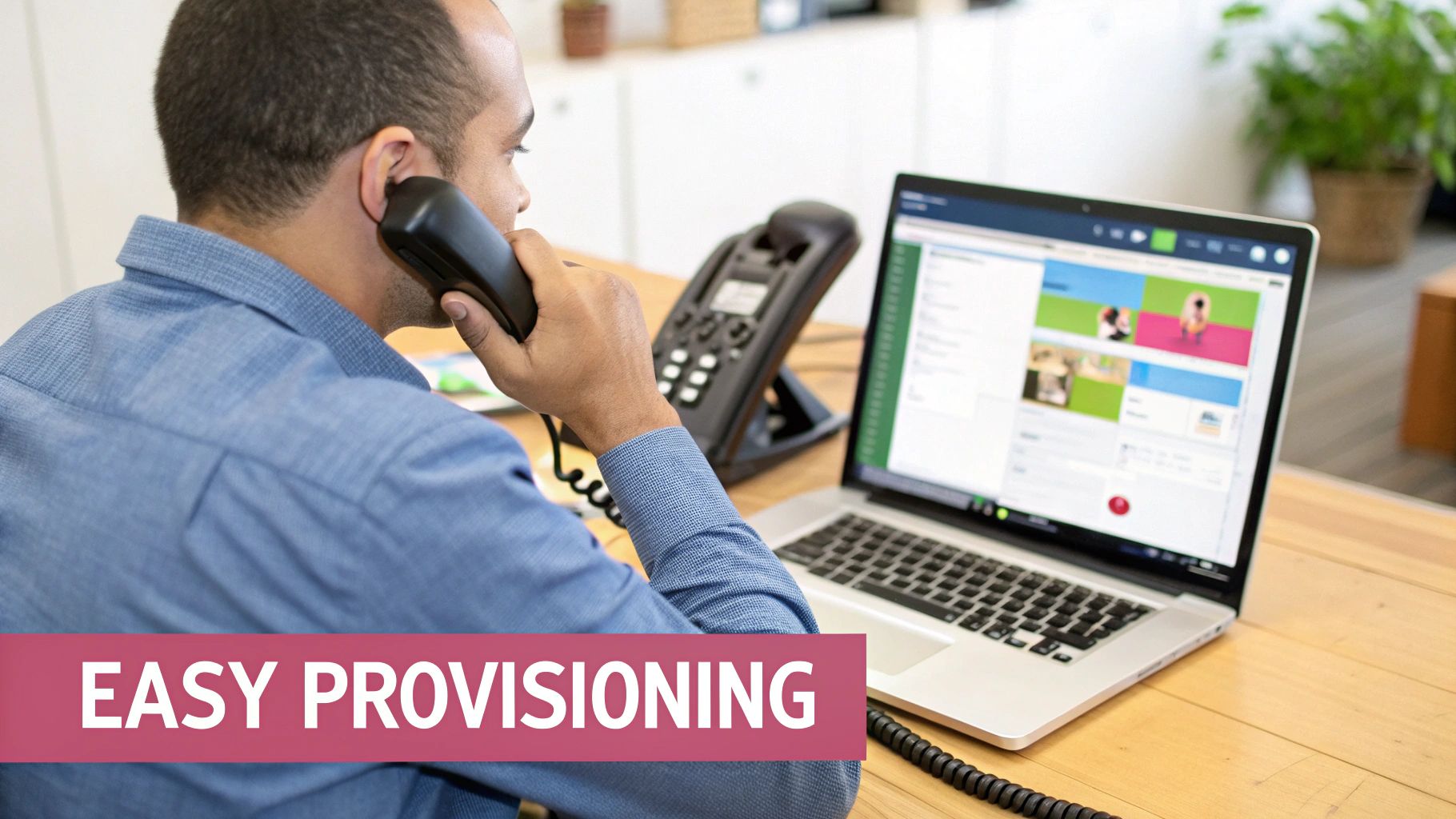
Handset Provisioning Made Easy
So, what does this look like in the real world? Let’s say you’ve just brought a new sales manager on board at your Wiltshire office and need their desk phone up and running. With a 3CX system, you're looking at a five-minute task, not a day of technical wrangling.
Getting a new Yealink or Snom handset configured usually just involves these few steps:
- Create the Extension: First, you’ll log into your 3CX Management Console and set up a new extension for your new team member.
- Assign the Handset: Next, you tell the system which phone belongs to them. You do this by linking the handset’s unique MAC address (a serial number found on the back of the device) to their extension.
- Plug and Play: Finally, just plug the handset into any live network socket in the office. That’s it. The phone powers up, finds the 3CX system automatically, and securely downloads its entire configuration.
After a quick reboot, the phone’s screen will display the user’s name and extension number. It’s fully programmed and ready to go, without anyone having to touch a single setting on the device itself.
This automated setup, known as provisioning, is a genuine game-changer. It doesn't just save a massive amount of IT time; it also wipes out the potential for human error, guaranteeing every phone is set up correctly and securely from day one.
This tight integration really shows what a well-designed VoIP system can do. To dig deeper into what a modern PBX can offer, it’s worth reading about the benefits of the 3CX Phone System.
Ultimately, the combination of SIP standards and automated provisioning transforms business operations. Adding a new starter or moving staff between desks becomes a simple administrative job. Your phone system should be helping your business grow, not holding it back. For professional firms that need a communication setup they can truly rely on, our guide to 3CX hosting options offers more detail on building a powerful and resilient system.
Building a Secure and Reliable Network for VoIP
Your phone system is the lifeblood of your business, and the quality of every call you make hinges on the network it runs on. Think of it this way: you would not run a high-performance car on cheap fuel. Similarly, a voice over IP handset needs a dependable, high-quality internet connection—like business fibre—to deliver that crystal-clear audio you expect.
Without it, you run into problems like jitter and packet loss. Those are the technical gremlins responsible for robotic-sounding voices and calls that frustratingly drop mid-sentence. For any professional firm, where clear communication is non-negotiable, this is not just an annoyance; it’s a direct threat to your reputation. A solid network foundation is the only way to guarantee your voice traffic gets the priority it deserves.
Essential Security Measures for VoIP Systems
Beyond a stable connection, we have to talk about security. Because VoIP is digital, it's exposed to a whole new world of cyber threats that did not affect old-fashioned copper lines. We’re talking about things like call interception and Denial-of-Service (DoS) attacks, which can completely paralyse your entire phone system. The good news is, there are powerful ways to lock it down.
A fantastic starting point is to create a Virtual LAN (VLAN). Imagine building a separate, private motorway exclusively for your voice traffic. By isolating your VoIP handsets from the rest of the network—your computers, printers, and other devices—you make it incredibly difficult for threats to jump across and disrupt your calls. You can read our guide on setting up a VoIP router to see just how crucial your network hardware is to getting this right.
On top of that, any modern VoIP system worth its salt uses strong encryption to shield your conversations. There are two key protocols you should know about:
- Secure Real-time Transport Protocol (SRTP): This is what encrypts the actual voice data. It essentially scrambles your conversations, making them complete nonsense to anyone who might be eavesdropping.
- Transport Layer Security (TLS): This protocol handles the encryption for all the signalling—the information used to set up, manage, and tear down calls—protecting that sensitive metadata from prying eyes.
Proactive Monitoring and Management
With over two-thirds of UK landlines expected to have switched to VoIP by early 2025, security is rightly in the spotlight. Ofcom is now regulating the industry to ensure these migrations go smoothly, but the responsibility for securing your own network remains as critical as ever. It is not just about encryption; building a secure system also involves implementing robust access control policies to keep unauthorised users out.
A managed service partner moves beyond a simple "set and forget" approach. They provide continuous, proactive monitoring to detect and neutralise emerging cyber threats before they can impact your business operations, ensuring your communication infrastructure remains resilient.
This is where partnering with an expert like SES Computers makes a real difference. We provide 3CX VoIP telephony backed by rapid incident response and constant cyber-security monitoring to defend against new vulnerabilities. This proactive approach ensures your phone system is not just a tool, but a secure and reliable asset you can count on. You can explore UK VoIP statistics and trends to see just how central this technology has become for businesses everywhere.
Is It Time to Partner with an Expert for Your VoIP Transition?
Switching to a modern VoIP system is a lot more than just plugging in a few new handsets. It’s a strategic move that requires careful planning, a solid grasp of the technology, and a security-first mindset to protect your business conversations. This is where bringing in a partner can turn a potentially complex project into a real competitive advantage.
Going it alone might seem like a way to save money, but it’s often a false economy. Misconfigured hardware can lead to frustratingly poor call quality, and overlooking network vulnerabilities could leave your entire system exposed. The time you’ll spend troubleshooting these issues is time taken away from running your actual business. A managed service simply makes these problems disappear.
The Value of Local Expertise and Proactive Support
With over 30 years of experience helping businesses across Dorset, Wiltshire, and Hampshire, we know the local landscape inside and out. We don’t just supply the technology; we deliver the peace of mind that comes from a fully managed VoIP service. Our entire approach is built on proactive, round-the-clock support and an expert understanding of systems like 3CX.
A true technology partner doesn’t just wait for things to go wrong. We provide 24/7 system monitoring and proactive support to spot and fix potential issues before they can affect your business, keeping your communications running smoothly.
This hands-on approach means you can focus entirely on your day-to-day operations, confident that your most critical communication tool is in safe hands.
Real-World Solutions for Your Business
Our job is to listen to your needs and translate them into a technical solution that just works. We’ve deployed robust DECT systems for busy manufacturing sites that need staff to be reachable anywhere on the factory floor. We’ve also managed zero-downtime migrations for accountancy firms where every single call is mission-critical. In every case, our goal is the same: to make your move to VoIP seamless, secure, and perfectly suited to how you work.
Ultimately, working with SES Computers gives you far more than a new phone system. You get a dedicated local team committed to managing every detail of your business communications, from the initial setup and security hardening to all the ongoing maintenance and support you’ll ever need.
Got Questions About VoIP Handsets? We've Got Answers
Switching to a new phone system naturally brings up a few questions. Let's tackle some of the most common queries we hear from professional service firms when they're thinking about VoIP handsets.
How Much Internet Bandwidth Do I Need for a VoIP Handset?
It's less about raw speed and more about quality. A single VoIP call typically only needs about 100 kbps of both upload and download bandwidth, which most modern connections can handle easily.
The real secret to crystal-clear calls is a stable connection with low latency and minimal jitter. That’s why we always recommend a dedicated, business-grade fibre connection over a standard residential one. A good provider will calculate exactly what you need based on how many concurrent calls your team makes at its busiest, making sure you always have enough headroom.
Can I Keep My Existing Business Phone Number?
Yes, absolutely. You’ve worked hard to build recognition for your number, and you do not have to give it up. In the UK, this process is called 'number porting', and it’s regulated by Ofcom to make sure everything goes smoothly.
Your clients and partners will not notice a thing. We handle the entire porting process for you, coordinating with your old provider to transfer your numbers seamlessly to the new VoIP service. The goal is zero downtime and a completely painless switch.
What Happens if the Internet Goes Down?
This is where a professionally configured VoIP system truly shines. Modern platforms like 3CX are built for business continuity, with smart failover rules to protect you from unexpected outages.
If your main office internet connection drops, calls can be instantly and automatically forwarded to mobile phones or even a colleague working from a different site. For a law firm that cannot afford even a moment of downtime, we can set up a backup 4G/5G internet connection, giving you a second layer of defence so you never miss that crucial call.
Ready to ensure your business communications are secure, reliable, and ready for the future? SES Computers offers fully managed 3CX VoIP solutions designed for SMEs. Contact us today for a consultation.