At its core, a VoIP system for business is simply a phone system that uses your internet connection to make and receive calls, rather than a traditional telephone line. It’s a modern approach that brings far more flexibility, significant cost savings, and powerful communication tools to the table compared to old-fashioned landlines. For any forward-thinking company, it's an essential upgrade.
Moving Beyond Outdated Phone Systems
For decades, UK businesses got by just fine with traditional PSTN and ISDN phone lines. They were dependable, sure, but also rigid, expensive to maintain, and completely out of step with the modern workplace. With the nationwide switch-off on the horizon, sticking with that old technology isn't just a bad idea—it's no longer an option. Embracing a Voice over Internet Protocol (VoIP) system is the logical, necessary next step.

Think of VoIP like sending an email, but for your voice. Instead of needing a dedicated copper wire, your conversation is converted into digital packets and sent securely over the internet connection you already use. For professional services firms—from solicitors and accountants to consultants—this isn't just a technical upgrade. It's a strategic move that delivers a real competitive edge.
Why Make the Switch Now?
The push to adopt a modern VoIP system for business comes down to clear, tangible benefits that directly impact your bottom line and operational agility. The main drivers for making the change are compelling:
- Significant Cost Savings: When you eliminate expensive line rentals and see your call charges plummet, the savings add up quickly. It's often one of the first and most substantial benefits businesses notice. For instance, a small law firm might save over £150 a month just by removing ISDN line rental fees.
- Unmatched Flexibility: Finally, you can empower your team to work effectively from anywhere. Staff can make and receive calls on their main office number using a laptop or a mobile app, whether they're at home, on the road, or meeting with clients.
- Advanced Client Service Tools: You get access to features that were once reserved for large enterprises. Think auto-attendants to route calls perfectly every time, call recording for training and compliance, and CRM integration that gives your team context for every conversation.
This shift has already transformed specialised sectors, as seen with modern medical office phone systems that handle sensitive patient data securely and efficiently.
The momentum is undeniable. A recent migration saw about 31% of UK businesses switch to VoIP, with many reporting cost reductions between 25–50%.
What VoIP Actually Does for Professional Services
Let's cut through the jargon. A modern business VoIP system isn't just a new way to make calls; it's a tool that delivers real-world advantages you can see and measure, especially for professional services firms here in the UK. We're talking about tangible improvements to how you work day-to-day.
Serious, Immediate Cost Savings
The most immediate benefit people notice is on the bottom line. Traditional phone systems are a constant drain, with fixed line rental for old ISDN or PSTN circuits, high call charges, and often expensive maintenance contracts for the hardware in your comms cabinet.
Think about a 15-person accounting firm in Hampshire. Just by switching from their old ISDN lines, they can wipe out hundreds of pounds in monthly rental fees straight away. Their call costs plummet, particularly for national calls. And for firms with clients overseas, the savings multiply. Learning about cost-saving international calls with VoIP often reveals a whole new layer of financial efficiency.
Work from Anywhere, Without Compromise
Let's face it, professionals are rarely chained to a desk anymore. A modern VoIP system is built for this reality, giving your team the tools to stay connected and professional, no matter where they are. This isn't just a nice-to-have; it's fundamental to great client service.
Imagine a solicitor from Dorset heading to court. With a simple app on their mobile, they can make and receive calls using their main office number. As far as the client is concerned, they're calling the office. The firm maintains its polished, professional image, and the solicitor doesn't miss a beat. That ability to work from anywhere is a massive advantage.
A well-implemented VoIP system transforms your business's communication from a fixed utility into a flexible asset. It empowers your team to be productive and professional wherever they are, directly improving client responsiveness and operational agility.
Grow Your Firm Without Growing Pains
Growth should be exciting, not a logistical nightmare. With traditional phone systems, adding a new team member is a slow, expensive chore involving engineers and new physical lines. A business VoIP system does away with all that friction.
When a consultancy in Wiltshire hires a new analyst, the IT manager can add them to the phone system in a few minutes via a simple web portal. They assign a new extension, set up the calling rules, and the new hire is ready to take calls on their laptop or a desk phone from day one. There's zero downtime or waiting around.
Powerful Features to Manage Clients Better
Finally, VoIP brings a suite of powerful tools to the table—features that used to be reserved for big corporate budgets. These aren't just gadgets; they actively help you work smarter and stay compliant.
- Call Recording: This is a must-have for compliance, staff training, and settling any client disputes. A financial adviser can have all calls automatically recorded to meet regulatory requirements, creating a perfect audit trail.
- CRM Integration: Imagine a client calls, and their entire history with your firm instantly pops up on your screen. This connection to your client management software means your team can offer a much more personal and informed service, right from the first "hello."
Essential VoIP Features That Drive Efficiency
A modern VoIP system is far more than just a clearer way to make calls over the internet. Its real value is unlocked through a suite of powerful features, each designed to solve specific business problems, automate tedious tasks, and make your firm more responsive.
These aren't just technical novelties; they are practical tools that deliver tangible results day in and day out. Let’s look at some of the most impactful features and how they actually work for a UK business.
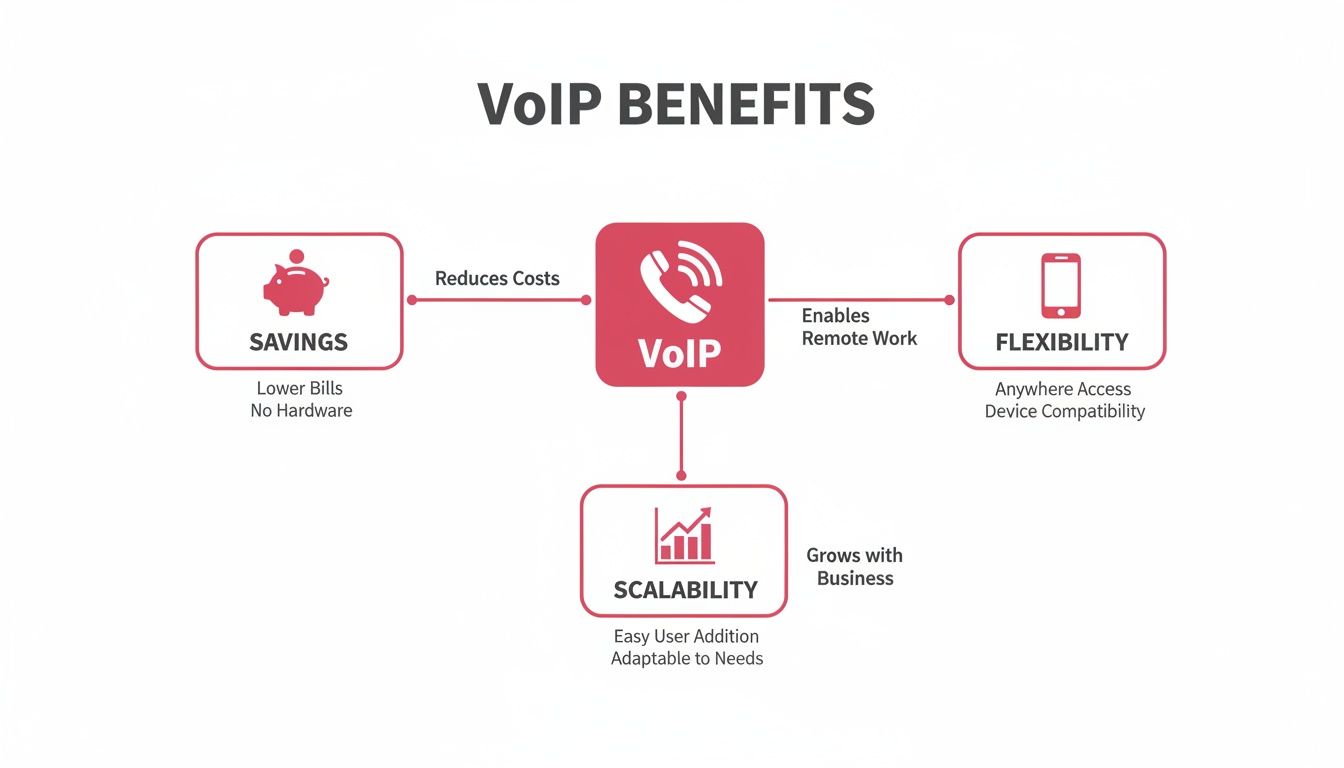
As you can see, the core benefits of savings, flexibility, and scalability work in concert, creating a far more resilient and efficient operation.
Tools That Automate and Organise
Many of the best VoIP features are built to handle incoming calls intelligently. They take the routine work off your team’s plate, creating a polished, professional experience for clients from the moment they dial your number.
- Auto-Attendant: Think of this as a digital receptionist that never needs a break. For a law firm, it can greet callers with a professional message and offer clear options: "Press 1 for conveyancing, 2 for corporate law." This routes clients straight to the right department, cutting down wait times and freeing up your administrative staff.
- Voicemail-to-Email: This simple but incredibly useful tool converts audio voicemails into sound files and sends them directly to your email. A busy accountant can listen to messages between meetings on their laptop, forward a query to a colleague for follow-up, and keep an organised, searchable record of communications—all without being tied to a desk phone.
Features for Compliance and Client Insight
In professional services, managing risk and understanding client needs are critical. A modern VoIP system gives you essential tools for both.
Integrating your phone system with your core business software is a game-changer. When a client calls, their entire case file or account history can appear on-screen, giving your team the context needed to provide exceptional, informed service instantly.
Call Recording is a vital asset for any regulated firm. It provides a definitive record to help resolve client disputes, confirm verbal instructions, and meet strict compliance requirements in sectors like finance or law.
At the same time, CRM Integration turns your phone into an intelligent client management tool. When a client calls, their record in your practice management software can automatically pop up, arming your team with their complete history. You can find out more in our guide to an IP phone service for business.
VoIP Feature Impact on Professional Services
Here’s a quick breakdown of how these features translate into concrete benefits for professional services firms across the UK.
| VoIP Feature | Practical Application in a UK Firm | Primary Business Benefit |
|---|---|---|
| Auto-Attendant | An architectural practice routes calls to "New Enquiries," "Project Updates," or "Accounts." | Improved client experience and reduced administrative workload. |
| Call Recording | A financial advisory firm records client calls to comply with FCA regulations. | Ensures regulatory compliance and provides a clear audit trail. |
| Voicemail-to-Email | A consultant receives voicemails as audio files on their mobile while travelling. | Enhanced responsiveness and better organisation of client messages. |
| CRM Integration | When a client calls a legal practice, their case file pops up on the solicitor's screen. | Faster, more personalised service and improved data accuracy. |
These features are no longer niche; they are becoming standard practice for any firm serious about efficiency and client service.
The adoption of these advanced tools has grown rapidly across the UK. Recent data shows that over 60% of UK organisations using cloud communications have reported measurable cost savings and improved productivity. There's also been a huge shift towards mobile working, with 74% of employees now using mobile apps for their business calls.
Choosing Your VoIP Deployment Model
When you decide to move your business to a VoIP system, one of the first big decisions you'll face is how to set it up. This isn't just a technical detail; it fundamentally shapes your initial costs, ongoing management, and how much control you have over the system.
Think of it like deciding on your business software. You could subscribe to something like Microsoft 365, where everything is handled for you in the cloud. Or, you could buy your own server, purchase the software licences, and have your IT team install and manage it all in-house. The same choice exists for your phone system.
Hosted VoIP: The Cloud-Based Subscription
For most small and medium-sized firms today, the go-to option is Hosted VoIP. In this setup, the entire phone system—all the complicated hardware, software, and networking gear—is owned and managed by a specialist provider in their secure data centre.
You simply connect your phones to the service through your internet connection. It’s a straightforward subscription model: you pay a predictable fee each month for every user, and you get all the features without any of the maintenance headaches.
Imagine a growing financial advisory firm in Somerset. A hosted approach would be perfect for them.
- Low Initial Investment: There’s no need to fork out thousands of pounds for an expensive on-site phone server, known as a Private Branch Exchange (PBX).
- Zero Maintenance Burden: The provider takes care of all the updates, security patches, and hardware maintenance. This frees up your team to focus on clients, not on troubleshooting a phone system.
- Effortless Scalability: Need to bring a new adviser on board? It's as simple as adding a user to your subscription, which can often be done in minutes through a web portal.
This model opens the door for any size of business to get a professional voip system for business, sidestepping the old barriers of high upfront costs and the need for specialist IT staff.
On-Premises VoIP: The In-House Control Model
The alternative is an On-Premises VoIP system. This is the more traditional route where you buy the physical PBX server yourself and keep it in your office. This hands your internal IT team total control over every aspect of the system’s configuration, security, and how it connects with your other software.
While this offers the ultimate flexibility, it also brings some serious responsibilities.
The decision between Hosted and On-Premises VoIP boils down to a strategic choice: do you want your phone system to be a predictable operating expense (Hosted) or a capital asset that you fully control and maintain (On-Premises)?
A large, established legal practice in Dorset with its own dedicated IT department might find this a viable option. However, it demands a significant capital investment for the hardware and software licences right at the start. You also have to factor in the ongoing costs for maintenance, upgrades, and the staff expertise needed to keep it all running smoothly. For most SMBs, the sheer simplicity and predictable costs of a hosted solution are a much better fit.
Ensuring Security and Compliance with VoIP
When your business is built on trust and handles sensitive client information, security isn't just an optional extra—it's the bedrock of your operations. A professionally managed VoIP system for business is designed from the ground up to protect your communications, often with security layers that traditional landlines simply can't match.

Of course, the idea of calls travelling over the internet can raise concerns about interception. That’s a valid point. The good news is that leading VoIP providers tackle this head-on, employing advanced encryption protocols that scramble your conversations from end to end, making them completely unreadable to anyone listening in.
Protecting Your Conversations and Data
Modern VoIP platforms create a secure bubble for your calls using a powerful combination of technologies. These work in tandem to shield your voice data as it travels across the network and when it's stored.
- Transport Layer Security (TLS): If you've ever used online banking, you've used TLS. It's the standard for securing websites, and in VoIP, it encrypts the call's signalling data—things like who is calling whom. This stops outsiders from seeing your call patterns.
- Secure Real-Time Transport Protocol (SRTP): This is the crucial part that encrypts the actual audio of your call. With SRTP, even if someone managed to grab the data packets, all they'd get is garbled, unusable noise. The conversation itself remains private.
Think of it this way: for a legal practice in Hampshire, this means a sensitive discussion about a client’s case is completely protected from eavesdropping. For a financial adviser in Dorset, it ensures that personal financial details shared over the phone stay exactly that—personal.
Meeting UK Compliance Obligations
Beyond the technical nuts and bolts of security, UK professional services firms have to navigate a maze of data protection laws, most notably the General Data Protection Regulation (GDPR). A high-quality VoIP system for business isn’t just a phone system; it's a tool that helps you meet those legal obligations.
For professional services firms, GDPR compliance is non-negotiable. A modern VoIP system provides the necessary tools, such as secure call recording and granular access controls, to help you manage client data responsibly and meet your regulatory duties.
Take call recordings. They are a treasure trove of personal data and must be handled with care under GDPR. A compliant VoIP system gives you the power to store these recordings securely, dictate exactly who can access them, and even set up automatic deletion policies so you are not holding onto data for longer than necessary.
Features like secure access controls are also critical. They let you define precise user permissions, ensuring only authorised staff can listen to specific recordings or view call logs. This creates a clear, defensible audit trail, turning your phone system from a potential compliance headache into a genuine asset.
How to Choose the Right UK VoIP Provider
Selecting the right VoIP system isn't just a technical decision; it's about finding a long-term partner for your business. The best technology in the world means little without solid support and reliability backing it up, which makes picking your provider absolutely critical.
This is more important than ever as UK businesses move away from old-school phone lines at a breakneck pace. By early 2025, revenues from traditional fixed lines in the UK had already plummeted to around £1.09 billion, a staggering 13.3% drop in just one year. This mass migration, driven by the planned shutdown of old PSTN and ISDN networks, means you need a partner who's built for the future. You can find more detail on this widespread shift to VoIP.
Key Questions to Ask Potential Providers
To see past the glossy brochures and find a provider you can actually count on, you need to ask the tough questions. A good checklist helps you cut through the noise and compare providers on the things that will make a real difference to your daily operations.
Here are the questions I always recommend starting with:
- Is your technical support team actually in the UK? When something goes wrong, you need help from someone who is in your time zone and understands the local landscape, not a call centre halfway across the world.
- What are your uptime guarantees and Service Level Agreements (SLAs)? Do not just take their word for it. Look for a contractual commitment to high availability—ideally 99.99% or more—to ensure your phones are always on.
- How do you handle moving our existing business numbers over? A professional provider will have a tried-and-tested process for porting your numbers across seamlessly, ensuring zero disruption for your clients.
The Local Specialist Advantage
There's a real benefit to working with a provider who lives and breathes the UK market, especially for professional services firms. You're not just buying a product; you're getting a tailored setup, genuinely responsive support, and insights that only a local expert can offer. Focusing on reliability and long-term support turns your voip system for business from a utility into a real asset.
Choosing a provider is a strategic decision that impacts your reliability, client service, and long-term costs. Prioritise UK-based support, clear uptime guarantees, and a proven process for number porting to build a successful partnership.
For a deeper dive, take a look at our guide on the best VoIP providers in the UK to help you weigh up your options.
Your Business VoIP Questions Answered
Switching up your core communications system is a big decision, so it's only natural to have a few questions. It’s smart to get the full picture before you dive in. Here are the answers to some of the most common queries we hear from businesses just like yours.
Will My Call Quality Be as Good as a Landline?
In a word, yes. In fact, you'll probably find it's a significant improvement. Modern VoIP systems deliver high-definition audio that’s far clearer than the old analogue lines we have all grown up with.
As long as you have a decent, stable internet connection, you can say goodbye to the crackles and fuzz of the past. The technology is smart enough to prioritise voice traffic, making sure your calls are always crisp and reliable.
Can I Keep My Existing Business Phone Numbers?
Absolutely. We understand how important your established phone number is to your business identity; it's often the first thing customers see. Keeping it is a standard part of the process.
This is called 'number porting', and any good VoIP provider will handle the entire switch for you, seamlessly. For your clients, nothing changes – they just carry on calling the number they’ve always known.
A key advantage of a modern VoIP system is built-in resilience. Unlike a traditional landline that is useless in a power cut, VoIP offers intelligent failover options to keep you connected.
What Happens If My Office Internet Goes Down?
This is a perfectly valid concern, but it’s something professional VoIP systems are built to handle. Business continuity is baked right in.
They use features like automatic call forwarding. If the system can't reach your office phones, it does not just give up. Instead, it instantly reroutes all incoming calls to mobiles or another location, based on rules you set. For example, a law firm could have calls automatically divert to key solicitors' mobiles if the office connection drops, ensuring that a crucial client call is never missed, even during a local outage.
Ready to upgrade your firm's communications with a reliable, feature-rich VoIP system? The team at SES Computers provides expert 3CX hosting and managed IT services to businesses across Dorset, Hampshire, and Wiltshire. Find out how we can help your business thrive.