So, what exactly are managed IT services?
In simple terms, it's about shifting your company's technology from a reactive 'break-fix' cycle to a proactive, preventative model. Instead of waiting for something to go wrong and then calling for help, you partner with a specialist IT firm—a Managed Service Provider (MSP)—who continuously looks after your entire IT environment for a flat, predictable monthly fee.
Moving From Reactive Fixes to Proactive Partnerships
Think of your business's technology like a high-performance racing car. The old 'break-fix' approach is like waiting for it to splutter to a halt mid-race before frantically calling a mechanic. It's stressful, expensive, and the downtime is disastrous.
Managed IT services, on the other hand, provide you with a dedicated pit crew. They are constantly monitoring performance, fine-tuning the engine, and checking the tyres to prevent problems before they ever happen. This is the fundamental difference—it’s about prevention, not just repair.
This model flips the traditional IT support relationship on its head. You move away from unpredictable, often eye-watering, invoices for emergency call-outs. In its place, you get a stable, fixed monthly cost and gain a team of experts whose job it is to keep your systems running smoothly, securely, and in line with your business goals.
The Role of a Managed Service Provider
A Managed Service Provider (MSP) essentially becomes your expert, outsourced IT department. For a professional services firm in Dorset, Somerset, Wiltshire, or Hampshire, partnering with an MSP can transform technology from a constant source of frustration into a genuine tool for growth.
Your MSP takes ownership of your IT infrastructure. They don't just fix things; they manage them. Their services typically cover a wide spectrum, including:
- Continuous Monitoring: Keeping a watchful eye over your networks, servers, and computers 24/7 to spot early warning signs and fix them before they escalate into disruptive problems.
- Preventative Maintenance: Proactively updating software, applying security patches, and optimising system performance to keep everything efficient and secure.
- Strategic Guidance: Offering expert advice on how you can use technology to improve your business processes, boost team productivity, and achieve your long-term ambitions.
This proactive approach is fast becoming the norm. The UK managed IT services market is expected to rocket from £15,349.99 million in 2023 to £28,291.12 million by 2032. This incredible growth is being fuelled by businesses realising the value of preventing problems rather than just reacting to them. For professional services firms in particular, this signals a clear move towards outsourcing IT to gain a competitive edge in efficiency and security.
The beauty of the managed services model is that it aligns our goals with yours. We are incentivised to keep your systems running perfectly because the fewer problems you have, the more efficient we are. It creates a genuine partnership built on stability and shared success.
As technology gets more complex, this principle of outsourcing for expertise becomes even more critical. Highly specialised areas like Managed Kubernetes services show how even large enterprises offload complex operational tasks to experts. This allows them to focus on their core business, which is the same core benefit an MSP brings to any small or medium-sized company.
The Core Components of Your Managed IT Plan
It’s one thing to understand the idea of proactive support, but what does a managed IT service plan actually look like in practice? Think of it as a set of building blocks for a stable, secure, and efficient technology foundation.
Each component is designed to solve a specific, real-world business challenge. They all work together, creating a seamless IT operation that lets you get on with running your business, free from tech-related worries.
To make it tangible, let's look at the individual services that typically make up a comprehensive managed IT plan. The following table gives a quick overview of what each service does and the core benefit it brings to your business.
A Breakdown of Managed IT Services
| Service Component | What It Does For You | Primary Business Benefit |
|---|---|---|
| Proactive Monitoring | Watches over your entire IT network 24/7, flagging potential issues before they cause downtime. | Prevents costly disruptions by fixing problems before they impact your operations. |
| Helpdesk Support | Provides your team with a direct line to IT experts for fast troubleshooting and issue resolution. | Minimises staff frustration and gets everyone back to work quickly. |
| Cloud & Hosting | Manages your cloud infrastructure, giving you secure access to data and apps from anywhere. | Increases flexibility and productivity for remote or mobile teams. |
| Backup & Disaster Recovery | Creates and manages a tested plan to restore all your systems and data after a major incident. | Provides an essential safety net, ensuring your business can survive a catastrophe. |
| Managed Cybersecurity | Deploys and manages a multi-layered defence system to protect against online threats. | Safeguards your sensitive data, client trust, and business reputation. |
Each of these pillars is crucial for a resilient and modern business. Now, let’s explore what each one means for you in more detail.
Proactive Monitoring and Maintenance
This is the real heart of any managed services agreement. Instead of waiting for something to break, your provider uses sophisticated software to keep a constant eye on the health and performance of your entire network, 24 hours a day, 7 days a week. This constant vigilance means potential issues get spotted and fixed long before they affect your team.
Practical Example: Picture a busy Wiltshire accountancy firm during tax season. A critical server starts showing early signs of a hard drive failure. Proactive monitoring flags this instantly, and an engineer schedules a replacement out of hours. The result? Zero downtime during their most important period, avoiding chaos and client frustration.
Responsive Helpdesk Support
When a problem does crop up, your team needs fast, effective support from people who know your setup inside and out. A managed helpdesk is your single point of contact for every tech query, from a simple password reset to a complex software issue. They are your dedicated team, ready to get your staff back to work.
Practical Example: An architectural practice in Somerset relies on specialist CAD software to meet project deadlines. A sudden software glitch stops an architect from accessing a critical design file. They can immediately call their MSP's helpdesk, where an engineer who is already familiar with their setup resolves the issue remotely in minutes. This ensures client deadlines are met and project momentum is maintained.
Secure Cloud and Hosting Services
Modern businesses need to be flexible. Cloud services give you the power to access data and applications from anywhere, on any device, without the cost and hassle of maintaining your own servers. A good MSP manages these cloud environments to make sure they are secure, efficient, and configured correctly for your needs.
This often includes Hosted Desktops (Desktop as a Service), which deliver a complete and secure Windows desktop environment right from the cloud. It’s a game-changer for businesses that have embraced remote or flexible working.
Practical Example: A law firm in Dorset needs its solicitors to have secure access to confidential case files while in court or visiting clients. Using managed hosted desktops, each employee gets a consistent, secure work environment on their laptop or tablet, boosting productivity without ever compromising client data security.
Robust Backup and Disaster Recovery
What would happen if you lost all your business data tomorrow in a fire, flood, or cyberattack? A frightening number of businesses without a solid recovery plan would be forced to close. Managed backup and disaster recovery is your insurance policy against this kind of catastrophic event.
It’s about more than just copying files. It’s a tested strategy to restore your entire IT environment—servers, applications, and data—quickly and reliably. You can learn more about how a UK managed backup service provides this vital safety net.
A backup is only as good as its last successful test. A managed disaster recovery plan ensures that when a real emergency hits, your data can be restored swiftly and accurately, turning a potential catastrophe into a manageable inconvenience.
Comprehensive Managed Cybersecurity
Cyber threats are growing more sophisticated every day, and professional services firms are prime targets. Basic antivirus software just isn't enough anymore. Managed cybersecurity is a multi-layered defence strategy built to protect your business from threats like ransomware, phishing, and data breaches.
This isn't a single product, but a combination of proactive measures, including:
- Managed Firewalls: Acting as the gatekeeper for your network.
- Threat Monitoring: Actively hunting for and neutralising suspicious activity.
- Patch Management: Keeping all your software updated to close security gaps.
- Employee Awareness Training: Turning your team into your first line of defence.
Practical Example: A solicitor's office in Hampshire holds a vast amount of confidential client data. A managed cybersecurity service detects and blocks a clever phishing email designed to deploy ransomware. This proactive stop prevents a devastating data breach, protecting the firm's reputation and saving it from huge financial and legal penalties.
Real-World Business Benefits of Managed IT
It’s one thing to understand the list of services included in a managed IT plan, but what really matters is how those features translate into real-world results for your business. For professional services firms, the true value is found in how these services strengthen your operations, protect your bottom line, and help you grow.
Moving to a managed IT model isn't just a technical change; it's a strategic business decision. It’s about transforming your technology from a source of unpredictable costs and frustrating risks into a reliable asset that actively works for you.
From Unpredictable Expenses to a Fixed Monthly Cost
One of the biggest headaches for any small business is managing cash flow. The old-school 'break-fix' approach to IT is a budget’s worst enemy. You might have zero IT costs one month, but the next, a server could go down and hit you with an unexpected bill for thousands of pounds in emergency repairs.
Managed IT services do away with this financial rollercoaster. Instead, you get a simple, predictable flat-rate monthly fee. This makes budgeting a breeze, eliminates nasty surprises, and frees up capital you can confidently invest in other parts of your business.
Gain Instant Access to Specialist Expertise
Trying to hire, train, and keep a skilled in-house IT team is a massive undertaking. A single senior IT technician can cost a small fortune, and it's impossible for one person to be an expert in everything—from cybersecurity and cloud systems to networking and VoIP.
When you partner with a managed IT provider, you get a whole team of certified specialists on your side for less than the cost of hiring one senior person. You tap into a deep well of knowledge and experience, ensuring that whatever technical challenge comes your way, there’s a genuine expert ready to solve it.
By partnering with an MSP, a business effectively hires a full-service IT department on demand. This approach provides access to high-level strategic advice and specialised skills that would otherwise be out of reach for most SMEs, levelling the playing field with larger competitors.
Enhanced Security and Effortless Compliance
Cyber threats aren't just a problem for big corporations anymore; professional services firms are now a prime target. At the same time, regulations like GDPR put a serious responsibility on your shoulders to protect customer data. Staying secure and compliant is a full-time job that requires constant attention and specialist skills.
Managed IT services give you a robust, multi-layered security defence that is proactively managed and always up-to-date. Your provider handles everything from firewall management and threat monitoring to making sure your data backups meet legal requirements. This not only gives you peace of mind but frees you from the complex and stressful world of cybersecurity. To discover more, you can learn about the key benefits of managed IT services in our detailed guide.
Maximised Uptime and Team Productivity
Every minute your systems are down is a minute your team can't work, serve customers, or bring in revenue. Proactive monitoring and preventative maintenance are designed to stop problems before they even start.
By keeping your systems healthy and secure, a managed service provider ensures you get maximum uptime. This means your staff can get on with their jobs without frustrating interruptions, which leads to better productivity, higher morale, and a much smoother operation overall.
Seamless and Agile Scalability
As your business grows, your technology must keep up. Adding new staff, opening another office, or adopting new software can put a huge strain on a rigid IT setup. Managed services are built to be flexible, allowing your IT to grow or shrink right alongside your business.
Practical Example: A growing legal practice in Wiltshire needed to onboard ten new paralegals to handle a major case. With their managed IT partner, all the necessary user accounts, secure cloud access, and hardware were prepared in advance. On their first day, the new team members were able to log in and be productive immediately, with zero IT disruption or delays to the business.
Understanding Managed IT Pricing Models
Cost is a major consideration in any business decision. When it comes to managed IT services, getting to grips with the different pricing structures is crucial for making a smart investment. Think of it like picking a mobile phone contract – the best plan is always the one that fits how you actually use it.
The whole point is to swap unpredictable, reactive IT bills for a model that gives you budget certainty and clear value. Different Managed Service Providers (MSPs) set up their fees in various ways, but they usually fall into a few common buckets. Knowing what these are helps you ask the right questions and find a partner whose model makes sense for your business.
This flowchart shows how making strategic IT decisions, like choosing the right pricing model, leads to predictable costs and other core business benefits.
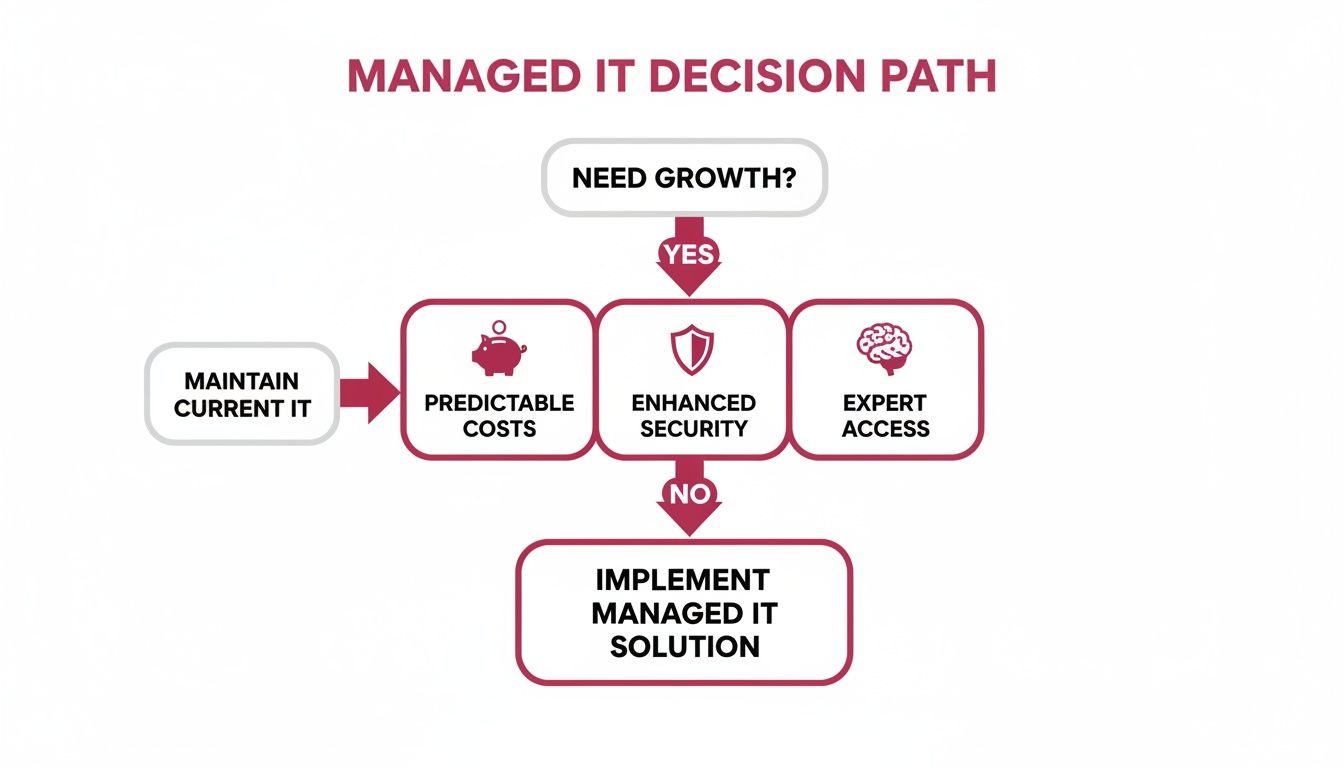
As you can see, the path to growth starts with recognising a need, and the right IT partnership makes cost predictability a foundational piece of the puzzle, right alongside better security and access to experts.
The Per-User Model
The per-user pricing model is often the most straightforward and is a real favourite among professional services firms. You simply pay a flat, fixed fee each month for every employee who needs IT support.
This approach is incredibly easy to manage and scales in a predictable way. When you bring on new staff, your IT costs go up by a set amount, which makes budgeting for growth a breeze.
- Best For: Businesses where staff numbers are fairly stable and each person uses multiple devices, like a desktop, a laptop, and a smartphone.
- Practical Example: Imagine an accountancy firm in Dorset with 25 staff. They’d pay a set fee per accountant each month. That single fee covers support for all their devices and systems, guaranteeing a predictable spend no matter how many support tickets they raise.
The Per-Device Model
On the other hand, some MSPs offer a per-device model. With this structure, you’re charged a flat fee for each piece of kit being managed – think servers, desktops, laptops, and network switches.
This can be a much more cost-effective option for organisations where multiple people share a single computer. It gives you a very clear picture of what it costs to maintain your physical IT assets.
The per-device model offers granular cost control, which is ideal for environments where technology is shared. It aligns the cost directly with the hardware infrastructure being supported, making it a good fit for schools, libraries, or manufacturing floors.
- Best For: Environments with more devices than people, like a school computer lab or a factory floor with shared workstations.
- Practical Example: A care home in Somerset has 15 shared desktop PCs for staff to update records, plus two servers. They would pay a monthly fee for each of these 17 devices. This is far more economical than paying for every one of their 50 staff members, many of whom might only use a computer for a few minutes each day.
Tiered Service Packages
Many MSPs bundle their services into tiered packages, often with familiar labels like Bronze, Silver, and Gold. Each tier comes with a different level of service, from basic monitoring and helpdesk support at the entry-level to comprehensive cybersecurity, strategic planning, and on-site visits at the top end.
This model lets you pick a package that aligns with both your budget and how heavily your business relies on technology. As you explore these, it’s worth digging into the different managed security service pricing models, as security is often a key difference-maker between the tiers.
At the end of the day, the right pricing model is the one that’s transparent, predictable, and flexible enough to support your business as it evolves. A good provider will sit down with you, analyse what you really need, and recommend the structure that delivers the most value for your unique situation.
How to Choose the Right IT Partner
Picking a Managed Service Provider (MSP) isn't just another procurement task; it's a serious commitment. You're bringing in a strategic partner who will be directly responsible for the security, stability, and smooth running of your entire technology backbone.

This is a decision that demands careful thought, looking past the sales pitch to find a company that genuinely clicks with your own goals and culture. The UK's managed IT services sector is massive, employing 343,762 people and generating over £51 billion each year. For a small or medium-sized business, this means you have plenty of choices, making a structured evaluation process essential to find the perfect fit. You can get a sense of the scale from this government research report.
To help you cut through the noise, we've put together a practical checklist of questions you should be asking any potential IT partner. It’s all about making an informed, confident choice.
Do They Have a Strong Local Presence?
When your entire network grinds to a halt, the last thing you need is to be told the nearest engineer is on the other side of the country. A local presence is absolutely critical for those times you need urgent, hands-on help.
- Key Question: How quickly can you get an engineer to our Hampshire office if we have a critical system failure?
- Why It Matters: A provider who is part of your local community understands the regional business landscape and can provide a rapid physical response when a remote fix just won’t cut it.
Can They Prove Their Industry Experience?
Every industry has its own unique IT quirks. A provider that's brilliant at supporting manufacturing firms might not have a clue about the specific software and compliance needs of a legal practice or an accountancy firm.
- Key Question: Can you give us some real-world examples of how you support other businesses in our industry?
- Why It Matters: Industry-specific experience means they'll already be familiar with your line-of-business software and regulatory duties. This translates into faster problem-solving and much more relevant strategic advice for your business.
What Do Their Clients Actually Say?
A sales pitch will always paint a rosy picture. The real acid test is what their existing clients think of them. You need to look for concrete proof that they can deliver on their promises.
Always ask for recent, relevant testimonials and detailed case studies. If a provider can't supply credible proof of their work with businesses like yours, that should be a major red flag.
- Key Question: Can we speak to one of your long-term clients in the Dorset or Wiltshire area?
- Why It Matters: A quick chat with a current client gives you unfiltered insight into their day-to-day service quality, communication, and overall reliability.
Is Their Approach Genuinely Proactive?
The whole point of managed IT services is to be proactive. A great partner doesn't just put out fires; they work tirelessly to stop them from starting in the first place.
- Key Question: What specific tools and processes do you use to monitor our systems and prevent downtime?
- Why It Matters: A truly proactive provider will talk about their 24/7 monitoring systems, regular maintenance schedules, and strategic reviews. This focus on prevention is what separates real managed services from a basic break-fix contract. Finding that right partner is a crucial step, and you can explore a comparison of leading managed IT service companies to see how different providers measure up.
So, Where Do You Go from Here?
We’ve covered a lot of ground explaining what managed IT services really are. Hopefully, it’s clear they’re much more than just an on-call IT guy. Think of it as a strategic investment in your business's security, day-to-day efficiency, and future growth. The real heart of the matter is the shift from putting out fires to preventing them in the first place.
This change frees you up to focus entirely on what you do best—running your business. Instead of losing sleep over potential downtime, system failures, or the constant threat of a cyberattack, you get a dedicated technology partner. Their success is tied directly to yours, which builds a relationship based on stability and shared goals.
Taking the Next Step
Making this transition is all about setting your business up for the long haul. A proactive IT strategy turns your technology from a source of frustration into a powerful tool for success. It ensures your systems are secure, your team can get their work done, and your infrastructure can grow with you, not hold you back.
Moving from a reactive to a proactive IT model is one of the most impactful decisions a business can make. It stops technology from being an unpredictable cost centre and transforms it into a reliable asset that drives performance and resilience.
To help you move forward with confidence, we invite businesses across Dorset, Somerset, Wiltshire, and Hampshire to book a complimentary, no-obligation IT health check.
This is a great chance to sit down with a local expert who gets the challenges and opportunities right here in our region. We can talk through your current IT headaches, get clear on your business goals, and give you some solid advice on how a proactive IT strategy can help you get there. It’s the perfect first step toward building a more secure and efficient future for your business.
Your Questions, Answered
It's natural to have a few questions when you're thinking about a new way to handle your IT. We get it. Below are some of the most common queries we hear from business owners, with straight-talking answers to help you see the full picture.
What's the Real Difference Between Managed Services and Traditional IT Support?
The simplest way to think about it is this: one is proactive, the other is reactive.
Traditional "break-fix" IT support is like calling a plumber when a pipe has already burst. You wait for a problem, call for help, and pay to get it fixed. It’s a purely transactional relationship focused on dealing with disasters after they’ve happened.
Managed IT services, on the other hand, are all about preventing that pipe from bursting in the first place. For a predictable monthly fee, we're constantly monitoring, maintaining, and securing your systems to keep everything running smoothly. Our goal is to stop fires from starting, not just race to put them out.
Aren't Managed Services Just for Big Corporations with Big Budgets?
That's a very common myth, but it couldn't be further from the truth. In reality, managed services are often the most cost-effective way for small and medium-sized businesses (SMEs) to get a handle on their technology.
Think about the cost of hiring just one experienced IT professional – you're looking at a significant salary, plus benefits, training, and other overheads. With a managed service plan, you get access to an entire team of specialists in cybersecurity, cloud systems, networking, and day-to-day support. You get all that expertise for a fixed monthly cost that's usually much less than a single employee's salary. It's a model designed to scale with you, so you only pay for what you actually need.
For an SME, managed services democratise access to enterprise-level IT expertise. You get the benefit of a fully-staffed, highly skilled IT department without the associated financial burden, levelling the playing field with much larger competitors.
How Exactly Do Managed IT Services Boost Our Cybersecurity?
Relying on a single antivirus program is a bit like locking your front door but leaving all the windows wide open. A proper Managed Service Provider (MSP) gives you a comprehensive, multi-layered security strategy that protects you from every angle.
A good MSP brings a much more robust defence to the table, including:
- 24/7 Threat Monitoring: We're always watching your network for suspicious activity, ready to neutralise threats before they cause any real damage.
- Proactive Patch Management: We make sure every piece of software on your network is kept up-to-date, closing the security gaps that hackers love to exploit.
- Advanced Threat Detection: We use sophisticated tools that go beyond basic antivirus to identify and block advanced malware, ransomware, and phishing attacks.
- Employee Security Training: Your team is your first line of defence. We equip them with the knowledge to spot and avoid common cyber threats.
We Already Have an IT Person on Staff. Would This Still Work for Us?
Absolutely. We work this way with many of our clients. It's known as a 'co-managed' IT model, and it's a fantastic way to blend your internal knowledge with our external expertise and resources.
In a co-managed partnership, we can handle the time-consuming daily grind—things like 24/7 monitoring, managing backups, security patching, and running the helpdesk. This frees up your in-house expert to focus on the big-picture projects that move your business forward, like developing new systems or improving internal processes. It’s about enhancing your existing team, not replacing it.
Ready to turn your IT from a reactive cost into a strategic asset? The team at SES Computers has been delivering reliable managed IT support to businesses across Dorset, Somerset, Wiltshire, and Hampshire for over 30 years. Book your complimentary IT health check today and discover a proactive approach to technology management. Find out more at https://www.sescomputers.com.