At its simplest, mobile broadband is high-speed internet delivered wirelessly over the same 4G and 5G networks your smartphone uses. Instead of a physical cable running into your building, it is a connection you can access virtually anywhere.
For a professional services firm, this could mean providing an immediate, secure internet connection for a team auditing a client on-site, allowing them to access cloud-based accounting software and company servers without relying on the client's guest WiFi. It is your own personal, high-performance internet source that you can take with you, providing a solid connection for laptops, tablets, or even an entire office network.
Understanding the Fundamentals of Mobile Broadband
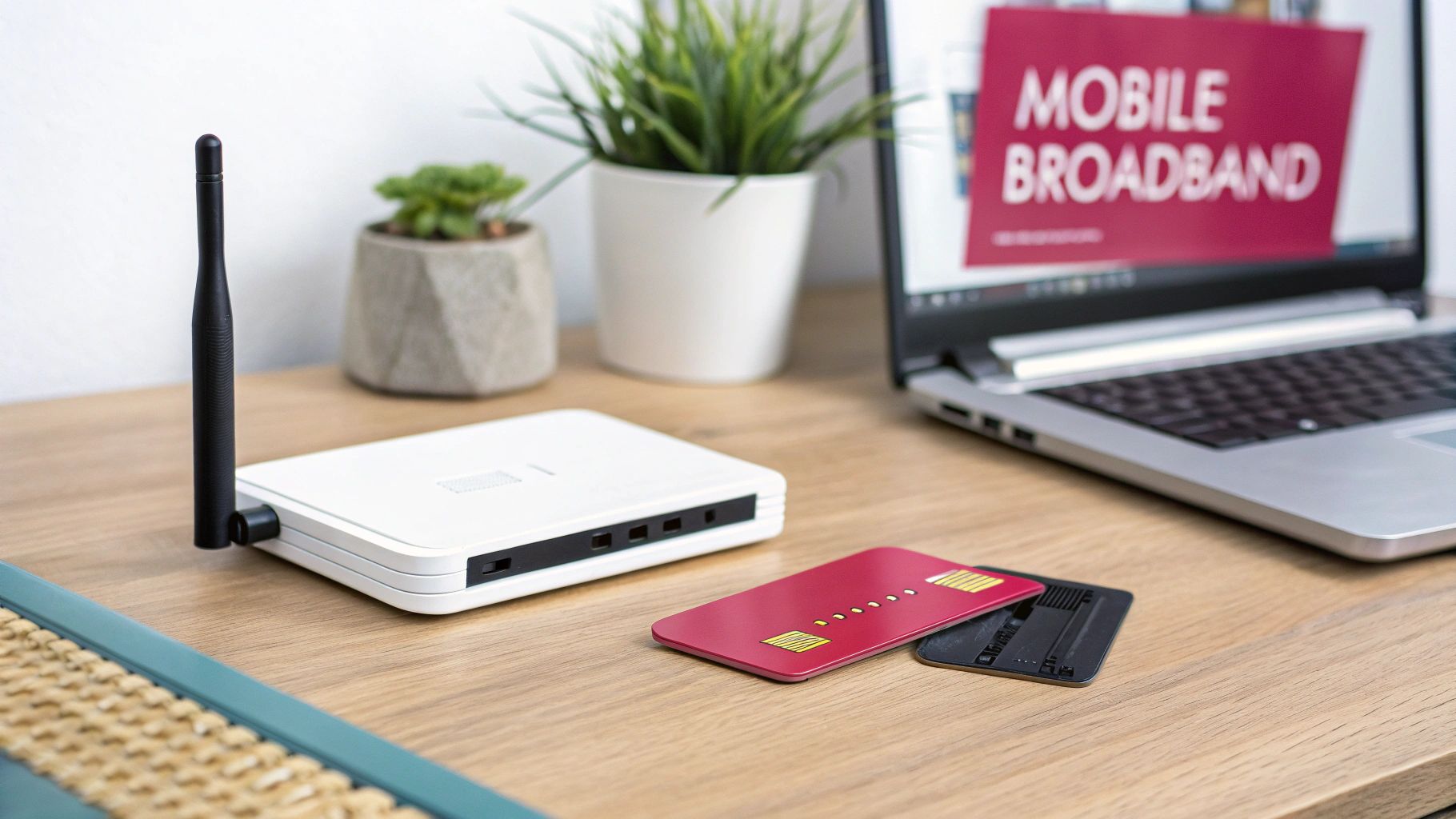
So, what is mobile broadband in practice? It is simply a way to get fast, reliable internet access without being tied to a phone line or a fibre optic cable. For businesses across the UK, this technology brings incredible flexibility, resilience, and rapid setup times. It works just like your mobile phone but is purpose-built to handle much higher data demands and connect professional equipment.
For example, imagine you need to set up a pop-up office for a construction project on-site. Rather than facing a long wait for a fixed line installation, you could have a 5G mobile broadband router up and running in minutes. This could provide high-speed WiFi for your project management team's laptops, security cameras, and payment systems for subcontractors. That ability to get connected instantly is one of its biggest advantages.
The Three Core Components of Mobile Broadband
To get this wireless connection working, you need three key ingredients to come together. Each one plays a critical role in bringing a stable internet connection to your business.
To break it down, here are the essential elements you need for a mobile broadband connection.
Core Components of a Mobile Broadband Setup
| Component | Function | Practical Examples for Professionals |
|---|---|---|
| A SIM Card | This is the "key" that authenticates your device on a mobile network. It connects your hardware to your chosen data plan. | Data-only SIM cards from major UK networks like Vodafone, EE, or O2 inserted into a business router. |
| A Data Plan | Your subscription service. This determines your data allowance, connection speed, and monthly cost. | Business plans ranging from a few gigabytes for a sole field engineer to unlimited data packages for a temporary project office. |
| A Compatible Device | The hardware that picks up the mobile signal and turns it into a WiFi or wired network connection for your devices. | USB dongles for individual use, portable MiFi hotspots for small teams, or robust 4G/5G business routers for a site office. |
These three pieces form a complete, self-contained internet solution that can be set up wherever you can get a decent mobile signal.
By combining the right SIM, data plan, and hardware, you create a powerful, portable internet solution. This is a game-changer for businesses needing reliable connectivity where traditional broadband just isn't an option.
The Technology Driving Your Connection
To really get what mobile broadband is, you have to look under the bonnet at the technology that makes it all work. It is an area that has moved at a blistering pace, from the dependable 4G networks we’ve all come to rely on to the genuinely game-changing performance of 5G. Each leap forward has brought real, practical benefits to how businesses operate.
Think of the 4G network as a well-organised three-lane motorway. It gets the job done for everyday business traffic—emails, file downloads, and general browsing. But just like a real motorway, it can get congested at peak times, slowing everything down. For years, this has been the workhorse that enabled remote working and basic access to cloud services.
From 4G Motorways to 5G Superhighways
Now, picture 5G as a brand-new, eight-lane superhighway. It has been built from the ground up for incredible speed, near-instantaneous response times (what we call low latency), and the capacity to handle thousands more vehicles without causing a jam.
For a business, this is not just a number on a specification sheet. It means a marketing agency can conduct lag-free video calls that do not drop, transfer huge project files in moments, and connect dozens of devices in a busy office without anyone noticing a slowdown.
This jump from 4G to 5G is more than just a speed bump; it opens up entirely new ways of working. It gives businesses the power to run data-hungry applications, stream crystal-clear security footage, and use real-time collaboration tools that once would have been unthinkable without a fibre line.
The constant investment from network operators is clearly paying dividends. Across the United Kingdom, mobile network performance has seen a significant uplift, with median download speeds climbing by 15% year-on-year to hit 63.03 Mbps. This steady improvement is precisely why mobile broadband is becoming such a compelling option for primary business internet. You can find out more about these UK mobile performance improvements and what they mean for businesses.
Your Secure Access: The SIM Card and Hardware
The key that unlocks all this potential is the humble SIM card. It works just like the one in your phone, securely identifying your hardware on the network and linking it to your company's data plan. In essence, it is what turns a simple box into your gateway to the internet.
When it comes to the hardware itself, your choice really comes down to what you need to achieve.
- USB Dongles: These are the simplest solution. Small, compact, and perfect for a single professional out in the field who just needs to get their laptop online, such as a surveyor updating a report.
- MiFi Devices: Think of these as a personal, portable WiFi bubble. They are small devices that can connect a small team of up to 10 people, making them brilliant for off-site meetings or temporary project sites.
- 4G/5G Routers: This is the heavyweight option for business. These are robust, office-grade routers designed to be left on 24/7. They can support a whole office with wired and wireless connections, come with advanced security features, and often have ports for external antennae to pull in an even stronger signal.
Getting the right mix of network technology (4G vs 5G), the right SIM plan, and the right hardware is the key to building a mobile broadband setup that works for you. It ensures your connection is not just fast, but is perfectly matched to the demands of your business.
Comparing Mobile Broadband with Fixed-Line Internet
When you are choosing an internet connection for your business, it is rarely a simple case of picking the fastest option. It is a strategic decision. You are weighing up the pros and cons of mobile broadband against traditional fixed-line services, and while both get you online, they solve very different problems. The right choice depends entirely on how your business operates—it is about agility versus raw power.
For years, fixed-line connections, especially fibre, have been the default choice for businesses that need serious performance. They offer symmetrical speeds, which means your upload speeds match your downloads. This is crucial if you are an architectural firm constantly sending large design files to the cloud, hosting your own servers, or running video conferences all day. But that power comes at a cost: it is physically tethered to your building.
Speed Versus Agility
The main headache with fixed-line broadband is the wait. Getting a new fibre line installed can be a long, drawn-out process, often taking weeks or even months. Sometimes it involves disruptive engineering work, like digging up the road outside your premises. If you need to get a new site online now, that kind of delay just is not an option.
This is where mobile broadband completely changes the game. A 5G business router can be up and running in a few hours. Think about it: a pop-up shop, a temporary construction office, or an events team can have enterprise-grade internet access almost instantly. For these kinds of businesses, rapid deployment is not a luxury; it is fundamental to their operation.
The performance of mobile networks has also come on in leaps and bounds.
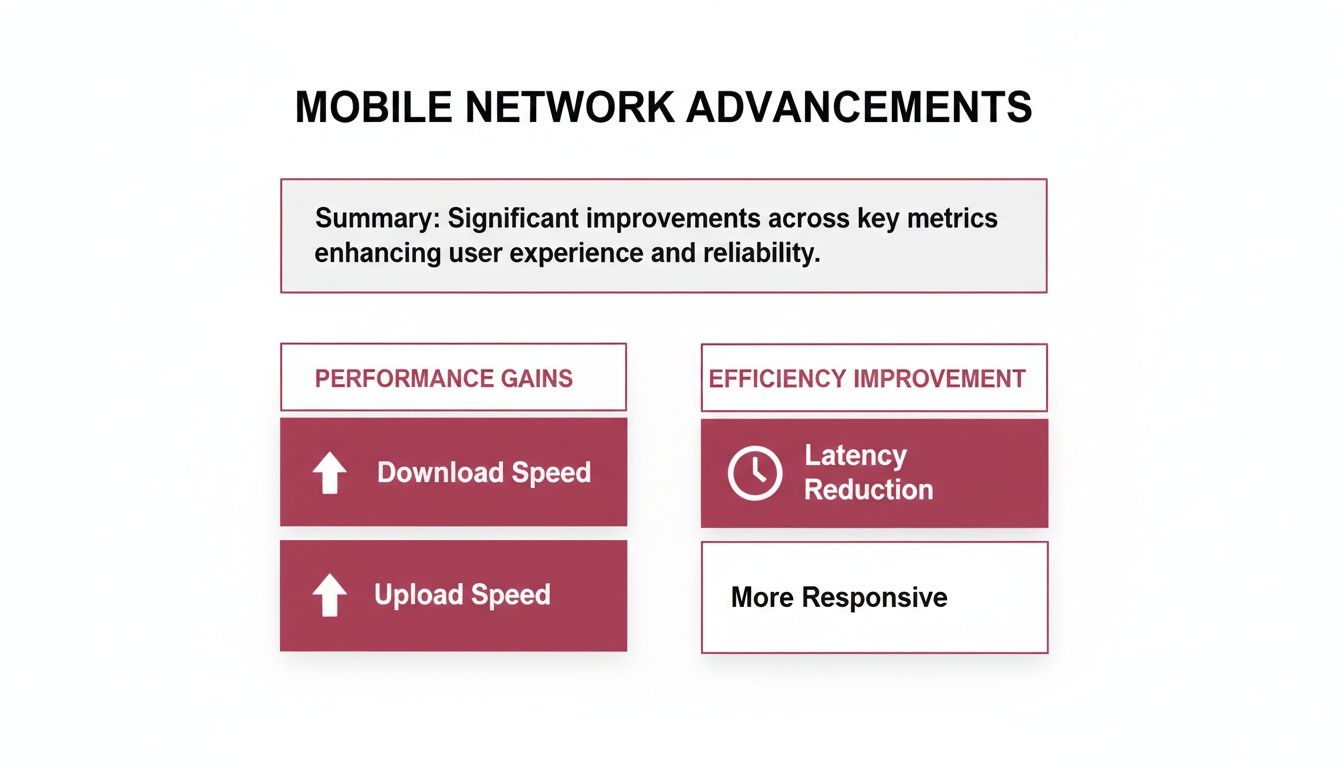
As you can see, the gap is closing fast. With huge improvements in download and upload speeds, plus much lower latency, modern mobile broadband is more than capable of serving as the primary connection for a huge number of businesses.
Mobile vs Fixed-Line Broadband A Head-to-Head Comparison
To make the differences clearer, let us break them down side-by-side. The following table compares mobile and fixed-line options based on the factors that typically matter most to a business.
For a more detailed look at dedicated, high-performance connections, you might find our guide on leased line vs broadband helpful.
| Feature | Mobile Broadband (4G/5G) | Fixed-Line Broadband (Fibre/ADSL) |
|---|---|---|
| Installation Time | Hours to days; plug-and-play setup. | Weeks to months; can require engineering works. |
| Portability | Extremely high; works anywhere with a signal. | None; physically tied to one address. |
| Reliability | Depends on network coverage and signal strength. | Very high and stable, with minimal fluctuations. |
| Best Use Case | Agile businesses, backup/failover, remote sites, mobile teams. | Offices with heavy data needs, server hosting, mission-critical tasks. |
Ultimately, understanding which solution fits best comes down to knowing your operational priorities.
A financial services firm handling massive volumes of sensitive data will almost certainly opt for a dedicated fibre line for its rock-solid stability. But you can bet they will have a 5G failover solution ready to kick in, ensuring 100% uptime. On the other hand, a mobile veterinary practice relies entirely on mobile broadband to run its diagnostic tools and payment systems from the back of a van.
How UK Businesses Use Mobile Broadband
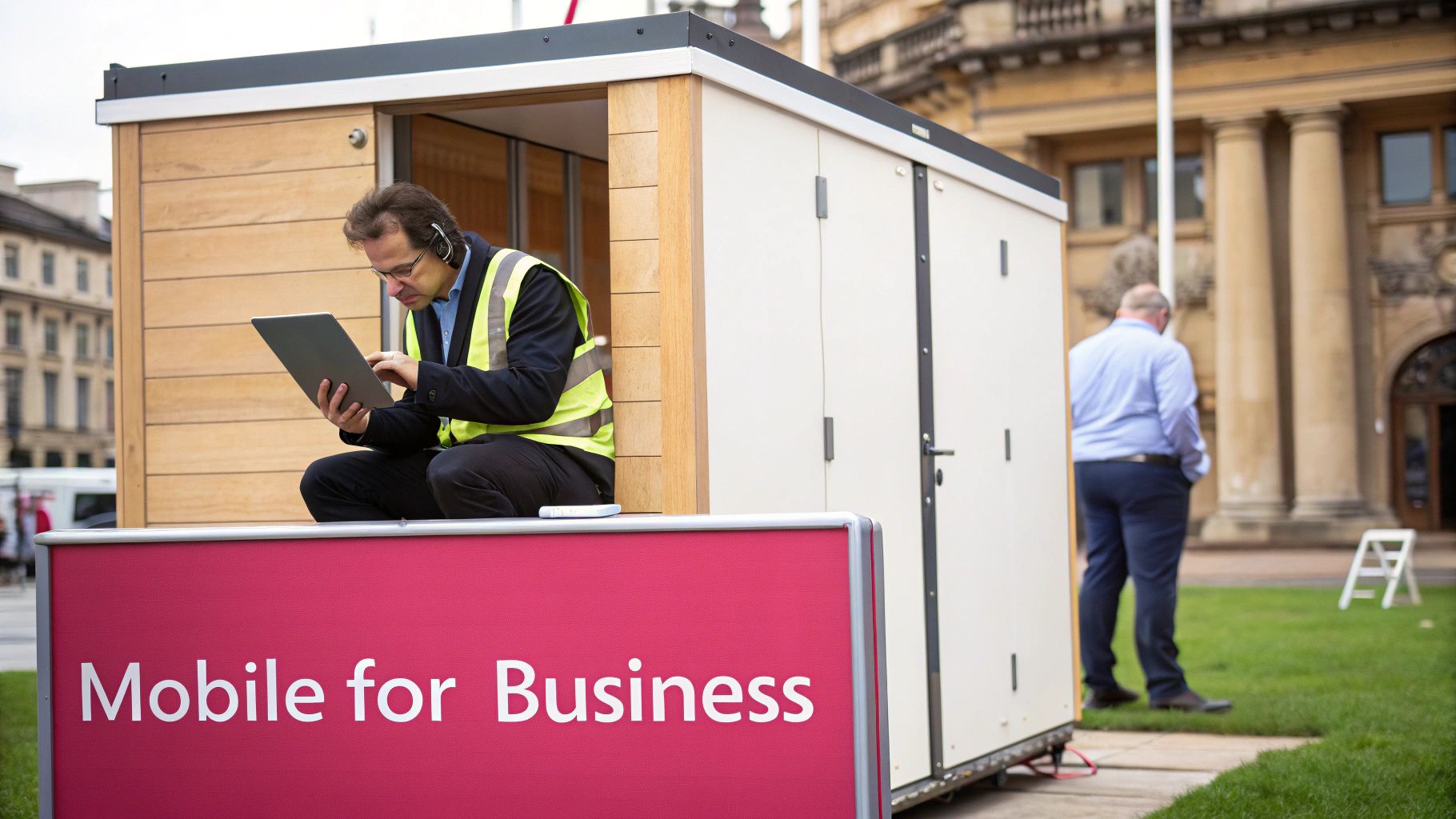
It is one thing to get your head around the technology, but the real value of mobile broadband shines through when you see how it solves genuine business problems. Across the UK, companies are using this incredibly flexible connectivity to boost productivity, guarantee continuity, and set up shop in places that were once internet dead zones.
The appetite for data on the move is soaring. Just last year, the UK saw an 18% jump in mobile data consumption, with total usage climbing past a staggering 1.2 billion gigabytes every month. This is not just about people streaming videos; it is a clear signal that businesses are relying more and more on fast, dependable mobile connections to get work done.
Primary Connectivity for Agile and Rural Businesses
For a growing number of businesses, mobile broadband has graduated from a backup plan to become their main connection to the outside world. This is a game-changer for companies in rural areas like Dorset or Somerset, where fixed-line broadband can often be frustratingly slow or unreliable.
Imagine a surveying firm working out in the Peak District. With a rugged 5G router in their van, they can upload massive, high-resolution drone scans and site data directly from the field. No more waiting until they get back to the office. It is also perfect for a modern marketing agency that hops between co-working spaces, giving them a consistent, secure network wherever they choose to work.
Essential Failover and Business Continuity
Let us be honest, downtime is a killer. A lost internet connection can grind sales, client communication, and your entire operation to a halt. This is where mobile broadband steps in as an indispensable safety net.
By setting up a 4G or 5G router for automatic failover, your business is protected. If your main fibre line goes down—whether it is a fault at the local exchange or a digger accidentally severing a cable—the mobile connection kicks in instantly. For a busy e-commerce warehouse, this means payment terminals keep working and orders keep flowing, preventing a minor outage from turning into a major financial headache.
Instant Internet for Temporary and Pop-Up Sites
The ability to get online instantly is a huge competitive advantage for any temporary setup. Mobile broadband gives you high-speed internet without the lengthy contracts and installation delays that come with a fixed line.
Here are a few practical examples:
- Construction Sites: A project manager can have a fully connected site office running in a portable cabin on day one, providing WiFi for laptops, VoIP phones, and security cameras.
- Event Management: A company exhibiting at a trade show can process card payments and stream product demos without relying on the venue's often-overloaded public WiFi.
- Pop-Up Retail: A seasonal shop can get its tills and stock systems online for the Christmas rush without committing to a year-long contract.
Empowering Mobile and Remote Teams
Finally, mobile broadband is the engine that powers a modern, distributed workforce. It provides the secure, high-performance connection your staff need to be productive, no matter where they are.
For companies with distributed teams, applying the best practices for managing remote teams alongside robust connectivity is the key to success. It gives field engineers, sales representatives, and home-based employees the freedom and tools to access cloud applications and collaborate just as effectively as if they were all in the same room. For example, a sales professional can update the company CRM, join a video call with a prospective client, and process an order—all from their vehicle between appointments.
Choosing the Right Mobile Broadband Solution
Picking the right mobile broadband setup is one of those decisions that can quietly make or break your business's productivity. It is about more than just finding a provider; it is about digging into how your business actually operates and finding a solution that fits like a glove. If you get it right, you will have a reliable connection that just works. If not, you will be paying for something that constantly lets you down.
The best place to start is with a straightforward needs analysis. Forget the jargon for a moment and just ask the simple questions: who will be using this connection, where will they be, and what will they be doing? Are we talking about a single field agent who just needs to fire off emails and update a CRM, or a pop-up office for five people who live on video calls? Answering this first will make every other choice much clearer.
Assessing Your Use Case
To get this right, you have to be really honest about your day-to-day operations. The mobile broadband needed to run a rural business as its primary connection is worlds away from what is required for a simple failover system in a city-centre office.
Think about these key points:
- Number of Users: How many people will be sharing the connection at any one time? A lone worker can get by with a simple dongle, but a whole team will need a much more powerful router to handle the load.
- Typical Activities: What does a normal day look like? Is it mostly sending emails and processing transactions, or are your staff regularly on high-definition video calls and shifting massive files around? The bandwidth demand is vastly different.
- Primary vs. Backup: Is this going to be your main, everyday internet connection, or is it just a safety net for when your fixed line inevitably goes down? A primary solution needs to be far more robust and reliable.
Matching Hardware to Your Needs
Once you have a clear picture of your usage, you can start looking at the hardware. The device you choose is the heart of your setup; it is what pulls in the mobile signal and shares it with your team. There is no single "best" option here—it all depends on the job at hand.
For example, a MiFi device is a small, portable hotspot that is brilliant for a small team at an off-site event or a temporary project. It is incredibly convenient but was not built to run 24/7. On the other hand, a business-grade 4G/5G router is a different beast entirely. It is designed for constant, heavy use and comes with better performance, stronger security, and often the ability to add external antennae to pull in a stronger signal in weaker areas. For UK businesses exploring different wireless internet options, this guide on Top WiFi Solutions for Businesses offers some really useful insights.
For any kind of permanent setup—whether it is the main internet for a site office or a critical backup system—a dedicated business router is not just a good idea, it is essential. It gives you the stability and security that a professional operation simply has to have.
Selecting the Right Data Plan and Provider
Finally, it is time to pick a data plan and a network provider. This decision really boils down to two things: how much data you need and who has the best signal in your area. An "unlimited" data plan can sound like the perfect solution, but always check the small print. Many come with fair usage policies that can slow your connection to a crawl if you use too much.
A capped plan might actually be the smarter, more cost-effective choice if your data usage is fairly consistent and predictable. But before you sign anything, the most important thing you can do is check the coverage maps from providers like EE, Vodafone, and O2. A fantastic device and a generous data plan are completely worthless if you cannot get a solid, reliable signal right where you need it most.
Why a Managed Service is the Smart Choice
You could set up your mobile broadband connection yourself, but that approach often leads to patchy performance and surprise outages. The real value of mobile broadband for business is not just in the connection itself—it is in turning that connection into a reliable, fully supported utility you can count on. That is where a managed service comes in.
Working with an expert partner takes all the guesswork out of the equation. It starts with something crucial: a professional site survey. Technicians will come to your exact location to find out which mobile network is genuinely the strongest and most stable right there, not just in your general postcode. This single step can be the difference between a lightning-fast connection and a painfully slow one.
From Hardware to Ongoing Support
After the survey, a managed service provider like SES Computers will supply and set up business-grade hardware. We are not talking about the kind of router you would pick up from a high street shop. This equipment is specifically selected for its superior performance, security features, and sheer reliability.
But the most important part? The service does not stop once the kit is installed.
A managed solution means you get proactive, ongoing monitoring and support. Potential problems are often spotted and fixed before you even notice them, keeping your business online when it matters most.
This continuous oversight is vital for any company that depends on its connection to function. If you are juggling connectivity across several sites, understanding the benefits of managed internet services can be a game-changer, simplifying your operations and guaranteeing performance everywhere. It is this end-to-end support that ensures your mobile broadband solution delivers, day in and day out.
Your Questions, Answered
When you start looking into mobile broadband for your business, a few key questions always come up. Let us tackle them head-on, so you can see exactly how this technology fits into your operations.
Is Mobile Broadband Genuinely Secure Enough for Business Use?
Yes, it absolutely is. There is a common myth that wireless connections are inherently risky, but that is simply not the case with professional-grade mobile broadband. Business-class 4G and 5G routers come packed with serious security features, from built-in firewalls to full support for VPNs that encrypt all your data from end to end.
For example, a law firm can confidently use a 5G router to allow its solicitors to access sensitive client files from a temporary project office, knowing the connection is secured by robust, enterprise-level encryption. This is far safer than using a public WiFi hotspot in a café, which can be a prime target for cybercriminals.
Can Mobile Broadband Really Take the Place of My Fibre Line?
For a growing number of small and medium-sized businesses, especially those in areas with solid 5G coverage, the answer is a definite yes. Today's mobile networks deliver the kind of speed and stability needed for everything from cloud software and video calls to your day-to-day digital workload.
That said, if your business has massive data requirements or you run your own servers on-site, mobile broadband shines as the perfect backup plan. It is the safety net that keeps your business online if your main fibre connection ever goes down.
It all boils down to what your business needs. For a new shop that needs to get online fast, 5G is a brilliant primary connection. For a finance firm that cannot afford a second of downtime, it is the ultimate business continuity tool.
What Happens If the Mobile Signal Is Weak at Our Location?
This is a very real concern, whether you are in a rural spot or a dense urban area where buildings interfere with signals. This is precisely where getting a professionally managed solution makes all the difference. An expert installer will not just plug in a router and hope for the best.
They have tools and techniques to overcome poor signal strength:
- Proper Site Surveys: A technician will visit your location to test the different networks and find out which one offers the strongest, most reliable signal right at your postcode.
- High-Gain External Antennae: If the indoor signal is weak, a powerful antenna can be mounted on the outside of your building. This captures a much stronger signal and pipes it directly into your router.
With this kind of professional setup, even a weak initial signal can be transformed into a fast and reliable internet connection for your business.
Ready to see how a managed mobile broadband solution can keep your business connected, no matter what? The team at SES Computers can carry out a full site survey and recommend the ideal hardware and network for your unique situation. Learn more at SES Computers.