At its most basic, enterprise software is the digital engine room for a modern business. It’s not just a single app or program; it's a comprehensive suite of tools built to manage and connect a company's most critical operations on a large scale.
Think of it as the central nervous system of an organisation. It links everything from finance and human resources to project management and client relationships, pulling them all together into one coherent, functioning system.
Defining Enterprise Software Beyond The Buzzwords
Let’s use an analogy. A small corner shop might get by just fine using a simple spreadsheet to track its stock. But what about a national retail chain with dozens of stores and multiple warehouses? They need something far more powerful to track inventory, coordinate logistics, and handle thousands of transactions every single day. That’s precisely where enterprise software comes in. It’s built from the ground up to handle this kind of complexity and scale.
For professional services firms right here in the UK—whether you’re a busy London consultancy or a meticulous architectural practice in Manchester—these systems are the operational backbone. They’re what keeps project timelines on track, client billing accurate, and resources allocated efficiently. This frees up your experts to do what they do best: deliver exceptional work for clients, instead of getting tangled up in administrative knots.
The Scale and Scope of Enterprise Systems
The ultimate goal here is to boost business efficiency and unlock insights from your own data. This is achieved by standardising how things get done and creating a single, reliable source of truth for company-wide information. No more crucial data locked away in separate departmental spreadsheets. Instead, it flows seamlessly between different parts of the business.
This connectivity gives leaders a clear, live view of the entire organisation, which is absolutely vital for making smart, strategic decisions. The growing importance of these tools is clear from the market figures. The UK enterprise software market pulled in around USD 17.52 billion in revenue in a recent year, and it's set for significant growth. This isn’t just a trend; it's a fundamental shift in how modern businesses operate. You can explore a detailed UK enterprise software market forecast on reportlinker.com for more detail.
At its core, enterprise software replaces isolated, manual processes with a cohesive, automated ecosystem. It is the framework that enables an organisation to operate efficiently, scale effectively, and maintain a competitive edge.
But the real value isn't just in the automation. It's in the visibility it provides. A project manager at a civil engineering firm can instantly see which surveyors are available for a new site assessment. A finance director at an advertising agency can pull accurate revenue forecasts in minutes. An HR manager can track performance metrics across teams—all from within the same interconnected system.
Core Functions of Enterprise Software at a Glance
To put it all together, let's break down the primary functions of this software and the value they bring to a business. This table gives a quick overview of what these systems actually do.
| Core Function | Description | Primary Business Value |
|---|---|---|
| Data Centralisation | Consolidates information from various departments into a single, shared database. | Creates a "single source of truth," reducing errors and improving decision-making. |
| Process Automation | Automates repetitive, manual tasks such as invoicing, reporting, and data entry. | Increases efficiency, minimises human error, and frees up staff for strategic work. |
| Business Intelligence | Gathers and analyses data to produce actionable insights, reports, and dashboards. | Enables data-driven strategies, helps identify trends, and improves forecasting. |
| Scalability | Designed to grow with the business, handling increased data, users, and transactions. | Supports business expansion without requiring a complete system overhaul. |
| Integration | Connects different business functions (e.g., finance, HR, CRM) into a unified system. | Provides a holistic view of the business and ensures seamless operational flow. |
Essentially, each function works to strip away complexity and provide clarity, helping the entire organisation run more smoothly and intelligently.
The Four Pillars of Enterprise-Grade Software
So, what’s the real difference between a sophisticated enterprise system and a standard business app you might download? The secret lies in a foundation built on four crucial pillars: scalability, performance, robustness, and security. These aren't just buzzwords on a feature list; they are the fundamental design principles that allow the software to handle complex, mission-critical operations without skipping a beat.
Each of these is vital, particularly for professional services firms where growth, reliability, and data protection are everything. A UK accountancy practice, for instance, simply cannot have its financial systems crashing during the tax season chaos. Likewise, a law firm cannot afford a data breach that exposes sensitive client files.
Let’s take a closer look at what makes each pillar so important.
Scalability and Performance
Scalability is all about the software's ability to grow with your business. An enterprise system is built from the ground up to handle more data, more users, and more transactions without slowing down. Think of it like a motorway: as traffic (your business activity) builds up, you need to add more lanes to keep everything moving smoothly.
Imagine a consulting firm that’s expanding fast, onboarding new clients and team members every quarter. A scalable project management system will absorb this growth effortlessly, ensuring that scheduling, resource planning, and reporting stay quick and responsive. This kind of high-performance architecture is designed to process thousands of complex requests in real-time—a non-negotiable for any business that needs to operate at pace.
The technology behind this is fascinating. The infrastructure plays a huge part, and you can get a better sense of it by reading our guide on what is cloud hosting.
Robustness and Security
Robustness is another way of talking about reliability and resilience. Enterprise software is engineered to run 24/7 with next to no downtime because it often powers the very core of the business. This is usually achieved with clever design, like having backup systems ready to take over instantly if one part fails.
Finally, we come to security—arguably the most critical pillar of all. Enterprise systems are locked down with multiple layers of security designed to protect sensitive company and client data. This typically includes:
- Access Control: Strict permissions are set up so people only see the data they absolutely need to for their job.
- Data Encryption: Information is scrambled both when it’s stored and when it's being sent, making it unreadable to anyone who shouldn't see it.
- Audit Trails: The system keeps a detailed log of all user activity, which is a massive help for monitoring what's going on and meeting compliance rules.
For a UK-based financial advisory firm, these security measures aren't just good practice—they're a legal necessity. The software must protect confidential client data while providing a clear audit trail to satisfy strict industry regulations.
Together, these four pillars ensure that enterprise software is more than just a tool; it's a dependable, secure, and future-proof foundation to build your business on.
Exploring The Main Types of Enterprise Software
The world of enterprise software isn't one single, catch-all solution. It's more like a collection of highly specialised systems, each built to tackle specific business challenges. Getting to grips with the main types is the first step to understanding how they can work together to transform an organisation.
Think of a well-run business as a complex, modern building. The software it uses provides the essential infrastructure for every department and function, from the foundations right up to the boardroom.
This intricate ecosystem is powered by a thriving UK software development industry. With a market size estimated at a staggering £52.3 billion, this sector is the engine creating these sophisticated tools. In fact, with over 60,000 businesses developing software across the country, the choice of platforms is vast.
Let's explore the most common systems using our building analogy.
Enterprise Resource Planning (ERP): The Foundation
Enterprise Resource Planning (ERP) software is the concrete foundation of the entire structure. It’s the central hub that connects and manages a company's core internal processes, making sure everything is built on solid ground.
An ERP system typically integrates finance, human resources (HR), project accounting, and resource management into a single, shared database. This gets rid of disconnected data silos and ensures everyone, from accounts to the project delivery team, is working from the same real-time information.
- A UK Architectural Practice's Example: Picture an architectural firm in Bristol. Their ERP tracks project budgets, manages employee timesheets against specific jobs, and handles all client invoicing and payroll. When a new project is won, the system instantly sets up the financial tracking and resource planning framework, creating a seamless, efficient workflow from start to finish.
Customer Relationship Management (CRM): The Reception
If ERP is the foundation, then Customer Relationship Management (CRM) software is the client-facing reception desk. Its entire purpose is to manage every single interaction and relationship with current and potential clients. It’s the friendly, organised face of the business.
A good CRM tracks communications, monitors sales pipelines, and keeps a detailed log of client support history. This gives your teams a complete 360-degree view of the client journey, helping them build stronger, more profitable relationships.
- A UK Consultancy's Example: A London-based consultancy uses its CRM to track new business leads, manage ongoing client communication, and log every meeting note. This means any consultant can pick up a client file and immediately have the full context, ensuring a consistently professional and personal service.
The infographic below shows how these different systems often slot together within an organisation.
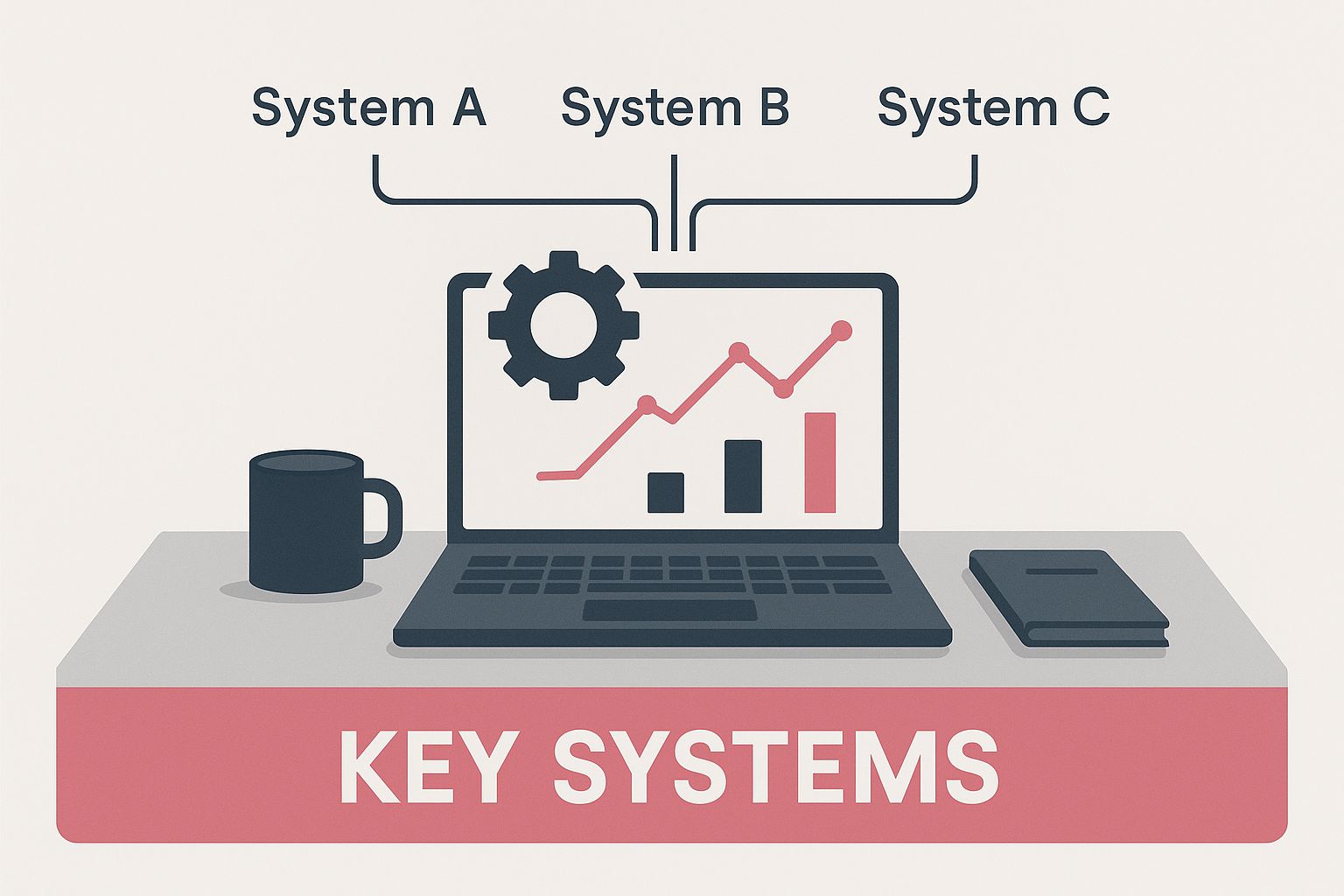
As you can see, the real power comes from how these different enterprise systems connect, allowing data to flow smoothly between them to create a single, cohesive operational structure.
SCM and BI: The Logistics Network and The Boardroom
Beyond the foundation and reception, a couple of other key systems complete the building.
Supply Chain Management (SCM) software acts as the building's entire logistics and delivery network. It manages the full journey of a product, from sourcing raw materials right through to delivering the finished item to the customer. While less common in pure professional services, firms dealing with physical deliverables or complex procurement rely heavily on SCM principles.
Business Intelligence (BI) is the strategic boardroom. These powerful tools pull data from the ERP, CRM, and other sources, then analyse it to create insightful reports, dashboards, and visualisations. BI software turns raw data into actionable intelligence, helping leaders make smarter, better-informed decisions.
To help clarify the roles of these different systems, this table breaks down their core functions and who typically uses them.
Comparing Enterprise Software Types
| Software Type | Primary Focus | Key Features Example | Typical Department |
|---|---|---|---|
| ERP | Integrating core internal business processes | Financial management, project accounting, payroll | Finance, HR, Operations |
| CRM | Managing all client interactions and data | Sales pipeline tracking, contact management | Sales, Marketing, Client Services |
| SCM | Optimising the flow of goods and services | Inventory management, logistics planning | Logistics, Procurement |
| BI | Analysing data to inform strategic decisions | Dashboards, reporting, data visualisation | Management, Analytics |
This table is just a snapshot, of course. Many other specialised systems exist to tackle specific industry needs, from managing people with Talent Management System Software to connecting teams effectively. These systems often rely on strong communication tools to function properly, a topic we cover in our guide on what is unified communications.
Why UK Professional Services Firms are Investing in Enterprise Software
For professional services firms across the United Kingdom, investing in robust enterprise software has moved from a "nice-to-have" to a core strategic priority. This isn't just about chasing the latest tech trend; it's a fundamental shift in how firms operate to sharpen their competitive edge, deepen client relationships, and build a more resilient business. The motivation is simple: tangible results.
We're seeing firms finally ditching the patchwork of disconnected spreadsheets and clunky manual processes that inevitably lead to bottlenecks and costly errors. They're moving towards integrated systems that act as a single source of truth for the entire business, allowing them to automate repetitive work, uncover powerful insights from their own data, and, most importantly, deliver more value to their clients.
Boosting Operational Efficiency
One of the first and most noticeable impacts is a huge leap in operational efficiency. Enterprise systems take over the time-consuming administrative grind, freeing up your best people—the experts your clients pay for—to focus on high-value, strategic work.
Picture a typical management consultancy in London. Before bringing in an Enterprise Resource Planning (ERP) system, partners and senior staff would lose countless hours manually tracking project time, piecing together invoices, and juggling resource schedules. With a proper ERP in place, these workflows are transformed.
- Automated Billing: The system can instantly generate precise invoices from logged project hours, slashing the administrative burden and speeding up cash flow.
- Smarter Resource Allocation: Managers get a live, clear view of consultant availability and expertise, making it far easier to staff projects effectively and maximise billable time.
This isn't just about saving time. It's about reallocating your most valuable asset—your team's expertise—away from admin and towards client strategy and winning new business.
By centralising core functions, enterprise software gives professional services firms the ability to operate with greater agility and precision. It turns cumbersome back-office processes into a streamlined, efficient engine for growth.
Driving Smarter, Data-Led Decisions
In today's market, running a firm on gut feeling alone is a massive gamble. Enterprise software, especially when paired with Business Intelligence (BI) tools, gives the leadership team access to accurate, real-time data from every corner of the organisation.
This unified view of data allows firms to shift from simply reacting to problems to proactively shaping their strategy. A law firm, for instance, can analyse data from its case management system to pinpoint its most profitable practice areas or identify where teams are stretched too thin. These insights empower the partners to make confident, evidence-based decisions about where to invest for future growth.
Enhancing Client Loyalty and Regulatory Compliance
Finally, these systems are indispensable for managing client relationships and navigating the UK’s complex regulatory environment. A modern Customer Relationship Management (CRM) system provides a complete, 360-degree view of every client interaction, which is the foundation for providing a consistently personal and high-quality service.
At the same time, many enterprise platforms are built with compliance in mind, offering features that help firms adhere to regulations like GDPR. They provide strong security, clear audit trails, and better control over sensitive client data. This dual benefit—strengthening client trust while reducing risk—makes the investment an open-and-shut case.
The Reality of Software Implementation and Integration

Buying a powerful piece of enterprise software is one thing. Actually getting it to work for your business is another challenge entirely. The real value is only unlocked during implementation and integration, a phase that demands meticulous planning and strategic execution.
To get it right, you need a solid plan that covers everything from customisation and data migration to comprehensive team training. This is where the software is shaped to fit your specific business processes, not the other way around. It involves carefully moving all your existing data into the new system and making sure your team feels comfortable with the new tools from the get-go. For a deeper dive into this complex process, take a look at a comprehensive guide to ERP system implementation.
Connecting The Dots With Integration
True operational efficiency comes when all your different systems communicate seamlessly. That’s the entire point of integration—getting your CRM, ERP, and other business tools to talk to one another.
This process demolishes the data silos that hold businesses back, creating a single source of truth across the whole organisation. Imagine a UK accountancy firm: when a new client is onboarded in the CRM, an account is automatically created in the billing system. No more manual double-entry, and far fewer costly errors.
The core purpose of integration is to build a cohesive digital ecosystem where data flows freely between applications, providing a unified view of business operations and improving overall efficiency.
Successfully navigating this kind of change is a big deal. To keep the process smooth and on track, it’s vital to have a strong grasp of IT change management processes.
The Role of Software Distributors and Partners
You don't have to go it alone when navigating the complexities of implementation. This is where specialist partners and software distributors come in. Think of them as expert guides for your deployment journey.
These partners bring the technical know-how and project management skills needed to configure the software correctly and ensure you see a real return on your investment. In the UK, this support network is a significant industry in its own right, with the software distribution market valued at around USD 22.12 billion.
With a projected annual growth rate of 12.8% over the next decade, this sector is a critical channel for getting enterprise solutions into the hands of businesses that need them. These experts are the ones who bridge the gap between powerful technology and tangible business value.
Choosing The Right Enterprise Software For Your Business
Picking the right enterprise software is far more than just a tech purchase; it's a strategic move that can shape your company's future. Before you even start looking at demos or getting quotes, the first step is to look inward. What are the real-world problems you're trying to fix? Are there specific, creaky processes you want to modernise?
Once you have a clear picture of your needs, you can start evaluating options, but don't get distracted by the initial price tag. It's crucial to think about the total cost of ownership (TCO). This figure includes everything from implementation and staff training to ongoing maintenance and any custom tweaks you might need down the line. A seemingly cheaper system can easily become a money pit if it requires constant attention to keep it running smoothly.
Then, think about where your business is heading. Will this software grow with you, or will it hold you back?
Choosing enterprise software is about equipping your business for the future. Prioritise scalability to ensure your investment supports long-term growth, rather than becoming a bottleneck in a few years' time.
Properly vetting vendors and finding a reliable implementation partner is just as important as the software itself. Taking this measured, strategic approach ensures the system you choose becomes a genuine asset. It’s not just about adding a new tool; it's about building a more resilient and competitive foundation for your UK business to thrive on.
Frequently Asked Questions
When you're thinking about enterprise software, a lot of practical questions naturally come to mind, especially if it's your first time making this kind of investment. Let's tackle some of the most common ones to give you a clearer picture.
Is Enterprise Software Only For Huge Corporations?
This is probably the biggest myth out there. It used to be true—enterprise systems were once the exclusive playground of massive corporations with deep pockets. But the game has completely changed, thanks to flexible, cloud-based solutions.
Modern Software as a Service (SaaS) models have made these powerful tools both affordable and accessible for Small and Medium-sized Enterprises (SMEs). A small UK engineering firm, for example, can now subscribe to a top-tier project management system on a simple per-user basis. They get the same operational muscle as a multinational giant, but without the crippling upfront cost. It’s all about adopting powerful tools that can grow right alongside your business.
Custom-Built vs Off-The-Shelf Software
This is a classic dilemma, and it really comes down to a trade-off between speed, cost, and getting that perfect fit for your business.
- Off-the-shelf: Think of this as ready-to-wear. It's pre-built, quick to get started with, and the initial cost is much lower. It's a fantastic choice for handling common business processes that don't need much tweaking.
- Custom-built: This is the bespoke, tailor-made suit. It's designed from the ground up to match your unique way of working. It costs more and takes longer to develop, but for highly specialised operations, it can be a true game-changer.
Imagine a professional services firm with a completely unique client billing process. Investing in a custom solution could give them a serious competitive edge. On the other hand, a business with more standard needs would get far more value from the speed and savings of an off-the-shelf system.
How Long Does Implementation Take?
If only there were a simple answer! The truth is, implementation timelines can vary wildly depending on what you're trying to do. Rolling out a straightforward cloud CRM for a small sales team might only take a few weeks.
At the other end of the spectrum, a complex ERP system being implemented across multiple departments in a larger organisation could easily take anywhere from six months to over a year. The final timeline really depends on the complexity of your business, how much data needs to be moved over, and the degree of customisation you need. Having your team ready and a clear project plan in place is absolutely crucial to keeping things on track.
Ready to discover how the right IT infrastructure can support your business's growth? The team at SES Computers has over 30 years of experience delivering managed IT and cloud services that drive efficiency and resilience. Explore our managed IT support services to learn how we can help.