When you hear the term 'superfast broadband', it's easy to get lost in the jargon. But what does it actually mean for your business? In simple terms, Ofcom, the UK's communications regulator, officially defines it as any internet connection that provides download speeds of at least 30 Megabits per second (Mbps).
This isn't just a minor bump in speed over the old ADSL connections we used to rely on. It's a fundamental step up, providing the kind of stable, quick, and reliable internet that has become the new baseline for any modern professional services business.
Defining Superfast Broadband for Your Business
Think of your internet connection like a road network. An old ADSL line is like a country B-road – it gets the job done for one or two cars, but it quickly becomes a traffic jam during rush hour. For a professional services firm, trying to run multiple cloud applications, video calls with clients, and large file transfers on it is a recipe for frustration and lost productivity.
Superfast broadband, on the other hand, is your business's multi-lane motorway. It creates a smooth, fast-flowing route for all your critical data. This means a law firm can upload large case files to a client portal without a hitch, an accountancy practice can run cloud-based accounting software seamlessly, and video calls are crystal-clear, projecting the professional image you need.

The Technology Behind the Speed
So, how does this digital motorway work? For the vast majority of UK businesses, the technology that makes superfast speeds possible is Fibre-to-the-Cabinet (FTTC).
FTTC is a clever hybrid solution. It uses incredibly fast fibre optic cables to get data all the way to that green cabinet you see on your street. From there, the connection completes the final short hop into your office using the existing copper phone line. It's this simple change that makes all the difference, removing the old bottleneck caused by miles of slow copper wiring.
The impact on day-to-day operations is immediate:
- Boosted Productivity: Your team spends less time staring at loading bars and more time on billable work.
- Greater Reliability: The connection is far more stable, which means fewer frustrating dropouts during important client video conferences or financial transactions.
- Ready for the Future: It gives you the power you need to confidently adopt modern tools like cloud software and VoIP phone systems.
Grasping the capacity of your connection is crucial. To dive a little deeper into these concepts, have a look at our guide on what is network bandwidth.
The rollout of this technology across the country has been a game-changer. Today, 98.31% of UK premises have access to superfast broadband, establishing it as a standard business utility. While there are still some regional differences, the availability is incredibly high.
For any professional services firm in Dorset, Somerset, Wiltshire, or Hampshire looking to stay competitive and efficient, a superfast connection is no longer a luxury—it's an absolute necessity.
The Technology Powering Your Connection
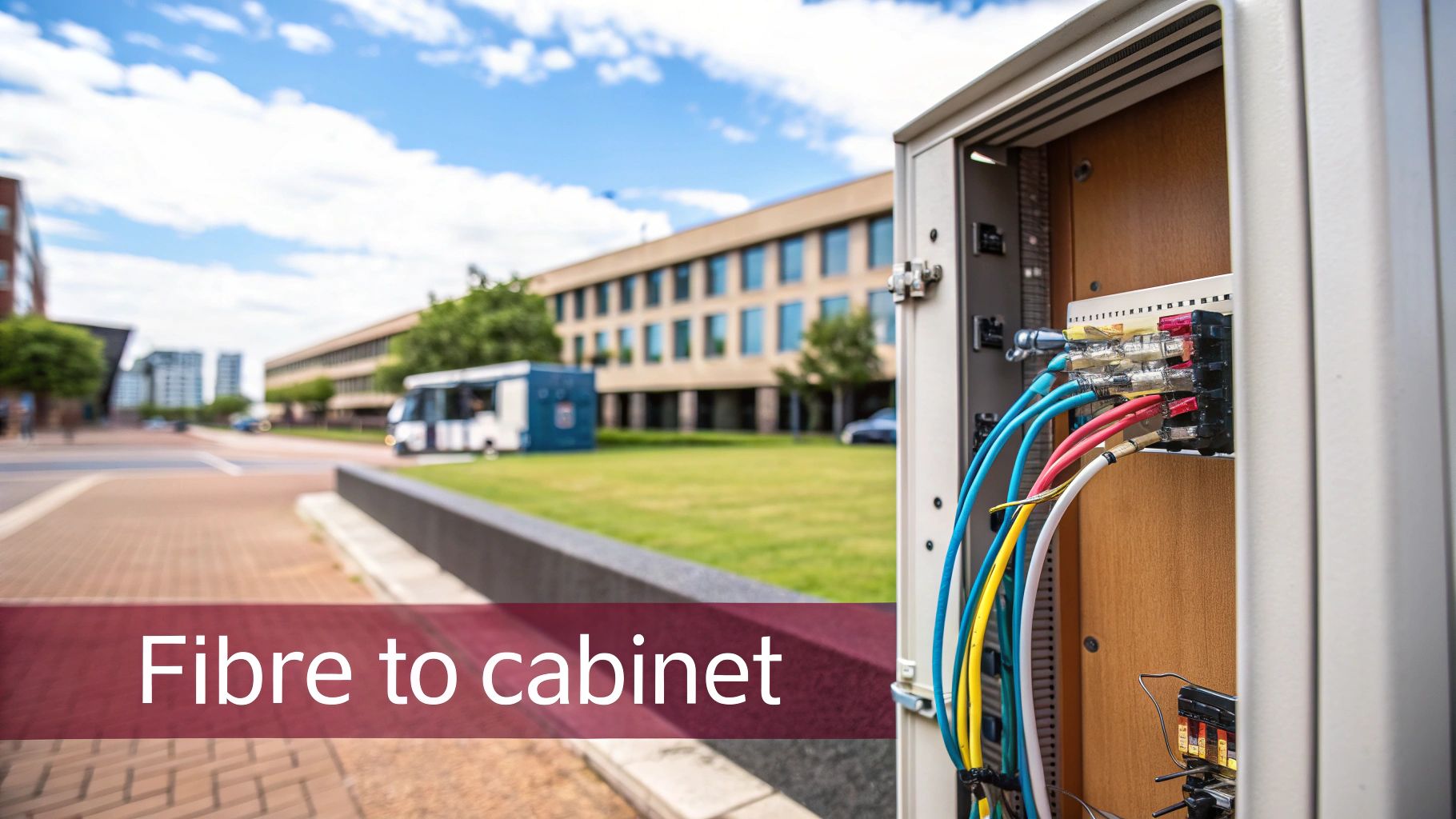
So, how does superfast broadband actually make it from the local telephone exchange into your office? For most businesses in the UK, the secret sauce is a smart hybrid technology known as Fibre-to-the-Cabinet (FTTC). It's a massive step up from the sluggish connections of yesteryear.
Think of it like a high-speed motorway. Data travels along incredibly fast fibre-optic cables—the motorway—right up to that green BT Openreach cabinet you see on the street corner. The final, short leg of the journey into your building uses the traditional copper phone line, which acts like a private driveway off the main road.
This combination is what makes it work so well. By replacing the long, signal-degrading stretch of copper wire with pure fibre, FTTC delivers a dramatic boost in both speed and reliability compared to old ADSL broadband, which had to rely on copper for the entire trip.
Understanding Key Performance Metrics
While FTTC provides the physical link, a few technical terms really define how it performs in the real world. Getting your head around these will help you pick the right service and troubleshoot any issues down the line.
First up is the vital difference between download and upload speeds. Download speed is all about how fast you can pull information from the internet—think loading websites or streaming video. Upload speed is the opposite; it’s how quickly you can send data out, which is critical for video calls, backing up to the cloud, or even just sending large email attachments.
Then there’s latency. This is simply the time it takes for a signal to travel from your computer to a server and back again. High latency creates that annoying lag you sometimes experience.
- For example: On a VoIP phone call, high latency leads to awkward pauses where you end up talking over each other. If you're using a remote desktop to connect to a client's system, it makes the experience feel sluggish and unresponsive.
A key benefit of fibre-based connections is their low latency, which keeps these essential business tools running without a hitch.
It's a common myth that broadband speed is a guaranteed, fixed number. In reality, most business broadband is a 'shared' service, and its performance can fluctuate based on something called the contention ratio.
Contention Ratio Explained
The contention ratio describes how many different users are sharing the same slice of bandwidth from the local cabinet. A lower ratio is always better because it means fewer businesses are competing for the same resources.
Imagine the connection from the cabinet is a shared water pipe. If only a few offices turn on their taps, everyone gets great pressure. But if the whole business park starts downloading huge files at once, the pressure drops for everyone. This is exactly why your internet might feel slower during peak business hours.
This shared nature is the main thing that separates superfast broadband from a dedicated leased line, which gives your business an exclusive, uncontested connection. To get a better handle on the technology, you can learn more about what fibre optic broadband is and see how it stacks up against other options. Getting this right is fundamental to choosing the best connection for your company.
What This Means for Your Business in the Real World
Forget the technical jargon for a moment. What does upgrading to superfast broadband actually do for your business day-to-day? For most small and medium-sized professional services firms, the difference is huge, going way beyond just making websites load faster. It fundamentally changes how your team works, collaborates, and ultimately, serves your customers.
A solid, high-speed connection is the bedrock for all the modern tools you rely on. It unlocks new efficiencies and ways of working that were simply impossible with older, less stable internet, directly fuelling your productivity and growth.
A Modern Phone System That Just Works
One of the first things you'll notice is how it opens the door to a Voice over IP (VoIP) phone system. With traditional copper landlines on their way out, VoIP is the clear successor, offering far more flexibility and power.
Instead of an old physical line, VoIP routes your calls over the internet. This needs a stable, low-latency connection to make sure every call is crystal-clear, without any annoying jitter or dropouts. Superfast broadband delivers exactly that.
Many businesses are already seeing huge advantages from modern solutions like cloud-based business phone systems, and for good reason. The benefits are tangible.
- Work From Anywhere: Your team can make and receive calls from your main office number on their mobiles or laptops, no matter where they are—perfect for hybrid working models.
- Big Business Features: For example, a solicitor's office can easily set up smart call routing to direct new enquiries to the right department, get voicemails transcribed and sent to email, and create a professional welcome menu without buying expensive kit.
- Grows With You: Adding a new staff member is as simple as plugging in a new handset, and the call costs are often much lower than old-fashioned landlines.
Making Your Cloud Software Fly
Let’s face it, modern businesses run in the cloud. Whether it’s Microsoft 365 for documents and email, Xero for your accounts, or a CRM to manage customer relationships, your team needs instant access.
A slow connection puts a constant brake on productivity. Every time someone has to wait for a file to synchronise or a spreadsheet to open, you're losing valuable minutes. Add that up across your whole team over a year, and it’s a staggering amount of wasted time and money.
Superfast broadband gets rid of that bottleneck. It makes your cloud software feel as quick and responsive as if it were running on your own computer, letting your team get on with their work without the constant frustration.
This instant access makes a real difference to daily workflows. It’s not just about convenience; it’s about creating a more efficient and less stressful working environment.
Bulletproof Backups That Won’t Slow You Down
What would you do if a server failed, you were hit by a cyber-attack, or someone accidentally deleted a critical folder tomorrow? For most, it would be a disaster. Off-site cloud backups are your safety net, but they're only useful if you can actually run them without grinding your business to a halt.
Trying to back up gigabytes of data over a slow ADSL line is painful. It can slow the entire network to a crawl, meaning you have to schedule backups overnight and just cross your fingers that they finish in time.
Superfast broadband, especially with its much better upload speeds, completely changes the picture.
- Run Backups Anytime: For an accountancy firm, this means your critical financial data can be backed up quickly and quietly in the background during the day without anyone even noticing.
- Recover in Record Time: If the worst happens, you can restore your crucial data from the cloud in a fraction of the time, dramatically reducing costly downtime.
- More Frequent Snapshots: You can back up your data more often, meaning you lose far less work if you ever need to restore.
This gives you incredible peace of mind, knowing your business is protected and can bounce back quickly from almost anything. This is what superfast broadband is all about—enabling a more productive, flexible, and secure way of working.
To put it in perspective, here’s how common business tasks stack up on different connections.
Superfast Broadband vs Standard ADSL for Business Tasks
| Business Task | Standard ADSL Broadband (<24 Mbps) | Superfast Broadband (30+ Mbps) |
|---|---|---|
| Sending large design files | Slow and disruptive; can take many minutes or hours. | Fast and seamless; files upload in the background in seconds. |
| Video conferencing | Prone to freezing, pixelation, and audio drops, especially with multiple users. | Smooth, high-definition video and clear audio for the whole team. |
| Cloud software access | Sluggish loading times for platforms like Microsoft 365 or Salesforce. | Instant, responsive access feels like using a desktop app. |
| VoIP phone calls | Risk of jitter, poor call quality, and dropped calls. | Crystal-clear, reliable voice quality for professional communication. |
| Running cloud backups | Incredibly slow; must be run overnight and can fail to complete. | Quick and non-disruptive; can run multiple times during the day. |
As you can see, the impact isn't just marginal. For the tasks that modern businesses depend on, the difference is night and day.
Choosing Your Connection: Superfast vs Leased Lines
For most small and medium-sized businesses, superfast broadband hits that sweet spot between performance and price. It’s got more than enough oomph to handle cloud apps, VoIP phone systems, and all the daily digital heavy lifting. But what happens when "more than enough" isn't quite enough? That's when you start looking at a dedicated leased line.
Choosing the right path means understanding the core difference between the two.
Think of superfast broadband as a busy, multi-lane motorway. It’s fast and gets you where you need to go, but you're sharing it with everyone else. During rush hour, you can expect a bit of congestion.
A leased line, on the other hand, is your own private road, built just for you, leading straight to the internet. It's yours and yours alone, delivering a level of performance and reliability that a shared connection just can't touch. This isn't a small distinction; for some organisations, even a few minutes of downtime is less of an inconvenience and more of a business catastrophe.
This decision tree can help you map out which technology best fits your operational needs.
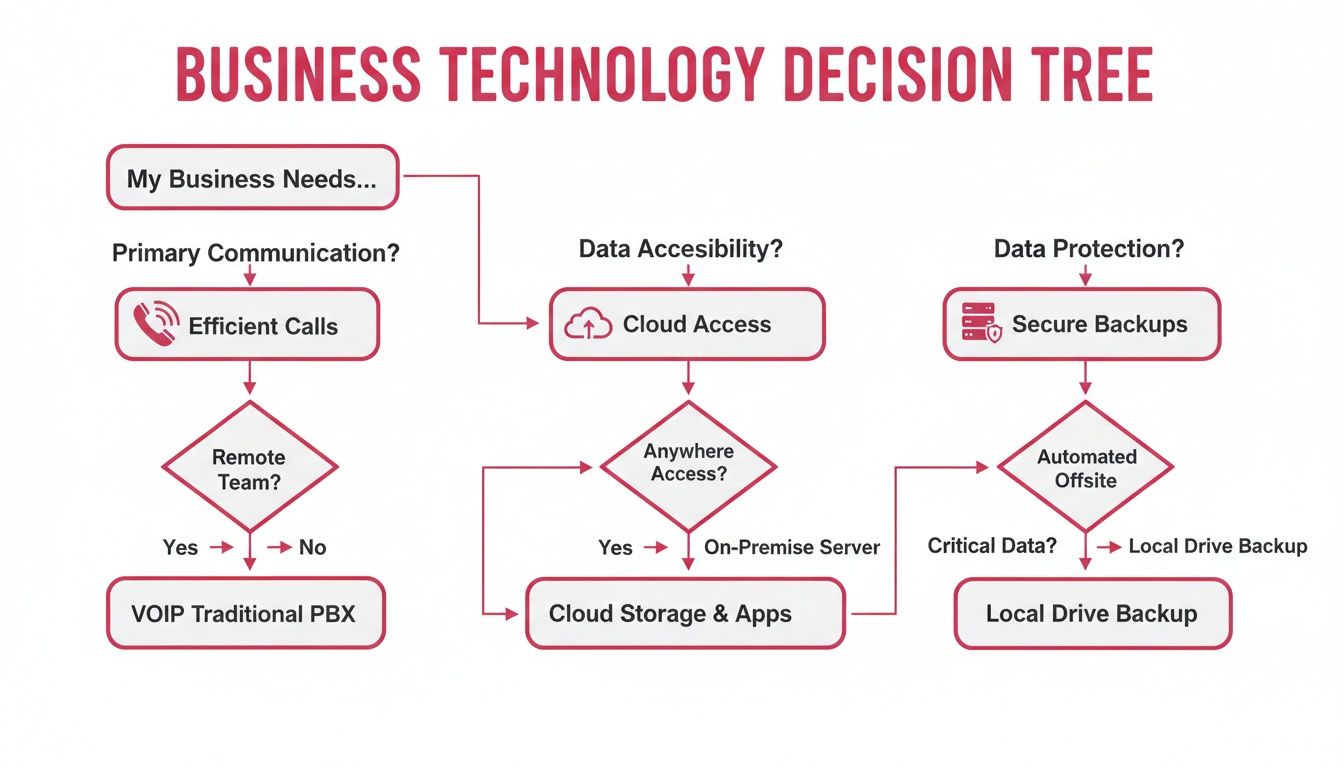
As you can see, the more you depend on flawless connectivity for calls, cloud access, and secure backups, the stronger the argument for a more robust, dedicated connection becomes.
Speed: Symmetrical vs Asymmetrical
One of the biggest differences is how speed is measured. Superfast broadband is asymmetrical, which simply means your download speed is far higher than your upload speed. That’s absolutely fine for most day-to-day use, but it can become a real bottleneck if your team is constantly sending large files or using high-definition video conferencing.
In contrast, a leased line provides symmetrical speeds. Your upload speed is just as lightning-fast as your download speed.
- Here's a practical example: A design agency on superfast broadband might spend 30 minutes uploading a large video file for a client. With a symmetrical leased line, that same file could be up in just two or three minutes. That’s a massive boost to workflow and productivity.
Reliability: Shared vs Dedicated Bandwidth
Reliability is the other major battleground. Because superfast broadband is a shared service, your performance can dip when lots of other people in your area are online—a factor known as contention. A leased line, however, gives you dedicated bandwidth.
You are the only one on that line. That means your connection speed is completely predictable and stable, whether it’s 3 PM on a busy Tuesday or 3 AM on a Sunday. This rock-solid consistency is critical for businesses that rely on real-time applications or transfer sensitive data where any performance drop is simply not an option.
A leased line isn't just about faster internet; it's about guaranteed performance. This is formalised through a Service Level Agreement (SLA)—a contract promising a specific level of uptime and rapid-response fault resolution.
Cost and Service Level Agreements
It’s no surprise that a dedicated, private service comes with a higher price tag. But that cost buys you something incredibly valuable: a business-grade Service Level Agreement (SLA). An SLA gives you a formal guarantee of uptime (often 99.9% or higher) and sets out firm fix times, ensuring any problem is sorted in hours, not days. Standard broadband just doesn't come with those kinds of assurances.
Thanks to government-backed initiatives like Broadband Delivery UK (BDUK), high-speed connectivity is more widespread than ever. In the last recorded year, an impressive 89% of premises connected through the scheme were in rural areas, opening up powerful new options for businesses outside major urban centres. You can see the full details in the government's latest BDUK delivery performance statistics.
Ultimately, the choice comes down to a cost-benefit analysis. For a much more detailed breakdown, have a look at our guide comparing leased line vs broadband. If your business can live with the occasional slowdown, superfast broadband is the sensible, cost-effective choice. But if every second of uptime is vital to your revenue and reputation, then investing in a leased line is one of the smartest business continuity decisions you can make.
Finding and Implementing the Right Broadband Solution
So, you’ve decided your business internet needs an upgrade. That’s a great first step, but figuring out what to do next can feel like a headache. With so many options and so much jargon, how do you pick a connection that will actually help your business, not just tick a box? It all comes down to a clear-headed strategy: understanding what's available locally, knowing how to measure where you are now, and looking past the flashy sales numbers.
This is particularly crucial for businesses across our region—D Dorset, Somerset, Wiltshire, and Hampshire. The connectivity landscape here is a real mix. You might have access to incredible speeds in one business park, while a company just a few miles down the road in a more rural spot has far fewer choices. Your first, non-negotiable step is to get a detailed availability check for your specific postcode.
What's Actually Available at Your Doorstep?
Before you even think about comparing packages, you need a clear picture of what’s genuinely on offer at your premises. A provider might have a huge presence in central Southampton, but their network might not reach an industrial estate on the outskirts of Salisbury. You can't assume anything.
Working with an independent IT partner is the smart move here. We can run a single, comprehensive check across all the major network carriers. This gives you the full menu of options—from FTTC and full-fibre to dedicated leased lines—and stops you from wasting time chasing providers who can't even service your building.
How to Test Your Current Internet Speed
To justify an upgrade, you need cold, hard data. You need to know exactly how your current connection is performing (or underperforming). A simple speed test is all it takes.
For a truly accurate reading, here’s what to do:
- Go Wired: Don't test over Wi-Fi. It’s too variable. Plug a computer directly into your router with an Ethernet cable to measure the true speed coming into your building.
- Run a Few Tests: Use a reliable online speed testing tool. Run it a couple of times at different points in the day—morning, lunchtime, and late afternoon—to get a real-world average.
- Understand the Numbers: The test will give you three figures: download speed, upload speed, and latency (ping). How do these stack up against what your provider promised? More importantly, how do they compare to what your business needs to run smoothly?
If your results are miles off what you’re paying for, or your upload speed is grinding everything to a halt, you’ve got a clear, evidence-based case for making a change.
Never take a provider’s advertised speed at face value. The real performance of your service is hidden in the small print, and those details are what will make or break your daily operations.
Look Beyond the Headline Speed
The number on the advert is just that—an advert. It’s the starting point of the conversation, not the final word. To make a decision you won't regret, you have to dig into the details buried in the terms and conditions.
Be prepared to ask some direct questions:
- Contention Ratio: This is a big one. How many other local businesses are you sharing your bandwidth with? A low ratio means your speeds stay consistent, even when everyone else is online.
- Traffic Management: Does the provider deliberately slow down certain activities, like cloud backups or large file transfers, during peak business hours? This is a common practice that could cripple your key processes.
- The Contract Itself: What are the real installation costs? How long are you locked in for? What are the penalties for ending the contract early? Business broadband contracts are far more rigid than residential ones.
By asking these questions, you shift from being just another customer to being an informed buyer. You’ll be equipped to choose a superfast broadband solution that's genuinely right for your business for the long haul.
Working with SES Computers on Your Broadband Upgrade
Picking the right internet connection is a big decision, but it’s really just the starting point. The true measure of a successful upgrade is in the planning, the installation, and the day-to-day management. That's where bringing in an experienced IT partner like SES Computers really pays off, turning a potentially painful project into a smooth, straightforward process.
We don't just sell you an internet package and walk away. Our entire approach is built around understanding what your business actually does, so we can deliver a managed connection that genuinely supports your work.
It All Starts with a Proper Conversation
Before we talk about technology, we talk about your business. We take the time to get a clear picture of how you operate. How many staff do you have? Are you heavily reliant on cloud services like Microsoft 365 or other specialised software? What does growth look like for you over the next few years?
This discovery phase is absolutely vital. Think about it: an accountancy firm needing rock-solid access to cloud accounting software during tax season has completely different needs to a manufacturer that just needs a reliable connection for their VoIP phone system. By understanding your daily workflow, we can recommend a service that fits like a glove.
Choosing a business internet connection isn’t just about the advertised speed. It’s about securing a reliable service backed by a guarantee that protects your business from costly downtime.
Once we have that insight, we can take the lead. We'll handle everything from finding the best provider in your area to coordinating a hassle-free installation, making sure it happens at a time that causes the least disruption to your team.
Why a Business-Grade SLA Matters
One of the biggest differences you'll notice when working with us is our focus on Service Level Agreements (SLAs). An SLA isn't just a piece of paper; it's a firm contract that guarantees the performance of your connection, including specific uptime targets and, crucially, guaranteed fix times if something goes wrong.
This is a world away from the support you get with a home broadband package. If your connection drops, you won't be stuck in a queue for days waiting for help. A solid SLA means an engineer is dispatched and the problem is fixed within hours, not days, protecting your productivity and your bottom line.
- Guaranteed Uptime: Your connection is guaranteed to be available when you need it, often for 99.9% of the time.
- Rapid Fix Times: We agree on a contractual promise that faults will be fixed within a strict window, typically just a few hours.
- Proactive Monitoring: In many cases, we spot and resolve potential issues long before they ever affect your business.
Ultimately, by managing your connection, we become your single point of contact. No more wasting your valuable time on hold with a call centre. You can get back to focusing on what you do best—running your business—knowing that your internet connection is in safe hands.
Your Business Broadband Questions, Answered
Deciding on the right broadband for your business can feel complicated. It's a significant decision, so naturally, questions come up. We've tackled some of the most common ones we hear from business owners to give you a clearer picture.
What Upload Speed Does My Business Actually Need?
It's easy to get fixated on download speeds, but for most businesses today, the real story is in the upload. Think about what your team does all day: saving files to OneDrive, joining video calls, or sending large project files to clients. All of that relies heavily on your upload speed.
A practical example for professional services would be an architectural practice needing to send large 3D model files to a client for review. On a standard connection, this could take an hour and bring other work to a halt. With superfast broadband's higher upload speed, it can be done in minutes in the background.
Is Superfast Broadband Secure?
Your broadband connection is like the main road leading to your business premises—it doesn't come with a built-in security guard. Securing the data that travels along that road is your responsibility, and it’s a critical one.
While some internet providers might bundle basic security tools, a proper business-grade connection demands a professionally managed firewall. This is your network's dedicated security detail, actively inspecting traffic and blocking threats before they can even get close to your servers and computers. This level of protection isn't an optional extra for us; it's a fundamental part of any connectivity solution we provide.
Can I Get Superfast Broadband in a Rural Area?
Access in rural parts of Dorset, Somerset, Wiltshire, and Hampshire has come on in leaps and bounds. That said, there are still pockets where traditional fibre-to-the-cabinet (FTTC) isn't an option. But that doesn't mean you're out of luck.
We often find that high-performance 4G or 5G mobile broadband can deliver fantastic speeds, even rivalling some fibre connections. For more isolated locations, satellite internet has also become a genuinely practical alternative. Our job is to investigate every technology available at your specific postcode to find the right blend of speed, reliability, and value.
Ready to find a broadband solution that can keep up with your business? The team at SES Computers has the local knowledge to understand your needs and manage a smooth, hassle-free upgrade. Get in touch today to talk through the possibilities. Learn more about SES Computers.