A business continuity service is your company's complete game plan for keeping the doors open, no matter what happens. It's much more than just backing up your files. It’s about ensuring every critical part of your business—from serving clients and taking payments to your team collaborating effectively—can carry on with little to no disruption.
What Is a Business Continuity Service?
Think about it this way. Imagine your accountancy practice in Dorset is suddenly hit with a massive, week-long power cut. A simple backup generator might keep the lights on, but can your payroll software still run? Can your team access client records? A true business continuity service is designed to answer "yes" to those questions.
It’s not just an IT fix; it's a blueprint for total business resilience. This is a proactive strategy that looks at the entire organisation and makes sure the heartbeat of your company—your client services, finances, operations, and professional relationships—keeps beating strong, even in a crisis.
The Three Pillars of Continuity
At its heart, a solid business continuity service stands on three pillars. They all work together to shield your business from the worst. Getting to grips with them shows you how the whole service hangs together.
- Proactive Planning: This is the thinking-ahead stage. We identify what could go wrong and how badly it could hurt your business. For an accounting firm in Wiltshire, the biggest threat might be a ransomware attack encrypting client data before a tax deadline. For a legal practice in Hampshire, it could be a major server failure that cuts off access to case files. The aim is to have a detailed, step-by-step plan ready to go before disaster ever hits.
- Rapid Recovery: This is all about the tech and processes needed to get you back on your feet, fast. It means having the right tools in the box, like systems that automatically switch over to a backup server or giving your staff a secure way to work from anywhere. The goal here is to measure downtime in minutes, not days.
- Clear Communication: In a crisis, confusion can cause as much damage as the incident itself. This pillar is about setting up clear lines of communication for your staff, clients, and suppliers. A solicitor's office in Somerset, for example, needs a pre-agreed way to tell clients about any disruption to maintain their trust and confidence.
A business continuity plan isn't just an IT document. It's a business-wide strategy for survival and stability. It answers one simple question: "How do we keep serving our clients and earning money when things go wrong?"
Ultimately, this service is about maintaining your momentum. It ensures that a local flood, a cyber-attack, or a server meltdown doesn't become a threat to your company's existence. For a fully rounded approach, it’s also wise to understand how Business Continuity Insurance can help, as it provides the financial safety net that works alongside your operational recovery plan.
The Core Components of a Modern Service
A modern business continuity service isn't a single product you buy off the shelf. It’s a complete strategy, weaving together several interconnected technologies and processes that work in harmony. Each piece has a specific job, all geared towards one goal: making sure a disruption is just a manageable incident, not a business-ending catastrophe.
Getting your head around these pillars is the first real step towards building genuine resilience.
It’s a step more and more businesses are taking. A recent survey revealed that a striking 85% of UK organisations now have a business continuity plan in place. That’s a massive jump from just 56% back in 2015, showing just how essential this has become for businesses of all sizes across the UK.
To help you understand how it all fits together, here’s a breakdown of the key elements.
Key Components of a Business Continuity Service
| Component | Purpose | Practical Example for a Professional Service |
|---|---|---|
| Automated Cloud Backup | To securely and continuously copy your critical data to an off-site location, protecting it from loss or corruption. | A ransomware attack encrypts all client files on your main server. With cloud backup, you can restore clean data from just before the attack happened. |
| Disaster Recovery (DR) | To restore your IT infrastructure and operations after a major incident, ensuring you can get back to business as quickly as possible. | A power surge destroys your primary server. The DR plan kicks in, spinning up your systems on a secondary server in a different location. |
| DaaS / Hosted Desktops | To give your team secure access to their work desktop, files, and applications from any device, anywhere. | Your office is inaccessible due to local flooding. Your team logs in from home using their laptops and continues working without interruption. |
| Failover Systems | To automatically switch operations from a failed system to a standby one, often with zero noticeable downtime. | The main database server for your practice management software crashes. A failover system instantly reroutes all traffic to a replica database server. |
| Incident Response Plan | To provide a clear, step-by-step guide for your team to follow during a crisis, defining roles and communication channels. | You discover a data breach. The incident response plan tells you who to contact, how to isolate the issue, and when to notify clients. |
Each component addresses a different potential point of failure, creating a safety net that covers your entire operation.
Automated Cloud Backup
The absolute foundation of any continuity plan is a solid backup. Forget about manually copying files to an external drive once a week. Modern services offer automated, secure cloud backups that work away in the background, protecting your critical data without anyone needing to lift a finger. This is your first line of defence.
Imagine a Wiltshire-based accounting firm gets hit by ransomware, locking up all their client files. With an automated cloud solution, they can simply roll back to a clean, uninfected version of their data from moments before the attack. They're back up and running in minutes, not days, meeting deadlines and keeping client trust intact. You can find out more about how a managed backup service protects your business in our detailed article.
Proactive Disaster Recovery
Backup is all about protecting your data, but disaster recovery (DR) is about keeping your systems running. DR is the active plan that swings into action when a primary system goes down. It's the engine that keeps the lights on, even if your main server room is out of action.
A good disaster recovery plan will almost always include failover systems. Consider a busy legal firm in Hampshire preparing for a major case. If their main practice management server dies, an automated failover system can instantly switch everything over to a standby server. Fee earners continue to access case files, clients don’t notice a thing, and the firm avoids a costly and embarrassing outage.
Disaster Recovery is the engine that powers your business through a crisis. It’s not just about getting data back; it’s about restoring the operational capability to use that data to serve your clients.
This simple flowchart shows how a well-structured plan moves logically from planning and prevention through to recovery and communication.
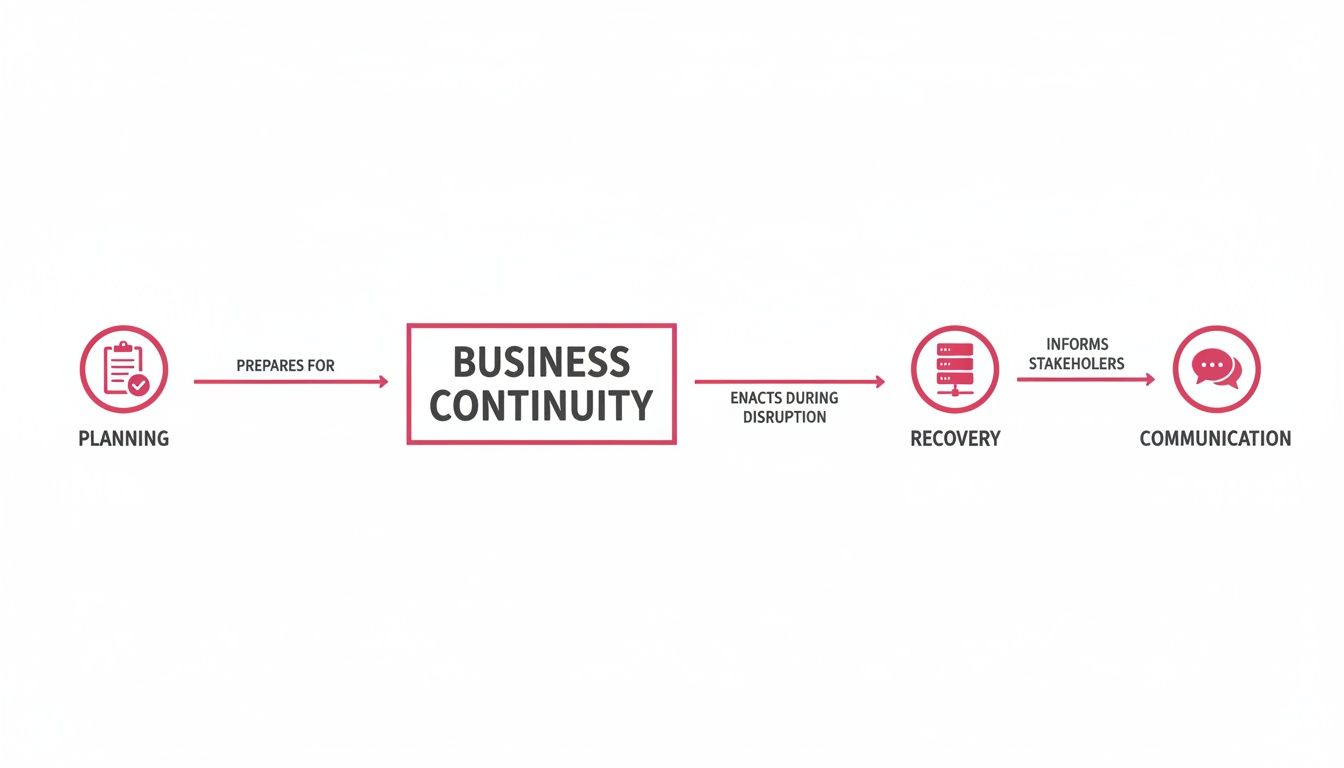
As you can see, each stage builds on the last, creating a seamless process for managing any disruption from start to finish.
Hosted Desktops or DaaS
What happens when your team can't physically get to the office? Local flooding, road closures, or even a simple power cut can make your premises unusable. This is where Hosted Desktops—often called Desktop-as-a-Service (DaaS)—become invaluable.
DaaS gives your staff secure access to their complete work desktop, including all their apps and files, from any device with an internet connection. For a solicitor's firm in Somerset, an office closure due to a burst pipe doesn't have to mean downtime. Their team can simply log in from home and carry on, accessing sensitive case files and collaborating with colleagues just as they would in the office.
A Clear Incident Response Plan
All the technology in the world won't help if people don't know what to do. The human element is just as critical. An Incident Response Plan is your team's playbook for a crisis. It removes the panic and confusion by clearly defining roles, responsibilities, and how everyone should communicate.
A solid plan answers the crucial questions before you need the answers:
- Who is in charge? This establishes a clear chain of command for making critical decisions.
- How do we communicate? It defines how to keep staff, clients, and suppliers in the loop.
- What are the immediate priorities? The plan outlines the very first steps to take to secure the business and kick off the recovery.
By putting these pieces together, a business continuity service stops being an abstract IT expense and becomes a tangible asset that actively protects your revenue, your reputation, and your future.
Real-World Threats Facing UK Businesses
It's easy to think of a business continuity service as a 'nice-to-have'—that is, until something goes very wrong. For businesses here in the UK, the threats that can stop you in your tracks aren't just hypothetical. They are very real, from localised flooding and sudden server failures to increasingly clever cyber-attacks.

When you start to picture these specific dangers, continuity planning stops being a box-ticking exercise and becomes an urgent priority. It’s all about getting ready for the exact scenarios that could impact your team, your clients, and your bottom line.
Environmental and Infrastructure Failures
Physical disruptions are still one of the most immediate and powerful threats. Let’s take a solicitor's firm in Somerset as an example. A winter storm brings severe flooding, and suddenly their office is completely out of action for days. Without a plan, that’s a crisis.
Client meetings get cancelled, court deadlines are put at risk, and nobody can access the crucial case files stored on the office server. The firm’s reputation for being reliable takes a serious knock. But, if they had a UK-hosted Desktop-as-a-Service (DaaS) solution, the story would be completely different. Their team would simply work from home, logging into their full desktops, applications, and client data just as if they were sitting at their desks. The business keeps running, and clients are none the wiser.
Or think about a busy architectural practice in Wiltshire. They arrive on Monday morning only to find their main design server has died. Every hour they're down means lost billable time, delayed project milestones, and a growing financial headache. More than that, their reputation is on the line. This is precisely where a disaster recovery service with a fast failover is worth its weight in gold, getting them back up and running from a replica server in minutes, not days.
The Ever-Present Danger of Cyber-Attacks
While you can see a flood coming, digital threats are often silent and can cause far more damage. Cyber-attacks aren’t just a problem for big city corporations; small and medium-sized businesses are now a prime target.
A solid business continuity plan has to cover both the seen and the unseen. A flood is obvious, but a cyber-attack can cripple your operations from the inside out before you even realise it's happening.
The UK Government's Cyber Security Breaches Survey paints a stark picture: 43% of UK businesses reported a breach or attack in the last year. That figure alone shows why continuity services are non-negotiable for professional service firms across Dorset, Somerset, Wiltshire, and Hampshire, especially if your business runs on data. You can learn more about the findings on cyber security breaches from GOV.UK.
Just one convincing phishing email can be enough to unleash ransomware, locking down every file you need to operate. The rising threat of infostealer malware is a perfect example of why strong cybersecurity must be woven into your continuity plan. Without a clean, off-site backup ready to go, a business can face an awful choice: pay a huge ransom or shut down for good.
These aren't far-fetched scenarios; they are the everyday realities for businesses across the UK. A proactive business continuity service is what turns these potential disasters into manageable problems, protecting your revenue, your reputation, and your future. To get your team prepared, take a look at our guide on essential cybersecurity for small businesses.
Calculating the Return on Investment
It’s easy to look at a business continuity service as just another line item on the expense sheet. But how do you measure its real-world value? The truth is, thinking of it as a cost is the wrong approach entirely. It’s a strategic investment in the very stability and survival of your business.
The maths behind it is actually quite simple. You weigh the predictable, manageable cost of the service against the completely unpredictable—and often devastating—cost of an outage. We’re not just talking about a few lost sales, either. The real cost of downtime includes everything from a damaged brand reputation to lost productivity and even hefty regulatory fines.
Quantifying the Cost of Downtime
To really grasp the ROI, you first need a clear picture of what an interruption would actually cost you. Even just a couple of hours of being offline can send financial shockwaves through your entire operation. It’s crucial to think beyond the immediate loss of income.
So, what should you factor in?
- Direct Revenue Loss: This is the most obvious hit. For every hour your systems are down, how much money are you not making? For a solicitor or accountant, it’s lost billable hours. For a consultant, it's missed deadlines and project fees at risk.
- Staff Productivity Costs: Your team might be ready and willing to work, but if they can't access their data, emails, or software, you're paying them to sit and wait. A team of ten professionals unable to work for a day quickly becomes a massive sunk cost.
- Reputational Damage: This one is harder to put a number on, but the long-term impact can be the most severe. Clients need to trust that you’ll be there for them. One bad outage can undo years of hard work building that trust, sending them straight to your competitors.
- Regulatory Penalties: For many businesses, particularly in legal, financial, or healthcare sectors, downtime can lead to a data breach or non-compliance. This could attract serious fines from regulators like the ICO for failing to meet GDPR obligations.
A Practical Hampshire Accountancy Scenario
Let's make this tangible. Picture an accountancy practice with its head office in Hampshire. Their client records, tax software, and billing systems all run through a central server at HQ. On a busy Tuesday morning before a VAT deadline, a construction crew accidentally cuts the main fibre optic cable to their building. The head office is completely offline.
Without a business continuity plan, the entire practice grinds to a halt. Accountants can't access client data. Payroll runs can't be completed. The financial bleeding starts immediately and gets worse with every minute that ticks by.
Now, let's rewind and imagine the same scenario, but this time they have a proper continuity service. The moment the primary connection goes down, automatic failover systems kick in. The entire operation is seamlessly rerouted through a secondary data centre. The team might see a momentary flicker on their screens, but otherwise, they carry on working. Business as usual.
Business continuity isn't just an insurance policy you hope to never use. It's a strategic investment that actively protects your revenue streams, client relationships, and professional reputation every single day.
In this example, the ROI is blindingly obvious. The modest monthly fee for the service is a drop in the ocean compared to the thousands of pounds in lost billable hours and client goodwill they just saved. That one incident alone has likely paid for the service several times over. It fundamentally shifts business continuity from being a cost centre to being a profit protector, giving you the solid foundation you need to grow with confidence.
How to Choose the Right IT Partner
Picking a partner for your business continuity service is one of the biggest calls you’ll make for the future of your company. This isn’t just about adding another supplier to your books; it's about handing over the keys to your operational resilience to a team of experts. The right partner becomes a genuine asset, but the wrong one can leave you dangerously exposed when disaster strikes.

This decision is more critical than ever when you realise that only 54% of UK organisations feel confident their continuity plans are even up to date. That figure, which has barely shifted since 2014, is a stark warning. It means nearly half of all businesses are banking on outdated strategies, a huge gamble for any SME in the South West. You can dive deeper into this by reading the full Data Health Check survey from Databarracks.
Demystifying RTO and RPO
As soon as you start talking to potential IT partners, two acronyms will pop up repeatedly: RTO and RPO. Getting your head around these is absolutely fundamental to choosing a service that actually fits your business.
Let’s use a medical analogy. The Recovery Time Objective (RTO) is how quickly the paramedics must arrive to save a patient. In business terms, it’s the absolute maximum time your systems can be offline before the damage becomes critical.
The Recovery Point Objective (RPO), on the other hand, is all about data loss. Imagine the paramedics asking the patient what they remember from just before they collapsed. The RPO is the amount of memory they might have lost in those final moments. For your business, it’s the maximum amount of data you can afford to lose, measured in time.
- RTO (Recovery Time Objective): How fast must you be back up and running? (e.g., within 15 minutes)
- RPO (Recovery Point Objective): How much recent data can you stand to lose? (e.g., no more than 5 minutes' worth)
A legal firm in Salisbury handling sensitive case files will likely need an RTO and RPO of almost zero—any downtime or lost data could be catastrophic. A marketing team’s internal project server, however, might be able to tolerate an RTO of a few hours. A good partner won’t just sell you a one-size-fits-all solution; they’ll help you define realistic targets for every part of your operation.
Why UK-Hosted Data Centres Matter
Where your data physically resides is more than just a line item on a proposal. It’s a crucial detail for security and compliance. Insisting on a provider that uses UK-hosted data centres gives your business two significant advantages.
First, it helps keep you on the right side of UK GDPR. By keeping your client and operational data within the UK's legal jurisdiction, you sidestep the complex and ever-changing world of international data transfer laws.
Second, it means you get local support when it counts. If there’s an incident, you want to be speaking to an engineering team in your time zone who understands the local business environment, not a call centre halfway across the globe. For businesses in Hampshire or Dorset, a provider with a tangible local presence offers a far more responsive and accountable service.
Critical Questions for Potential Providers
Before you sign on the dotted line, you need to ask some direct questions. This isn't about trying to catch a provider out; it's about making sure their service truly aligns with what your business needs to survive a crisis. Any transparent, capable partner will welcome this level of scrutiny.
Here are five essential questions to kickstart the conversation:
- Testing and Validation: How often will you test our disaster recovery plan, and will we be actively involved in those tests?
- Security Certifications: Do you hold accreditations like ISO 27001 that prove your commitment to information security?
- Industry Experience: Can you share examples of how you've helped other businesses in our sector, such as legal or financial services?
- Service Level Agreements (SLAs): Where exactly in the contract are your RTO and RPO guarantees, and what are the penalties if you don't meet them?
- Local Expertise: Is your support team actually based in the UK? Do they have experience with the challenges facing businesses right here in our region?
Ultimately, finding the right IT partner is about more than just tech specs; it's about building a relationship based on trust. By asking these questions, you can cut through the sales talk and find a provider who will be a true partner in protecting your business. For more tips, check out our guide on what to look for when choosing from managed services providers in the UK.
So, What Are Your Next Steps?
You’ve got a handle on what a business continuity service is and why it matters. That's the first hurdle cleared. The next part is turning that understanding into a solid plan of action, and it's probably not as complicated as you think.
Getting started doesn't involve diving headfirst into complex tech. It actually begins with a straightforward look in the mirror and asking some honest questions about how your business really works. This groundwork is what makes the difference between a plan that just sits on a shelf and one that actually saves you when you need it.
Start with a Simple Risk Assessment
Before you can build your defences, you need to know what you’re defending. Start by pinpointing the absolute core of your operations. What are the processes you simply cannot do without if you want to keep the lights on, serve your clients, and bring in money?
For a local accountancy firm, that’s likely your client database and tax software. If you're an architectural practice in Wiltshire, it’s probably the systems that run your CAD software and project files.
The aim here is to create a 'must-have' list. If everything went offline tomorrow, what are the top three to five things you'd need back up and running immediately to stop the business from grinding to a halt? This single exercise brings a huge amount of focus.
Figure Out How Much Downtime You Can Really Tolerate
Now, let's put a clock on it. For each of those critical functions, how long can it be down before things get serious? This is where you start to shape your own Recovery Time Objectives (RTO) and Recovery Point Objectives (RPO).
Be realistic. Could your business cope if your main client management system was offline for an entire day? Or do you need it back within the hour? Answering this question honestly is the key to creating a plan that actually fits your budget and operational reality.
Once you’ve got these insights, you're in a fantastic position to have a meaningful chat with an expert. When you come to a specialist like us at SES Computers, you’re not starting from scratch. You’re bringing a clear picture of your needs, which allows us to help you build a business continuity plan that’s genuinely right for you. It's the best way to ensure that when a disruption hits, you’re not just surviving—you’re ready to get back to business.
Frequently Asked Questions
When it comes to protecting a business, it's the practical questions that matter most. We get asked a lot of them by business owners across Dorset, Somerset, Wiltshire, and Hampshire. Here are the straight answers to the most common queries we hear.
How Much Does a Business Continuity Service Cost?
There's no one-size-fits-all price, and that's a good thing. The cost is scaled entirely to what your business actually needs. It hinges on a few key factors, mainly the amount of data you need to protect and how fast you absolutely must be back online after a disaster (your RTO and RPO).
For instance, a Salisbury-based financial adviser with sensitive client portfolios needs almost immediate recovery, so their investment will be different from a local architect whose main worry is getting their project management software back. A good partner will work with you to build a plan that makes sense for your budget and how your business truly operates.
What is the Real Difference Between Backup and Business Continuity?
This is a brilliant question because the two get confused all the time. The simplest way to think about it is that backup is a component, but business continuity is the entire strategy. A backup is just a secure copy of your data. It’s essential, but it doesn't get your doors open again.
Business continuity is the complete playbook that takes that backup and puts it to work, keeping your company trading. It answers the question, "How do we keep serving clients and making money when our systems are down?" while a backup simply answers, "Do we have a copy of our files?"
How Often Should We Test Our Continuity Plan?
A plan that isn't tested is just a piece of paper. We recommend a full-scale test of your business continuity plan at least once a year. This isn't just about ticking a box; it's about making sure the technology works as expected and, crucially, that your team knows exactly what their roles are in a crisis.
Beyond the annual test, it's wise to review and update the plan whenever your business changes in a big way. This could be things like:
- Moving to a new software platform.
- Relocating your office.
- Changes in key staff members.
- Launching a new professional service.
Consistent testing turns a theoretical plan into a tried-and-tested process you can count on. It's what ensures your business continuity service is ready to perform when it matters most.
Protecting your business isn’t just about bouncing back from a crisis; it’s about making sure you never lose momentum. At SES Computers, we build resilience plans that keep you moving forward, no matter what happens.
Discover our tailored Business Continuity solutions today at sescomputers.com